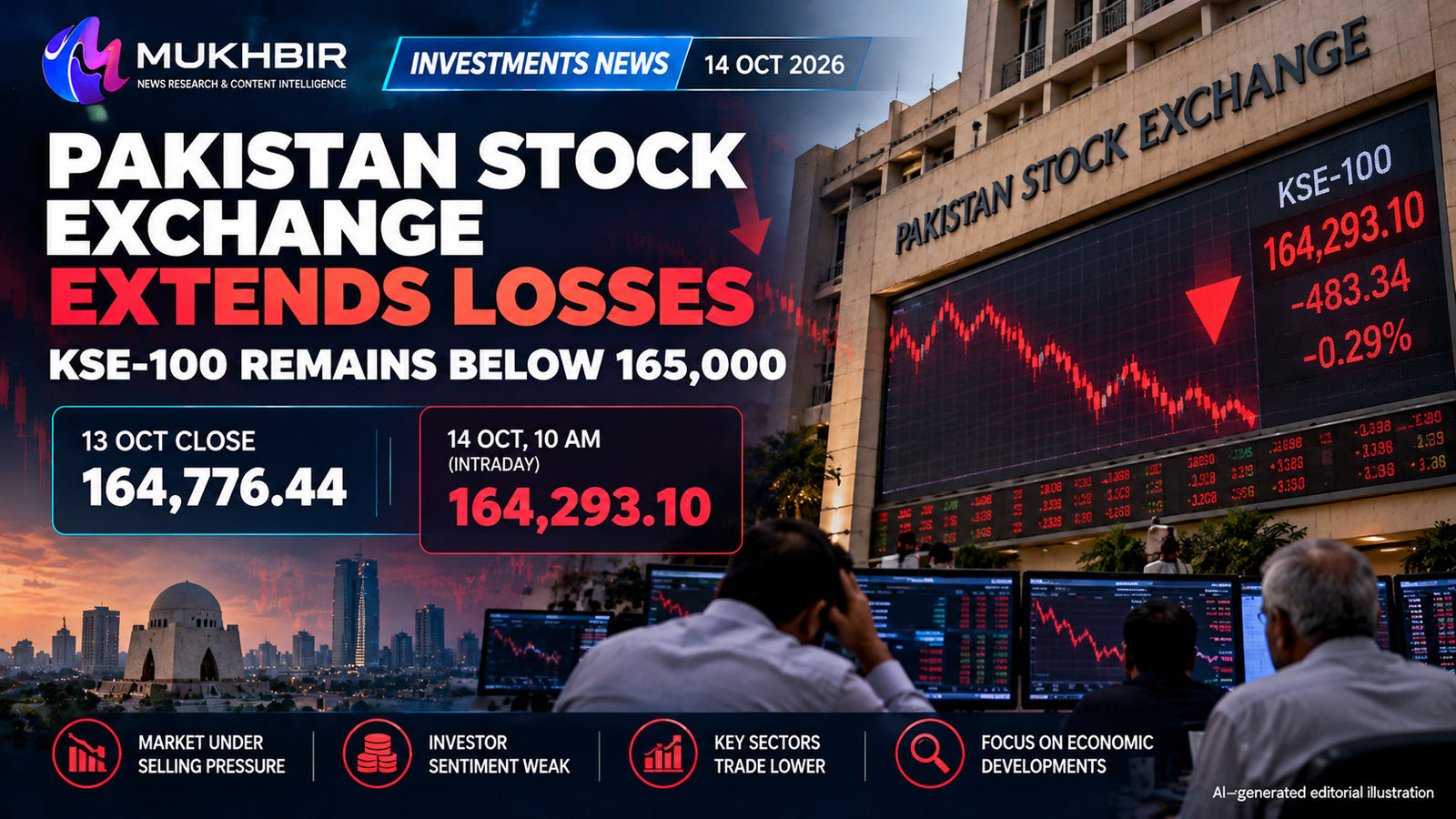
KARACHI, October 18, 2026 – The Pakistan Stock Exchange (PSX) ended another difficult week as its benchmark KSE-100 index fell for the fourth consecutive week. Despite recovering during the final trading sessions, the index finished the week ended October 16 at 166,419.72 points, down 669.56 points, or approximately 0.40%.
The Pakistan Stock Exchange weekly decline came as investors reacted to domestic political uncertainty, elevated global oil prices and concerns that inflation could lead to higher interest rates. Market summaries from Arif Habib Limited, reported by Dawn and other financial outlets, show that losses early in the week were large enough to outweigh the later rebound.
One detail matters: Friday itself was a positive trading day. The KSE-100 rose 233.55 points, or 0.14%, on October 16. However, this daily gain was not enough to reverse the decline recorded over the full Monday-to-Friday trading week.
Pakistan Stock Exchange Weekly Decline: Key Numbers
Week ending: Friday, October 16, 2026.
Published market review: Sunday, October 18, 2026.
KSE-100 closing index: 166,419.72 points.
Weekly loss: About 669.56 points.
Weekly percentage change: Approximately -0.40%.
Consecutive losing weeks: Four.
Friday’s change: +233.55 points, or +0.14%.
Largest daily fall of the week: Around 1,965 points on Monday.
Total weekly turnover: Approximately 2.15 billion shares.
Total weekly transaction value: Around Rs89 billion.
Average daily trading volume: About 449 million shares, according to Arif Habib Limited.
These figures describe the previous completed trading week. They are not live prices for Sunday, when the normal PSX trading session is closed.
Why Did the Pakistan Stock Exchange Fall?
Investors had several reasons to remain cautious. The market faced political uncertainty in Pakistan, tension in the Middle East and rising global energy costs.
An increase in crude oil prices can affect Pakistan because it imports energy. Higher fuel costs can put pressure on businesses, transport and inflation. Investors may then become concerned that the State Bank of Pakistan will keep interest rates higher or raise them.
Political developments added another layer of uncertainty. The emergency and Governor’s Rule imposed in Khyber Pakhtunkhwa at the beginning of the week drew strong political reactions.
None of these factors alone can explain every company’s share-price movement. Stock prices change for many reasons, including earnings expectations and demand from buyers and sellers.
Monday’s Sell-Off Had the Biggest Impact
The index fell by approximately 1,965 points on Monday, October 12. Financial analysts linked the sharp movement to political concerns following the emergency decision in Khyber Pakhtunkhwa and continued nervousness about regional security.
A large fall at the beginning of a week can be difficult to reverse even if stocks rise on the following days. That is what happened in this case.
The market recovered part of its losses between Tuesday and Friday, but the final weekly index level remained below the previous week’s close.
This helps explain how a headline saying that the market rose on Friday can be true at the same time as another headline reporting four consecutive weekly declines.
What Happened on Friday, October 16?
The final trading day ended with a modest gain. The KSE-100 increased by 233.55 points and closed around 166,420.
Dawn’s daily report said Systems Limited and several major banks helped lift the benchmark. At the same time, declines in other large companies continued to limit the overall recovery.
Trading remained mixed. Investors bought selected shares but did not show a strong, broad-based return to risk-taking.
The positive Friday result provides context, but it should not be confused with a reversal of the wider monthly or weekly trend.
Which Sectors Lost the Most?
According to Arif Habib Limited’s market review, exploration and production companies contributed the largest negative impact on the index, accounting for roughly 330 points of the weekly fall.
Banks contributed around 319 negative points. Cement stocks accounted for about 136 points, while investment banks and power companies also weighed on the market.
These figures show how much particular sectors contributed to the benchmark index’s change. They are not a percentage return or total market value lost by every company in those industries.
Large index companies can have a major influence on the KSE-100, so the benchmark may fall even while some individual stocks perform well.
Which Companies Were Under Pressure?
The financial review identified Oil and Gas Development Company as the largest individual negative contributor, with an index impact of approximately 161 points.
United Bank contributed a loss of around 136 index points. Habib Bank, Pakistan Telecommunication Company and Pakistan Oilfields were also among significant negative contributors.
That does not mean all investors in these companies experienced exactly the same monetary loss. An individual’s outcome depends on the shares owned, purchase price and trading decisions.
Sector and company performance should be considered alongside financial results and other business information.
Which Sectors Helped Limit the Decline?
Not every part of the market fell. Fertiliser companies contributed about 171 positive points to the benchmark during the week.
Oil marketing companies, refineries, pharmaceuticals and consumer goods businesses also offered support.
Fauji Fertiliser Company, Systems Limited, Pakistan State Oil, Engro Fertilisers and Attock Refinery were among the leading positive contributors named in the market review.
This mixed performance is important for investors. A negative index headline does not mean every stock declined. Different industries can react differently to economic developments.
How Did Global Oil Prices Affect Investor Confidence?
High oil prices remained a concern because conflict and shipping risks in the Middle East threatened future energy supplies.
Pakistan relies on imported petroleum, so expensive crude can affect the national import bill and costs faced by businesses. Investors monitor this because energy costs can influence company earnings and the country’s external finances.
Brent crude reached around $110 per barrel during October 16 trading before settling near $109.86. Different weekly market notes used earlier oil prices depending on when their analysis was prepared.
The key point is not that rising crude automatically makes every Pakistani stock fall. It is that expensive energy creates uncertainty, particularly for fuel-intensive industries and the wider economy.
Why Are Interest Rates Important to the Stock Market?
Interest rates influence how much businesses pay to borrow money. They also affect the returns investors can earn from bank deposits and government securities.
If investors expect higher interest rates, they may become more cautious about buying stocks. This is especially true for companies that have large borrowing needs.
Inflation is one reason central banks may consider tighter monetary policy. Higher energy prices can make inflation harder to control, although the final policy decision depends on many indicators.
At the time of the October 18 market report, a new interest-rate increase was a concern or expectation, not a confirmed decision by the State Bank of Pakistan.
Pakistan’s Current Account Figures Added to the Pressure
Pakistan’s current account recorded a $356 million deficit in September 2026, compared with a smaller deficit of $73 million in August.
For the first quarter of FY2026–27, the cumulative current account deficit reached approximately $874 million, compared with $755 million a year earlier.
A current account deficit broadly means a country spends more foreign currency on certain international transactions than it receives through them.
The figure is not the same as the government’s budget deficit. Investors watch it because a large or persistent external deficit can increase financing and exchange-rate concerns.
What Happened to Trade and Imports?
September’s merchandise trade deficit reached about $3.53 billion, according to figures cited in the market analysis.
Exports were approximately $2.96 billion, while imports were around $6.49 billion. That shows why stronger exports do not necessarily eliminate trade pressure if imports remain much larger.
In the first quarter of the financial year, the trade deficit widened to approximately $10.77 billion.
These indicators help investors understand Pakistan’s demand for foreign currency, though they do not establish how any particular share will perform.
Were There Any Positive Economic Indicators?
Yes. Worker remittances increased by about 13% year-on-year to approximately $3.6 billion in September.
State Bank foreign-exchange reserves also rose modestly, reaching approximately $21.47 billion as of October 9, according to the reported market review.
These figures can provide some support for confidence because they reflect foreign-currency inflows and the country’s reserve position.
Still, investors must consider positive and negative indicators together. A stronger remittance month does not automatically offset every concern about oil prices, trade or monetary policy.
What Does Higher Trading Volume Mean?
Arif Habib Limited reported that average daily trading volume increased by approximately 5.2% to 449 million shares.
At the same time, average daily value traded decreased by about 1.5% to around $65 million.
Volume counts the number of shares traded. Value measures the money exchanged. The two do not necessarily move in the same direction because stocks have different prices.
More volume can reflect increased activity, but it does not automatically mean investors are more confident or that the market will rise.
Did Pakistan’s Stock Market Lose Rs89 Billion?
Dunya News reported that total market capitalisation declined by approximately Rs89 billion over the week to around Rs18.479 trillion.
Market capitalisation means the combined value of listed companies based on their share prices.
A fall in market capitalisation is not the same as Rs89 billion of cash physically leaving the exchange or the government losing that amount from its treasury.
Share prices can recover or decline further, changing the market value again.
What Does the KSE-100 Index Actually Measure?
The KSE-100 tracks a group of major companies listed on the Pakistan Stock Exchange. It is widely used as a quick indicator of market performance.
Its value changes as the prices of its constituent companies move. The influence of each company depends on the index’s calculation methodology.
The KSE-100 is not a count of investors, a figure in rupees or a direct measure of the entire Pakistani economy.
An index can fall while some businesses continue to report strong sales or profits. It is one useful signal, not a complete economic report card.
How Could the Decline Affect Small Investors?
A falling market can be worrying, especially for people who recently purchased shares. But short-term price movements alone do not reveal whether a particular company is financially strong or weak.
Investors should look at company accounts, debt, earnings, cash flow and their own financial goals. Buying based only on a headline about a recovery or selling because of a bad week can carry risks.
Diversification and understanding the possibility of losing money are important. No investment can be described as certain to rise.
This article provides information, not personalised advice to buy, hold or sell any security.
What Should Investors Watch Next Week?
Analysts expect the upcoming company earnings season to be one of the important market drivers. Businesses will begin releasing financial results for the September quarter.
Investors will also be watching the State Bank’s policy direction, oil prices and security developments in the Middle East.
A reduction in geopolitical tension could lower some market pressure, while fresh disruptions or signs of persistent inflation could increase uncertainty.
The market’s next move remains unknown. The previous week’s decline is a fact, not a guaranteed forecast of the following week.
Why the Story Matters Beyond Stock Traders
The stock market attracts attention because listed companies operate in sectors such as banking, energy, construction, technology and consumer products.
Their financial performance can affect investment plans and business confidence. However, a weak trading week is not proof that all businesses are cutting jobs or that Pakistan’s economy has suddenly contracted.
For readers who do not own shares, the wider economic indicators may be more relevant than daily price movements.
Understanding the difference helps people follow market news without drawing conclusions that the available figures do not support.
Conclusion
The Pakistan Stock Exchange completed its fourth consecutive losing week on October 16, with the KSE-100 ending at 166,419.72 after shedding roughly 670 points.
Domestic political uncertainty, high global oil prices and concerns about interest rates weighed on sentiment. A recovery later in the week helped limit the damage, and Friday itself closed slightly higher.
Investors will now watch corporate earnings, economic policy and geopolitical events for signs of whether confidence is improving. The market’s future direction cannot be guaranteed from one weekly report.
Frequently Asked Questions
Why did the Pakistan Stock Exchange fall this week?
Analysts cited political uncertainty, rising oil prices, geopolitical tension and concerns about interest rates.
What was the KSE-100 closing level on October 16, 2026?
The index closed at 166,419.72 points.
How much did the KSE-100 lose during the week?
It fell approximately 669.56 points, or 0.40%.
Did PSX fall on Friday?
No. The benchmark rose 233.55 points on Friday, although the full week ended lower.
How many weeks in a row did the market decline?
The week ended October 16 marked the fourth consecutive weekly decline.
Which sectors caused the biggest losses?
Exploration and production companies and banks were among the largest negative index contributors.
Which sectors supported the market?
Fertilisers, oil marketing companies, refineries and some other sectors provided positive contributions.
What could affect PSX next week?
Company earnings, oil prices, State Bank policy expectations and political or geopolitical developments.
About The Author