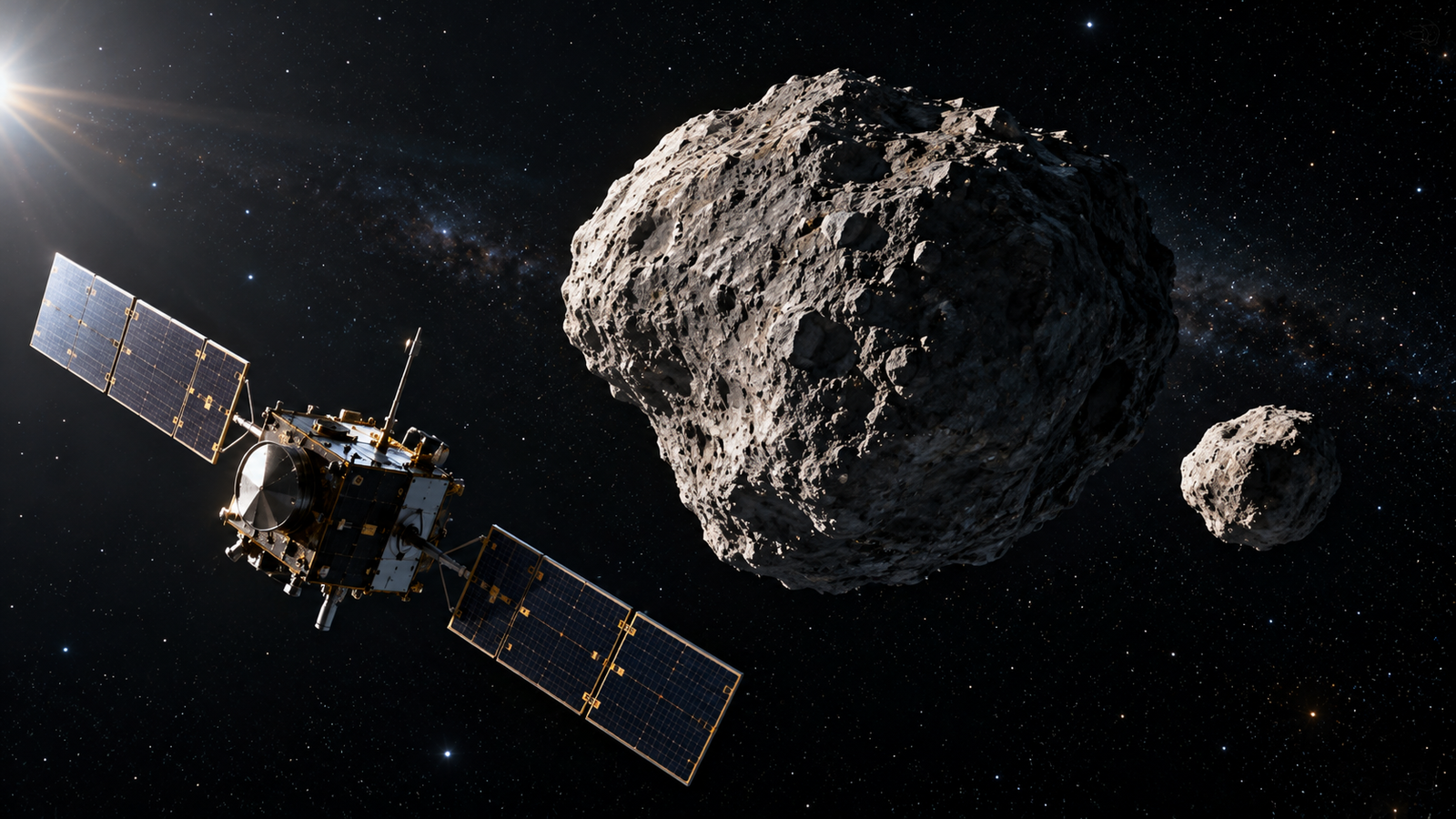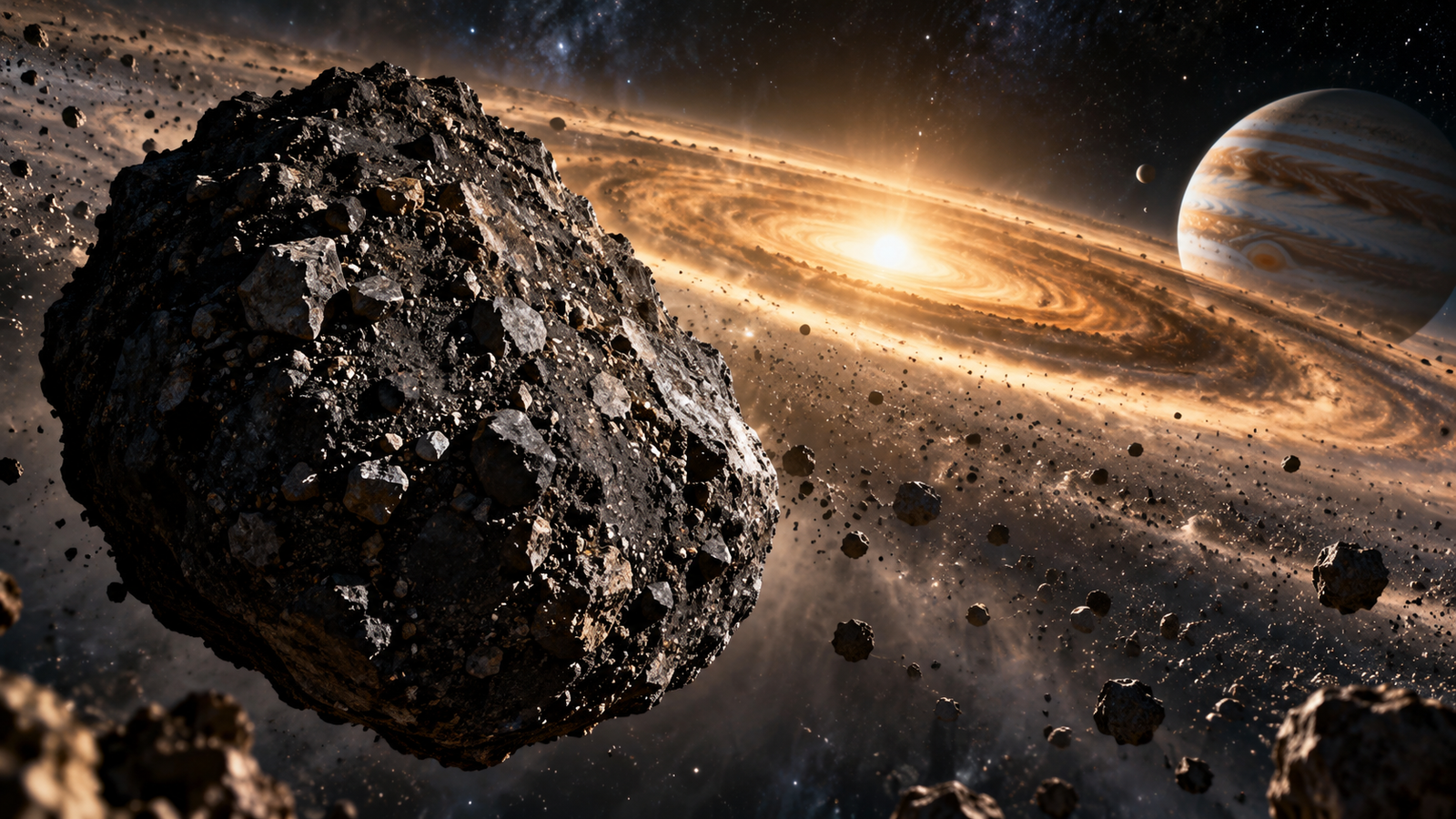
Samples collected from asteroid Bennu by NASA’s OSIRIS-REx mission have revealed new evidence about how different types of material mixed during the earliest stages of the Solar System. In a peer-reviewed paper published in Science Advances on September 23, 2026, an international research team reported chemical signatures suggesting that material related to Bennu and another asteroid, Ryugu, accumulated from a shared reservoir of fine dust. The researchers propose that this process took place near the water-ice line, inside the orbit of a growing Jupiter.
The findings were highlighted again in wider science coverage on October 24, drawing attention to an important question: Where did the primitive ingredients that later contributed to planets and asteroids come from? The new work does not show that scientists have identified one precise location where today’s asteroid Bennu formed. Instead, it offers a supported reconstruction of how the material in its larger parent body may have gathered approximately 4.5 billion years ago.
By comparing isotopes in samples returned from space, scientists can study ancient material far less altered by Earth’s environment than many meteorites collected on the ground.
What Did Scientists Discover in Bennu Asteroid Samples?
The team studied isotopes of iron, titanium and chromium in returned Bennu material. Isotopes are variants of an element whose atoms contain different numbers of neutrons. Some of the ratios between these variants act as chemical fingerprints that reveal the sources and history of the dust from which rocks formed.
The most important result is the close resemblance between Bennu, Japan’s sampled asteroid Ryugu and a rare class of carbon-rich meteorites called CI chondrites. Iron and titanium signatures in the Bennu material were notably consistent and closely matched those comparison samples when measured in sufficiently large portions. Some chromium differences appeared among smaller subsamples, potentially reflecting changes caused by water within Bennu’s ancient parent body.
Together, the measurements support a shared reservoir of early Solar System dust rather than a completely separate origin for each of these materials. That finding is significant because researchers can use the chemistry of relatively unchanged samples to test competing models of planet formation.
How Was the Research Conducted?
The research was led by Maria Schönbächler of ETH Zurich, working with collaborators who measured high-precision isotopic compositions. The team compared Bennu samples with established measurements of Ryugu and CI-type carbonaceous chondrites. Its findings were published as “Nucleosynthetic constraints on the origin of Bennu and CI-like asteroids” in Science Advances, volume 12, issue 39, article eaei9107.
The term ‘nucleosynthetic’ refers to the processes that created different isotopes in earlier generations of stars. When those materials became part of the gas and dust surrounding the young Sun, their distinctive isotope patterns were not always distributed evenly. Scientists can therefore identify whether ancient rocks acquired ingredients from different regions of the protoplanetary disk.
The paper is a laboratory analysis combined with interpretation of the wider evidence. Its conclusions are stronger than a casual visual resemblance between rocks, but the proposed formation location still depends on a scientific model that can be tested with further samples.
What Is the Water-Ice Line?
The water-ice line, sometimes called the snow line, is the boundary in a young planetary system where temperatures become low enough for water vapour to freeze into ice. It was not a fixed painted line in space. Its location could change as the surrounding gas disk evolved and the young Sun and planets altered local conditions.
Near that boundary, water vapour and ice could move, evaporate and recondense. The resulting redistribution of water and dust may have helped small particles stick together and form the building blocks of asteroids. The study suggests that Bennu-like bodies assembled from fine material near the water-ice line rather than from one isolated outer region of the Solar System.
This is a reconstruction of conditions billions of years ago, not an observation of the original event. Asteroids can also experience impacts and orbital changes after the formation of their parent bodies, so the present position of Bennu does not directly reveal its birthplace.
Why Does Jupiter Matter?
One striking part of the proposed explanation involves Jupiter. The gas giant began growing early in the Solar System’s history, and its expanding gravitational influence could have affected how solid particles crossed different parts of the planet-forming disk.
The researchers argue that proto-Jupiter may have impeded the inward movement of relatively large particles while still allowing smaller dust grains to mix efficiently. Near the water-ice line, such fine material could have contributed to the formation of bodies with chemical signatures blending components associated with the inner and outer Solar System. The resulting parent material would differ from a model in which the two regions remained completely separated.
Jupiter’s involvement is therefore a plausible mechanism consistent with the isotopic evidence. It is not proof that scientists watched Jupiter assemble Bennu, and the exact timeline and efficiency of dust transport remain topics for additional research.
Why Bennu and Ryugu Are Scientifically Important
Bennu and Ryugu are especially valuable because spacecraft collected material directly from their surfaces and returned it to laboratories on Earth. Bennu was visited by NASA’s OSIRIS-REx spacecraft, while Ryugu was sampled by Japan’s Hayabusa2 mission. Their returned samples allow measurements of material whose collection and handling histories are carefully documented.
Most meteorites found on Earth have spent time exposed to the atmosphere, weather and possible contamination. These factors do not make meteorites useless, but they can complicate investigations into fragile organic molecules and original mineral chemistry. Spacecraft-returned material gives researchers an unusually well-controlled window into ancient rocky bodies.
The fact that Bennu and Ryugu share notable isotopic similarities with CI chondrites also helps connect spacecraft discoveries to decades of meteorite research. Instead of treating each sample-return mission as an isolated event, scientists can combine their measurements into a broader history of the Solar System.
What Did NASA’s OSIRIS-REx Mission Bring Back?
NASA launched OSIRIS-REx in 2016. The spacecraft arrived at Bennu in 2018 and collected a sample in 2020, before sending a capsule back to Earth in September 2023. The returned material enabled scientists worldwide to examine Bennu in laboratories using sophisticated instruments that cannot realistically be flown to every asteroid.
A total of approximately 121.6 grams of asteroid material was recovered according to mission reporting. The scientific value does not depend on the quantity alone: carefully curated samples can be shared among research groups, permitting independent measurements and new experiments years after the original mission ended.
The newer isotope work is one example of how a single sample-return mission can continue producing results long after collection. It also explains why space agencies preserve much of the material for future generations of researchers and instruments.
What Makes Bennu a Primitive Asteroid?
Bennu is often called primitive because its material preserves characteristics associated with the early Solar System. That description does not mean every grain has remained untouched since formation. Water-related chemical reactions, impacts and other processes have affected its parent material over billions of years.
The research distinguishes between some isotope signals that remain stable and others that may show local variations associated with alteration by water. That distinction helps investigators decide which measurements are best suited to reconstructing the original dust reservoir and which may record later changes.
Understanding the differences matters because an asteroid’s present-day composition can contain several layers of history: ingredients formed before the Sun, mixing in the early disk, assembly into a parent body and subsequent modification. The new analysis attempts to separate those stages rather than attributing every chemical signature to a single event.
Could Bennu Explain How Earth Acquired Water?
Bennu contains water-bearing minerals and organic material, making it relevant to research about the chemical ingredients available when Earth and other rocky planets formed. The new isotopic work suggests that primitive material could be mixed and transported through the early Solar System in ways that may also have influenced the composition of terrestrial planets.
However, the study does not demonstrate that Bennu itself delivered water to Earth. Nor does it prove that Earth’s oceans came from one particular asteroid population. Understanding the sources of terrestrial water requires multiple kinds of evidence, including measurements of water-related isotopes, planetary formation models and comparisons among different meteorites.
The cautious conclusion is that Bennu provides evidence about the reservoirs and transport processes that existed while the ingredients of the planets were being assembled.
Does the Discovery Prove Life Exists on Bennu?
No. The presence of organic molecules or water-related minerals in asteroid samples is not evidence that life existed on Bennu. Organic chemistry includes many compounds that can form without biological activity. Researchers study them because they help reconstruct the availability of chemical building blocks before life emerged on Earth.
This distinction is important in science reporting. A story about the origin of primitive Solar System material should not be rewritten as a discovery of alien life or a confirmed explanation for how life began on Earth. The current research focuses on isotopes and formation environments, not detection of organisms.
Bennu’s scientific value lies in the history recorded by its rocks and grains. That history can inform questions about planetary chemistry without resolving every question about the emergence of life.
What Do the Results Mean for Planetary Formation Models?
The findings challenge overly simple versions of models that place Bennu-like primitive material exclusively in a distant reservoir beyond Jupiter. The team’s measurements support a mixture of material with both inner and outer Solar System affinities, and they identify a possible setting where that mixture could have accumulated.
Models of early Solar System evolution have to account for the distribution of dust, the movement of water ice and gas, and the gravitational influence of growing planets. A mechanism that produces Bennu’s chemical fingerprint can therefore offer clues about the broader development of the planet-forming disk.
Researchers should still test whether the same model explains samples from other asteroids and the known differences among meteorite classes. A single successful interpretation is not automatically the final description of every part of the early Solar System.
What Are the Limits of This Research?
High-precision isotope data provide unusually detailed evidence, but some uncertainties remain. The study examines samples from Bennu rather than a complete inventory of all ancient bodies. Different grains within a parent asteroid may have had separate histories, and later water-related alteration can influence some measured ratios.
Likewise, the inferred influence of Jupiter depends on how scientists reconstruct the conditions of the young protoplanetary disk. The team’s preferred explanation is based on multiple lines of evidence, but alternative transport histories may require evaluation as new materials become available.
Scientific uncertainty does not erase the discovery. Instead, it identifies which parts are directly measured, which findings depend on comparisons and which conclusions are proposed mechanisms awaiting further tests.
What Is Next for Asteroid and Moon Sample Research?
Researchers want to know whether other primitive asteroids share Bennu and Ryugu’s distinctive isotopic signature. More sample-return missions could show whether the inferred common dust reservoir was widespread or limited to a particular population of early Solar System bodies.
The study’s authors have also expressed interest in future material from Phobos, one of Mars’ moons, through a Japanese mission. Such samples could provide another way to examine ancient processes and compare bodies that formed or evolved in different environments. Mission schedules and return dates are subject to change, so they should not be reported as completed achievements before confirmation.
For now, the existing Bennu samples remain a major scientific resource, and additional laboratory analyses are likely to refine the picture presented by this research.
Global Significance and Relevance for Pakistan
The discovery has global scientific value because the processes that formed the Solar System are relevant to every planet, including Earth. It also illustrates the usefulness of international collaborations, public research archives and long-term scientific investment. The project connects laboratory geochemistry with NASA’s spacecraft mission and Japan’s earlier asteroid work.
For students, universities and science readers in Pakistan, the story is primarily educational. It provides a clear example of how scientists use isotope ratios to test ideas about planetary history. There is no verified Pakistan-specific policy change, space mission or direct commercial impact stemming from this paper. Its regional relevance should therefore not be overstated.
As a public-interest science story, it also highlights how discoveries can emerge years after a mission returns material to Earth, once investigators ask new questions or develop more sensitive measurement techniques.
Conclusion
New analysis of Bennu asteroid samples strengthens the link between Bennu, Ryugu and CI-type meteorites. The isotopic evidence indicates that their parent materials shared a reservoir of ancient dust containing components from different parts of the young Solar System. The researchers propose that this material accumulated near the water-ice line, where Jupiter’s growth may have influenced the movement of larger and smaller particles.
The work was published in Science Advances in September 2026 and received renewed coverage on October 24. It is an important contribution to understanding planetary origins, but the proposed role of Jupiter and the precise formation setting remain scientific interpretations to be tested with future evidence.
Frequently Asked Questions
What did scientists find in Bennu asteroid samples?
They found iron, titanium and chromium isotope patterns linking Bennu to asteroid Ryugu and rare CI carbonaceous meteorites, supporting a common ancient dust reservoir.
When was the new Bennu study published?
The peer-reviewed Science Advances paper appeared on September 23, 2026, and was highlighted by ScienceDaily on October 24, 2026.
What is the water-ice line?
It is a region in a young planetary disk where temperatures are low enough for water vapour to freeze, influencing how ice and dust accumulate.
Did Jupiter create asteroid Bennu?
The researchers propose that Jupiter influenced dust transport and mixing, but they have not proven that Jupiter directly created Bennu.
How did NASA collect Bennu samples?
NASA’s OSIRIS-REx spacecraft collected material from Bennu in 2020 and returned a sample capsule to Earth in September 2023.
Is Bennu similar to Ryugu?
Yes. The study found notable isotopic similarities between Bennu, Ryugu and CI chondrites, although the bodies also have distinct histories.
Does the Bennu research prove that life existed in space?
No. It concerns the formation and chemistry of ancient Solar System material, not the discovery of extraterrestrial life.
Why is Bennu research important for Earth?
It helps scientists examine the ancient ingredients and transport processes involved in building rocky planets, including Earth.
About The Author