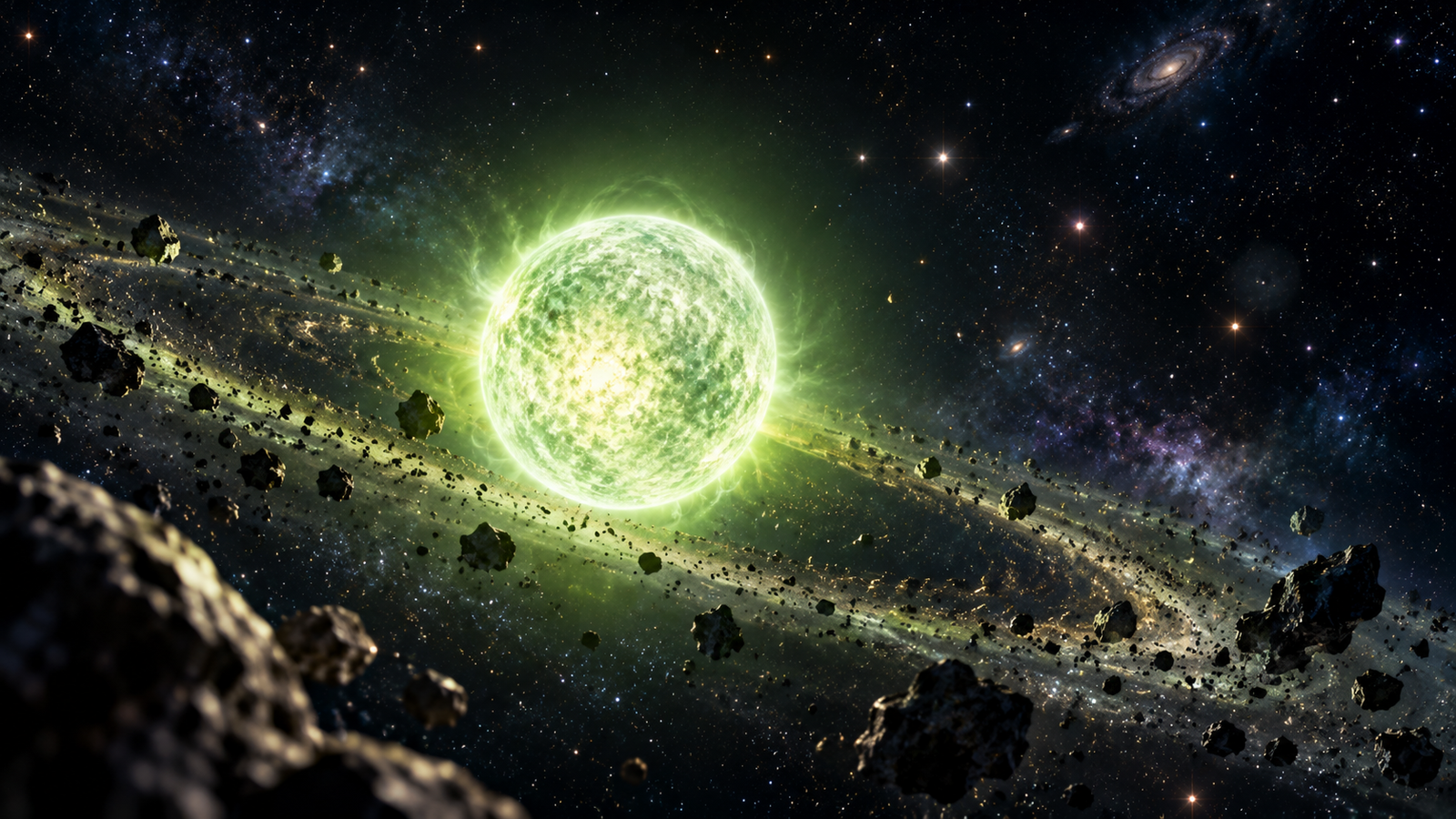
October 18, 2026 – Astronomers have identified an unusual green white dwarf star about 280 light-years from Earth. The star, called WD J1330+6435, is located in the constellation Draco. Scientists say its soft greenish colour comes from a surprising combination of chemicals and extremely dense gas in its atmosphere.
The finding was described in a scientific paper published on October 15 in the journal RAS Techniques and Instruments. Reuters reported it on October 16, followed by coverage from The News and India Today on October 17. The research helps explain why some stellar remains have colours that ordinary stars rarely display.
There is one important detail: astronomers did not take a close-up photograph showing a bright green ball in space. They measured the star’s light and used scientific models to calculate how its surface would look if an observer could see it clearly from nearby.
Green White Dwarf Star: Key Discovery Facts
Name: WD J1330+6435.
Type: White dwarf, the dense core remaining after an ordinary star’s life ends.
Location: Draco constellation, Milky Way.
Distance: Approximately 280 light-years, according to Reuters and the researchers’ reporting.
Unusual colour: Pale yellow-green, sometimes called chartreuse.
Main cause: Sodium in an extremely dense, helium-rich atmosphere.
Other detected elements: Calcium and lithium associated with rocky planetary material.
Research leader: Mark Hollands, University of Warwick.
Research publication: October 15, 2026.
Scientific journal: RAS Techniques and Instruments.
The word “green” describes a colour predicted from measured light and human colour perception. It does not mean the star is close enough to appear green to the naked eye.
What Exactly Did Astronomers Discover?
Researchers studying white dwarfs found that WD J1330+6435 has a very unusual light spectrum. A spectrum separates starlight into its different colours, allowing scientists to find out which wavelengths reach us and which are absorbed.
For most stars, temperature is the main reason one star looks warmer or bluer than another. The scientists found that the chemical content and density of this particular white dwarf create a different effect.
The result is a predicted yellow-green appearance, a colour rarely associated with real stars. The team described it as the first documented example of a genuinely green-looking stellar object of this kind.
What Is a White Dwarf?
A white dwarf is what remains after a star similar in mass to the Sun has used up the fuel that powers its normal life. Such a star eventually sheds its outer layers, leaving behind a very compact core.
A white dwarf can have a mass comparable to that of a star while being roughly the size of Earth. This makes its material far denser than anything we normally encounter.
White dwarfs no longer generate energy in the same way that a typical hydrogen-burning star does. Instead, they gradually cool over very long periods.
Our own Sun is expected to become a white dwarf far in the future. That does not mean this recently studied green one was once our Sun or is heading toward Earth.
Why Does This White Dwarf Look Green?
The central clue is sodium, a chemical element also found in ordinary matter on Earth. In normal conditions, sodium absorbs a relatively narrow part of orange light.
Inside the atmosphere of WD J1330+6435, the situation is different. The gas is so dense that sodium atoms repeatedly interact with nearby helium atoms. These collisions change how the sodium absorbs light.
Instead of blocking only a narrow orange band, the sodium can absorb a much broader range of yellow, orange and red wavelengths. The mix of light left behind has a pale greenish appearance.
The researchers say this effect would not occur in the same way in an ordinary Sun-like star because its atmospheric conditions are very different.
How Could Planetary Debris Change a Star’s Colour?
Astronomers found signs of elements such as calcium, lithium and sodium in the white dwarf’s outer layers. These elements can be connected to rocky material from objects that once orbited the original star.
As a star ages, its planetary system may change. Asteroids or fragments of planets can move into unstable orbits, break apart and eventually fall onto the stellar remnant.
The material can then alter the outer atmosphere. For WD J1330+6435, sodium-rich debris is especially important because it helps explain the unusual colour.
This does not mean astronomers watched the star swallow a complete living planet. The evidence concerns material associated with rocky planetary remains.
How Far Is 280 Light-Years?
A light-year measures distance, not time. It is the distance light travels in one year — roughly 9.5 trillion kilometres.
A distance of 280 light-years means that the light reaching Earth today left this object about 280 years ago. Astronomers use such distances to describe the scale of our galaxy.
The star is located within the Milky Way, but it is far beyond our Solar System. No ordinary spacecraft could reach it in a short journey.
Some media reports give different distance estimates. This article uses the approximately 280-light-year figure reported by Reuters; the key scientific finding concerns its spectrum and appearance rather than an exact distance rounded to one number.
Can People See the Green Star Through a Telescope?
Not as a large green sphere. White dwarfs are small and often faint, even when powerful instruments can detect their light.
Scientists cannot simply zoom in with a normal telescope and photograph the detailed surface of this distant object. Instead, they gather light, examine the spectrum and calculate what the combined colours would look like at close range.
A close-up artist’s illustration can help readers imagine the science, but it is not an actual view recorded from a nearby spacecraft.
The green-white-dwarf illustration accompanying this article is also conceptual. It should never be labelled as a direct NASA or telescope photograph.
Why Are Most Stars Not Green?
Ordinary stars emit a broad range of visible colours at the same time. Their overall appearance is largely determined by surface temperature.
Cooler stars tend to look reddish or orange. Stars like the Sun look white when viewed from space. Very hot stars can appear bluish.
Even when an ordinary star emits plenty of green light, it generally also emits red and blue light. Our eyes combine those wavelengths, so the star does not appear clearly green.
Dense white-dwarf atmospheres can remove large parts of the visible spectrum. That is what makes the new discovery unusual.
Scientists Also Found Pink and Purple Examples
The study did not stop with one star. Researchers examined how different atmospheric chemicals might change the colour of several types of white dwarfs.
They identified examples that could look pink, purple, yellow, cyan and green under suitable viewing conditions. Many white dwarfs still have a mainly white appearance.
One remarkable example, WD J1011+2845, was described as having a salmon-pink shade. Its colour is linked to carbon rising from inside the stellar remnant rather than sodium-rich material arriving from outside.
This tells astronomers that more than one physical process can produce unusual white-dwarf colours.
How Did Researchers Study the Stars?
The team used light-spectrum information from astronomical observations, including Sloan Digital Sky Survey data, along with computer models of white-dwarf atmospheres.
The models account for temperature, density and chemical composition. Researchers then worked out how the recorded light would be perceived by human eyes.
The peer-reviewed paper also studied a nearby sample of white dwarfs to understand which colours are common and which are exceptional.
It found that white remains the typical overall colour. That means the discovery does not overturn everything astronomers know about stars; it adds an important exception.
What Does the Scientific Paper Actually Say?
The paper is titled “Any colour you like: the diverse chromaticities of white dwarfs.” It was written by Mark A. Hollands, Boris T. Gänsicke, Pier-Emmanuel Tremblay and Detlev Koester.
Its central result is that the atmospheres of some cool, dense white dwarfs can strongly change the mix of light escaping from them.
The researchers also produced colour-accurate models for how these stellar discs might look to an observer sufficiently close to resolve their surfaces.
Their results show that white dwarfs have a wider range of possible appearances than the name “white dwarf” might suggest.
Why Is This Discovery Important?
The discovery offers a new way to understand the chemicals present in old stars. Those chemicals can reveal information about the rocky objects that survived, broke apart or fell inward after a star changed.
By studying a white dwarf’s atmosphere, scientists may learn more about the composition of material in a former planetary system.
The work also improves how researchers interpret light from extremely dense gases. Better models can help distinguish temperature effects from chemical changes.
This is an advance in astronomy and colour science. It is not evidence of alien life, a new planet near Earth or an approaching danger.
Does the Green Star Pose Any Danger to Earth?
No danger to Earth is described in the scientific paper or the news reports. WD J1330+6435 is a distant stellar remnant in our galaxy.
Its unusual colour is an observational discovery, not a sign that it is heading toward us or about to explode.
There is no basis in the verified sources for alarming claims about radiation reaching Pakistan, major disturbances in the Solar System or changes to the night sky.
Readers can enjoy the unusual discovery without mistaking it for an astronomical emergency.
Why the News Matters to Students in Pakistan
Astronomy discoveries often start with careful measurement rather than dramatic photographs. This study is a good example of how physics, chemistry, mathematics and computing work together.
Students can learn about the life cycle of stars, how atoms absorb light and how astronomers use a spectrum to study distant objects.
The work also shows why scientific language matters. A simulated colour is useful information, but it should be distinguished from a picture taken by a camera.
The research is global in importance, with educational relevance for Pakistan and other countries. It does not have a direct Pakistan-specific astronomical impact.
What’s Next for White Dwarf Research?
Scientists can use similar methods to study other unusual white dwarfs, compare their atmospheres and refine models of extreme matter.
Future studies may examine how planetary debris changes over time and whether new observations reveal other rare colours.
The research could also help astronomers reconstruct what happened to planetary systems after their parent stars grew old.
For now, the main verified result is that WD J1330+6435 has a spectrum consistent with an unusually green-looking white dwarf, adding a surprising new colour to our picture of the universe.
Frequently Asked Questions
What is the green white dwarf star called?
It is named WD J1330+6435 and is located in the Draco constellation.
How far away is the green star?
Reuters reports that it is approximately 280 light-years from Earth.
Why does the white dwarf appear green?
Sodium in its extremely dense atmosphere absorbs broad ranges of yellow, orange and red light, leaving a greenish colour.
Is it really a green star?
Scientists calculated its perceived colour using light spectra and atmospheric models. It is not a close-up camera photograph.
What is a white dwarf star?
It is a small, very dense stellar core left after an ordinary star has finished its main life cycle.
Did the star eat a planet?
Researchers found chemical evidence consistent with rocky planetary debris entering its atmosphere. They did not directly watch an entire planet being swallowed.
Are there pink or purple white dwarfs?
Yes. The study identified other examples whose atmospheres could produce pink, purple or cyan appearances.
Is this green star dangerous to Earth?
No. The cited research does not indicate any danger to Earth.
About The Author