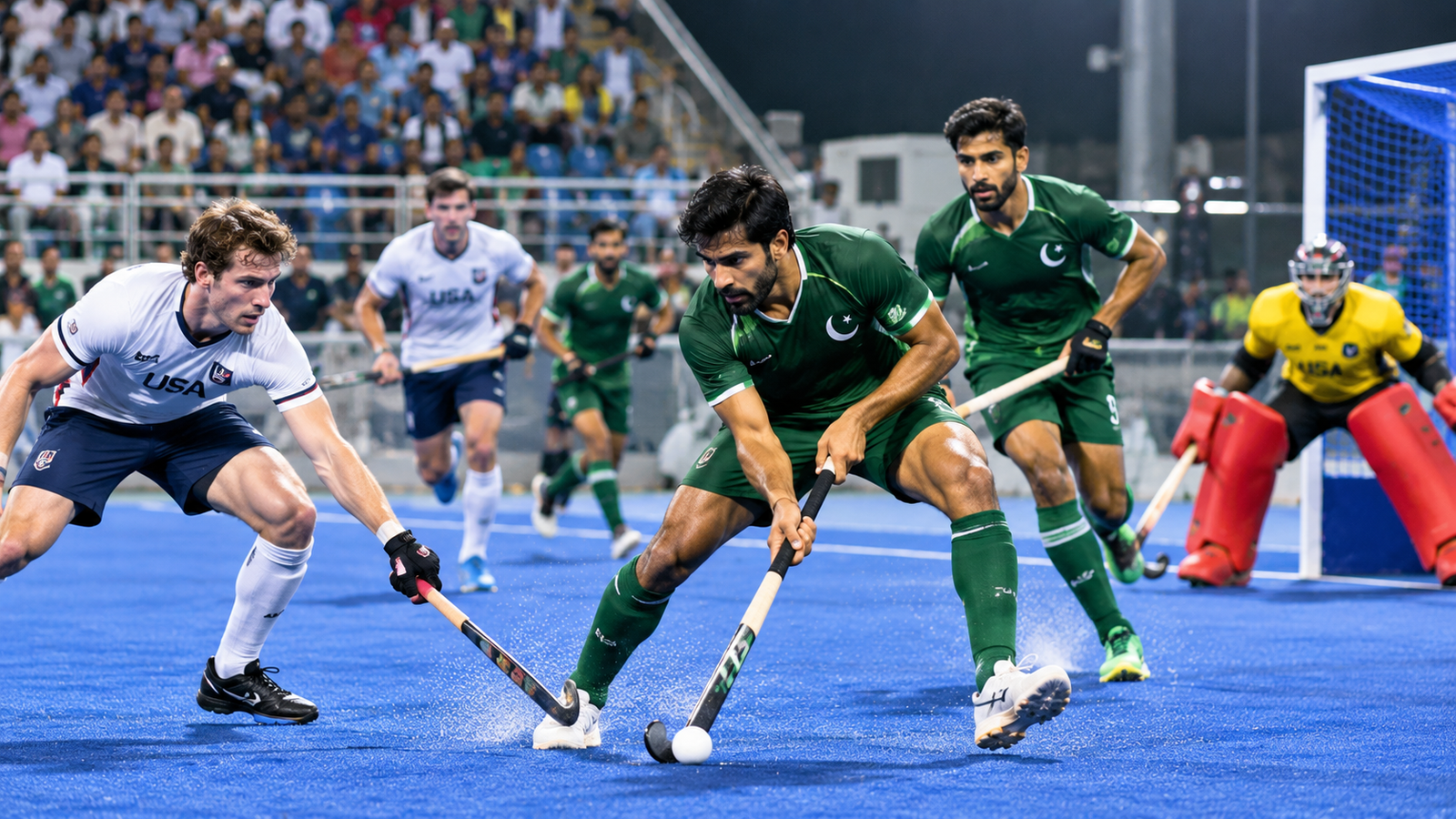
Pakistan continued their impressive start at the 32nd Sultan Azlan Shah Cup with a commanding 5-1 victory over the United States in Ipoh, Malaysia. The result gave Pakistan their second consecutive win in the tournament after they had also defeated Canada by the same score in their opening match. Five different Pakistani players contributed to the victory, demonstrating the team’s attacking depth and ability to create scoring opportunities through both field play and penalty corners.
The match was played at the Sultan Azlan Shah Stadium, where Pakistan gradually took control after a goalless opening quarter. The team increased its pressure during the second period and established a two-goal advantage before half-time. The United States briefly reduced the deficit in the third quarter, but Pakistan responded almost immediately and restored its two-goal cushion. Further goals in the final period secured a convincing result for the Green Shirts.
The official match record published by the International Hockey Federation (FIH) confirms the final score, the goal timings and the players responsible for each goal. Waheed Ashraf Rana opened the scoring in the 18th minute, while Sufyan Khan converted a penalty corner three minutes later. The United States scored through Sekayi Charasika in the 31st minute, but Muhammad Ammad, Abu Mahmood and Hannan Shahid added three more goals for Pakistan.
The victory strengthened Pakistan’s position in the early league-stage standings and provided another positive result ahead of a challenging fixture against Australia. However, the tournament was still in progress after the match, meaning Pakistan had not secured a place in the final or won the competition. Their performance against the United States nevertheless demonstrated encouraging attacking form and gave the team an opportunity to build momentum before facing stronger opposition.
Pakistan Take Control After a Goalless Opening Quarter
The opening quarter of the match ended without a goal, with both teams attempting to establish control and create opportunities in the attacking areas. Pakistan looked to use its pace and movement to put pressure on the American defence, while the United States tried to prevent the Green Shirts from finding space near the goal. The first period remained competitive, but neither side managed to convert its opportunities into a score.
Pakistan’s breakthrough arrived in the 18th minute when Waheed Ashraf Rana scored a field goal to give his team a 1-0 lead. The goal was important because it rewarded Pakistan’s attacking pressure and forced the United States to respond from a position of disadvantage. Once Pakistan had opened the scoring, the team continued to press rather than retreat into a defensive approach.
Three minutes later, Sufyan Khan converted a penalty corner in the 21st minute to double Pakistan’s advantage. The goal gave the Green Shirts a 2-0 lead and provided a stronger platform heading into the remainder of the first half. Penalty corners are a significant scoring opportunity in international hockey because teams can use rehearsed routines and specialised players to create direct attempts on goal.
Pakistan’s ability to score through both a field goal and a penalty corner showed that the team was not dependent on a single attacking method. The two-goal advantage also placed pressure on the United States, which needed to improve its attacking output while limiting further opportunities for Pakistan.
United States Reduce the Deficit in the Third Quarter
The United States returned for the second half looking to change the direction of the match. Its efforts produced a goal in the 31st minute when Sekayi Charasika converted a penalty corner, reducing Pakistan’s lead to 2-1. The goal gave the American side a chance to put pressure on Pakistan and potentially move closer to an equaliser.
However, Pakistan responded almost immediately. Muhammad Ammad scored in the 32nd minute through another penalty corner, restoring the two-goal advantage and moving the score to 3-1. The quick response was an important moment because it prevented the United States from building momentum after its first goal.
Pakistan’s reaction also demonstrated the importance of maintaining concentration after conceding. In closely contested hockey matches, a team that scores can often use the momentum to create additional chances, particularly when the opposition becomes less organised. Pakistan avoided that situation by producing an immediate response and re-establishing control of the scoreboard.
The third quarter therefore became a decisive period in the match. Although the United States managed to score, Pakistan’s ability to answer quickly ensured that the American side could not turn the goal into a sustained comeback. The Green Shirts entered the final period with a 3-1 lead and an opportunity to extend their advantage.
Two More Goals Complete Pakistan’s 5-1 Victory
Pakistan continued their attacking approach in the final quarter and added two more goals to secure the result. Abu Mahmood scored in the 46th minute through a penalty corner, increasing the lead to 4-1. The goal further reduced the United States’ chances of returning to the match and gave Pakistan a comfortable advantage during the closing stages.
Hannan Shahid completed the scoring in the 58th minute with a field goal that made the final score 5-1. His goal ensured that Pakistan finished the match with a four-goal margin and confirmed their second consecutive victory in the competition. The late goal also reflected Pakistan’s ability to remain active in attack even after establishing a substantial lead.
The official FIH match report records five Pakistani goals from five different players. Waheed Ashraf Rana and Hannan Shahid scored field goals, while Sufyan Khan, Muhammad Ammad and Abu Mahmood converted penalty corners. This distribution showed that Pakistan were able to generate goals through different players and different attacking situations.
For the United States, Sekayi Charasika was the only scorer. His penalty-corner goal briefly reduced the deficit, but the American side could not produce another successful attack before the final whistle. Pakistan’s defensive organisation and continued pressure helped preserve the winning margin.
Goal Scorers and Match Progress
The official FIH match record provides a clear breakdown of the scoring sequence, allowing the result to be checked against the tournament’s match documentation.
| Team | Player | Minute | Goal type |
|---|---|---|---|
| Pakistan | Waheed Ashraf Rana | 18th | Field goal |
| Pakistan | Sufyan Khan | 21st | Penalty corner |
| United States | Sekayi Charasika | 31st | Penalty corner |
| Pakistan | Muhammad Ammad | 32nd | Penalty corner |
| Pakistan | Abu Mahmood | 46th | Penalty corner |
| Pakistan | Hannan Shahid | 58th | Field goal |
The scoring pattern shows that Pakistan converted three penalty corners during the match, in addition to two field goals. The United States also scored through a penalty corner, meaning set-piece opportunities played an important role in the final result. Pakistan’s ability to convert its opportunities helped create the difference between the teams.
The timing of the goals was equally significant. Pakistan established a two-goal lead before half-time, responded immediately after conceding in the third quarter and added two more goals in the final period. This sequence allowed the Green Shirts to maintain control of the match rather than allowing the United States to build a sustained challenge.
Second Consecutive Win Strengthens Pakistan’s Start
The victory over the United States followed Pakistan’s 5-1 win against Canada in their opening match. Winning two consecutive games by the same score gave Pakistan a positive start to the league stage and strengthened their position among the teams competing for a place in the final.
A strong start is valuable in a round-robin tournament because teams need to collect points consistently across their scheduled matches. Each result contributes to the standings, while goal difference can also become important if teams finish level on points. Pakistan’s two victories therefore provided an encouraging foundation, although the remaining fixtures still carried considerable importance.
The tournament includes six national teams: Pakistan, Australia, Malaysia, Canada, South Korea and the United States. Each side competes in the league stage, with the final positions determining which teams progress to the concluding matches. The competition runs from November 20 to November 28 in Ipoh, Malaysia, according to the FIH tournament information.
Pakistan’s opening results showed that the team could produce goals against different opponents, but the level of competition was expected to increase as the tournament progressed. Their next major challenge was scheduled against Australia, a side that also produced strong results during the opening matches.
Australia Present a Major Test for Pakistan
Australia emerged as one of the early strong performers after recording a 7-1 victory over South Korea. That result strengthened Australia’s position in the standings and created additional interest in the upcoming meeting between Australia and Pakistan. Both teams had started their campaigns with positive performances, making their scheduled encounter an important fixture in the league stage.
Australia are known for their structured attacking play, physical intensity and experience in international hockey. Facing such an opponent would provide Pakistan with a more demanding test than simply repeating the performance delivered against the United States. The match would require the Green Shirts to maintain defensive discipline while continuing to create opportunities through field play and penalty corners.
For Pakistan, the Australia fixture also offered an opportunity to assess how well the team could perform against a leading international opponent. A strong result could improve their position in the competition and increase confidence ahead of the remaining league matches. However, the outcome could not be assumed in advance, and the match needed to be decided on the field.
The scheduled fixture list published by the tournament’s official match system placed Pakistan against Australia on November 23. The result of that match was not part of the confirmed USA victory and should be treated as a separate upcoming event until the official score is recorded.
Why Penalty Corners Were Important in the Match
Penalty corners played a central role in Pakistan’s victory over the United States. Three of Pakistan’s five goals came from penalty-corner situations, showing the importance of set-piece execution in modern international hockey. These opportunities allow attacking teams to organise their players around a structured routine and attempt to create a direct scoring chance.
Sufyan Khan converted Pakistan’s first penalty corner in the 21st minute, while Muhammad Ammad scored from another in the 32nd minute. Abu Mahmood added a third penalty-corner goal in the 46th minute, giving Pakistan a 4-1 advantage. The successful conversions helped the team turn attacking pressure into a clear lead.
Penalty corners require coordination between the player injecting the ball, the stopper, the striker and other attackers involved in the routine. Teams also need to adapt their approach according to the opposition’s defensive formation and goalkeeper positioning. A successful conversion can change the momentum of a match, while missed opportunities may allow opponents to remain in contention.
Pakistan’s performance against the United States demonstrated the value of effective set-piece execution. The team was able to convert several opportunities at important stages, particularly after the Americans had reduced the deficit. Maintaining this level of accuracy could become important in later matches against stronger opponents.
What the Result Means for Pakistan Hockey
Pakistan have a long history in international field hockey and have previously achieved major success at the Olympic Games, World Cup and other international competitions. The country has also produced generations of players who helped establish its reputation as one of the sport’s historically important nations. However, maintaining competitiveness in modern hockey requires consistent investment, player development, coaching standards and regular participation in strong international events.
Recent years have presented challenges for Pakistan hockey, including the need to improve international results and strengthen the structures supporting the national team. Victories in tournaments such as the Sultan Azlan Shah Cup can provide confidence, but long-term progress depends on more than a few successful matches.
The two consecutive wins against Canada and the United States offer a positive sign for the current campaign. They show that Pakistan can create scoring opportunities, convert penalty corners and maintain attacking pressure across different periods of a match. The next step is to demonstrate that these strengths can also be maintained against higher-ranked and more experienced opposition.
A strong tournament performance could help improve confidence among players and supporters while providing valuable competitive experience. It could also encourage greater attention towards domestic hockey structures, youth development and the preparation of players for future international competitions.
Importance of International Tournaments for Player Development
International tournaments give national teams the opportunity to test their preparation against opponents with different styles and tactical approaches. A competition involving teams from different hockey traditions can expose players to a range of defensive systems, attacking patterns and match situations. This experience can help coaches identify strengths and areas requiring improvement.
For Pakistan, playing against teams such as Australia, Malaysia, South Korea, Canada and the United States provides an opportunity to assess performance across different types of opposition. Matches against technically strong teams can test defensive organisation, while fixtures against physically demanding opponents can reveal how well players manage pressure and maintain possession.
The tournament also offers opportunities for individual players to develop confidence and demonstrate their ability at international level. Scoring goals, defending penalty corners and contributing to team organisation can help players strengthen their roles within the national side. Consistent performances may also help coaching staff evaluate combinations and identify players suited to particular tactical responsibilities.
However, development should be assessed over a longer period rather than through one result. A successful campaign requires consistency, fitness, discipline and the ability to respond when matches become difficult. Pakistan’s opening victories are encouraging, but the remaining fixtures will provide a more complete assessment of the team’s progress.
The Road Ahead in the Sultan Azlan Shah Cup
Pakistan’s campaign continued with several important fixtures remaining in the league stage. The scheduled match against Australia on November 23 was expected to be a key test, followed by further competition against other participating teams. The tournament’s official schedule listed Pakistan’s later fixtures against South Korea and Malaysia before the final positions were decided.
The league stage is important because every match can influence a team’s chances of reaching the final. Winning early games provides a foundation, but teams must continue collecting points and maintaining a strong goal difference. A loss in a later fixture can change the standings, particularly when several teams are competing closely for the top positions.
Pakistan’s coaching staff will need to assess the team’s performance against the United States and identify areas that require improvement. Converting penalty corners was a clear strength, but the team will also need to maintain defensive concentration and avoid giving opponents opportunities to return to matches. Stronger opposition may punish mistakes that were not decisive against the United States.
Supporters will be watching how Pakistan perform in the upcoming fixtures, particularly against Australia. The result of that match could provide a clearer indication of the team’s ability to challenge for a place in the final. Until then, the confirmed achievement remains two consecutive wins at the start of the tournament.
Conclusion
Pakistan secured a convincing 5-1 victory over the United States at the Sultan Azlan Shah Cup, recording their second consecutive win in the competition. The Green Shirts established control through goals from Waheed Ashraf Rana and Sufyan Khan before responding quickly to the American goal in the third quarter. Muhammad Ammad, Abu Mahmood and Hannan Shahid added further goals to complete the result.
The official International Hockey Federation match report confirms the final score and the scoring sequence, while Pakistan’s earlier 5-1 victory over Canada provides additional context for the team’s strong start. The results have strengthened Pakistan’s early position in the league stage and created momentum ahead of a demanding fixture against Australia.
The victory is an encouraging development for Pakistan hockey, particularly because the team displayed attacking variety and effective penalty-corner execution. Nevertheless, the tournament was still underway, and Pakistan had not yet secured a place in the final. Their remaining performances would determine whether the positive start could be converted into a successful overall campaign.
For now, the win over the United States gives Pakistan another opportunity to build confidence, improve consistency and demonstrate their competitiveness in international hockey. The next matches will be important in determining how far the Green Shirts can progress in the competition.
What was the score of Pakistan vs USA at the Sultan Azlan Shah Cup?
Pakistan defeated the United States 5-1 in their league-stage match at the 32nd Sultan Azlan Shah Cup in Ipoh, Malaysia.
When did Pakistan play against the United States in the tournament?
The match was played on November 21, 2026, at the Sultan Azlan Shah Stadium in Ipoh, Malaysia.
Who scored goals for Pakistan against the USA?
Waheed Ashraf Rana, Sufyan Khan, Muhammad Ammad, Abu Mahmood and Hannan Shahid each scored one goal for Pakistan.
Who scored the only goal for the United States?
Sekayi Charasika scored the United States’ only goal through a penalty corner in the 31st minute.
Was the victory Pakistan’s second consecutive win?
Yes. Pakistan followed their 5-1 opening victory over Canada with another 5-1 win against the United States.
Which Pakistan players scored from penalty corners?
Sufyan Khan, Muhammad Ammad and Abu Mahmood scored Pakistan’s three penalty-corner goals against the United States.
Who was Pakistan scheduled to face after the USA match?
Pakistan’s next scheduled opponent was Australia, with the match listed for November 23 in the official tournament schedule.
Did Pakistan qualify for the Sultan Azlan Shah Cup final after beating the USA?
The victory strengthened Pakistan’s position in the league stage, but it did not by itself confirm qualification for the final. The remaining matches were still important in determining the final standings.
About The Author