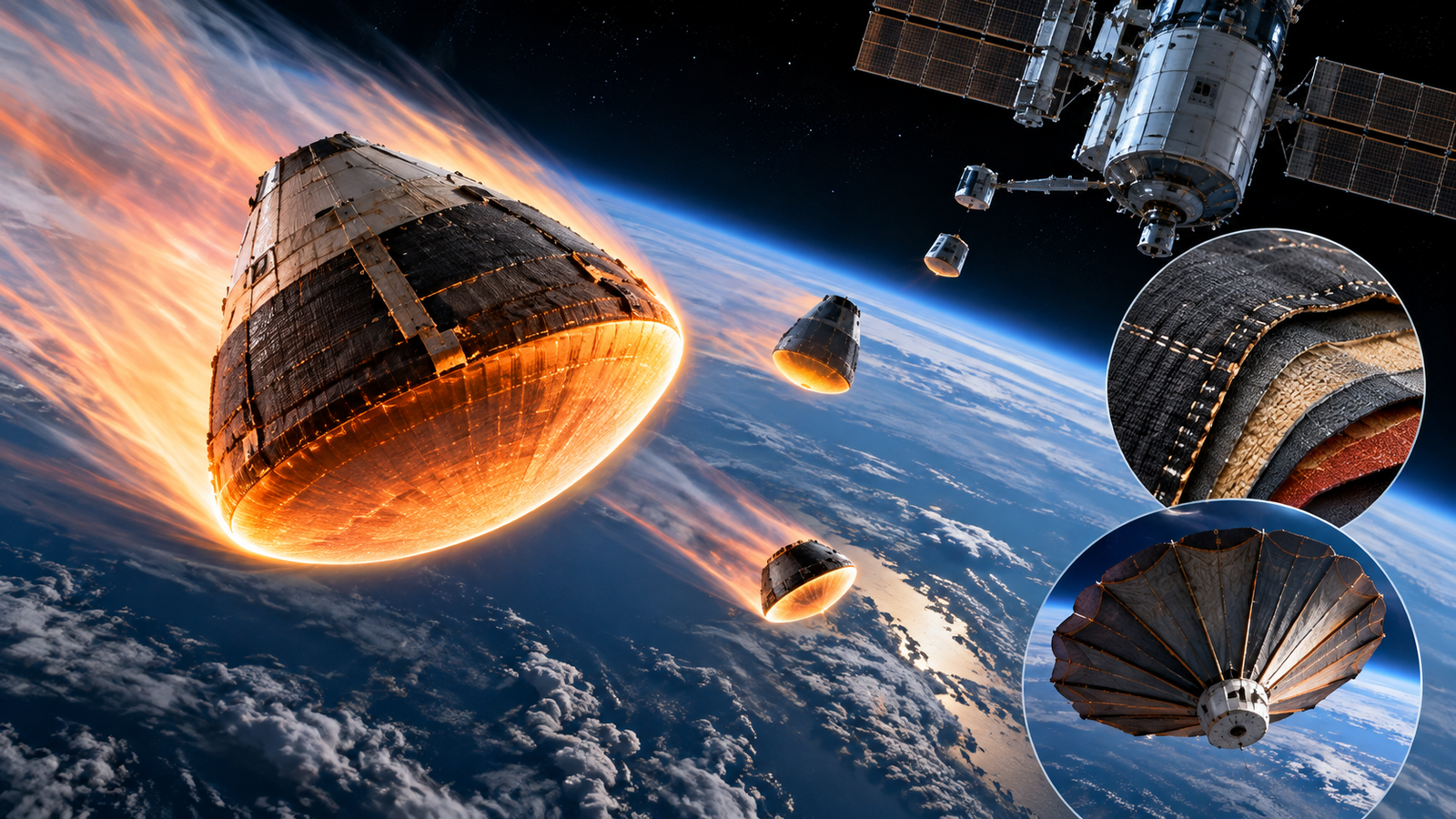
NASA is testing a new generation of heat-shield materials and reentry designs that could help future spacecraft return safely from missions to the Moon, Mars and other destinations. The agency is using an unusually practical test platform: the final descent of a cargo spacecraft that has already completed its mission at the International Space Station.
NASA said the Northrop Grumman Cygnus XL cargo spacecraft departed the station carrying 12 small experimental capsules for the Kentucky Reentry Probe Experiment-3, or KREPE-3. The capsules are designed to collect real-world data during atmospheric reentry, allowing researchers to test thermal-protection materials, spacecraft shapes and sensors under conditions that are difficult and expensive to reproduce on the ground.
The October 9 announcement is important because heat shields remain one of the most critical technologies in human and robotic spaceflight. Any spacecraft returning through an atmosphere must survive enormous thermal loads generated by high-speed reentry. Better materials could reduce weight, lower cost and improve mission flexibility.
NASA says the experiment includes multiple technologies intended for future Mars missions, Earth-return vehicles and planetary exploration. The tests are not a single heat shield for one spacecraft; they are a collection of different materials and designs being evaluated side by side.
What KREPE-3 Is Testing
KREPE-3 is the third mission in a series of low-cost reentry experiments. Instead of launching a dedicated spacecraft only for heat-shield research, NASA and its partners use the final phase of a cargo spacecraft’s life to release small instrumented capsules into the atmosphere.
The capsules gather data while they experience real reentry heating, aerodynamic forces and structural stress. Researchers can then compare the measured results with computer models and laboratory predictions.
This approach is valuable because heat-shield performance depends on more than material chemistry. Shape, airflow, temperature distribution, surface erosion and vehicle stability all interact during atmospheric entry. Real flight data helps engineers validate the models used to design larger spacecraft.
MERINO Materials Could Reduce Cost and Manufacturing Time
NASA’s Ames Research Center is contributing several experimental materials to KREPE-3. Two capsules are testing a family of protective coverings called Materials Engineered for Re-entry using Innovative Needling Operations, or MERINO.
MERINO uses layers of carbon and phenolic fibers stitched together in a felt-like structure. NASA says the material is more flexible, faster to manufacture and potentially less expensive than traditional thermal-protection systems.
Those characteristics are especially important for Mars missions. Because Mars has a much thinner atmosphere than Earth, spacecraft face a different heating environment during entry. Engineers may be able to use lighter protection systems while still maintaining adequate safety margins.
A lighter heat shield can create major mission benefits. Every kilogram saved in thermal protection can potentially be reassigned to science instruments, cargo, fuel or other mission systems.
NASA Is Also Testing New Vehicle Shapes
One KREPE-3 capsule is part of the Kentucky Instrumented Conical Hypersonic Experiment. It uses a dual-cone configuration combining a tungsten tip, heat-resistant fiber layers and MERINO material.
The purpose is not only to test materials but also to compare real aerodynamic and thermal data with computer simulations. Hypersonic entry is difficult to model because air behaves differently at extremely high speed and temperature.
More accurate models can reduce uncertainty in future spacecraft design. That matters because engineers often have to add extra material or structural margin when they are uncertain about the exact conditions a spacecraft will experience.
Dragonfly-Style Aeroshell Also Gets a Flight Test
Another capsule is shaped like the aeroshell planned for NASA’s Dragonfly mission to Saturn’s moon Titan. The test will examine the dynamic stability of that type of geometry during reentry.
The capsule is protected with Phenolic Impregnated Carbon Ablator, or PICA, a material developed at NASA Ames. PICA has a long flight heritage and has been used on missions including Stardust, Mars Science Laboratory and Mars 2020.
PICA works by absorbing and dissipating intense heat as parts of the material char and erode during atmospheric entry. The material is lightweight compared with many older thermal-protection systems, which makes it useful for missions where mass is tightly constrained.
Deployable Heat Shield Could Help Land Larger Payloads
KREPE-3 also includes a test of Adaptable Deployable Entry and Placement Technology, a deployable heat shield that can open like an umbrella.
The idea is to increase surface area during descent. A larger area can generate more aerodynamic drag, slowing a vehicle higher in the atmosphere and reducing the heating and forces it experiences.
At full scale, a deployable system could be folded during launch and expanded later. That could allow a mission to use a heat shield larger than the diameter of the rocket fairing that carried it into space.
This concept is especially relevant for Mars because landing large payloads on the planet is difficult. Mars has enough atmosphere to create heating but not enough to slow heavy spacecraft easily. Larger deployable entry systems could eventually help deliver heavier cargo, habitats or science platforms.
Why Heat Shields Are So Difficult to Design
Atmospheric reentry converts enormous kinetic energy into heat. A spacecraft returning from orbit can travel at several kilometres per second, compressing and heating the air in front of it.
The resulting temperatures can destroy an unprotected vehicle. A heat shield therefore has to survive extreme heating while remaining lightweight and structurally reliable.
Different destinations create different requirements. Earth-return capsules, Mars landers and probes entering the atmospheres of other planets may encounter very different combinations of speed, density and heating.
That is why NASA continues testing multiple materials rather than relying on a single universal solution.
Low-Cost Reentry Tests Can Speed Up Development
NASA describes the KREPE approach as a low-cost, high-impact way to gather flight data. Traditional flight testing can require a dedicated launch, spacecraft and recovery campaign, making each experiment expensive.
By placing small capsules inside a cargo spacecraft that is already scheduled to leave the space station, researchers can test technologies without building an entire mission around them.
This method can support faster iteration. Engineers can test a material, compare results with predictions, adjust the design and prepare another experiment with less cost than a full-scale spacecraft programme.
International and University Partners Are Involved
The KREPE-3 mission includes capsules developed by domestic and international partners. NASA said one experiment includes a heat-flux sensor developed at the University of Stuttgart in Germany.
Heat-flux measurements help scientists understand how thermal energy moves across a spacecraft surface during reentry. Better measurements can improve material models and guide future design decisions.
The involvement of universities and international partners also makes the experiment useful as a broader research platform rather than a single-agency technology test.
What This Means for Artemis and Future Mars Missions
NASA’s Artemis programme is designed to return humans to the Moon and establish a foundation for deeper exploration. Reliable thermal protection is essential because crewed spacecraft must safely return through Earth’s atmosphere after lunar missions.
Mars missions present an additional challenge. Crewed missions would need to protect larger vehicles and heavier payloads during entry while keeping launch mass within practical limits.
Technologies such as MERINO and deployable heat shields could contribute to those future architectures if testing shows they can perform reliably at larger scale.
The current experiments should therefore be viewed as research steps rather than flight-qualified systems ready for immediate crew use.
Technology Impact
The KREPE-3 tests could influence several areas of spacecraft engineering, including materials science, sensor design, hypersonic modelling and deployable structures.
More efficient heat shields can reduce vehicle mass and potentially lower mission cost. Faster manufacturing methods could also make it easier to build thermal-protection systems for a larger number of spacecraft.
Commercial space companies may also benefit from NASA’s research. Heat-shield technologies developed by the agency have already found applications in commercial cargo and reentry vehicles.
Global Importance
Atmospheric reentry is becoming more important as commercial and government missions return more material from orbit. Crew capsules, research payloads, manufacturing experiments and sample-return missions all need reliable thermal protection.
As activity in low Earth orbit grows, more companies may need safe and repeatable reentry systems. That creates a wider market for lightweight heat shields and accurate reentry modelling.
The research also has relevance beyond Earth. Future missions to Mars, Titan and other worlds require tailored entry systems that can survive different atmospheric environments.
Pakistan and South Asia Relevance
The direct impact on Pakistan is limited, but the underlying technology is relevant to countries developing satellite and space-research capabilities.
Universities and research organisations in South Asia can benefit from advances in materials science, computational modelling and small reentry experiments, particularly as access to commercial launch services improves.
Over time, lower-cost space testing could make participation in advanced aerospace research more accessible to smaller national programmes and academic institutions.
What Happens Next
Researchers will analyse the data gathered by the KREPE-3 capsules to determine how the materials, shapes and sensors performed during reentry.
The most important step will be comparing flight measurements with computer models. If the results match predictions, engineers gain confidence that those models can be used to design larger systems.
If the data reveals unexpected behaviour, the findings can be used to improve materials or modelling methods before the technology is scaled up.
NASA says the goal is to push the boundaries of what heat shields can do while testing them in a way that is relatively fast and affordable.
FAQs
What is KREPE-3?
KREPE-3 is NASA’s third Kentucky Reentry Probe Experiment mission, using small capsules to test heat-shield materials, vehicle shapes and sensors during real atmospheric reentry.
How many capsules are involved?
NASA said the Cygnus XL cargo spacecraft carried a fleet of 12 experimental capsules for the reentry tests.
What is MERINO?
MERINO is a next-generation thermal-protection material made from stitched layers of carbon and phenolic fibers. NASA says it is flexible, faster to produce and potentially less expensive than traditional materials.
Why are these heat shields important for Mars?
Mars missions need lightweight systems capable of protecting spacecraft during entry through the planet’s thin atmosphere. Lower mass can leave more capacity for cargo, science equipment and other systems.
What is PICA?
PICA stands for Phenolic Impregnated Carbon Ablator, a lightweight NASA-developed heat-shield material with flight heritage on multiple missions.
What is a deployable heat shield?
It is a heat shield that can be folded for launch and expanded before atmospheric entry, increasing surface area and helping slow a spacecraft.
Are these technologies ready for astronauts?
Not yet. KREPE-3 is an experimental test programme designed to collect data that could support future spacecraft development.
Why does NASA use a cargo spacecraft for the tests?
Using the cargo spacecraft’s planned end-of-mission reentry provides a lower-cost way to gather real flight data without launching a dedicated test mission.
About The Author