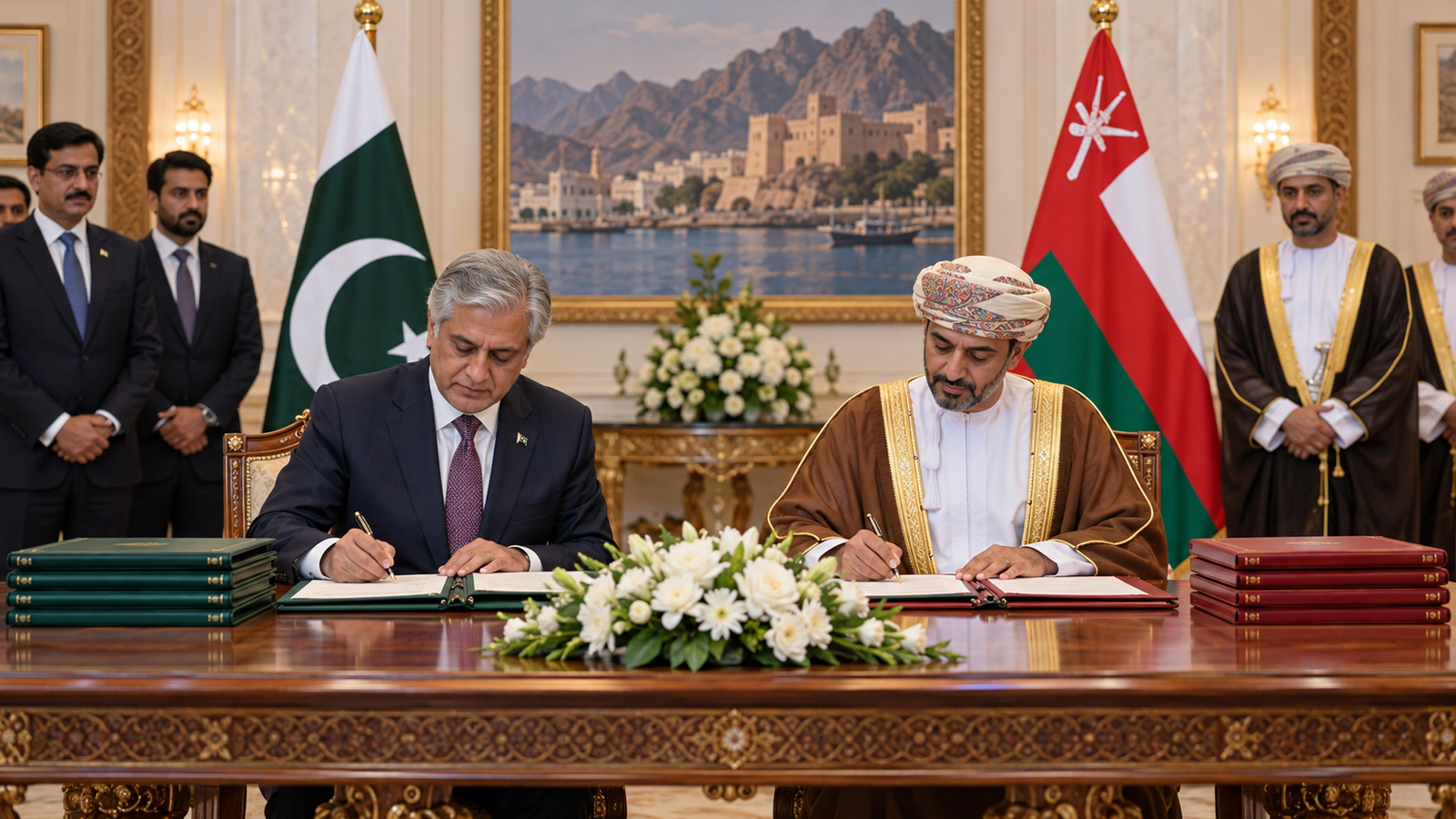
ISLAMABAD, October 15, 2026 – Pakistan and Oman exchanged six bilateral cooperation documents in Islamabad on October 14, seeking to expand institutional ties in visa facilitation, telecommunications, information technology, broadcasting, news exchange and archival cooperation. The ceremony took place at the Prime Minister’s Office during the official visit of Omani Foreign Minister Sayyid Badr bin Hamad bin Hamood Al Busaidi.
Prime Minister Shehbaz Sharif witnessed the exchange of the documents. Deputy Prime Minister and Foreign Minister Mohammad Ishaq Dar signed three of them alongside Oman’s foreign minister, according to Pakistan’s Press Information Department (PID) and state broadcaster Radio Pakistan. The remaining three memorandums of understanding were signed on Pakistan’s side by the relevant federal ministers for information and broadcasting and information technology and telecommunications.
The Pakistan Oman agreements 2026 were an outcome of the eighth Pakistan–Oman Joint Ministerial Commission (JMC). The signing marks a new step in bilateral cooperation, but does not mean every initiative is already operational or that unrestricted visa-free travel has been introduced for all Pakistani citizens.
Who Signed the Pakistan–Oman Documents?
The most important clarification concerns the roles of Pakistan’s senior officials. Prime Minister Shehbaz Sharif attended and witnessed the ceremony; the official statements do not describe him as personally signing all six documents.
PID states that Ishaq Dar and Omani Foreign Minister Badr Al Busaidi signed the protocol recording the eighth JMC’s minutes, the agreement covering mutual visa exemptions for specified official passport categories, and the memorandum concerning national records and archives.
The other three memorandums dealt with information and broadcasting, information technology and telecommunications, and news exchange and media cooperation. PID identifies the responsible federal ministers for information and broadcasting and IT and telecommunications as the Pakistani signatories for these sector-specific documents.
Oman’s Foreign Ministry also identifies the two foreign ministers as principal signatories in its summary. Pakistan’s more detailed PID account clarifies which documents involved additional Pakistani ministers. These descriptions should be read together rather than used to claim that the prime minister or president signed the agreements.
President Asif Ali Zardari is not identified as a signatory in the official ceremony accounts reviewed for this article.
Six Documents: What Was Actually Signed?
The package consisted of one agreement, four memorandums of understanding and a protocol recording the minutes of the eighth Joint Ministerial Commission. Official descriptions sometimes refer collectively to all six as agreements or MoUs, but technically they are not all the same type of instrument.
The six were:
1. Protocol recording the minutes of the eighth Pakistan–Oman Joint Ministerial Commission.
2. Agreement on mutual visa exemption for holders of diplomatic, special, official and service passports.
3. Memorandum of understanding on cooperation in records and archives.
4. Memorandum of understanding on information and broadcasting.
5. Memorandum of understanding on information technology and telecommunications.
6. Memorandum of understanding on news exchange and media cooperation.
Oman’s Foreign Ministry describes one agreement and four MoUs, along with the JMC minutes. Pakistan’s PID and Radio Pakistan describe the combined package as six cooperation documents. Both accounts are consistent when the meeting protocol is counted as the sixth document.
Where and When Did the Signing Take Place?
The ceremony took place on October 14, 2026, at the Prime Minister’s Office in Islamabad. It followed the eighth session of the bilateral Joint Ministerial Commission, co-chaired by Pakistan’s Deputy Prime Minister and Foreign Minister Ishaq Dar and Omani Foreign Minister Badr Al Busaidi.
Pakistan’s Ministry of Foreign Affairs published remarks delivered by Dar at a joint press interaction, describing discussions on a broad agenda and the expected signing later that day.
Oman’s official foreign-ministry account, published October 14, confirmed that the documents were signed in the presence of Prime Minister Shehbaz Sharif.
This October 15 article reports the prior day’s completed diplomatic event; it should not be headlined as a signing held on October 15.
Does the Visa Agreement Allow All Pakistanis to Enter Oman Without a Visa?
No. The official agreement concerns specific categories of passports: diplomatic, special, official and service passports.
These are not the same as ordinary passports held by most Pakistani travellers. Neither the Pakistani nor the Omani official account announces visa-free access for every Pakistani citizen.
The mutual exemption is intended to facilitate qualifying official travel between the two countries. The exact implementation date, administrative conditions and documentation should be confirmed through official government or embassy guidance.
People planning tourism, private visits or employment in Oman should continue checking the visa requirements applicable to their own passport category. A headline saying that Oman has made entry visa-free for all Pakistanis would be misleading.
Why Telecommunications and IT Are Part of the Agreement
One of the memorandums addresses cooperation in telecommunications and information technology. Digital connectivity, technical expertise and exchange of information are increasingly important components of bilateral economic relations.
The document creates a framework for cooperation, but the October 14 official statement does not provide a complete project list, spending amount or binding implementation schedule for a new telecom infrastructure programme.
For Pakistan, technology-related collaboration may eventually support professional exchanges, government coordination or private-sector opportunities, depending on follow-up decisions.
Mukhbir should not turn the announcement into an unverified claim that Oman has funded a Pakistani 5G rollout, approved a specific data-centre investment or launched a new mobile network.
Broadcasting and Media Cooperation
The signed package includes separate instruments covering information and broadcasting, and news exchange and media cooperation.
Such arrangements can provide a basis for communication between institutions, exchange of expertise and future coordination on media-related initiatives.
The official announcements do not specify that the two governments have merged state broadcasters, created a shared news agency or transferred editorial control over media organisations.
News and broadcasting cooperation can be reported as a diplomatic agreement without assuming the content or outcome of programmes that have not yet been publicly detailed.
Cooperation on National Records and Archives
The MoU on national records and archives involves Oman’s National Records and Archives Authority and the National Archives of Pakistan.
Archival cooperation may include exchange of professional knowledge, preservation practices, documentation or institutional engagement, subject to arrangements developed by the relevant agencies.
Historic records and archives are important sources for understanding trade, migration and cultural ties between Pakistan and Oman.
However, the official signing report does not announce a completed joint digitisation platform or release a specific collection of previously inaccessible records. Those would require separate verification.
What Is the Pakistan–Oman Joint Ministerial Commission?
The JMC provides a formal channel through which the two governments discuss and coordinate bilateral cooperation.
Its eighth session in Islamabad was jointly chaired by Dar and Badr Al Busaidi. Pakistan’s Ministry of Foreign Affairs said the discussions covered trade, investment, maritime and logistics connectivity, agriculture, industry, energy, workforce mobility, education, information technology, media and climate-related issues.
The session also discussed cooperation mechanisms for converting broad commitments into more concrete decisions.
A commission meeting is not itself a finalised investment contract. Its value lies in setting priorities, assigning responsibility and following up through appropriate institutions.
Trade and Investment Opportunities
Pakistan and Oman have geographic proximity across the Arabian Sea and longstanding commercial and people-to-people links.
Dar’s official October 14 remarks identified trade and investment as areas for greater coordination. The two governments discussed the establishment and operation of joint working groups as mechanisms for continued engagement.
Closer trade relations could potentially benefit exporters, shipping services and businesses looking for partnerships, but the six signed documents do not establish a specific new bilateral trade volume.
Any claim about billions of dollars in committed investments, new factories or completed projects would need separate signed agreements and credible financial disclosures.
Maritime Connectivity and Logistics
Oman’s position on important shipping routes and Pakistan’s access to the Arabian Sea make maritime links a natural subject for government discussions.
PID reported that the ministerial commission covered maritime and logistics connectivity alongside industry, energy and investment. These topics are particularly relevant to importers, exporters and regional logistics businesses.
The discussions should not be confused with a confirmed inauguration of a new ferry, shipping corridor or direct port service.
Actual operational links depend on commercial arrangements, maritime regulations, port capacity and subsequent decisions by relevant authorities.
Labour and Workforce Mobility
Many Pakistani citizens work in Gulf countries, and mobility of skilled and other workers remains a public-interest issue.
The Foreign Ministry said the Pakistan–Oman meeting discussed labour and human resource development, workforce mobility and people-to-people ties.
Those discussions do not amount to a newly announced quota of Omani jobs for Pakistanis. Nor does the diplomatic passport agreement remove employment visa and work-permit requirements for ordinary workers.
People interested in overseas employment should seek verified recruitment information and official Omani immigration guidance before paying an agent or committing to travel.
Energy, Agriculture and Climate Cooperation
The Joint Ministerial Commission’s agenda included energy, oil and gas, agriculture, industry and climate change.
These sectors have potential relevance for food security, industrial development and the energy needs of both countries. The meeting’s stated objective was to identify opportunities and strengthen institutional coordination.
Not every item on the broader agenda was a separate signed memorandum in the six-document package. In particular, the statements reviewed do not establish a completed oil-and-gas supply agreement or a newly funded agricultural project as part of this signing.
A careful article distinguishes the subjects discussed from the documents that were actually exchanged.
What Did Prime Minister Shehbaz Sharif Say?
Pakistan’s Press Information Department reported that Prime Minister Shehbaz Sharif received the visiting Omani foreign minister on October 14.
The prime minister emphasised the historical and cultural foundations of the bilateral relationship, described Oman as an important maritime neighbour and welcomed the successful holding of the eighth Joint Ministerial Commission.
His appearance at the signing ceremony reflected senior political support for the bilateral agenda.
Yet the precise role remains important: he witnessed the document exchange. Calling him a signatory would misstate the government’s own account of the event.
What Did Foreign Minister Ishaq Dar Say?
At the joint press interaction, Ishaq Dar described the discussions as constructive and emphasised expanding cooperation through institutional mechanisms.
He referred to planned work in trade, investment, agriculture, oil and gas, labour and human-resource development, alongside the agreements being signed on visas, media, IT and archives.
He highlighted the establishment or activation of joint working groups that could maintain engagement between commission sessions.
The official remarks show policy priorities, not evidence that all proposed programmes were already completed.
Oman’s Position on Bilateral Relations
Oman’s Foreign Ministry described the agreement and MoUs as practical steps to strengthen the institutional framework of cooperation and expand exchanges between relevant authorities.
The Omani government confirmed the signing date, venue, presence of Prime Minister Shehbaz Sharif and participation of the two foreign ministers.
The official reporting highlights continuity in bilateral relations rather than a sudden replacement of either country’s existing foreign policy.
Any further details about entry into force, funding or programme implementation will need to come from the responsible ministries.
Why This Story Matters for Pakistan
The development has direct Pakistan relevance because it involves foreign policy, official travel arrangements, telecom cooperation and possible avenues for trade and employment dialogue.
The visa agreement has an immediate information value: readers need to know which passport holders are covered and which are not.
For businesses, the significant point is the strengthening of institutional channels through which concrete commercial projects might later emerge.
For ordinary citizens, the most important caution is not to mistake a diplomatic announcement for changes to general tourism visas, recruitment opportunities or telecom services that have not been officially notified.
What Happens Next?
The next newsworthy developments will include implementation details for the passport exemption, sector-specific working group meetings, institutional programmes under the MoUs and any separately announced investment or trade arrangements.
Embassies and the responsible ministries may eventually issue guidance on how the visa agreement is to be applied.
Journalists should check those notices before describing the exemption as operational, and should distinguish proposed projects from completed contracts.
As of October 15, the verified news is that Pakistan and Oman signed and exchanged six cooperation documents in Islamabad on October 14, with Foreign Minister Ishaq Dar and other responsible Pakistani ministers serving as signatories and Prime Minister Shehbaz Sharif witnessing the ceremony.
Frequently Asked Questions
When did Pakistan and Oman sign the six documents?
They were signed and exchanged in Islamabad on October 14, 2026.
Who signed on behalf of Pakistan?
Ishaq Dar signed three documents alongside Oman’s foreign minister. The relevant federal ministers for information and broadcasting and IT and telecommunications signed the remaining sector-specific MoUs, according to Pakistan’s PID.
Did Prime Minister Shehbaz Sharif sign the agreements?
Official reporting identifies him as witnessing the signing and exchange ceremony, not personally signing all six documents.
Did Pakistan’s president sign the agreements?
The reviewed official reports do not name President Asif Ali Zardari as a signatory.
Does the agreement provide visa-free entry to every Pakistani?
No. It concerns holders of diplomatic, special, official and service passports, not all ordinary passport holders.
What fields do the documents cover?
Visa exemption for specified passport categories, telecommunications and IT, information and broadcasting, news exchange, archives and the record of the Joint Ministerial Commission meeting.
Who represented Oman at the signing?
Omani Foreign Minister Sayyid Badr bin Hamad bin Hamood Al Busaidi signed on behalf of Oman, according to official foreign-ministry reporting.
Were six new investment projects confirmed?
No. The six cooperation documents establish frameworks and record ministerial decisions; the sources reviewed do not announce six separately funded investment projects.
About The Author