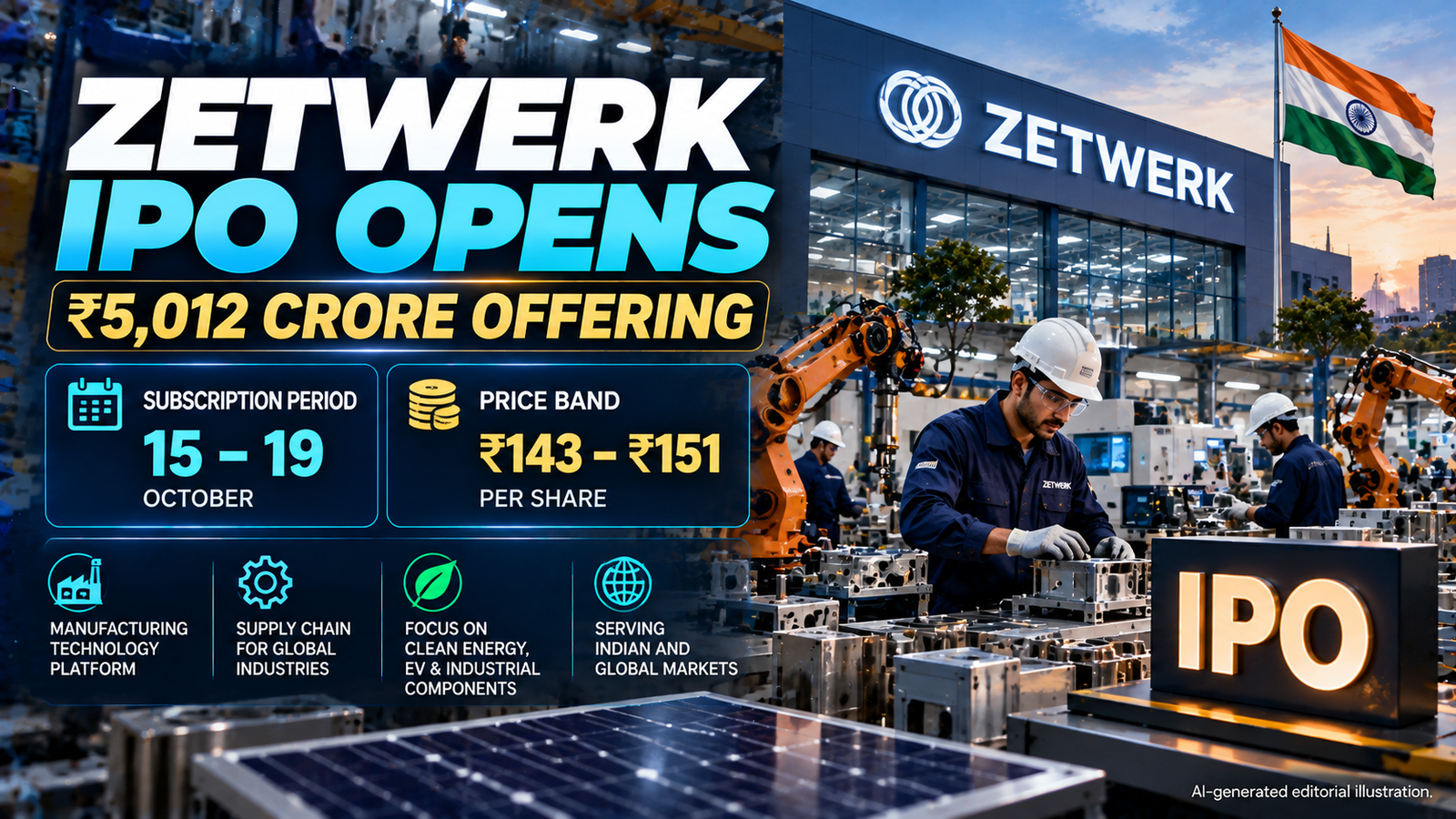
MUMBAI, October 15, 2026 – The initial public offering of India’s technology-led manufacturing platform Zetwerk Manufacturing Businesses opened for subscription on Thursday, seeking to raise up to ₹5,012.33 crore through a combination of new shares and sales by existing shareholders. The offering’s price band is ₹143 to ₹151 per share, with bidding scheduled to continue through October 19.
The Zetwerk IPO 2026 was covered on its opening day by NDTV Profit and The Economic Times, following earlier reports from Reuters, Financial Express, Moneycontrol and other market publications. The proposed valuation was reported at approximately $2.64 billion, or ₹25,583 crore, at the upper end of the price band. That is a proposed IPO valuation, not the price at which shares have already started trading.
The company operates a manufacturing and supply-chain platform serving industrial and consumer sectors. Its flotation will test investor demand for a business attempting to combine digital procurement systems, supplier coordination and ownership of selected manufacturing assets.
Zetwerk IPO 2026: Key Details
Company: Zetwerk Manufacturing Businesses Limited.
Public subscription: October 15–19, 2026.
Issue size: Approximately ₹5,012.33 crore.
Price band: ₹143–₹151 per equity share.
Fresh issue: Approximately ₹2,830 crore.
Offer for sale: Approximately ₹2,182.33 crore.
Retail lot size: 99 shares.
Minimum investment at the upper band: ₹14,949 per lot.
Reported anchor allocation: ₹2,251.23 crore on October 14.
Proposed listing: BSE and NSE on October 23, 2026.
Reported IPO valuation: Approximately $2.64 billion at the upper end.
These are announced or scheduled terms. The final public subscription, allotment and listing outcome were not known when bidding opened.
What Is Zetwerk Manufacturing Businesses?
Zetwerk is a Bengaluru-based manufacturing technology company founded in 2017. It began with a platform intended to connect customers needing industrial products with manufacturers able to produce them, before expanding into a more integrated supply-chain business.
The model involves managing sourcing, production coordination, quality requirements and delivery across a large network of manufacturers. Reuters identified customers across renewable energy, electronics and industrial equipment, illustrating how the company reaches markets beyond conventional consumer software.
Unlike a typical app-based startup, Zetwerk deals with physical products that must meet engineering specifications and delivery schedules. Its technology platform is important, but factories, suppliers, inventory and working capital also affect performance.
Financial Express reported that the business has developed direct manufacturing capacity alongside its network model. Readers should not assume it is purely asset-light or that every product is made in a Zetwerk-owned plant.
Why Is the IPO Important for India’s Startup Ecosystem?
India has produced large technology-enabled businesses that operate outside familiar sectors such as payments, food delivery and online shopping. Zetwerk represents an approach in which software and operational data are used to organise complex manufacturing supply chains.
An IPO of this scale offers a way for early backers to sell some of their shares while giving the company access to public-market capital. At the same time, public investors gain exposure to an industrial business with distinct execution and financing risks.
Investors named in Reuters reporting include Peak XV Partners, Accel India and Lightspeed Venture Partners. Participation by prominent venture investors is relevant to the company’s funding history, but it does not guarantee investment returns.
The offer follows a period of large Indian listings, and investors will compare Zetwerk’s valuation and financial results with other listed industrial and technology businesses.
How Is the ₹5,012 Crore Offering Structured?
The offering includes a fresh issue of about ₹2,830 crore and an offer for sale of approximately ₹2,182.33 crore.
Fresh-issue proceeds, after applicable expenses, go to the company and can be applied to the purposes described in its prospectus. By contrast, proceeds from the offer-for-sale component go to shareholders who sell existing stock rather than becoming additional corporate cash.
This distinction prevents a common misunderstanding: Zetwerk does not receive the entire ₹5,012.33 crore for its own operations.
Reuters and Financial Express reported that debt repayment is a significant intended use of the fresh money. Investors should consult final offer documents for detailed allocations and any changes to the original proposal.
What Is the IPO Price Band and Minimum Lot?
Zetwerk is offering shares in a band from ₹143 to ₹151. The reported retail lot size is 99 shares.
At the upper end of ₹151, a 99-share lot requires ₹14,949 before any relevant charges. At the lower price of ₹143, the same lot would cost ₹14,157.
These calculations reflect shares multiplied by the selected offer price. The final allotment depends on subscription levels and the applicable allocation rules.
An offer price does not establish the market price after listing. The share could trade above or below the issue price once the exchange debut takes place.
Which Anchor Investors Participated?
The Economic Times and Moneycontrol reported that Zetwerk allotted shares worth approximately ₹2,251.23 crore to 99 anchor investors on October 14, the day before public subscriptions opened.
The reported investor roster included BlackRock, Goldman Sachs and Nomura among other institutional participants.
An anchor allocation is a separate part of the issuance process and demonstrates that eligible investors committed capital under those terms. It should not be mistaken for the subscription figure achieved by retail applicants after the public offer opened.
Institutional participation may attract attention, but anchor investment alone cannot predict the eventual listing price or long-term share performance.
What Does Zetwerk Manufacture?
Zetwerk works with clients across industrial and consumer-product categories. Reuters described energy products as the largest business segment, including products used in renewable-energy and power infrastructure.
Precision manufacturing is another important area, involving components linked to consumer electronics, electric vehicles and wearable devices. The company has also served customers in industrial machinery and related sectors.
Its operations may involve coordinating independent suppliers and manufacturing at selected company-controlled facilities. That mix creates opportunities to serve clients at scale but requires strong quality assurance and delivery management.
The industry is more capital-intensive than pure software because physical orders need materials, tools, production capacity, transport and sometimes financing before customers pay.
How Large Is Zetwerk’s Supplier Network?
Upstox reported that Zetwerk’s operating network included 6,979 third-party suppliers across 26 countries. That broad reach allows the company to source and coordinate manufacturing for multiple customer requirements.
A large supplier network, however, does not automatically mean all suppliers are actively producing at the same time or that they deliver identical product quality. Clients expect the platform to manage reliability, pricing and compliance.
International sourcing can also introduce exposure to trade restrictions, freight costs, exchange rates and geopolitical disruptions.
The supplier-network figure should be treated as the company’s reported business metric rather than a count of Zetwerk-owned factories.
Revenue Growth and Losses: What Investors Should Know
Reuters reported Zetwerk’s revenue for a recent quarter at approximately ₹4,118 crore, representing growth of more than 55% compared with the year-earlier period.
The company also reported a quarterly loss of approximately ₹64.1 crore in the period described by Reuters. Those figures show meaningful business scale while illustrating that revenue growth and net profitability are not the same thing.
Other financial summaries show substantial losses for the full financial year. Differences in period definitions and accounting items mean quarterly and annual results must not be combined without explanation.
Investors should assess gross margins, debt, cash conversion, operating costs and the sustainability of customer demand. A fast-growing order book is useful context but is not equivalent to cash in the bank.
Why Debt Repayment Is a Major IPO Objective
Business operations involving industrial orders may require financing for raw materials, production and the interval before customers settle invoices. Borrowing can help support that cycle but also creates interest costs and repayment obligations.
The published IPO breakdown describes a substantial allocation toward reducing debt held by the company and some subsidiaries. If executed as described, repayment could reduce financing pressure.
Nevertheless, how much benefit investors receive will depend on the actual debt repaid, borrowing rates and future capital requirements. It is not possible to guarantee higher profits simply because the company plans to use IPO proceeds for repayment.
The final prospectus provides more precise information than social-media graphics or speculative discussion about how the capital will be deployed.
Who Are Zetwerk’s Major Customers?
Reuters identified customers such as Siemens Gamesa, Acer India, the Indian Air Force and NTPC Renewable Energy among the company’s business relationships.
These examples illustrate the breadth of sectors the company serves. They should not be used to infer that each client accounts for an equal proportion of revenue or has committed to identical future contracts.
Some manufacturing businesses depend heavily on large customers or particular industry cycles. Investors should review concentration disclosures and order terms in the company’s prospectus.
Contracts can grow, change or expire, and the existence of a recognized customer does not remove operational or financial risk.
What Is the Expected Listing Date?
Published offering schedules point to a planned listing on October 23, 2026, on the National Stock Exchange of India and BSE.
Moneycontrol and Mint listed an expected basis-of-allotment date of October 21, followed by settlement steps before trading begins.
These remain scheduled milestones rather than completed events. Changes could occur under applicable exchange and regulatory procedures.
Investors should use official market announcements for the final allotment results, share-credit timetable and first trading price.
Is the Grey Market Premium a Reliable Indicator?
Several business outlets discussed an unofficial grey market premium before the IPO opened. Such premiums describe informal market interest rather than prices generated by an official stock exchange.
A positive quoted premium can change rapidly or disappear before listing. It does not guarantee an allocation or a specific profit.
Headlines that convert a grey-market estimate into a promised listing gain are misleading. Public investors still face valuation, liquidity and market risks.
Mukhbir therefore reports the offering’s verified terms without presenting an unofficial premium as a dependable forecast.
Main Business and Investment Risks
Zetwerk operates in industries where raw material costs, supplier performance, working capital and delivery schedules can materially affect operating results.
Competition includes other manufacturing service companies and suppliers with direct relationships to large customers. Changes in energy-sector spending, electronics demand or export conditions can influence orders.
Financial risks include borrowing costs, reported losses and the complexity of integrating any acquisitions. Investors must also consider whether the IPO valuation adequately reflects those uncertainties.
None of these risks means the company is certain to underperform. They are factors that deserve independent evaluation alongside its scale, customer base and growth.
Pakistan and South Asia Relevance
This is an Indian startup and public-market story. The sources reviewed do not announce a Zetwerk investment, new factory or dedicated project in Pakistan.
Still, manufacturing technology, supplier digitisation and renewable-energy supply chains are important subjects across South Asia. Entrepreneurs in Pakistan and neighbouring economies can study how platforms coordinate industrial suppliers and fund growth.
The IPO may also influence the regional discussion about whether technology-enabled industrial companies can attract large public-market valuations.
Any direct Pakistan business impact would require verified evidence rather than an assumed connection based solely on geographic proximity.
What Happens Next for Zetwerk?
Public subscriptions are due to close on October 19. Later developments will include the final bidding data, share allotment, settlement and an expected October 23 stock-market debut.
Investors will then be able to evaluate the trading price against the offer price and assess future disclosures about debt, cash flow and operating performance.
As of October 15, the confirmed core development is that Zetwerk’s ₹5,012.33 crore IPO opened for public applications with a ₹143–₹151 price band, following a separately reported institutional anchor allocation.
Whether the company ultimately delivers sustained profitability or an attractive investment return remains uncertain.
Frequently Asked Questions
When did the Zetwerk IPO 2026 open?
Public subscription opened on October 15, 2026, and is scheduled to close October 19.
What is the total issue size?
Approximately ₹5,012.33 crore, combining a fresh issue and an offer for sale.
What is the Zetwerk IPO price band?
The price range is ₹143 to ₹151 per share.
How many shares are in one retail lot?
One lot contains 99 shares, costing ₹14,949 at the upper price band before charges.
How much is the fresh issue?
Approximately ₹2,830 crore is to be raised through newly issued shares.
Did Zetwerk raise money from anchor investors?
Yes. Published reports say ₹2,251.23 crore was allotted to 99 anchor investors on October 14.
When is Zetwerk expected to list?
October 23, 2026, on India’s NSE and BSE, subject to the official timetable.
Does the IPO guarantee a listing gain?
No. Official and unofficial indicators cannot guarantee the price at which shares will trade after listing.
About The Author