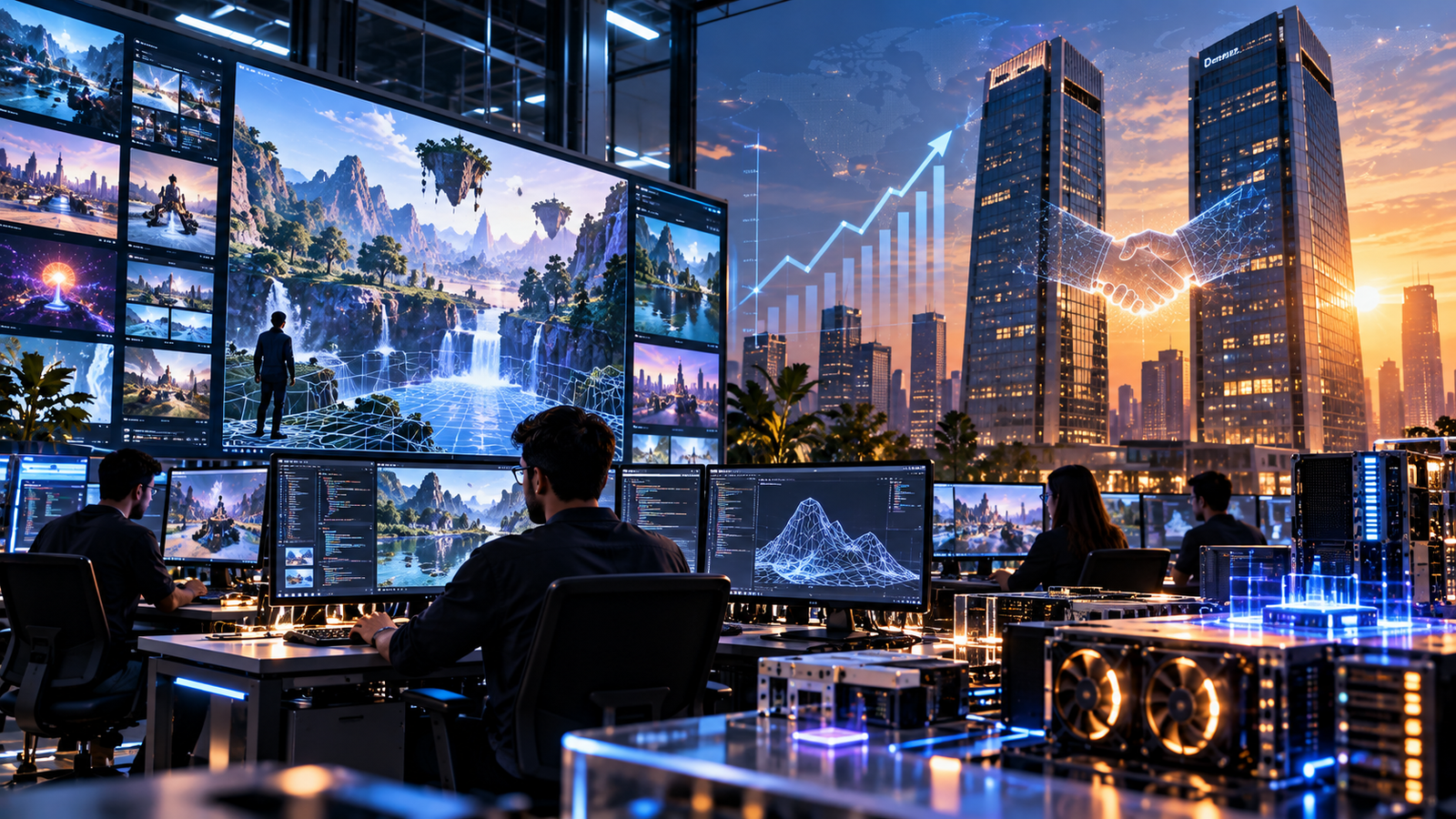
Amazon Decart acquisition talks could lead to a deal worth approximately $7 billion, according to a Wall Street Journal report published on October 11, 2026. The newspaper, citing people familiar with the discussions, said the technology giant is considering buying the artificial intelligence startup behind video-generation and simulation technology.
Reuters carried the report but said it could not independently verify the negotiations. Amazon and Decart did not immediately respond to requests for comment. No completed acquisition, definitive agreement or official purchase price had been announced as of the reporting reviewed for October 12.
The possible transaction is drawing attention because Decart works on two fast-developing areas of AI: tools for processing or generating video and systems that simulate environments. The startup is also associated with software designed to help developers use different AI chips, a capability with potential value to major cloud providers.
For investors and technology companies, the reported talks illustrate competition for specialist AI talent and products. However, an acquisition discussion can change direction, attract another bidder or end without a deal. Any article describing Decart as already owned by Amazon would be premature.
What is known about the potential $7 billion deal?
The Wall Street Journal reported that Amazon was in advanced discussions to acquire Decart at a possible valuation of roughly $7 billion. Reuters subsequently summarized the account and clearly identified the Journal as the source of the acquisition claim.
The reported price is not an officially agreed transaction value. There is no verified announcement specifying whether a purchase would be paid in cash, shares or a mixture, nor any confirmed timetable for closing. Terms could change during negotiation and review.
The Journal also reported that another potential buyer might emerge. Reuters noted that the talks could still collapse. Mukhbir therefore treats the reported transaction as a developing negotiation, with the acquisition status explicitly unconfirmed.
An eventual agreement would likely bring more detail about assets, employees, technology rights and any applicable regulatory reviews. Until those disclosures appear, it is more accurate to discuss why Decart interests potential buyers than to assume what Amazon will do with the company.
What is Decart AI?
Decart is a San Francisco-based AI startup established in 2023 by Israeli engineers, according to the Journal and other coverage. Its reported founders include Dean and Orian Leitersdorf and Moshe Shalev. The company has developed technology spanning real-time visual editing, AI-generated environments and compute infrastructure.
Decart’s work is not limited to a traditional text chatbot. Its products explore systems that transform visual inputs or model changing scenes. Such technology can serve developers experimenting with interactive media, simulation and other applications where video or environments must update quickly.
The company has attracted major venture-capital backers. Reuters reported that Decart raised $300 million in May 2026 in a round led by Radical Ventures, with Nvidia joining as a new investor. The Journal placed Decart’s valuation around $4 billion in May, citing PitchBook data.
These financial figures describe a previous funding round and reported valuation, not the proposed Amazon purchase price. The amount investors contributed in May should not be added to a potential $7 billion acquisition as if both were newly completed funding.
What does Decart’s Lucy model do?
Decart describes Lucy as a model capable of editing live video in real time. Rather than simply producing a finished clip after a lengthy offline process, the technology aims to transform video streams with low enough delay for interactive use.
Real-time video modification could have applications in creative software, digital entertainment, online production and visual communication. The commercial appeal depends on image quality, speed, controllability and cost, not just how impressive a demonstration looks.
Video AI is technically demanding because the model must maintain continuity between frames. Objects, lighting and movement need to remain coherent over time. Processing delays can disrupt live interactions even when individual images look convincing.
The reporting associates Nvidia with backing Decart’s work, but does not prove that Lucy has already achieved widespread enterprise adoption or that Amazon plans to integrate it into a particular existing service. Those claims require separate product or company confirmation.
What is Oasis, Decart’s simulated-world technology?
Decart has also developed Oasis, described in reporting as a model that can create simulated environments. World-model research explores how systems represent scenes and anticipate how an environment may change in response to actions.
Potential applications include training or evaluating robots, autonomous systems and interactive software. A simulated environment can let developers explore scenarios without physically creating every situation, although digital simulations cannot fully substitute for testing in the real world.
The accuracy of a simulation matters as much as the realism of its appearance. An environment may look convincing while failing to reproduce the physics, safety conditions or unusual events needed for a technical evaluation.
The Wall Street Journal linked Decart’s broader work to advanced world models, but no buyer has announced a specific product roadmap tied to the reported talks. Future uses at Amazon remain possibilities, not verified commitments.
Why Amazon might be interested in Decart
Amazon operates a large cloud-computing business through Amazon Web Services and has invested in its own AI infrastructure. Specialized software that runs models across different chip types could complement a cloud provider’s interest in improving performance and flexibility.
According to the Journal, Decart has worked on technology intended to make it easier for developers to switch between AI chips. Such portability may help reduce dependence on a single hardware configuration, although practical compatibility is complex and differs among workloads.
Amazon has developed its Trainium family of AI chips, including Trainium3, as part of its computing strategy. The Journal reported that Amazon gave Decart early access to Trainium technology in 2025. That history is relevant context, but it does not establish that the reported acquisition will happen.
There may also be strategic interest in Decart’s visual and simulation capabilities. Video generation, robotics and interactive environments are areas of active research across the technology industry. Assigning any particular integration plan to Amazon without an announcement would be speculation.
How the reported deal compares with Decart’s earlier valuation
The proposed $7 billion valuation is notably higher than the nearly $4 billion May 2026 figure cited by the Journal. But comparing a private financing valuation with a possible company sale is not the same as measuring a realized investor return.
Private funding rounds can involve different securities, preferences and rights from a later corporate acquisition. The eventual value received by investors and founders depends on ownership, financing terms, debt and any sale agreement.
The previously reported $300 million round, led by Radical Ventures, is a completed fundraising event in the coverage. The Amazon negotiations are reported but unconfirmed by the companies. Treating both developments with the same certainty would blur an important distinction.
An acquisition valuation can also reflect strategic value to a buyer rather than only the standalone business’s current revenue. Without Decart’s audited financial statements or final terms, it would be unsound to calculate an acquisition multiple or claim that a premium is justified.
What happened with Anthropic’s reported interest?
Reuters noted Bloomberg reporting that Anthropic had considered acquiring Decart in August for a potential $6 billion but later decided not to pursue the deal after due diligence. This is another reported negotiation, not an acquisition that was completed.
Due diligence normally involves reviewing a target’s technology, financial records, contracts and potential liabilities. A prospective buyer can stop considering a transaction for many reasons, and the available coverage does not establish precisely why Anthropic reportedly withdrew.
Reports of more than one interested party illustrate the potential attraction of advanced AI capabilities. Nevertheless, they do not guarantee a bidding contest or indicate that Amazon will complete its discussions.
Why AI startup acquisitions are accelerating competition
Large technology companies have strong incentives to obtain specialized talent, intellectual property and products. Buying a startup can sometimes accelerate product development, but it introduces integration, cultural and execution risks.
Independent startups face different choices. A sale may provide investors with a liquidity event and teams with greater resources; remaining independent can offer control over partnerships and product direction. The better path depends on the company’s circumstances and the terms available.
The Decart story arrives during intense interest in AI computing infrastructure, particularly chips, efficient inference and tools that make AI systems more interactive. Yet acquisition rumours are not a reliable measure of the overall financial health of the startup market.
What could the deal mean for Nvidia and AI chips?
Nvidia joined Decart’s May financing round, according to Reuters. Its involvement provides a connection between the startup and the wider AI hardware ecosystem, but no source reviewed here confirms how Nvidia would respond to an Amazon acquisition.
Portability across hardware platforms is strategically interesting because AI developers need to balance cost, availability, software support and performance. Real portability can be difficult when models depend on vendor-specific optimization and infrastructure.
A potential Amazon acquisition might sharpen industry attention on alternatives to proprietary computing stacks. It would not by itself prove that one chip architecture can immediately replace another for every workload.
Potential impact on creators, robotics and software
If real-time visual AI becomes more reliable and affordable, creators may gain new editing and interactive storytelling tools. Businesses could experiment with synthetic demonstrations, virtual experiences and rapid prototyping.
Robotics teams may benefit from better simulated environments when training or stress-testing systems. But simulation outputs require careful validation, especially where a product’s actions could affect real-world safety.
Responsible product design will also require attention to copyright, consent, privacy and misleading synthetic video. Those obligations remain important regardless of which company owns a visual AI platform.
Why this matters for Pakistan and South Asia
The reported Amazon–Decart discussions do not establish a Pakistan-based investment or partnership. Their relevance to South Asia is broader: software developers and startups in the region can track advances in visual AI, cloud computing and portable model infrastructure.
Regional founders building tools for media production, business automation or simulation may face both new technical opportunities and stronger competition. Access to computing resources, reliable distribution and paying customers will matter more than the size of a foreign company’s reported valuation.
For technology professionals, the story also illustrates the importance of understanding the distinction between investment funding and an exit. A $7 billion reported negotiation does not mean startup shareholders have received $7 billion.
No Pakistan-specific launch or hiring announcement was confirmed in the reporting used for this article, so any local business connection should remain clearly framed as a potential indirect effect.
What should readers watch next?
The clearest next milestone would be an official statement from Amazon or Decart confirming whether a definitive agreement has been signed. If an agreement emerges, the disclosure should clarify terms and expected completion conditions.
Regulatory review, competing interest or a change in financing conditions could alter a proposed transaction. Reports from identified news organizations remain useful, but they should not replace final corporate documentation.
As of October 12, the central story remains a reported negotiation: Amazon may seek to acquire Decart for around $7 billion. It is not yet an announced completed purchase, and readers should treat the valuation as an estimate attributed to the original report.
Frequently Asked Questions
Is Amazon buying Decart for $7 billion?
Amazon is reportedly in talks to acquire Decart for approximately $7 billion, but no completed deal was confirmed as of October 12, 2026.
Who reported the Amazon Decart acquisition talks?
The Wall Street Journal first reported the negotiations citing people familiar with them. Reuters covered the report and said it could not independently verify it.
What does Decart AI do?
Decart develops visual AI technology, including the Lucy real-time video-editing model and Oasis simulated environments, as well as work related to AI computing.
How much was Decart valued at before the reported talks?
The Wall Street Journal cited PitchBook data suggesting a valuation near $4 billion in May 2026.
Who invested in Decart?
Reuters reported a $300 million May funding round led by Radical Ventures, with Nvidia joining as a new investor.
Did Anthropic previously consider buying Decart?
Reuters cited Bloomberg reporting that Anthropic examined a possible acquisition in August but did not proceed after due diligence.
Has Amazon announced plans to integrate Lucy or Oasis?
No specific integration plan was verified in the available acquisition reporting.
What happens next in the possible acquisition?
Watch for official company statements, a signed agreement, final valuation details, potential competing bids and regulatory updates.
About The Author