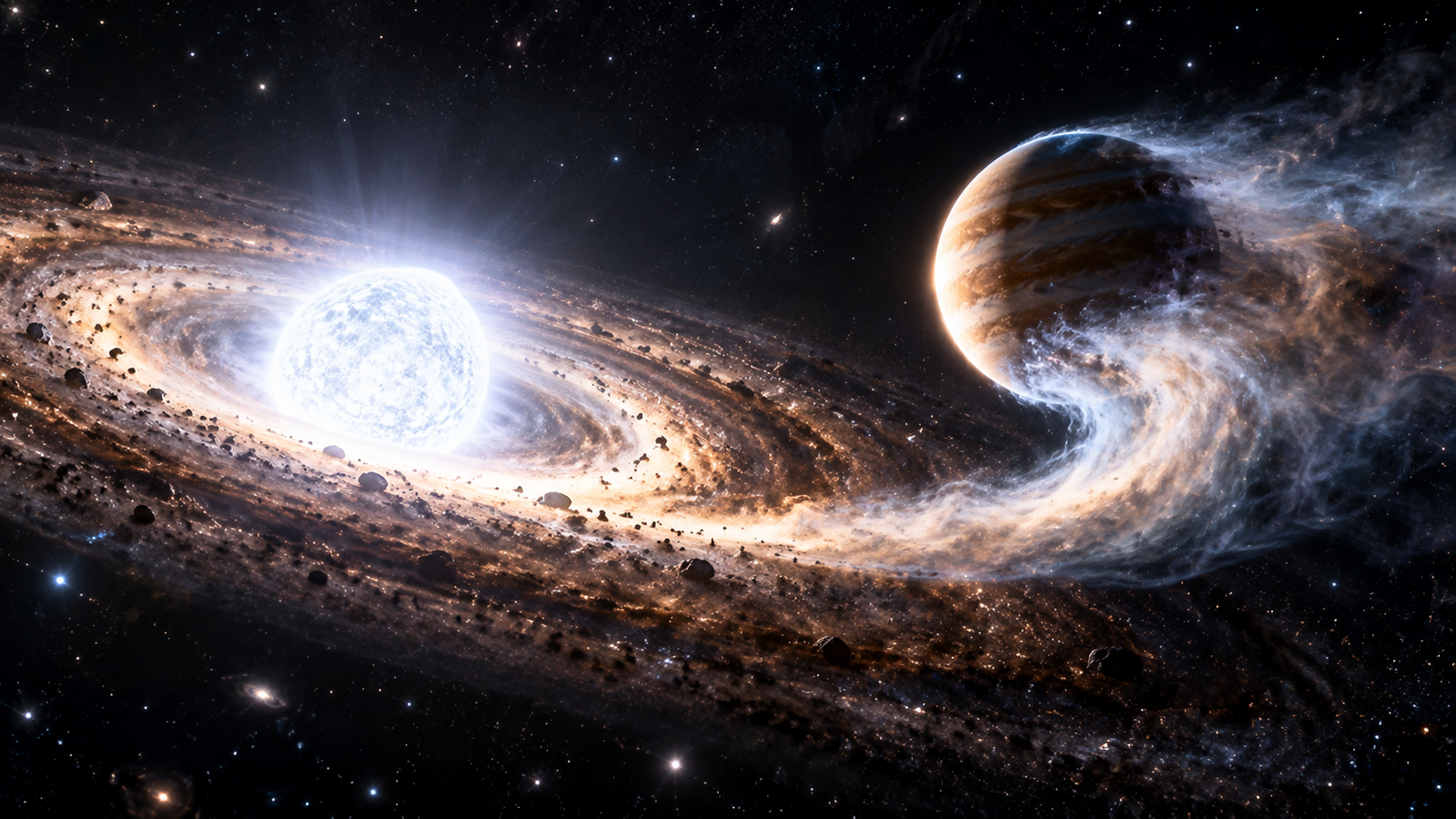
Astronomers analysing old Hubble Space Telescope data have found evidence that the white dwarf HS 0209+0832 may host a rare ‘second-generation’ planet — a world that formed after its star died, using material expelled during the star’s giant phase.
The study, published in Nature Astronomy on October 5, 2026, identifies an unusual chemical pattern in the white dwarf’s atmosphere, including a strong abundance of niobium and other elements heavier than iron. The researchers argue that this composition is consistent with material coming from a planet formed from the star’s own processed ejecta rather than from the original planetary system.
NASA says TESS observations also detected a repeating 4.399-day brightness signal that supports the possibility of a close-orbiting giant planet. The team estimates that the candidate world could be roughly Jupiter-sized and orbit only about 6 million kilometres from the white dwarf.
The object is not yet a directly imaged, independently confirmed planet. The researchers describe it as a second-generation planet candidate, and further observations will be needed to test how it formed, how common such systems are and whether the proposed interpretation is correct.
What Did Hubble Find Around HS 0209+0832?
The discovery began with archival ultraviolet observations taken by Hubble in January 1999.
Those observations showed many metal absorption lines in the white dwarf’s atmosphere. Around 100 features could not be identified at the time because the available atomic databases were not detailed enough.
Lead author Jamie Williams of the University of Warwick revisited the old spectrum with updated atomic data and found that niobium matched many of the previously unexplained features.
That was unusual. Niobium had not previously been reported in another analysed white dwarf in this way, according to the research team.
Why Niobium Became the Key Clue
Niobium is important because it belongs to a group of heavy elements that are not mainly produced by ordinary fusion inside a stable star.
Elements such as niobium can be created during late stages of stellar evolution through neutron-capture processes associated with dying stars.
The Nature Astronomy paper reports that HS 0209+0832 is enriched in trans-iron elements including zinc, copper and niobium while being depleted in common rocky elements such as silicon and iron.
That chemical mixture does not resemble normal rocky planetary debris. Instead, the researchers say it is consistent with material that was chemically processed inside the star before being expelled and later incorporated into a new planetary object.
What Is a Second-Generation Planet?
Most known planets, including Earth, are first-generation planets.
They form from the disk of gas and dust left over when a young star is born.
A second-generation planet would form much later, after the original star has evolved, expanded into a giant and ejected large amounts of material into space.
If enough of that material remains gravitationally bound, it could form a new disk around the stellar remnant. Under the right conditions, matter in that disk could collect into a new planet.
That possibility has been discussed theoretically for years, but convincing observational evidence has been difficult to find.
Why a White Dwarf Can Still Have Planetary Activity
A white dwarf is the dense core left behind after a low- or medium-mass star exhausts its nuclear fuel and sheds its outer layers.
These stellar remnants are small but extremely dense. A white dwarf can contain a substantial fraction of the Sun’s mass in an object roughly comparable to Earth in size.
HS 0209+0832 is especially young and hot for a white dwarf. The Nature Astronomy study estimates its temperature at about 35,000 kelvin and its cooling age at roughly five million years.
Because it is still so hot, the white dwarf emits intense radiation that can strongly affect any nearby planet.
TESS Found a 4.399-Day Signal
NASA’s Transiting Exoplanet Survey Satellite, or TESS, adds another piece of evidence.
The research team analysed four months of TESS data collected across observations in 2021 and 2023.
They found a statistically significant periodic brightness variation every 4.399 days, with an uncertainty of about 0.026 days.
The researchers propose two possible explanations: thermal variation from the day and night sides of an orbiting planet, or a comet-like tail from a giant planet losing atmosphere.
Neither explanation by itself proves the presence of a planet, but the signal supports the broader interpretation drawn from the chemical evidence.
The Candidate Planet May Orbit Extremely Close to the Star
NASA says the suspected planet would orbit at a distance of about 3.7 million miles, or around 6 million kilometres.
That is far closer to its star than Mercury is to the Sun.
At that distance, the young white dwarf’s intense radiation could heat the planet severely and strip gas from its atmosphere.
The team believes escaping material may form a stream or disk that eventually falls onto the white dwarf, allowing Hubble to detect the unusual elements in the star’s atmosphere.
Why the Planet May Be Losing Its Atmosphere
The candidate is thought to be a gas giant, possibly around the size of Jupiter.
Because the white dwarf remains extremely hot, ultraviolet radiation can heat the planet’s upper atmosphere until some of the gas escapes into space.
That escaping material could create a long tail, similar in broad appearance to a comet, although the physical process is very different.
Some of the stripped material may eventually spiral inward and land on the white dwarf. That would explain why the stellar atmosphere contains the chemical signature of material associated with the suspected planet.
How Hubble Turned a 1999 Mystery Into a 2026 Discovery
The story also highlights the scientific value of telescope archives.
Hubble did not need to make a new observation to reveal the niobium signature. Instead, researchers reanalysed data recorded more than 25 years earlier.
Scientific databases improve over time. Atomic transition data, modelling tools and computing methods can allow astronomers to interpret old observations in ways that were impossible when those observations were first collected.
In this case, roughly 100 unidentified spectral features from the original analysis became a new clue once improved atomic information was available.
The FUSE Mission Provided an Independent Check
The researchers also examined ultraviolet observations from NASA’s retired Far Ultraviolet Spectroscopic Explorer, known as FUSE.
NASA says the FUSE data independently showed strong signatures of niobium in the HS 0209+0832 system.
That matters because it reduces the chance that the unusual chemical detection is simply an artefact of one instrument or one dataset.
The combination of Hubble spectroscopy, FUSE confirmation and TESS brightness measurements gives the second-generation planet interpretation several independent lines of evidence.
Why the Chemical Pattern Is So Unusual
White dwarfs often show metals in their atmospheres because they are accreting material from asteroids, comets or planets that survived the star’s evolution.
In those systems, researchers usually see elements associated with rocky bodies, including iron, silicon, magnesium and calcium.
HS 0209+0832 looks different.
The Nature Astronomy paper reports strong enrichment in elements associated with stellar nucleosynthesis while several common rock-forming elements are comparatively depleted.
That mismatch is one reason the researchers argue that this material may not be debris from a conventional first-generation rocky world.
Could the Planet Really Have Formed After the Star Died?
That is the central scientific claim being tested.
The team proposes that material expelled while the original star evolved through its giant phase remained around the new white dwarf long enough to form a second planetary disk.
Inside that disk, gas and dust may have collected into a new giant planet.
Because the expelled material had already been chemically processed inside the star, the planet would have a composition very different from planets formed from the original protoplanetary disk.
The unusual niobium-rich material seen falling onto the white dwarf is therefore treated as a possible fingerprint of this second generation of planet formation.
Why Astronomers Are Being Careful With the Word ‘Planet’
The study uses the phrase ‘second-generation planet candidate’ rather than presenting the object as an unquestionably confirmed exoplanet.
That caution is important.
The planet has not been directly photographed, and the current interpretation depends on combining atmospheric chemistry with periodic brightness variations and physical modelling.
Alternative explanations must continue to be tested. Additional Hubble observations and future data could strengthen or weaken the planet hypothesis.
For Mukhbir, the accurate framing is therefore ‘possible’ or ‘candidate’ rather than ‘NASA discovered a confirmed new planet.’
Could the Planet Survive for Millions of Years?
Despite the apparent atmospheric loss, the research team does not necessarily expect the candidate planet to disappear quickly.
NASA quotes Williams as saying the planet may survive as the white dwarf gradually cools.
Over time, lower stellar temperatures would reduce the intense radiation stripping the atmosphere.
The planet could then remain in a relatively stable orbit for millions of years, though whether such a world could ever support habitable conditions is a separate and much more speculative question.
Does This Mean Dead Stars Can Build New Solar Systems?
Not yet in the broad sense.
One candidate system does not prove that second-generation planet formation is common.
What the research does show is that astronomers may now have a practical chemical signature to search for in other white dwarfs.
The Nature Astronomy team suggests looking for unusually high carbon abundances and enhancements of heavy elements produced by late-stage stellar nucleosynthesis.
If similar patterns appear in multiple systems, astronomers could begin estimating how often stars produce new planets after their original planetary systems have been transformed.
Why This Changes the Story of Planetary Evolution
Planetary systems are often described as forming once, early in a star’s life.
The second-generation scenario challenges that simple timeline.
A star could form its original planets, age for billions of years, become a red giant, destroy or disrupt parts of that system, shed its outer layers and then potentially create the raw material for a new planet.
That would mean planet formation is not always restricted to stellar youth.
It could continue, under unusual conditions, after the original star has effectively died.
Science Impact: A New Way to Search for Hidden Worlds
The discovery may give astronomers a new method for finding planets around white dwarfs.
Directly detecting small or close-in objects around these compact stars can be difficult.
Instead, researchers can study the white dwarf’s atmosphere for elements that should not normally remain there.
Because heavy elements sink rapidly in white-dwarf atmospheres, their presence can indicate ongoing accretion from external material.
By analysing the exact chemical pattern, astronomers may be able to distinguish between ordinary rocky debris and material linked to more exotic second-generation planets.
Technology Impact: Why Space Telescope Archives Matter
The research demonstrates how older missions can continue producing discoveries long after the original observation.
Hubble’s 1999 spectrum, FUSE archival data and later TESS photometry were all combined using modern analysis.
This type of work depends on long-term data preservation, improved atomic databases and the ability to compare observations from multiple missions.
It also shows why scientific archives are valuable infrastructure. A telescope does not only create discoveries in real time; its data can become more useful as theory and analysis tools improve.
Pakistan and South Asia Relevance
There is no direct Pakistan-specific role in this discovery.
The relevance to South Asia is primarily scientific and educational, particularly for astronomy, astrophysics and data-analysis communities.
The research is a useful example of how archival data, spectroscopy and computational modelling can produce major results without launching a new spacecraft.
For universities in Pakistan and elsewhere in South Asia, that is important because many astronomy projects can contribute through publicly available datasets and analysis rather than requiring direct ownership of expensive observatories.
What Happens Next?
Jamie Williams and colleagues plan to continue studying white dwarf systems with Hubble.
The immediate goal is to determine whether HS 0209+0832 really hosts the proposed giant planet and to identify additional systems with similar chemical signatures.
A larger sample would allow scientists to test whether second-generation planet formation is rare or a recurring stage in the evolution of some stellar systems.
Future observations could also better constrain the candidate planet’s orbit, atmosphere, mass and rate of material loss.
Important Questions Still Unanswered
The biggest question is whether the object around HS 0209+0832 can be independently confirmed as a planet.
Researchers also do not yet know exactly how a second-generation protoplanetary disk would evolve around this particular white dwarf or how quickly a Jupiter-sized world could form from the expelled stellar material.
The origin of the 4.399-day brightness signal also needs further testing.
Finally, scientists do not yet know how common second-generation planets are or whether this system is an exceptional case.
FAQs
What did Hubble discover around HS 0209+0832?
Astronomers found an unusual chemical pattern in the white dwarf’s atmosphere that is consistent with material from a possible second-generation planet. The planet itself has not been directly imaged or fully confirmed.
What is a second-generation planet?
It is a planet that forms after its star has evolved and expelled material, rather than forming from the original disk present when the star was young.
How close is the candidate planet to the white dwarf?
NASA says the proposed planet may orbit at about 6 million kilometres, or 3.7 million miles, from the white dwarf.
How long is the suspected planet’s orbit?
TESS observations revealed a repeating brightness signal every 4.399 days, which the researchers connect to the possible planet or its escaping material.
Is the planet confirmed?
TESS observations revealed a repeating brightness signal every 4.399 days, which the researchers connect to the possible planet or its escaping material.
Could the planet survive the white dwarf’s radiation?
The candidate appears to be losing atmosphere, but the researchers think it may survive as the white dwarf cools over time.
When were the Hubble observations originally taken?
The key Hubble ultraviolet observations were recorded in January 1999 and were reanalysed with improved atomic data more than 25 years later.
About The Author