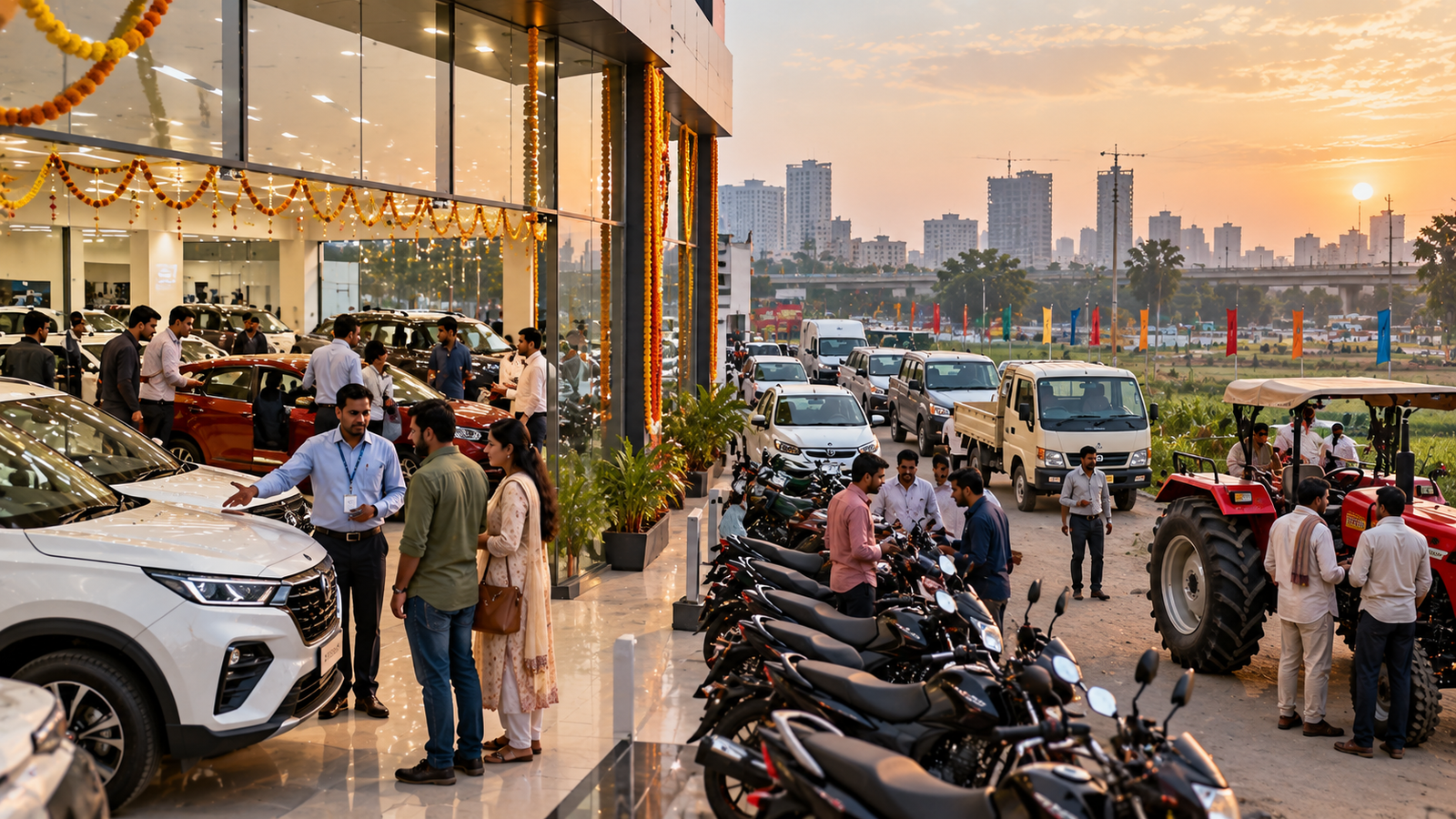
India’s automobile retail market posted its best-ever September in 2026, with total registrations rising 31.82% year on year to 25,36,920 units, according to data released by the Federation of Automobile Dealers Associations on October 6.
The headline growth was driven by strong two-wheeler, passenger-vehicle and commercial-vehicle demand, but FADA cautioned that the annual comparison was flattered by a weak September 2025 base when buyers delayed purchases ahead of the GST 2.0 rollout.
Tractors were the main soft spot on a month-on-month basis. Retail sales fell 12.58% from August to 76,906 units, with dealers pointing to patchy monsoon conditions and a later festive calendar as key reasons for weaker rural demand.
The result shows a split auto market: urban and consumer vehicle demand remains strong, while farm-linked purchases are more sensitive to rainfall, rural cash flow and seasonal timing.
India Records Its Best-Ever September for Auto Retail
FADA said total retail sales reached 25,36,920 units in September, up 31.82% from a year earlier and 4.69% from August.
Five of the six major vehicle categories tracked by the dealer body delivered their best-ever September performance.
Passenger vehicles reached 4,27,213 units, while commercial vehicles crossed the one-lakh mark for the first time in a September.
Two-wheelers remained the largest segment, with 17,90,188 retail registrations during the month.
Why the 31.82% Growth Figure Needs Context
FADA warned that September’s year-on-year growth rate should not be read in isolation.
September 2025 was unusually weak because many consumers postponed purchases shortly before GST 2.0 changes took effect.
That created a low comparison base, making the 2026 annual growth rate look stronger than underlying demand alone would suggest.
For that reason, the 4.69% month-on-month increase and the record first-half performance provide a more balanced picture of market momentum.
Passenger Vehicle Sales Rose 32.10%
Passenger vehicle retail increased 32.10% year on year to 4,27,213 units in September.
The segment also rose 6.17% from August, making it the strongest September on record for passenger vehicles.
Urban and rural growth was almost identical on a year-on-year basis, suggesting that demand remained broad rather than concentrated only in metropolitan markets.
Sport utility vehicles, premium models and festive-season buying continued to support the category.
Two-Wheeler Sales Remained the Biggest Volume Driver
Two-wheeler retail reached 17,90,188 units, up 33.08% from September 2025.
FADA data showed the category also increased 4.41% from August.
Dealers cited festive buying, improving rural and semi-urban demand, premium motorcycle interest and rising electric two-wheeler adoption.
The two-wheeler segment is especially important because it is closely tied to household affordability and income conditions across smaller cities and rural India.
Commercial Vehicles Crossed 100,000 Units
Commercial vehicle registrations rose 37.62% year on year to 1,03,557 units.
That was the first time the segment crossed 100,000 retail sales in a September.
Month-on-month growth was also strong at 14.09%, pointing to continued demand from logistics, construction and goods movement.
Commercial-vehicle performance is often viewed as a useful indicator of business activity because fleet purchases are linked to freight demand and infrastructure spending.
Why Tractor Sales Fell 12.6% From August
Tractor retail stood at 76,906 units in September, down from 87,977 in August.
That represented a 12.58% month-on-month decline, making tractors the only major category to fall sequentially.
Reuters reported that weak monsoon conditions had weighed on rural demand, while FADA also pointed to the later festive calendar.
Tractor demand is closely linked to farm incomes, crop expectations and rainfall because agricultural buyers often time purchases around harvests and cash flows.
Tractor Sales Were Still Higher Than a Year Earlier
The monthly decline does not mean the tractor market was weaker than September 2025.
FADA data showed tractor retail was still 13.75% higher year on year.
Rural tractor sales grew faster than urban sales over the annual comparison, even though both fell from August.
This distinction matters because the sector is showing short-term seasonal weakness rather than a broad collapse in yearly demand.
The Monsoon Matters Directly to Auto Demand
India’s rural economy remains highly sensitive to monsoon rainfall.
Reuters reported that the June-to-September monsoon season delivered rainfall 12.6% below normal, the weakest performance in more than a decade.
Lower or uneven rainfall can reduce crop output expectations, delay farm income and make buyers more cautious about financing tractors, motorcycles and other durable goods.
The impact is not uniform across regions, but weaker rainfall can quickly appear in dealership traffic and financing decisions.
Festive Timing Also Distorted September Demand
India’s festive calendar is an important driver of vehicle buying.
In 2026, major festivals fell later than they did in some previous years, shifting part of demand into October.
FADA expects Navratri and Dussehra to support sales in the coming weeks.
That means September tractor weakness may partly reflect timing rather than a lasting demand decline.
Electric Vehicle Sales Are Becoming More Important
Electric vehicles continued to gain share across several categories.
Industry reports citing FADA data said total EV retail reached roughly 3.34 lakh units in September, a new monthly high.
Passenger-vehicle EV penetration reached about 8.45%, while electric two-wheelers continued to expand their share of the market.
The shift matters because manufacturers are increasingly competing not only on price and range but also on financing, charging access and total ownership cost.
Alternative-Fuel Vehicles Are Reshaping Passenger Cars
Alternative-fuel vehicles now account for a much larger share of passenger-vehicle demand than they did only a few years ago.
Hybrid, electric and other non-petrol options are gaining ground as buyers respond to fuel costs, policy incentives and expanding model choices.
Some industry reports based on September FADA data showed alternative-fuel vehicles nearly matching petrol vehicles in passenger-car share.
That trend increases pressure on automakers to diversify powertrains rather than rely on a single technology.
Price Hikes Could Test Demand
FADA cautioned that vehicle price increases remain a risk.
Automakers have been raising prices to offset higher input, compliance and technology costs.
If prices rise faster than incomes or financing affordability, part of the benefit from earlier tax cuts could be lost.
That is especially important for entry-level cars, motorcycles and rural buyers, where monthly payment sensitivity is high.
Inventory Levels Remain an Industry Watchpoint
Strong retail sales do not automatically mean inventory risks have disappeared.
Dealers still monitor the number of days of stock sitting at showrooms because high inventories tie up capital and increase discounting pressure.
Passenger-vehicle makers and dealers will be watching October demand closely to ensure festive dispatches do not run ahead of actual retail sales.
A healthy market depends on both strong registrations and manageable dealer stock.
Why the First Half of FY27 Looks Strong
India’s auto retail market also posted a record first half for the financial year.
FADA data showed April-to-September retail sales of 1,55,12,319 units, up 20.77% year on year.
That broader six-month trend is less distorted by the unusually weak September 2025 base.
It suggests that the market has genuine underlying momentum even after accounting for the headline statistical boost.
Business Impact for Indian Automakers
Strong retail demand supports revenue visibility for manufacturers including Maruti Suzuki, Mahindra & Mahindra, Tata Motors, Hyundai, Bajaj Auto and other large players.
However, the mix of demand matters as much as total volume.
Passenger vehicles, premium two-wheelers and commercial vehicles can support margins differently from entry-level models.
Automakers will also need to balance festive demand with rising costs, EV investment and increasingly intense competition.
Why the Tractor Slowdown Matters for Mahindra and Rural-Focused Brands
Tractor demand is especially important for companies with large exposure to agriculture and rural markets.
Mahindra & Mahindra is a major tractor producer, while other manufacturers also depend heavily on farm-sector demand.
A one-month fall does not establish a negative long-term trend, but weaker monsoon conditions can affect order timing and dealer sentiment.
October and post-harvest demand will therefore be closely watched for signs of recovery.
Consumer Impact
For consumers, strong demand can have mixed effects.
High showroom traffic and popular models can reduce discounting, while stronger inventories can improve availability.
At the same time, rising manufacturer prices and financing costs can offset tax-related affordability gains.
Buyers may therefore see a market with more choice but continued pressure on monthly ownership costs.
South Asia and Pakistan Relevance
The story has genuine South Asia relevance because India is the region’s largest automotive market and a major manufacturing base for vehicles and components.
Pakistan’s auto market is structurally different, but Indian demand trends can still matter for regional suppliers, technology adoption and competitive benchmarking.
The contrast between strong urban vehicle demand and weaker farm-linked purchases is also relevant to other South Asian economies where rural incomes remain sensitive to weather and agriculture.
What Happens Next?
October will be the next major test for the market.
Navratri and Dussehra are expected to shift some demand that did not appear in September, particularly in categories affected by the later festive calendar.
Dealers will also watch whether monsoon weakness continues to weigh on tractors and rural two-wheeler demand.
At the industry level, the key question is whether record September sales can translate into a strong festive quarter without creating excess inventory.
Important Questions Still Unanswered
The biggest uncertainty is whether September’s strong retail performance can continue after the low-base effect fades.
It is also unclear how much October demand was simply delayed from September because of the festival calendar.
Tractor sales will depend heavily on rural cash flows, harvest conditions and financing availability.
Finally, further price increases could test affordability even if overall economic demand remains healthy.
FAQs
How many vehicles were sold in India in September 2026?
FADA reported 25,36,920 retail vehicle registrations in September 2026, the highest total ever recorded for the month.
How much did total auto retail sales grow?
Total retail sales rose 31.82% year on year and 4.69% from August. FADA cautioned that the annual figure was boosted by a weak September 2025 comparison base.
How many passenger vehicles were sold?
Passenger vehicle retail reached 4,27,213 units, up 32.10% year on year and 6.17% month on month.
Why did tractor sales fall in September?
Tractor sales fell 12.58% from August, with dealers citing patchy monsoon conditions and a later festive calendar that shifted some purchases into October.
Were tractor sales lower than last year?
No. Tractor retail was still 13.75% higher than September 2025 despite the month-on-month decline.
What was the biggest vehicle segment?
Two-wheelers remained the largest segment, with 17,90,188 retail registrations in September.
Are EV sales growing in India?
Yes. Industry reports based on FADA data show EV retail reaching a record monthly level in September, with rising penetration in both two-wheelers and passenger vehicles.
What should the auto industry watch next?
The key issues are festive-season demand in October, tractor recovery after weak monsoon conditions, vehicle price increases and dealer inventory levels.
About The Author