The nuclear clock breakthrough 2026 has moved a decades-old physics idea into working laboratory prototypes. Independent research teams in Vienna, Austria, and Beijing, China, demonstrated clocks that use an energy transition inside thorium-229 atomic nuclei rather than the electronic transitions used by conventional atomic clocks. Their peer-reviewed studies appeared in Nature on October 7, 2026.
The results mark a milestone in precision timekeeping, a field essential to navigation, communications and fundamental science. In Vienna, researchers built a self-stabilizing clock that could operate without intervention for more than 24 hours, according to Vienna University of Technology (TU Wien). In Beijing, researchers independently demonstrated a clock locked to a nuclear transition inside a crystal.
These devices are experimental clocks, not consumer products or immediate replacements for the best atomic clocks. Their present performance does not conclusively beat today’s most accurate optical atomic clocks. Scientists believe further improvements could eventually deliver robust frequency standards and unusually sensitive tests of physics.
The announcements on October 7–8 remain a significant science development for October 12 coverage because two independent Nature papers establish operational nuclear-clock references. The work also clarifies how much engineering remains before practical deployment.
What did scientists achieve in the 2026 nuclear clock research?
The teams addressed a long-standing problem: seeing a nuclear resonance is not the same as running a clock. A useful clock needs a stable oscillator, a reference transition and a feedback system that repeatedly corrects drift. The new experiments combined these elements, making it possible to lock laser frequencies to thorium-229 nuclei in a solid material.
The Beijing-led Nature study, titled ‘A nuclear clock synchronized to 229Th,’ reported locking a narrow-linewidth 148.4-nanometre vacuum-ultraviolet laser to nuclear transitions in calcium fluoride crystals containing thorium-229. The team measured reproducible reference frequencies in two independently produced crystals.
The Vienna study, ‘A thorium-229 optical nuclear clock with feedback loop,’ also used ultraviolet laser light and a thorium-doped calcium fluoride crystal. It compared the nuclear-based reference with an established ytterbium-ion optical clock while using feedback to stabilize operation.
Their methods differed in important technical details, yet both showed that a nuclear transition can serve as an operational clock reference. The results are strongest when described as independent demonstrations of an emerging precision technology rather than a final victory over every existing clock.
How does a nuclear clock work?
All precise clocks rely on repeatable events. A pendulum clock counts mechanical swings, while an atomic clock locks an electronic oscillator to an extremely stable frequency associated with an atom. In optical atomic clocks, laser light drives transitions between electronic energy levels and supplies the timing reference.
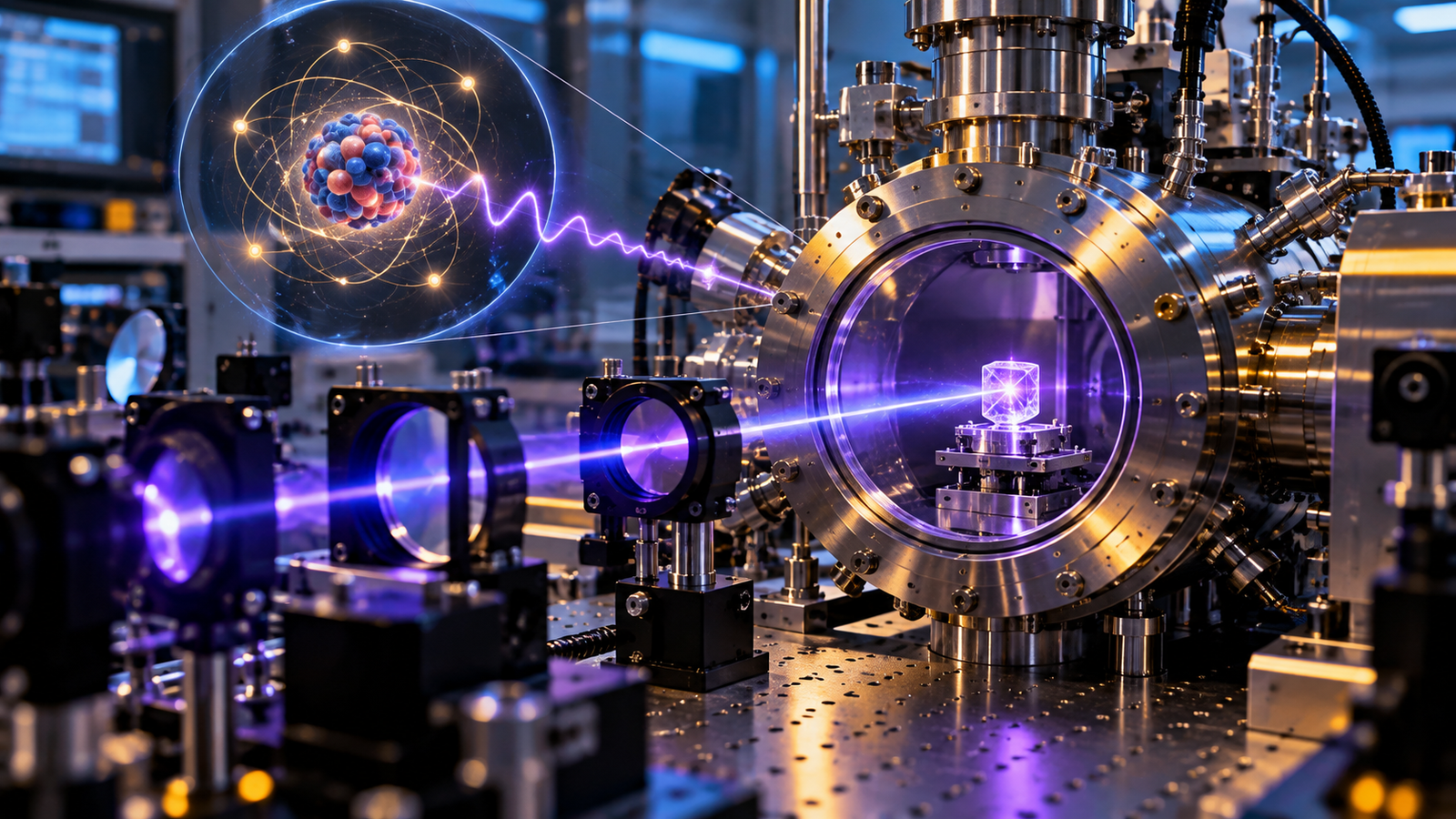
A nuclear clock follows a similar principle but targets the atom’s nucleus instead of its electron cloud. Protons and neutrons inside a nucleus can occupy different energy states. A transition between two such states produces an exceptionally consistent frequency that a carefully tuned laser may detect.
Most nuclear energy transitions require radiation that is difficult to generate and control using standard laser systems. Thorium-229 is unusual because it has a remarkably low-energy nuclear excited state accessible using vacuum-ultraviolet light. That property makes it a leading candidate for a practical nuclear frequency standard.
Researchers embed the isotope in calcium fluoride, a transparent crystal host, and interrogate its nuclear transition with specialized lasers. Electronic control circuits compare the observed response with the laser’s frequency and adjust the oscillator to reduce drift. This closed feedback loop is what turns a measured resonance into a clock.
Why thorium-229 is so important
Thorium-229 is a radioactive isotope with an unusually accessible transition between nuclear energy levels. Because nuclei are far smaller and more shielded than electron clouds, scientists expect some nuclear references to be relatively insensitive to external electric and magnetic disturbances.
That resilience is a possibility grounded in physical principles, not a blanket immunity to temperature or other environmental effects. Real crystals still contain defects, and their internal structure can alter measured transition frequencies. Careful material preparation, characterization and stability monitoring remain essential.
The Beijing team’s study reports that frequencies measured in two separate crystals agreed at roughly the 10^-13 fractional level. Such reproducibility matters because useful technology must work across multiple samples, not only one carefully optimized laboratory specimen.
Thorium-229 also presents practical obstacles. It is not a common material for everyday manufacturing, and working with radioactive samples requires specialized handling and safety procedures. Researchers must improve material availability and laser systems before imagining widespread use.
What the Vienna team demonstrated
TU Wien announced its self-stabilizing prototype on October 8, describing uninterrupted operation over more than 24 hours. The associated Nature paper reported laser stabilization to a nuclear transition in a millimetre-scale, room-temperature calcium fluoride crystal.
Its researchers compared a frequency related to the ultraviolet nuclear interrogation laser with a ytterbium-ion optical clock. That comparison lets scientists characterize the prototype against an established precision reference instead of relying only on internal readings.
The Vienna study reported fractional frequency instability of approximately 3 × 10^-12 divided by the square root of averaging time in seconds, approaching 10^-15 over a day. Those technical numbers describe how the measured frequency fluctuates with averaging; they are not equivalent to claiming the clock gains or loses a particular number of seconds per year.
The researchers also used the experimental setup to place constraints on models of ultralight dark matter. That research application is significant, but no dark matter discovery was reported. The clock provides a new instrument for testing hypotheses, not confirmation that such particles exist.
What the Beijing team demonstrated
Researchers in Beijing presented another fully functioning thorium-based reference, also published in Nature on October 7. Their system stabilized a continuous-wave 148.4-nanometre ultraviolet laser to a nuclear transition in thorium-doped calcium fluoride.
The experiment generated ultraviolet radiation using four-wave mixing in cadmium vapour and used frequency-modulated absorption measurements to derive a correction signal. This approach produced a reference that could steer the laser back toward the resonance when its frequency shifted.
The team’s reported fractional frequency instability was approximately 5 × 10^-13 divided by the square root of averaging time in seconds. Different measurement configurations and averaging regimes make a simple ranking of the two clock designs inappropriate without detailed technical comparison.
The study’s strongest contribution was demonstrating a reliable nuclear reference in more than one independently prepared crystal. Reproducible solid-state performance could eventually make it easier to build compact clocks or scientific sensors, though miniaturized commercial products are not yet established.
How are nuclear clocks different from atomic clocks?
Conventional atomic clocks operate using transitions involving electrons, even though their overall stability can be extraordinary. Nuclear clocks use transitions within nuclei, offering a different class of physical frequency reference. Both need precision lasers or oscillators, control electronics and extensive testing.
Modern optical atomic clocks already perform at astonishing levels, and the new nuclear prototypes have not definitively surpassed the leading instruments. Future performance gains depend on narrower spectral lines, better measurement signals, reduced systematic errors and stable operation under realistic conditions.
A nuclear clock therefore should not be presented as automatically more accurate merely because it measures nuclei. Accuracy, stability, reproducibility and robustness are distinct technical properties. A device can be promising on one metric while lagging existing clocks on another.
Possible applications in GPS, telecommunications and science
Global navigation satellite systems depend on extremely precise timing to calculate positions. Improved time standards could ultimately help navigation infrastructure, but incorporating a new clock technology would require years of qualification, engineering and reliability tests.
Telecommunications networks also depend on synchronized timing, particularly when equipment exchanges data at high speed across different locations. More robust frequency references might someday strengthen synchronization or serve specialized research and infrastructure needs.
The strongest nearer-term opportunity may be fundamental physics. Scientists can compare different types of clocks over time to search for tiny variations in physical constants or oscillations predicted by certain dark matter models. Distinct nuclear and electronic references can respond differently to hypothetical effects.
The research does not prove that future phones, satellites or mobile networks will adopt nuclear clocks. Any practical application needs demonstrated gains over mature atomic timing technology and a convincing balance of cost, size, reliability and power consumption.
Could nuclear clocks help scientists detect dark matter?
Dark matter is inferred from gravitational effects in the universe, but its underlying composition remains uncertain. Some theoretical models suggest ultralight fields could cause very small, periodic changes in fundamental constants or atomic and nuclear transition energies.
Comparing a nuclear clock with another precision reference may reveal whether their frequencies drift in a correlated, unusual way. Such measurements can tighten limits on models even when scientists do not observe a candidate signal.
The Vienna researchers used their prototype to test dark matter hypotheses over timescales from tens of seconds to around one day. Their analysis constrained possible interactions; it did not establish a detection. The distinction between an experimental bound and a discovery is essential in science reporting.
What challenges remain before commercial use?
The technology still needs better long-term stability, control of crystal-related effects and improved frequency readout. Laser generation at vacuum-ultraviolet wavelengths is technically demanding. Researchers also face constraints involving thorium sample preparation, instrument complexity and operating costs.
Metrology laboratories must reproduce results in independent environments and compare devices against international frequency standards. Reliability under temperature changes, vibration and electromagnetic interference will matter alongside raw laboratory precision.
Funding and access to specialized equipment can also determine progress. Even successful research projects do not automatically translate into commercial devices. Engineering a field-ready product requires durable components, maintenance procedures and documented performance.
Why the breakthrough matters globally and in South Asia
The Vienna and Beijing results illustrate international competition and collaboration in precision measurement science. Teams in different regions approached the same physics challenge through complementary methods, providing the research community with more than one path to refine the technology.
For Pakistan and South Asia, the immediate relevance is educational and scientific rather than an announced local deployment. Universities teaching optics, quantum physics, electronics and precision instrumentation can draw on the new open research to understand emerging measurement systems.
Longer-term benefits to navigation, telecoms or high-precision industry are plausible but not guaranteed. No Pakistan-specific nuclear clock initiative or partnership was verified in the materials reviewed for this article, so such claims should not be added without official evidence.
What happens next for nuclear clock research?
Researchers will work to reduce instability, better understand crystal environments, refine ultraviolet lasers and compare clocks across laboratories. Improvements could make nuclear references more sensitive scientific instruments and eventually more practical timing devices.
The October 2026 milestone is specific and important: two peer-reviewed teams demonstrated operational thorium-229 nuclear clocks. It is not yet evidence of a complete replacement for atomic clocks. The most meaningful future headlines will come from independently measured performance gains and real-world testing.
Frequently Asked Questions
What is the nuclear clock breakthrough in 2026?
Two teams in Vienna and Beijing reported working thorium-229 nuclear clocks in separate Nature papers published on October 7, 2026.
How does a nuclear clock work?
It uses a stable transition between energy levels inside an atomic nucleus as a frequency reference, with lasers and feedback electronics maintaining the oscillator.
Why is thorium-229 used?
Thorium-229 has a low-energy nuclear transition accessible with specially generated ultraviolet laser light, making it suitable for experimental nuclear timekeeping.
Are nuclear clocks already more accurate than atomic clocks?
No. The 2026 prototypes are important demonstrations, but the leading optical atomic clocks still set extremely demanding performance benchmarks.
Which countries developed these nuclear clocks?
Independent research teams working in Vienna, Austria, and Beijing, China, reported the new working clocks.
Can nuclear clocks improve GPS and telecom networks?
They could eventually support precise timing systems, but there is no verified immediate commercial deployment or replacement of present infrastructure.
Did the nuclear clock experiments discover dark matter?
No. Researchers used a nuclear clock to test and constrain theoretical dark matter models; they did not report a confirmed detection.
When was the research published?
The two research papers appeared in the journal Nature on October 7, 2026, followed by university and science-news coverage.
About The Author