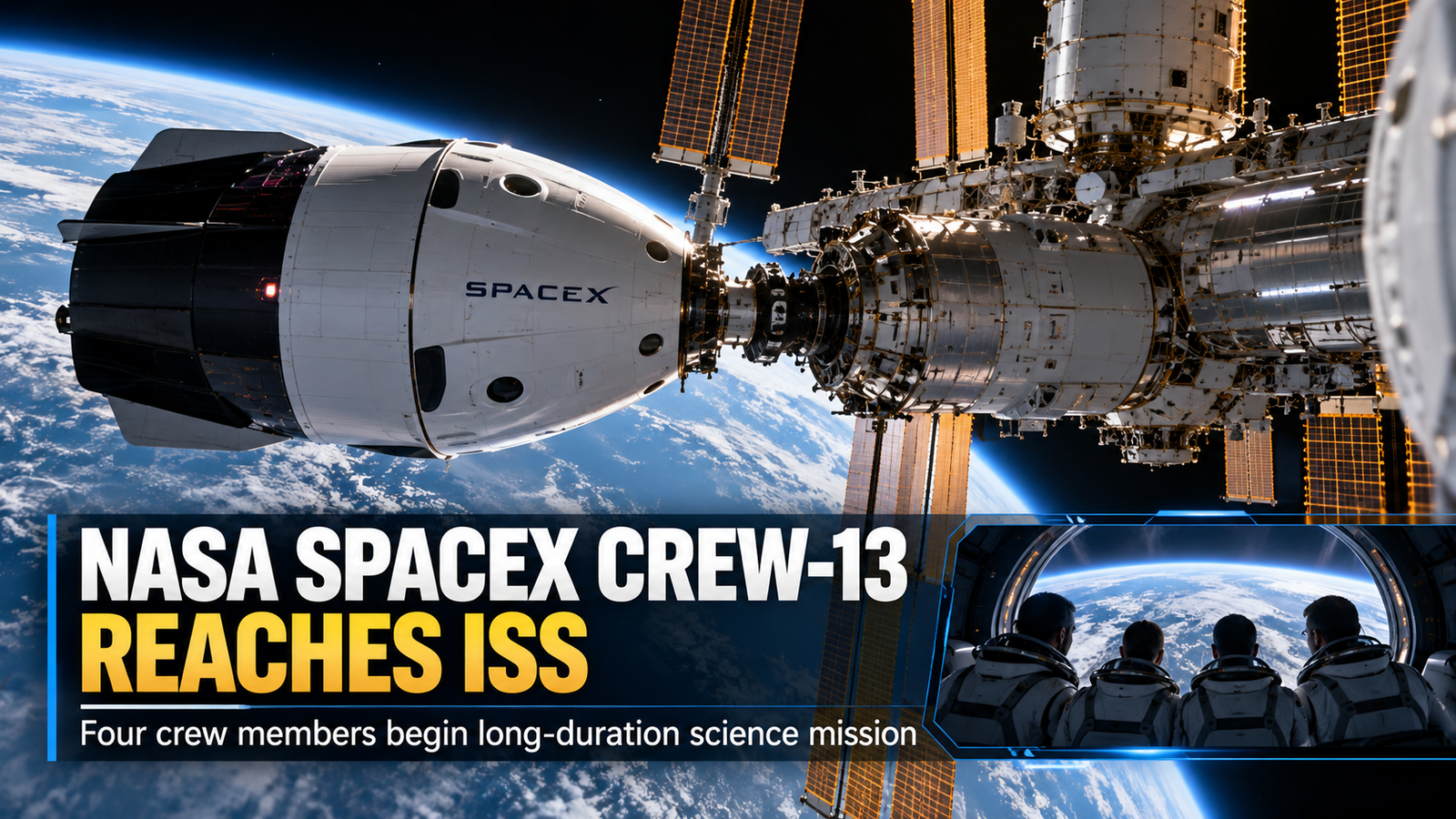
NASA’s SpaceX Crew-13 has reached the International Space Station, adding four new crew members to the orbiting laboratory for a long-duration science mission.
The crew includes NASA astronauts Jessica Watkins and Luke Delaney, Canadian Space Agency astronaut Joshua Kutryk and Roscosmos cosmonaut Sergey Teteryatnikov.
NASA said the Dragon spacecraft completed a record-setting 7-hour, 55-minute flight from Florida to the station, where the new arrivals joined the Expedition 75 team.
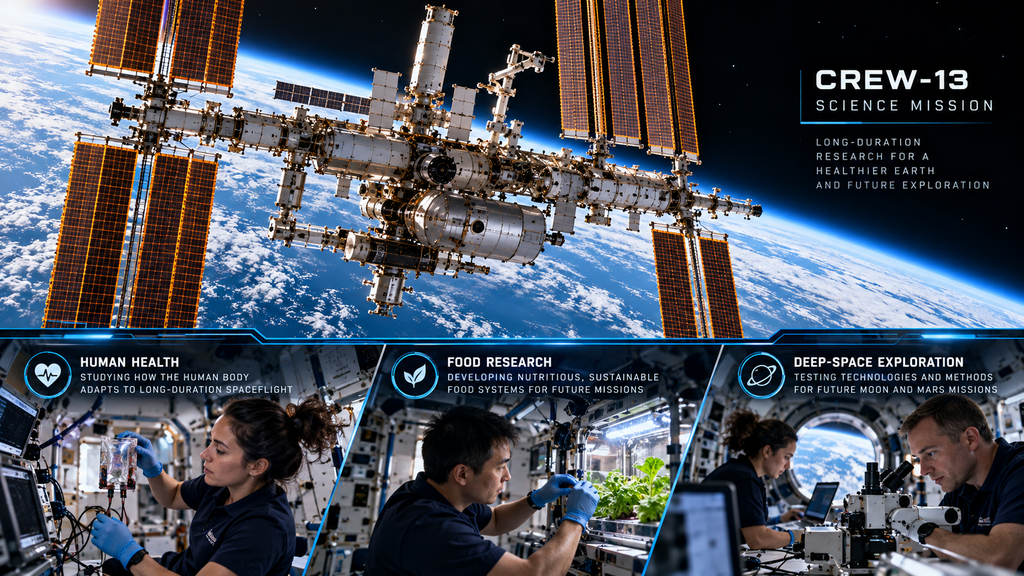
Their mission will focus on scientific research that supports human health, food production and future exploration beyond low Earth orbit.
The arrival also temporarily increased the station population to 11 people while NASA’s SpaceX Crew-12 prepared to return to Earth.
What Happened
Crew-13 launched aboard a SpaceX Falcon 9 rocket from Space Launch Complex 40 at Cape Canaveral Space Force Station in Florida on October 1, 2026.
The Dragon spacecraft then traveled to the International Space Station and docked later the same day.
NASA confirmed that the crew entered the station after the Dragon hatch opened at 9:19 p.m. EDT.
The arrival marked the start of a long-duration stay aboard the ISS.
The four Crew-13 members joined astronauts and cosmonauts already serving as part of Expedition 75.
Who Is on NASA’s SpaceX Crew-13?
Jessica Watkins
Jessica Watkins is the commander of Crew-13 and a NASA astronaut.
This is her second spaceflight.
Watkins has a background in geology and previously worked with NASA’s Curiosity rover science team.
Her experience in planetary science is relevant to NASA’s broader goals of preparing for future missions to the Moon and Mars.
Luke Delaney
Luke Delaney is the mission pilot.
Crew-13 is his first trip to space.
As pilot, he supports spacecraft operations and the crew’s transition to life and work aboard the ISS.
Joshua Kutryk
Joshua Kutryk represents the Canadian Space Agency.
He is serving as a mission specialist and is making his first spaceflight.
His participation highlights the continued international role of Canada in human spaceflight and station operations.
Sergey Teteryatnikov
Sergey Teteryatnikov is a Roscosmos cosmonaut serving as a mission specialist.
This is also his first spaceflight.
His presence continues the long-standing operational cooperation between the United States and Russia aboard the International Space Station despite wider geopolitical tensions.
Why Crew-13 Is Important
The mission is not only a transport flight.
Crew-13 will support research designed to help scientists understand how the human body behaves during long periods in microgravity.
That information is important because NASA plans to send astronauts on longer missions to the Moon and eventually Mars.
A journey to Mars would expose astronauts to isolation, radiation, altered gravity and limited medical support for much longer than a typical ISS stay.
Research aboard the station allows scientists to study some of those challenges before crews travel farther from Earth.
Health Research in Microgravity
One of Crew-13’s main research areas is human health.
NASA says the mission will contribute to studies involving blood circulation, clotting and other physiological changes that occur in microgravity.
Why blood-flow research matters
On Earth, gravity affects how blood moves through the body.
In orbit, fluids shift toward the upper body and head.
That can influence the heart, blood vessels, eyes and other systems.
Understanding these changes helps doctors prepare astronauts for longer missions.
Clotting is another area of concern because the risks and behavior of blood clots in space are still being studied.
Research on these processes could also produce useful medical knowledge for people on Earth.
Food Research for Future Moon and Mars Missions
Crew-13 will also support experiments related to food production.
NASA has been working for years on ways to grow fresh food in space.
Long-distance missions cannot rely entirely on regular resupply from Earth.
That means future crews may need to grow at least part of their own food.
Plants also offer benefits beyond nutrition.
They can help recycle carbon dioxide, produce oxygen and provide psychological benefits during long missions.
NASA has already tested multiple crops aboard the ISS, and Crew-13 will continue research connected to sustainable food production.
Why the International Space Station Still Matters
The ISS has been continuously occupied for more than 25 years.
It remains one of the most important laboratories for studying how humans and technology perform in space.
Experiments conducted aboard the station cover areas including:
– human health
– materials science
– biology
– plant growth
– physics
– Earth observation
– robotics
– spacecraft systems
The station allows scientists to test technologies in real microgravity before those technologies are used on future missions.
How Crew-13 Supports Moon and Mars Exploration
NASA’s current exploration strategy depends on learning how to keep crews healthy and productive for longer periods.
The Moon is relatively close to Earth.
Mars is not.
A Mars mission would require astronauts to live with significant communication delays and limited opportunities for emergency return.
That makes reliability essential.
ISS research helps NASA test systems, medical procedures and operational methods under conditions that cannot be fully recreated on Earth.
Crew-13’s work therefore connects directly to future deep-space missions.
A Record-Setting Dragon Flight
NASA said Crew-13 reached the station after a 7-hour, 55-minute Dragon flight from Florida.
That was a record-setting journey for this type of mission, according to the agency.
Fast transit reduces the time astronauts spend confined inside the spacecraft before reaching the station.
It also demonstrates how mature commercial crew operations have become since SpaceX began flying NASA astronauts in 2020.
SpaceX’s Role in NASA Human Spaceflight
SpaceX now plays a central role in transporting NASA astronauts to and from the ISS.
The Commercial Crew Program was designed to allow private companies to develop transportation systems for government astronauts.
Dragon has become NASA’s primary operational crew vehicle for station flights.
That partnership has reduced NASA’s dependence on Russian Soyuz spacecraft for routine astronaut transport.
It has also created a model NASA hopes to extend to future commercial space stations.
Crew Dragon Grace
Crew-13 flew aboard the Dragon spacecraft named Grace.
NASA noted that Grace previously flew on Axiom Mission 4 in 2025.
Reusing crew spacecraft is part of SpaceX’s broader approach to reducing launch costs and increasing flight frequency.
The Falcon 9 first stage used for the launch also returned to Earth after sending the crew toward orbit.
Why International Crews Still Matter
Crew-13 includes astronauts from the United States, Canada and Russia.
That mix reflects the international structure of the ISS program.
The station involves NASA, Roscosmos, the European Space Agency, the Canadian Space Agency and Japan’s JAXA.
International cooperation remains one of the defining features of the ISS.
Even when political relations between countries are strained on Earth, station operations require close technical coordination.
The Transition From Crew-12 to Crew-13
Crew-13 arrived while Crew-12 was still aboard the station.
That temporarily increased the number of people living on the ISS to 11.
Crew overlap is normal during handover periods.
The outgoing crew can brief the incoming team on experiments, maintenance tasks and station conditions before returning to Earth.
NASA said Crew-12 was preparing for departure after completing its own science mission.
Why Crew Handover Is Important
A space station operates continuously.
There is no practical pause between one crew leaving and another taking over.
Handover allows astronauts to transfer operational knowledge directly.
That includes details about ongoing experiments, equipment behavior and maintenance issues.
In an environment where small mistakes can have serious consequences, that direct communication is valuable.
Science Beyond Human Health
Crew-13’s mission includes research beyond medicine.
NASA has highlighted work related to food systems and deep-space science.
The station can also support experiments involving radiation, materials and technology demonstrations.
Some research may be directly connected to future lunar missions.
Other experiments may have commercial or scientific applications on Earth.
Business and Technology Impact
The mission also demonstrates the growing role of commercial companies in government space programs.
SpaceX provides transportation.
Other private companies are developing lunar landers, station modules, satellite services and future commercial space stations.
This model is changing how space infrastructure is financed and operated.
Instead of government agencies building every system themselves, they increasingly purchase services from private providers.
Crew-13 is another example of that shift.
Pakistan Relevance
Crew-13 has no direct Pakistan role, but the mission still has relevance for Pakistan’s emerging space ambitions.
Pakistan is expanding cooperation with China in human spaceflight and lunar exploration.
Two Pakistani pilots are currently training in China as part of a program expected to send one Pakistani participant to the Tiangong space station.
That makes developments aboard the ISS especially relevant because they show how long-duration crewed missions are organized, how experiments are selected and how international partnerships operate in orbit.
For Pakistani students and researchers, ISS missions also provide a useful model of how science experiments can be designed for microgravity.
What Pakistan Can Learn From ISS Research
Pakistan’s future role in crewed spaceflight will likely depend on international partnerships.
That means local universities and research institutions need experience in designing experiments that meet strict spaceflight requirements.
ISS missions demonstrate several useful principles:
– experiments must be compact and reliable
– crew time is limited
– hardware must operate safely in microgravity
– data collection must be carefully planned
– research should address clear scientific questions
These lessons are relevant to Pakistan’s planned space-science activities with China.
Why This Mission Matters
Crew-13 matters because it connects routine station operations with the future of human exploration.
The International Space Station is approaching the final years of its current operating life, but the research conducted there continues to shape plans for the Moon and Mars.
NASA’s goal is not simply to keep astronauts in orbit.
It is to learn how humans can travel farther from Earth, remain healthy and operate with greater independence.
Crew-13 is part of that longer transition.
What Happens Next?
The four Crew-13 members will settle into their long-duration mission and begin supporting research aboard the station.
NASA will continue publishing updates on experiments, station maintenance and crew activities.
Crew-12 is expected to depart after completing its handover.
Over the coming months, Crew-13’s research results may contribute to future mission planning for lunar exploration and deep-space travel.
Frequently Asked Questions
When did NASA’s SpaceX Crew-13 launch?
Crew-13 launched on October 1, 2026, from Cape Canaveral Space Force Station in Florida.
Who is on Crew-13?
The crew includes NASA astronauts Jessica Watkins and Luke Delaney, Canadian astronaut Joshua Kutryk and Roscosmos cosmonaut Sergey Teteryatnikov.
How long did the Dragon flight to the ISS take?
NASA said the trip took 7 hours and 55 minutes.
Why is Crew-13 going to the ISS?
The crew is beginning a long-duration science mission focused on research including human health, food systems and deep-space exploration.
How many people were on the ISS after Crew-13 arrived?
NASA said Crew-13’s arrival temporarily increased the station population to 11.
Why is Crew-13 important for future Moon and Mars missions?
Its research helps NASA study human health, food production and operational challenges that become more important on longer missions beyond low Earth orbit.
Does Crew-13 have direct Pakistan involvement?
No, but the mission is relevant to Pakistan because the country is developing its own crewed-space ambitions through cooperation with China.
About The Author