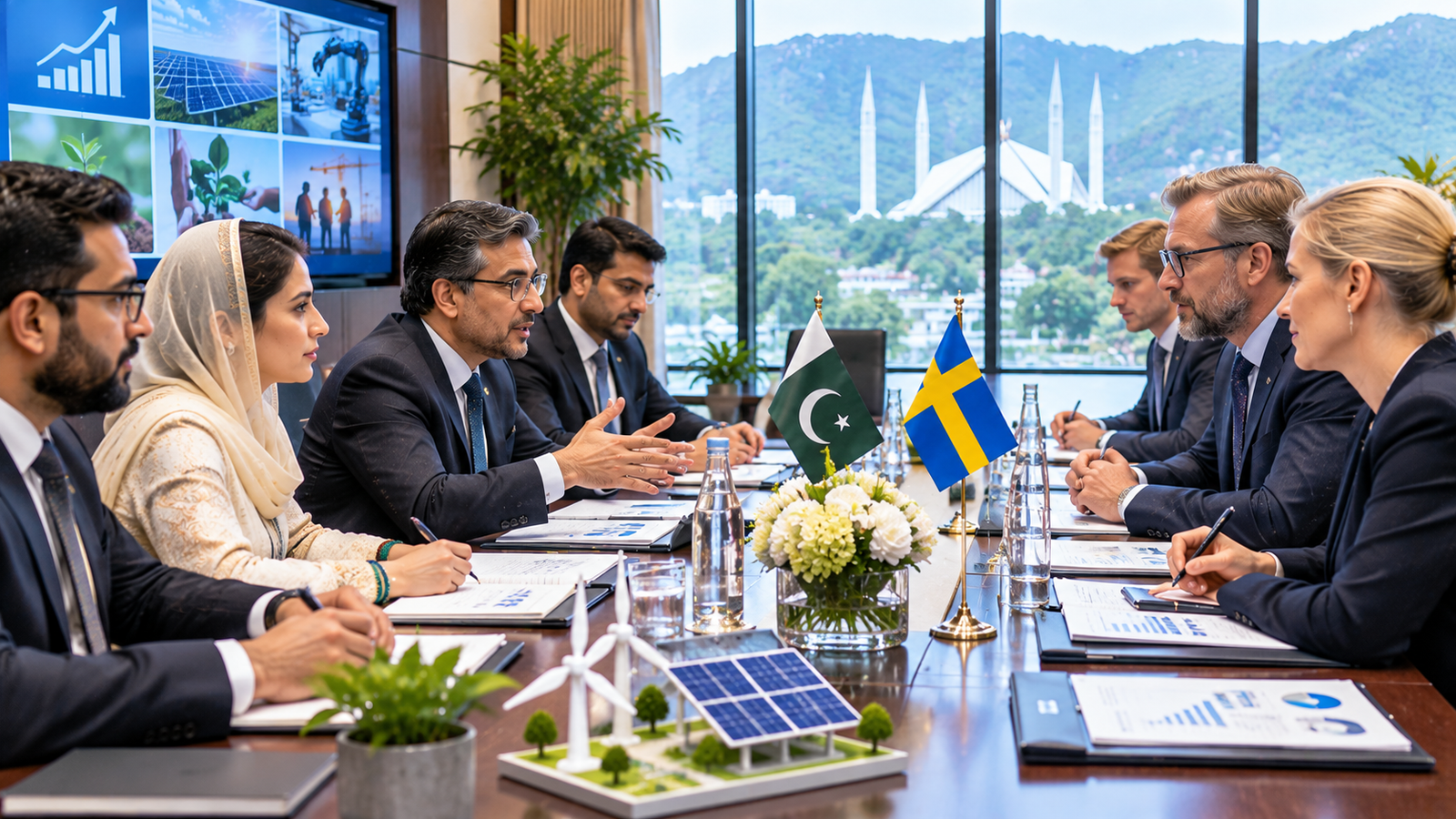
Pakistan and Sweden have begun negotiations to modernise their 1981 Bilateral Investment Treaty (BIT), in a move aimed at updating the legal framework governing investment between the two countries and encouraging stronger economic cooperation. The discussions were held in Islamabad, where senior officials from both sides participated in the opening session. According to the Special Investment Facilitation Council (SIFC), technical teams made significant progress on key provisions of the draft treaty, reflecting continued engagement between the negotiating sides.
The development is important because investment agreements help establish the rules under which investors operate across international borders. They can address issues such as the treatment of foreign investors, investment protection, dispute settlement and the responsibilities of governments. Pakistan and Sweden have maintained economic and diplomatic relations for decades, but the investment framework established in 1981 belongs to a different international business environment. Updating that framework could help both countries respond to modern investment practices and changing economic priorities.
The Swedish delegation was led by Sweden’s Ambassador to Pakistan, while SIFC Secretary Jamil Ahmed Qureshi represented the Pakistani side during the opening engagement. The Swedish ambassador expressed interest in expanding economic links with Pakistan, particularly in sustainable investment, innovation and job creation. Pakistani officials also highlighted the need for a contemporary framework that could support bilateral investment and encourage greater private-sector participation.
However, the negotiations should not be confused with a completed agreement or an immediate investment commitment. The two countries have not announced that a revised treaty has been signed, nor have they disclosed a final text, a signing date or a confirmed investment amount resulting from the discussions. The current development represents progress in negotiations, while the final economic impact will depend on the treaty’s eventual provisions and the willingness of businesses to invest.
What Is the Pakistan-Sweden Bilateral Investment Treaty?
A Bilateral Investment Treaty is an agreement between two countries that establishes a legal framework for investments made by investors from one country in the territory of the other. Such treaties generally aim to create greater clarity about the treatment and protection of investments, while setting out procedures for handling disputes that may arise between investors and governments. Their precise provisions differ, which makes the wording of each agreement important for both host countries and foreign investors.
Pakistan and Sweden signed their existing Bilateral Investment Treaty in 1981. At the time, international investment rules, global supply chains and the role of multinational businesses were different from the conditions that shape the global economy today. Since then, investment activity has expanded into areas such as digital services, advanced manufacturing, renewable energy, telecommunications, healthcare technology and other sectors that were not as prominent in international business discussions when the original agreement was signed.
Modern investment treaties may address a wider range of issues, including regulatory transparency, responsible investment, environmental considerations and the balance between investor protections and governments’ ability to regulate in the public interest. The exact provisions under discussion in the Pakistan-Sweden negotiations have not been publicly detailed, so it would be premature to claim that either country has already agreed to particular new protections or obligations.
The purpose of modernisation is to examine whether the existing framework remains suitable for current economic conditions and whether updated provisions can provide greater clarity for investors. For Pakistan, this review is also relevant to its wider effort to improve the investment environment and maintain constructive economic relationships with international partners.
Why Pakistan and Sweden Want to Update the 1981 Agreement
Investment agreements need to remain relevant to the economic conditions in which businesses operate. Since 1981, the international investment landscape has changed considerably, with businesses increasingly operating across multiple markets and investing in technology, infrastructure, renewable energy and specialised services. Governments also face newer policy questions involving digital business models, environmental standards, supply-chain resilience and the regulation of strategic industries.
Pakistan’s discussions with Sweden reflect an effort to bring the bilateral investment framework in line with evolving economic priorities. SIFC Secretary Jamil Ahmed Qureshi emphasised the importance of developing a contemporary framework that could provide an enabling environment for bilateral investment. Sweden’s representative also expressed interest in expanding economic links, particularly in sustainable investment, innovation and employment opportunities.
A modernised agreement could potentially help investors understand the legal conditions under which they operate in both countries. Greater clarity may support business planning, reduce uncertainty and encourage companies to examine opportunities that require long-term investment. However, an updated treaty alone cannot guarantee investment, because companies also consider taxation, infrastructure, energy costs, market demand, regulatory consistency and political and economic stability.
The negotiations therefore form one part of a wider economic relationship rather than a standalone solution to every investment challenge. Their value will depend on whether the final framework addresses genuine concerns faced by businesses and is supported by practical improvements in the investment environment.
What Progress Has Been Made in the Negotiations?
The SIFC’s official announcement stated that technical teams from Pakistan and Sweden had made significant progress on key provisions of the draft treaty. This indicates that the discussions have moved beyond a general expression of interest and that officials are examining proposed treaty language. The opening session brought together senior representatives from both countries, while the technical discussions focused on developing an updated framework for bilateral investment cooperation.
The public announcement, however, does not identify the specific articles or clauses on which progress has been made. It also does not disclose whether all major differences have been resolved or whether further technical and legal consultations are required. Without the draft text, it is not possible to determine precisely how the proposed agreement would change the rights and responsibilities of investors or the regulatory powers of either government.
The distinction between progress in negotiations and completion of a treaty is essential. International agreements generally require further legal review, agreement on final wording and completion of the relevant approval procedures before they can enter into force. Even after negotiators reach an understanding, governments may need to complete domestic legal and administrative steps.
For businesses, the immediate development is therefore a positive diplomatic and technical signal, not a new legal guarantee that is already in operation. Investors will need to wait for official publication of the final treaty and confirmation of its legal status before relying on any revised provisions.
The Earlier Dispute Over the Treaty
The modernisation talks follow an earlier episode involving the future of Pakistan’s investment treaty with Sweden. In October 2026, Pakistan’s Board of Investment reported that the government had decided to revoke a notice of termination concerning the 1981 treaty. The issue had prompted a review of the country’s approach to bilateral investment agreements and the procedures involved in decisions about terminating or maintaining such arrangements.
According to the Board of Investment’s October announcement, the government had constituted a committee to review Pakistan’s overall Bilateral Investment Treaty framework and develop a clearer policy approach. The review was also expected to examine the country’s Model BIT template so that future investment agreements could be more modern, balanced and aligned with contemporary international practices.
This background helps explain why the current negotiations matter. Rather than proceeding with the termination of the Sweden treaty, Pakistan decided to retain the agreement and engage in discussions about updating it. The October announcement also indicated that both sides would continue consultation on the review and modernisation process.
The earlier dispute should not be confused with the current negotiating stage. Revoking a termination notice meant that Pakistan chose to retain the existing treaty framework, while the subsequent discussions are intended to examine how that framework could be updated. The outcome of the wider review of Pakistan’s BIT policy and the final wording of the Sweden agreement remain matters that require official confirmation.
What Sweden Wants From Stronger Investment Relations
Sweden has expressed interest in expanding its economic links with Pakistan, particularly in sustainable investment, innovation and job creation. These priorities are consistent with areas in which Swedish businesses and institutions have experience, including telecommunications, engineering, industrial technology, environmental solutions and research-driven development. Stronger investment relations could provide opportunities for companies to explore partnerships, technology cooperation and commercial activity in the Pakistani market.
The Swedish delegation’s participation in the negotiations indicates continued engagement with Pakistan’s investment framework. A predictable legal environment can be relevant to companies considering long-term business activity because major investments often require planning over several years. Investors may evaluate legal protections alongside market demand, operational costs, infrastructure and the ability to resolve disputes through established procedures.
Swedish companies already have a business presence in Pakistan. The Board of Investment’s October discussions referred to the long-standing operations of Ericsson, which has maintained a presence in the country for more than six decades. This example illustrates that economic links between the two countries are not limited to government-level diplomatic engagement and that international companies have been part of Pakistan’s business environment for many years.
Nevertheless, the Swedish government’s interest in expanding economic links should not be interpreted as a commitment by specific companies to announce new projects. No new Swedish investment amount, company-specific project or employment target was announced in the SIFC statement about the treaty negotiations. Such developments should be reported separately if and when companies or government agencies formally confirm them.
Potential Investment Opportunities in Renewable Energy
Renewable energy is one of the sectors that could benefit from stronger economic engagement between Pakistan and Sweden. Pakistan faces the challenge of improving energy affordability, strengthening supply reliability and diversifying its energy sources. Investment in solar power, wind energy, energy storage, grid technology and energy efficiency could support these objectives when projects are commercially viable and properly planned.
Sweden has experience in clean technology, energy efficiency and sustainable industrial development. Cooperation between Swedish companies and Pakistani businesses could create opportunities for technology transfer, technical services, project development and industrial partnerships. Such collaboration may also support training and the development of local technical expertise.
An updated investment framework could help create greater legal clarity for companies considering long-term projects. However, the treaty itself would not provide project financing, guarantee electricity purchases or replace the regulatory approvals required for energy investments. Businesses would still need to assess project economics, land requirements, grid connections, financing conditions and relevant government policies.
The current negotiations identify sustainable investment as an area of mutual interest, but they do not confirm that a particular renewable energy project has been approved. The potential benefits will depend on future commercial agreements and actual investment decisions made by companies.
Opportunities in Technology and Telecommunications
Technology and telecommunications are other areas where Pakistan and Sweden could explore stronger economic cooperation. Digital infrastructure is important for modern businesses because companies increasingly depend on reliable connectivity, data services, secure networks and digital platforms. Investment in telecommunications and technology can also support the growth of software businesses, online services and industrial automation.
Swedish technology companies have an established history of working in international markets, while Pakistan has a large population of technology users, growing digital businesses and demand for modern communications infrastructure. These conditions could create opportunities for partnerships involving telecommunications equipment, network modernisation, enterprise technology and specialised digital services.
The existing presence of Swedish companies such as Ericsson provides a foundation for understanding the commercial relationship between the two countries. However, the future scale of cooperation will depend on market demand, investment conditions, regulatory requirements and business decisions. A revised investment treaty may contribute to the wider legal framework, but it will not automatically produce new telecom projects or technology transfers.
Further opportunities could emerge through cooperation between universities, research institutions and private companies. Pakistan and Sweden’s November 19 bilateral political consultations also highlighted renewable energy, sustainable technologies, healthcare, science and technology, information and communication technologies, and research and development as areas for closer cooperation.
Healthcare, Research and Industrial Cooperation
Healthcare and research are additional sectors in which Pakistan and Sweden have identified opportunities for stronger engagement. International cooperation can support the exchange of technical knowledge, research partnerships, medical technology development and the improvement of specialised services. Such collaboration may involve universities, hospitals, technology companies and research institutions working on projects that address shared challenges.
Pakistan’s healthcare sector requires continued investment in medical facilities, diagnostic services, equipment and technical capacity. Partnerships with international businesses and research organisations could help introduce modern technologies and develop local expertise. Swedish participation in such areas would depend on commercial interest, regulatory approvals and the availability of suitable partners.
Industrial cooperation may also be relevant because modern manufacturing increasingly depends on automation, efficient production processes, advanced materials and environmental standards. Businesses that can combine Swedish technology and expertise with Pakistani market knowledge and industrial capabilities may identify opportunities for joint ventures or supplier relationships.
However, the current treaty negotiations have not announced specific healthcare, research or manufacturing projects. These sectors should be understood as potential areas for future cooperation, supported by the wider bilateral discussions, rather than confirmed investment commitments arising from the draft agreement.
Why Investment Protection Matters to Foreign Companies
Foreign investors often make decisions based on the expected return from a project and the risks involved in operating in another country. These risks may include regulatory changes, contractual disputes, restrictions on transferring funds, inconsistent administrative procedures and uncertainty about how disputes will be resolved. Investment treaties can provide a legal framework addressing certain aspects of these concerns, although the protections available depend on the actual wording of the agreement.
For companies considering projects that require substantial capital, the legal environment can influence how they assess long-term exposure. A treaty that clearly explains the treatment of investments and the procedures available in case of disputes may contribute to greater confidence. At the same time, governments need to preserve their ability to regulate in the public interest, protect the environment and enforce legitimate laws.
Modern investment agreements increasingly involve discussions about balancing investor protection with the policy responsibilities of governments. This balance is important because an agreement that is too uncertain may discourage investment, while provisions that are excessively broad can create legal and financial risks for the host state.
Pakistan’s review of its BIT framework, including the Model BIT template, is relevant to this challenge. The government has indicated that it wants future arrangements to be modern and balanced, suggesting that treaty reform is being considered as part of a wider investment policy review.
What the Treaty Modernisation Could Mean for Pakistani Businesses
A modernised Pakistan-Sweden investment framework could be relevant not only to large international companies but also to Pakistani businesses seeking partnerships, technology and access to new markets. Small and medium-sized enterprises may benefit indirectly if stronger bilateral relations encourage Swedish companies to develop supplier relationships, outsource specialised services or work with local partners.
For Pakistani exporters, stronger business connections could create opportunities to understand Swedish market requirements and establish commercial relationships with buyers and distributors. Companies operating in technology, engineering, textiles, healthcare-related products and industrial services may explore opportunities where their capabilities match market demand. However, access to a market depends on product standards, certification, pricing, logistics and customer requirements, not simply on the existence of an investment treaty.
Joint ventures and business-to-business partnerships could also help local companies improve their technical capabilities. International partners may bring experience in production methods, quality management, research and development or specialised equipment. Pakistani businesses could contribute local market knowledge, skilled workers and access to regional commercial networks.
These possibilities remain potential outcomes rather than confirmed results of the negotiations. The practical impact will become clearer only when the final treaty is agreed and businesses begin announcing specific partnerships or investment projects.
Challenges That Could Affect the Investment Relationship
Modernising an investment treaty is only one part of creating an attractive investment environment. International companies also assess macroeconomic stability, taxation, access to foreign exchange, energy prices, infrastructure, regulatory consistency and the ease of doing business. If these wider conditions remain difficult, a revised treaty may have a limited effect on the amount of new investment entering the country.
Pakistan will therefore need to connect treaty reform with practical improvements in the business environment. Investors often require predictable rules, timely approvals and clear communication between government departments. Delays in administrative processes or uncertainty about regulations can increase the cost of doing business, even when an investment agreement provides formal protections.
Another challenge is ensuring that treaty provisions are balanced and legally clear. The government must consider the interests of foreign investors while preserving its ability to introduce legitimate public policies. This requires careful legal drafting, consultation with relevant institutions and a clear understanding of the potential financial implications of different provisions.
The negotiations with Sweden provide an opportunity to examine these issues through a bilateral process. Their success will depend on whether both sides can agree on a framework that supports investment while respecting their respective legal systems and policy priorities.
What Happens Next in Pakistan-Sweden Investment Talks?
The immediate next stage is expected to involve continued technical and legal engagement between the negotiating teams. The SIFC announcement confirms that progress has been made on key provisions of the draft treaty, but it does not provide a timetable for completing negotiations or publishing a final text. Further official announcements will be needed to establish whether the remaining issues have been resolved and when the agreement may move towards formal approval.
Once negotiators reach agreement on the text, both countries would need to follow the applicable legal and domestic procedures before a revised treaty could enter into force. These steps may include legal review, approval by the relevant authorities and completion of formal diplomatic processes. The precise requirements will depend on the final agreement and the laws of each country.
Businesses should therefore monitor official communications from Pakistan’s SIFC, Board of Investment and Foreign Office, as well as announcements from Swedish authorities. These sources will be important for confirming any changes to the negotiating process, the publication of treaty provisions and the legal status of a revised agreement.
For now, the key development is that Pakistan and Sweden have moved forward with discussions to update their 1981 investment treaty. The negotiations provide a basis for future cooperation, but their final economic impact will depend on the agreement reached and the investment decisions that follow.
Conclusion
Pakistan and Sweden’s negotiations to modernise their 1981 Bilateral Investment Treaty represent an important step in the development of their economic relationship. The discussions in Islamabad brought together senior officials and technical teams from both countries, while the SIFC reported progress on key provisions of the draft agreement. Both sides have expressed interest in strengthening investment links, particularly in areas such as sustainable investment, innovation and job creation.
The talks are taking place against the background of Pakistan’s wider review of its bilateral investment treaty framework and its decision to retain the existing agreement with Sweden after revoking a termination notice. This process reflects the government’s effort to examine how investment agreements can be made more modern, balanced and relevant to current economic conditions.
Potential areas for stronger cooperation include renewable energy, telecommunications, technology, healthcare, research and industrial development. However, the negotiations have not yet produced a signed treaty or confirmed new investment commitments, and the exact provisions under discussion have not been publicly disclosed.
The next important milestone will be the completion of negotiations and publication of the final agreement, followed by the required legal procedures in both countries. Until then, the development should be viewed as progress towards a modern investment framework rather than a completed investment deal. The real test will be whether the revised agreement encourages sustainable business partnerships, strengthens investor confidence and leads to measurable economic cooperation between Pakistan and Sweden.
What is the Pakistan-Sweden Bilateral Investment Treaty?
The Pakistan-Sweden Bilateral Investment Treaty is an agreement signed in 1981 that provides a legal framework for investment relations between the two countries. Pakistan and Sweden are now negotiating to modernise it.
Why are Pakistan and Sweden modernising their investment treaty?
The two countries want to update the decades-old investment framework to reflect changing economic priorities, encourage private-sector participation and support stronger bilateral investment cooperation.
When did Pakistan and Sweden hold investment treaty negotiations?
Negotiations to modernise the 1981 treaty were held in Islamabad in November 2026, with senior officials and technical teams from both countries participating.
Have Pakistan and Sweden signed a new investment treaty?
No. The two countries have held negotiations and reported progress on key provisions of a draft treaty, but a revised agreement has not yet been announced as signed.
Which sectors could benefit from stronger Pakistan-Sweden investment cooperation?
Potential areas include sustainable investment, renewable energy, innovation, telecommunications, healthcare, science and technology, research and development, and industrial cooperation.
What role does SIFC have in the Pakistan-Sweden investment talks?
The Special Investment Facilitation Council participated in the negotiations. SIFC Secretary Jamil Ahmed Qureshi welcomed the Swedish delegation and highlighted the importance of a modern investment framework.
Why was the 1981 Pakistan-Sweden treaty’s termination notice revoked?
Pakistan’s Board of Investment stated in October 2026 that the government had decided to revoke the termination notice and had formed a committee to review the country’s wider Bilateral Investment Treaty framework.
When will the modernised Pakistan-Sweden investment treaty take effect?
No signing date or entry-into-force date has been announced. The treaty must first be finalised through negotiations and then complete the applicable legal and approval procedures in both countries.
About The Author