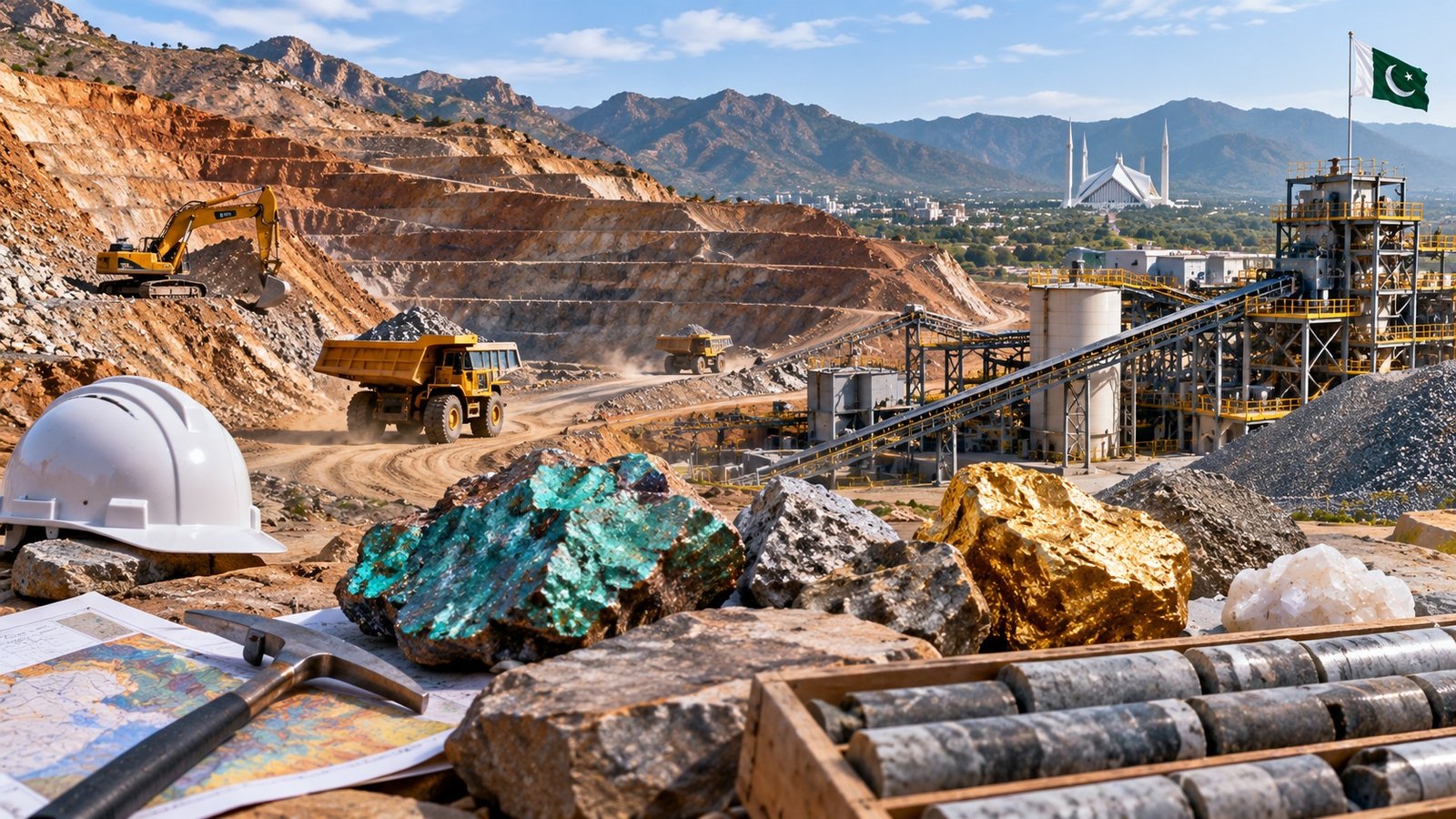
Pakistan is preparing to host an international gathering of mining companies, investors, policymakers and technical experts as the Pakistan Minerals Investment Forum 2026 (PMIF26) takes place in Islamabad on November 12 and 13. The event is expected to put the country’s mineral resources, exploration projects and investment framework in front of global industry participants at a time when demand for copper and other critical minerals is rising.
The Pakistan Minerals Investment Forum 2026 is organised by the Government of Pakistan, endorsed by the Special Investment Facilitation Council (SIFC), and lists Oil and Gas Development Company Limited (OGDCL) as its founding partner. The official event programme includes discussions on early-stage exploration finance, next-generation mining projects, geological survey cooperation, investor-ready regulations, infrastructure and export corridors.
The forum is an investment platform, not proof that new capital has already entered Pakistan. Its value will depend on whether meetings lead to bankable projects, financing commitments, technical partnerships and agreements that progress beyond announcements. This distinction matters because mineral development requires years of exploration, approvals, infrastructure, financing and construction before a mine can begin commercial production.
What Is the Pakistan Minerals Investment Forum 2026?
The Pakistan Minerals Investment Forum 2026 (PMIF26) is a two-day international forum scheduled for November 12–13 at the Jinnah Convention Centre in Islamabad. Its stated purpose is to connect Pakistan’s public and private sectors with international mining companies, financial institutions, geological organisations, engineering firms and technology providers.
The official programme is divided into strategic and technical discussions, alongside an international exhibition. The strategic conference is designed for policymakers, investors and senior executives, while the technical programme focuses on exploration, geology, processing, sustainability and innovation.
The event website says the forum is intended to bring together more than 5,000 global investors, mining executives and policymakers. This is an organiser-provided attendance ambition, not a confirmed count of people who have already registered or attended.
Organisers say PMIF26 builds on the previous edition and aims to deepen international engagement, highlight policy reforms and open pathways for investment in exploration, processing and sustainable mining. The forum’s success will be judged by the quality and follow-through of the opportunities presented.
Why Pakistan Is Promoting Its Mineral Resources
Pakistan has mineral deposits that include copper, gold, coal, industrial minerals, gemstones and other resources. The government is seeking to attract investment not only in extraction but also in exploration, processing, refining, infrastructure and downstream industries.
Global demand for minerals such as copper is linked to electricity networks, renewable energy systems, electric vehicles, construction and industrial equipment. Critical minerals are also important to advanced manufacturing and some defence and technology supply chains. This creates a potential opportunity for countries that can provide reliable resources and responsible production.
However, geological potential is not the same as a commercially viable mine. Investors need reliable geological data, clear licences, predictable taxation, water and power access, roads and rail links, security arrangements, skilled workers and confidence that contracts will be respected.
Pakistan’s investment pitch will therefore need to address both the resource opportunity and the practical risks of developing projects. The forum’s agenda includes several of these issues, particularly exploration financing, geological collaboration, infrastructure and investor-ready mining jurisdictions.
Exploration Finance: Funding Projects Before Production
One of the first major sessions on November 12 is focused on capital deployment in early-stage mineral exploration. This is an important part of mining investment because companies often need substantial funding before they know whether a deposit can support a profitable mine.
Exploration can involve geological mapping, sampling, drilling, laboratory analysis and resource estimation. Each stage can reduce uncertainty, but it can also reveal that a prospect is smaller, lower-grade or more difficult to develop than expected. Investors therefore face technical, financial, regulatory and operational risks long before a project generates revenue.
The Pakistan Minerals Investment Forum 2026 agenda brings together financiers, lenders and mining experts to discuss strategies for funding and managing these early-stage risks. It also includes a session on building a pipeline of next-generation mining projects, including discoveries under active licences and plans for moving projects towards production.
For Pakistan, the Pakistan Minerals Investment Forum 2026 could help spotlight a stronger exploration finance ecosystem and connect local companies with international partners assessing new prospects. But investors will still expect transparent licensing, reliable geological information, clear ownership structures and credible feasibility studies before committing large amounts of capital.
Reko Diq and the Wider Mining Project Pipeline
Reko Diq is among the most prominent mining projects associated with Pakistan’s mineral investment strategy. The project is frequently cited in discussions about the country’s copper and gold potential, and the PMIF26 programme specifically refers to it as a flagship project in technical and investment discussions.
The official event website also lists sessions on Pakistan’s next-generation mining projects and the development of investor-ready mining jurisdictions. This suggests the forum is intended to look beyond a single flagship development and discuss a wider pipeline of exploration and mining opportunities.
Large mining projects can create demand for engineering, transport, power, water, construction, equipment, laboratory services and specialised skills. Local businesses may find opportunities in supplying these services, provided they can meet the technical and safety standards required by international operators.
At the same time, a project’s presence on a conference agenda does not mean that financing, construction or production milestones have been completed. Readers and investors should check company disclosures and official project updates for confirmed investment amounts, construction progress and expected production dates.
Critical Minerals, Processing and Local Value Addition
PMIF26 is not limited to extracting ore from the ground. The official event material highlights exploration, processing, local value addition and the development of downstream industries as important themes.
Processing can increase the value retained in the country by turning mined material into higher-value products. Depending on the mineral and the economics of a project, this may involve concentration, separation, refining or the production of materials used by manufacturers.
Local processing can also create skilled jobs and demand for industrial services. But it requires reliable electricity, water, transport, technical expertise, environmental controls and sufficient scale. In some cases, exporting ore or concentrate may be more commercially viable at an early stage, while downstream processing is developed gradually.
The investment discussion therefore needs to consider the full value chain. A project may attract exploration funding but still require separate capital for a processing plant, transport links, energy infrastructure and export facilities. Transparent cost estimates and realistic market demand are essential.
Geological Data and International Technical Partnerships
Another Pakistan Minerals Investment Forum 2026 session will examine cooperation between geological surveys. The event programme says the discussion will focus on data sharing and technical partnerships that can strengthen geological knowledge, reduce exploration risks and support investment.
Reliable geological information is a foundation for mineral investment. Better mapping, geophysical surveys, remote sensing, drilling records and laboratory analysis can help companies understand where resources may exist and how difficult they may be to extract.
International technical partnerships can help build local expertise and introduce modern exploration and processing methods. The event’s technical conference is designed to bring together geologists, engineers, researchers and mining professionals, with sessions covering exploration, resource assessment, mineral processing, metallurgy and sustainability.
Pakistan’s ability to make useful geological information accessible, while protecting legitimate commercial and national interests, will be an important factor in investor confidence. Better data can reduce uncertainty, but it cannot remove the geological and commercial risks inherent in exploration.
Infrastructure, Security and Environmental Standards
Mining operations often take place far from major cities, ports and established industrial centres. A viable project may require roads, railways, power supply, water systems, communications, worker accommodation and export routes. These costs can be substantial and may determine whether a deposit can be developed economically.
The Pakistan Minerals Investment Forum 2026 agenda includes a session titled “License to Deliver: Building Trust, Infrastructure & Export Corridors”. The programme says participants will discuss infrastructure, logistics, rail, power, water, CPEC connectivity and public-private partnership models for remote operations.
Environmental, social and governance (ESG) standards are also part of the investment discussion. Mining projects can affect land, water, ecosystems and nearby communities. Responsible development requires environmental assessment, safe waste management, consultation with communities, fair labour practices and transparent benefit-sharing arrangements.
Security is another practical consideration for projects operating in remote areas. Investors need to assess security arrangements alongside community relations, regulatory certainty and the reliability of infrastructure. No single conference or policy announcement can remove these risks; they require sustained implementation and credible oversight.
What Global Investors Will Look For
International mining investors typically assess a project through several stages. They examine geological evidence, licence status, ownership, resource estimates, feasibility studies, capital requirements, operating costs, infrastructure access, market prices and the legal framework.
They also consider whether the host country offers predictable rules for taxes, royalties, foreign exchange, imports, exports and dispute resolution. Long-term mining projects are particularly sensitive to policy changes because capital is committed years before revenues may begin.
At the Pakistan Minerals Investment Forum 2026, government dialogues are scheduled to discuss investor-ready mining jurisdictions, policy certainty, local content, skills development and regional cooperation. These are important topics because investors need clarity about how projects will be approved, built, operated and eventually closed.
Pakistan will need to demonstrate progress through published rules, timely decisions, reliable project data and transparent agreements. Announced interest or participation by international companies should not be reported as a confirmed investment unless a binding agreement, financing decision or documented capital deployment supports that claim.
Opportunities for Pakistani Companies and Workers
International investment in mining can create opportunities beyond the mining companies themselves. Local engineering firms, construction contractors, transport operators, equipment suppliers, laboratories, software providers and environmental consultants may all be able to participate in project supply chains.
Mining projects also require geologists, mining engineers, metallurgists, electricians, mechanics, health and safety specialists, environmental scientists and skilled technicians. The forum’s programme includes a discussion on building a future-ready mining workforce and strengthening women’s participation in the sector.
Local participation will depend on whether Pakistani businesses and workers can meet project requirements for quality, safety, cost and delivery. Training partnerships, supplier development programmes and clear local-content rules can help build the capabilities needed to participate.
For communities near mining areas, the key issues include employment, public services, land rights, environmental protection and the fair distribution of economic benefits. Investment figures alone do not show whether local communities are benefiting; that requires measurable information on jobs, procurement, revenues and social outcomes.
What to Watch During PMIF26
The first indicator from the Pakistan Minerals Investment Forum 2026 will be whether the event produces concrete project updates rather than broad statements of potential. Investors will want to know which exploration blocks, licences and projects are ready for financing, what technical information is available and what approvals remain outstanding.
Second, attention will be on financing. Early-stage exploration needs risk capital, while advanced projects require large commitments for feasibility work, construction and infrastructure. Any announced financing should be assessed by its source, amount, conditions and stage of completion.
Third, observers will look for policy and regulatory clarity. The government dialogue on investor-ready jurisdictions could provide more information about licensing, fiscal terms, local content and the process for resolving disputes.
Finally, the forum’s partnership announcements should be tracked after the event. A memorandum of understanding may establish a basis for cooperation, but it is not necessarily a final investment decision. Follow-up disclosures will be needed to determine whether partnerships progress into funded work, construction or operating projects.
Conclusion
The Pakistan Minerals Investment Forum 2026 gives the country an opportunity to present its mineral resources and investment plans to a global audience. Its agenda covers early-stage exploration finance, next-generation projects, Reko Diq, geological data, local value addition, infrastructure, ESG and the development of a skilled workforce.
The event’s potential importance lies in connecting investors with projects and institutions that can turn geological prospects into commercially viable operations. But resource potential and conference participation should not be confused with completed investment. Actual progress will depend on transparent rules, reliable data, bankable feasibility studies, infrastructure, community trust and long-term policy consistency.
For Pakistan, the most meaningful outcome will be investment that moves beyond announcements into responsible exploration, processing, jobs and exports. The forum will provide a platform for those discussions; the results will need to be measured through what happens after the delegates leave Islamabad.
Frequently Asked Questions
When will the Pakistan Minerals Investment Forum 2026 take place?
The forum is scheduled for November 12 and 13, 2026, at the Jinnah Convention Centre in Islamabad.
Who is organising PMIF26?
The forum is organised by the Government of Pakistan, endorsed by the Special Investment Facilitation Council, and lists OGDCL as its founding partner.
What is the main purpose of PMIF26?
It aims to connect global investors, mining companies, policymakers and technical experts with opportunities across Pakistan’s mineral sector.
Which minerals and opportunities will be discussed?
The official event material refers to copper, lithium, rare earths, industrial minerals and gemstones, as well as exploration, processing and downstream opportunities.
Will Reko Diq be discussed at the forum?
Yes. The official programme includes technical and strategic discussions that refer to Reko Diq and other mining projects.
Does the forum mean new investment has already been secured?
No. A conference, meeting or memorandum of understanding does not automatically mean capital has been deployed. Confirmed investments require documented agreements or financing disclosures.
Who is expected to attend PMIF26?
The organisers say the event is intended to attract more than 5,000 investors, mining executives and policymakers. This is an organiser-stated target, not a confirmed attendance figure.
What role can Pakistani businesses play?
Local firms may supply engineering, construction, transport, equipment, laboratory, software, environmental and other specialist services if they meet project standards.
About The Author