Orion Nebula, one of the Milky Way’s best-known star-forming regions, is featured in NASA’s October 26, 2026 Astronomy Picture of the Day. Located approximately 1,500 light-years from Earth, this cosmic nursery offers a remarkable look at how new stars form within vast clouds of gas and dust. Also known as Messier 42 or M42, the nebula spans roughly 40 light-years and contains bright young stars, protoplanetary material and dark interstellar clouds.
The October 26 feature is a new presentation of an astronomical subject, not an announcement that the nebula has only just been discovered or that astronomers have detected an unprecedented event there. That distinction matters: the scientific value of this image comes from showing the environments in which stars and potential planetary systems develop.
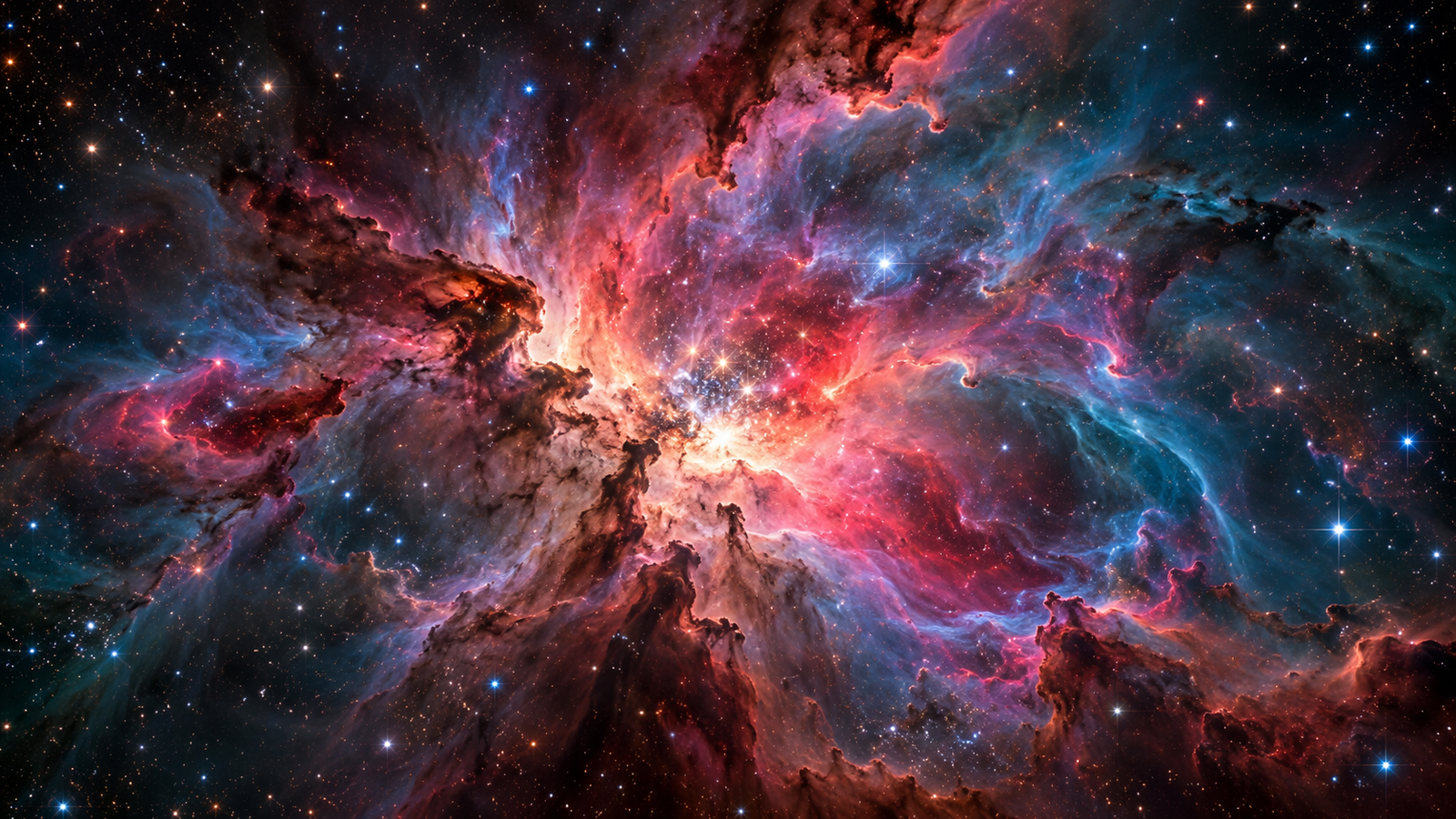
The photograph selected for NASA’s October 26 page is credited to astrophotographer Roberto Palaia. The page describes its image as using assigned colours highlighting hydrogen emission. A separate AI-generated illustration may help explain the nebula visually, but it must not be mistaken for Palaia’s original observation or presented as NASA telescope data.
What Did NASA Share on October 26, 2026?
NASA’s daily image programme showcased M42: The Great Nebula in Orion, accompanied by an expert explanation. It described a cloud of hot, glowing gas bordering a much larger molecular cloud. The region contains youthful stars and smaller structures associated with early stellar and planetary development.
The official explanation calls attention to the Trapezium, a prominent group of bright stars in the nebula, alongside protoplanetary disks and energetic stellar jets. Its scale is extraordinary: a region roughly 40 light-years wide appears in Earth’s sky as a diffuse patch because its light has travelled across interstellar space.
Nothing in the NASA page says that October 26 brought a newly launched spacecraft, a previously unknown planet or a sudden new burst of star formation. A responsible headline should therefore use wording such as ‘NASA highlights’ or ‘NASA features’, not ‘NASA discovers’.
Where Is the Orion Nebula Located?
The Orion Nebula lies in the constellation Orion, one of the easiest constellations to recognise from many inhabited parts of Earth. Observers often identify Orion using its three relatively closely aligned belt stars. The nebula is situated in the region below that belt, within Orion’s sword. Under sufficiently dark skies it can appear to the unaided eye as a faint, fuzzy object rather than a crisp, colourful cloud.
NASA places the region at a distance of approximately 1,500 light-years, although astronomy publications sometimes use somewhat different estimates based on methods and definitions. A light-year is a measure of distance, not time: it is the distance that light travels through vacuum in one year. Light from this nebula therefore took roughly 1,500 years to reach us based on that rounded distance.
The nebula resides within the Milky Way, in the same broad spiral-arm neighbourhood as our Sun. It is neither another galaxy nor an object located outside the Milky Way.
How Does a Nebula Produce New Stars?
A nebula is a large interstellar region containing gas and dust. Not every nebula forms stars, but cold, dense portions of giant molecular clouds can collapse when gravity overwhelms the internal forces resisting contraction. Material moving inward gathers into denser cores and eventually produces protostars.
As protostars develop, gravitational contraction raises temperatures and pressures near their centres. When conditions become sufficient for sustained hydrogen fusion, an object begins its long life as a star. This process takes place over substantial timescales and is influenced by magnetic fields, turbulence and material flowing through a surrounding disk.
The Orion complex is a particularly valuable place for studying these steps because it contains stars of different ages and a variety of dense clouds. Rather than relying only on theoretical models, astronomers can observe gas, protostars, stellar winds, jets and surrounding material in a single accessible region.
Why Are the Trapezium Stars Important?
Near the heart of M42 is the Trapezium Cluster, named for the pattern made by four of its brightest members when seen through suitable instruments. These are hot, massive young stars whose intense ultraviolet radiation helps make surrounding gas glow. Their stellar winds and radiation can also shape the environment for other nearby developing stars.
NASA’s observations have shown that the cluster is not merely an attractive pattern of stars. Its radiation affects how the cloud evolves, clearing some surrounding regions and illuminating others. Those effects offer a natural laboratory for investigating how massive stars influence smaller neighbours forming in the same stellar nursery.
The Trapezium is not the entire nebula, and many fainter stellar members lie beyond the familiar four-star configuration. Images taken with different instruments reveal additional young stars hidden among the dust.
What Are Proplyds and Why Do They Matter?
The term ‘proplyd’ is short for protoplanetary disk, often referring to disks around newly forming stars in environments like Orion. Such disks contain gas and dust that can contribute to planet formation. In Orion, energetic radiation from nearby massive stars can illuminate or erode some of these disks, producing distinct shapes visible in detailed observations.
These structures matter because planets are thought to arise from material orbiting young stars. The presence of proplyds indicates that at least some young stars in this region are accompanied by ingredients relevant to future planetary systems. It does not prove that every observed disk already contains a planet or that it will eventually build an Earth-like world.
NASA’s Hubble material has long used Orion to illustrate these processes. Detailed views show silhouettes and bright rims that help scientists estimate how radiation, gas flows and the local environment affect disks over time.
Why Does the Nebula Appear Red, Pink and Blue?
The colours seen in astrophotographs must be interpreted carefully. Some features come from emission lines produced by atoms and ions in excited gas, including hydrogen, while other areas can reflect starlight or appear dark where dust blocks visible light. Instruments also have different filters and detectors that capture wavelengths outside ordinary human vision.
NASA specifically notes that the October 26 featured deep image uses assigned colours highlighted by hydrogen emission. ‘Assigned colours’ means that the displayed hues have been chosen to represent captured signals in an interpretable way. These images can be scientifically meaningful without reproducing exactly what a human observer would see through a small backyard telescope.
For readers, a vivid photograph should prompt curiosity about its wavelengths, filters and processing rather than the assumption that every pixel reflects an identical naked-eye colour. That same caution applies to AI-generated space art, which is an illustration rather than an observational record.
What Can Hubble, Chandra and Webb Reveal?
Different space observatories investigate complementary aspects of the same cosmic region. The Hubble Space Telescope has documented bright nebular gas, young stars and protoplanetary material in extraordinary detail. Chandra uses X-ray observations to detect energetic activity associated with young stars, sometimes identifying sources that are less obvious in visible light.
The James Webb Space Telescope observes at infrared wavelengths, making it particularly useful for viewing regions where dust obscures visible-light signals. Infrared imagery can reveal populations and structures that a conventional optical image does not show as clearly. These tools help astronomers compare how dust, stellar heating and star formation appear across the electromagnetic spectrum.
NASA’s previously published Orion imagery, including Chandra material and Hubble educational resources, helps explain the phenomenon. But it would be inaccurate to claim that every detail in the October 26 APOD was newly measured by all three telescopes; the October 26 feature credits the specific astrophotographer Roberto Palaia.
Can People in Pakistan See the Orion Nebula?
Orion is visible during suitable seasons from Pakistan, and the nebula is a reasonable target for skywatchers with a clear view of the constellation. Actual visibility depends on local time, month, weather, artificial light pollution and the height of Orion above the horizon. A small telescope or binoculars can help reveal the fuzzy patch more readily than unaided vision in bright urban conditions.
For first-time observers, begin by learning the three-star line of Orion’s Belt, then look toward the sword region below it. A sky-chart application can help confirm the direction for a given date and location. Avoid expecting the richly saturated reds and blues of long-exposure astrophotography; the human eye receives far less light during a brief glance.
This Pakistan angle is useful because the astronomical object is accessible to amateur observers worldwide. However, NASA’s October 26 image itself is a global science feature, not a Pakistan-specific discovery or mission.
How Large Is the Orion Nebula?
NASA’s October 26 explanation gives M42 a span of about 40 light-years. A distance of 40 light-years is enormous compared with the scale of our planetary system. Yet the nebula remains a relatively nearby target in galactic terms, which is one reason it provides a valuable observing ground for astronomers.
The size quoted for a nebula depends partly on which visible or molecular structures are included. The broader Orion molecular-cloud complex extends well beyond the bright patch typically identified as M42, and not every photograph shows the same boundaries. Readers should avoid assuming that the familiar luminous region and the entire molecular complex are identical in size.
Descriptions such as ‘stellar nursery’ are metaphors for a physical environment that can generate stars; they do not imply the whole cloud transforms into stars at once. Only some dense portions of a large cloud may collapse while other gas is dispersed or remains diffuse.
What Does This Tell Us About Planet Formation?
The Orion Nebula is significant not simply because it produces stars but because some of those stars form with surrounding disks. Planet formation research investigates how dust grains grow, how larger objects accumulate and how disks evolve in the presence of stellar radiation, winds and collisions.
Observations of young stars in a crowded region give scientists opportunities to compare disk survival under different local conditions. A disk close to a powerful ultraviolet source may evolve differently from a disk in a quieter environment. These differences help researchers test models of how frequently certain kinds of planetary systems might form.
Nevertheless, no generic photograph of the nebula can establish how many habitable planets exist there. Claims about life, Earth-like planets or confirmed intelligent civilisations would require separate evidence and should not be attached to this daily image feature.
Is This a New Scientific Discovery?
No newly discovered nebula is being announced. M42 has been observed for centuries and has repeatedly appeared in astronomical research and public outreach. NASA’s Astronomy Picture of the Day is a curated educational programme, regularly presenting striking astronomical imagery with contextual explanations.
The October 26, 2026 date is the publication date of the featured picture and description, not necessarily the night on which its underlying astronomical data were captured. The official credit assigns the featured image to Roberto Palaia. That distinction is essential for headlines, social captions and image licensing.
This news is therefore best presented as a timely astronomy explainer: NASA’s new daily image selection provides an occasion to revisit how the Orion Nebula forms stars and why the region remains an important target for scientists.
What Should Readers Remember?
Three factual points stand out. First, the Orion Nebula is a nearby star-forming region about 1,500 light-years away, as described in NASA’s October 26 feature. Second, it contains illuminating massive stars, gas, dust, proplyds and stellar jets, making it useful for understanding early star formation. Third, the dramatic colours of space imagery are affected by observing filters and processing choices.
Readers can explore NASA’s original APOD page for the credited observation and its explanation. Those who want to observe the object themselves should use a current sky map rather than rely on a fixed viewing time that may not match their location. For classrooms, the image offers a practical starting point for teaching the difference between light-years, star formation and planetary-system development.
The most responsible takeaway is scientific rather than sensational: this magnificent celestial region is already well known, but every carefully interpreted image can help the public understand the physical processes shaping stars and planets.
Frequently Asked Questions
What did NASA publish on October 26, 2026?
NASA featured an image titled ‘M42: The Great Nebula in Orion’ as its Astronomy Picture of the Day, with an explanation of the nebula’s star-forming gas, dust and young stars.
How far away is the Orion Nebula?
NASA’s October 26 description places it at about 1,500 light-years from Earth. The figure is rounded and is a measure of distance.
What is M42?
M42, or Messier 42, is another designation for the Orion Nebula, a prominent star-forming region in the Orion constellation.
Is the Orion Nebula newly discovered?
No. Astronomers have studied it for centuries. The fresh element is NASA’s dated public image feature, not the discovery of the object.
What is the Trapezium Cluster?
It is a bright group of young stars in the Orion Nebula whose radiation helps illuminate and sculpt surrounding gas and dust.
Can the Orion Nebula be seen without a telescope?
Under sufficiently dark conditions it can appear as a faint fuzzy patch near Orion’s sword. Optical equipment makes identification easier.
Does the Orion Nebula contain planets?
Astronomers have observed protoplanetary disks that contain potential planet-forming material, but a disk alone is not proof of a confirmed planet.
Why are NASA’s nebula pictures so colourful?
Observations may use filters and assigned colours to visualise emissions and structures. These colours do not always match what a person would see unaided.
About The Author