Pakistan Launches PM Youth Chromebook Scheme
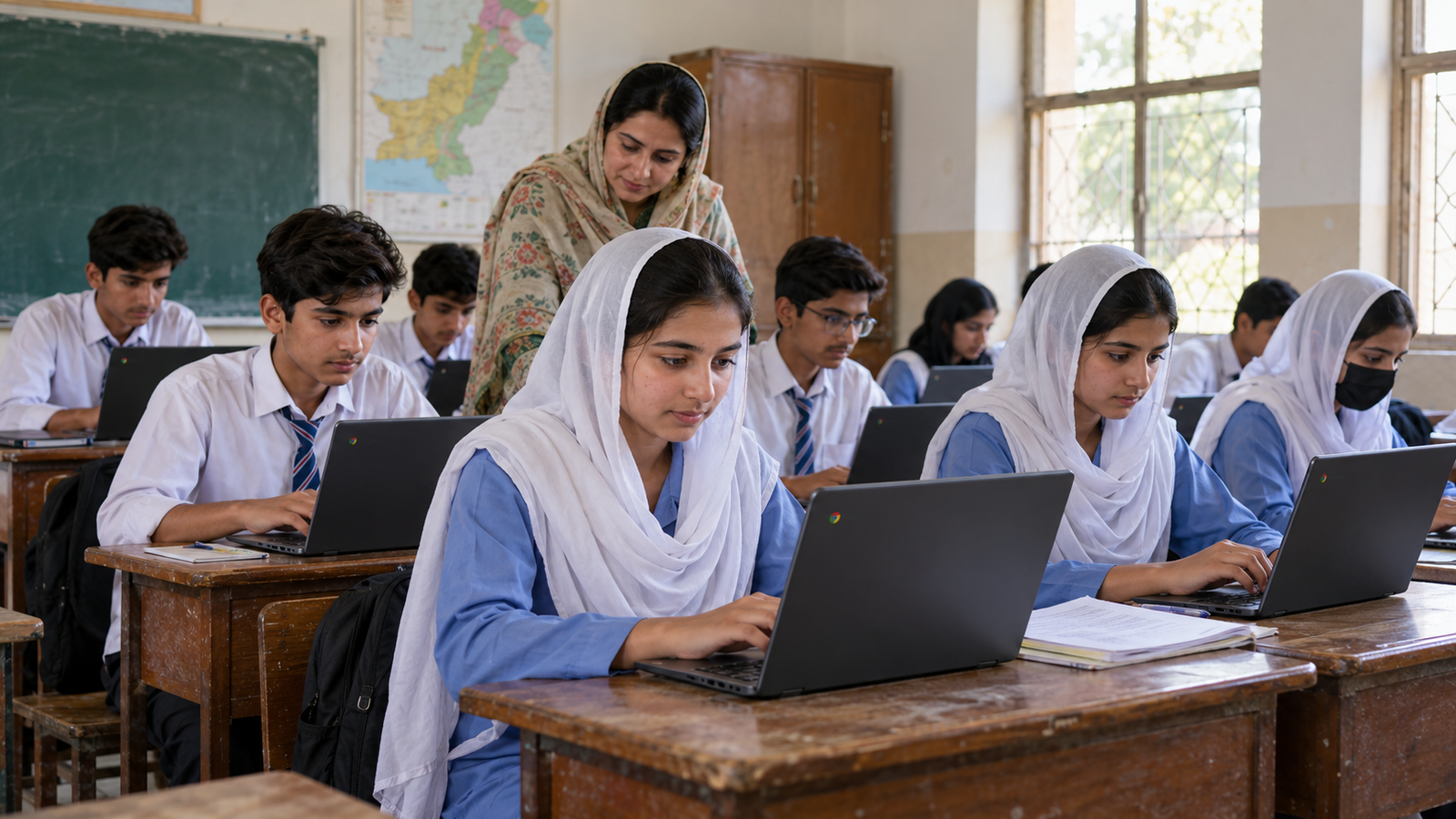
Pakistan has formally launched the Prime Minister’s Youth Chromebook Scheme, a national initiative intended to provide 500,000 refurbished Chromebooks and internet connectivity to selected students. Prime Minister Shehbaz Sharif inaugurated the programme in Islamabad on October 25, 2026, with the announcement receiving further coverage on October 26. Radio Pakistan, Dawn, Geo News and Business Recorder independently reported the ceremony and its principal targets.
The government says the devices will be distributed on merit, with the prime minister announcing a target of completing distribution within two years. Some earlier briefing reports mentioned a three-year implementation period, so the two-year figure is best described as the prime minister’s latest publicly stated target rather than proof that all deliveries will be completed on schedule. Officials gave Chromebooks and MiFi devices to students during the launch event.
For students and families, the most useful development is the availability of an official application portal operated under the Inter Boards Coordination Commission, or IBCC. Its published criteria are narrower than some general reports about the overall programme. Applicants should rely on the portal rules for the current application route rather than assuming every school, grade or stream can register immediately.
Key Facts at a Glance
Programme: Prime Minister’s Youth Chromebook Scheme.
Launch date: October 25, 2026.
Total target: 500,000 refurbished Chromebooks.
Latest announced rollout target: Within two years, according to the prime minister.
Digital access: MiFi internet devices or connections announced alongside Chromebooks.
Merit: Academic performance and verified examination records.
Current IBCC online portal: https://pmychromebooks.ibcc.edu.pk/
Current online applicant category: High-performing government/public-school students in designated SSC examination classes, subject to regional rules.
Punjab, Sindh, Khyber Pakhtunkhwa and Balochistan: Grade 9 (SSC-I) Annual Examination 2026.
Islamabad Capital Territory, Azad Jammu and Kashmir and Gilgit-Baltistan: Grades 9 and 10, based on 2026 annual examinations.
Special note: Sindh registration will open after boards announce Class 9 annual results, according to the portal.
Some reported allocations for registered madaris and other institutions are separate from the public-school online eligibility notice; those pathways require further official instructions.
Who Is Eligible to Apply Online?
The IBCC portal currently specifies that top-performing students from government or public schools may be considered under the scheme. For boards in Punjab, Sindh, Khyber Pakhtunkhwa and Balochistan, the current online category is Grade 9, also called SSC-I, using Annual Examination 2026 results. For boards in Islamabad Capital Territory, Azad Jammu and Kashmir and Gilgit-Baltistan, it includes high achievers in both Grade 9 and Grade 10, or SSC-I and SSC-II, using the same examination year.
The portal expressly states that only students enrolled in government or public schools qualify under its posted eligibility criteria. It does not establish a universal right to a free device for all students or anyone who completes an online form. Academic standing, examination-board records and any applicable regional allocation remain relevant.
Some reporting sourced to education ministry officials describes additional categories, including students from foundation-funded private schools and registered religious seminaries. Those categories should not be conflated with the currently displayed public-school registration process. Families outside the portal’s stated eligibility should wait for instructions relevant to their institutions instead of entering inaccurate information.
Is There a Minimum Marks Requirement?
Geo News reported, citing education ministry officials, that the merit process would use the latest SSC-I examination results verified by IBCC, with a minimum threshold of 50 percent. It also described ranking students within province or region, examination board and educational stream until the allocated quota is filled.
The public portal page currently prioritises the term ‘top-performing students’ and its regional grade rules. It does not, in the text reviewed, make a promise that every applicant scoring 50 percent will receive a Chromebook. The reported minimum is therefore best understood as a potential threshold for assessment, not a guaranteed allocation.
Applicants should submit their real results and verify whether the correct examination board records are available. Final merit selection is a separate step from application submission.
How to Apply Through the Official IBCC Portal
The currently published process is straightforward. First, visit https://pmychromebooks.ibcc.edu.pk/ and select the relevant examination board. Enter the requested identification number and date of birth so the system can find the examination record. Review the name, school and marks retrieved from the board’s list, making sure they match official documents.
Next, upload the required photo, mark sheet and attested identity documents in the portal’s accepted formats. Review the entire form carefully, then submit. The system provides a reference number and a downloadable acknowledgement slip. Retaining both will help applicants check details or raise a question through an authorised channel.
According to the portal, each student may submit only one application, and applicants cannot independently edit the form after final submission. If the board record is not found, students can try an eligible alternative identifier such as a roll number or registration number. Persistent problems should be taken to the relevant examination board rather than solved by inventing information or using an unofficial intermediary.
Documents Required for Chromebook Registration
The IBCC website lists a recent colour photograph with a plain background, the relevant SSC-I or SSC-II mark sheet, an attested copy of the student’s B-Form or CNIC, and an attested copy of the father’s or guardian’s CNIC. The photo can be a JPG or PNG file, while the mark sheet and identity-document copies may be uploaded in JPG, PNG or PDF formats as indicated on the portal.
The portal currently shows a file-size limit of up to 300 KB for each listed upload. Students should follow the on-screen instructions and ensure scanned documents are legible. Names, examination numbers and dates of birth should match official board records.
These instructions are for the official online route visible on October 26. Different channels for registered madaris or other special categories may involve separate verification procedures, and families should avoid assuming that one portal list describes every possible pathway.
Important Notice for Students in Sindh
IBCC has posted a special notice for Sindh applicants. Registration for students of Sindh will open on the same official portal after all relevant examination boards announce their 2026 annual Grade 9 results. Consequently, a student from Sindh who cannot yet register should not assume the scheme is cancelled or that they have been permanently excluded.
It is important to check the actual board result announcements and the portal notice before attempting to apply. There is no verified single nationwide final registration deadline in the material reviewed. Deadlines may depend on the board and phase, so specific dates shared in social-media messages should be confirmed with the authorities.
Likewise, students in other regions should check whether the relevant registration function is active and whether their result records have been uploaded.
Province-Wise Chromebook Allocation
Geo News and ProPakistani reported a proposed allocation of 181,090 Chromebooks for Punjab, 85,925 for Sindh, 51,170 for Khyber Pakhtunkhwa and 31,815 for Balochistan. The reports also listed 100,000 for Islamabad and 25,000 each for Azad Jammu and Kashmir and Gilgit-Baltistan. Those figures total 500,000.
The same reports described an overall share for school students and registered religious seminaries. This is a reported planning distribution, not confirmation that every device has already been delivered. An allocation is also not the same as a final individual merit list.
The government should be expected to publish operational details and transparent selection outcomes as implementation advances. If a later official quota document changes the numbers, editors should update the figures with the date of the revision.
Are Madrasa Students Included?
Yes, the official launch explicitly discussed access for deserving students from religious seminaries. The prime minister, ministers and organisers described inclusion across educational backgrounds, and students from seminaries received devices at the ceremony. Dawn reported a statement that one out of five Chromebooks would be allocated to students of registered madaris, while detailed reporting mentioned separate verification through religious education authorities.
However, the current IBCC portal’s general eligibility page specifies public-school applicants. This creates an important distinction between the programme’s wider allocation and the form available to a particular applicant today. A registered madrasa student should seek the official institutional procedure rather than assume the public-school portal will recognise a seminary record.
The fact that a category appears in launch statements is not evidence that its exact registration instructions have already been published on the same portal.
What Is a Refurbished Chromebook?
A Chromebook is a laptop primarily designed to run ChromeOS and internet-focused applications. It can be useful for web-based learning, document creation, video lessons and accessing educational resources, although the exact functions depend on the device model, specifications, software support and available internet connectivity.
Geo and Dawn reported that the programme’s devices are refurbished. This usually means previously manufactured or used equipment has been inspected, prepared or restored for further use, rather than every Chromebook being a newly manufactured retail device. The announcement did not give complete model-level specifications for every unit.
Students should therefore not assume a particular processor, storage capacity, battery runtime or software support deadline. These questions matter because a laptop’s educational value depends on reliability, updates and suitability for the intended activities.
What Does the MiFi Device Provide?
The prime minister and programme officials said students would receive MiFi internet devices or connectivity alongside the Chromebooks. A MiFi device provides portable wireless internet connectivity to compatible devices through a mobile data connection. Its usefulness depends on mobile coverage, an active data arrangement and the terms of service.
The government suggested that an internet connection could serve several family members, giving the initiative a possible reach beyond the individual recipient. Officials cited a broader potential audience of approximately 2.5 million people. This is a projection of possible usage, not an audited total of people who already received internet service.
Important remaining questions include any data limits, subscription duration, network operator and renewal conditions. Students should rely on official distribution documents for these practical details.
Who Is Implementing the Scheme?
The programme involves the Ministry of Federal Education and Professional Training and the Prime Minister’s Youth Programme, with IBCC providing the online registration infrastructure and examination-record verification route. Government reporting also identified Tokyo Technology Care Foundation as a partner supporting the initiative.
The foundation’s chairman, Rashid Minhas, took part in the launch, and officials said a memorandum of understanding supports the effort to widen digital access. The presence of a foundation partner does not necessarily mean every service, delivery or device-repair obligation falls to that organisation.
Clear assignment of responsibilities among schools, boards, the ministry, programme managers and suppliers will matter as applications move into merit selection and distribution.
How Will Devices Be Selected and Delivered?
Education ministry officials quoted by Geo News described merit ranking based on verified examination records, followed by checks against enrolment and school information. The reported distribution model includes associating each device’s serial number with an approved recipient, delivery through couriers and a tracking system for dispatch and receipt.
Grievance committees at relevant board and provincial or regional levels have also been described in coverage, along with arrangements for later repairs and maintenance. These elements represent reported implementation plans; their effectiveness can only be evaluated once deliveries begin at scale and official outcomes are available.
Applicants should not treat a submitted form or generated reference slip as confirmation of selection. A completed merit assessment and authorised distribution notice are separate stages.
What if a Student’s Record Is Missing?
The official portal advises students to use available identifiers such as a roll number or registration number if a CNIC or B-Form search does not find their record. If the record remains unavailable, the student should contact the relevant examination board. This is particularly important because the portal draws examination details from external board records.
Students should not create multiple applications using different spellings or provide false marks to bypass a validation problem. The portal warns that false information may cancel an allocation and lead to further action. Inaccurate submissions can also complicate genuine applicants’ verification.
Before submitting, families should check the student’s full name, school, examination results, guardian details and uploaded evidence.
How Does the Scheme Differ From Older Laptop Programmes?
The prime minister said past administrations had distributed around 600,000 laptops over the preceding decade and presented the new Chromebook target as a faster effort to broaden access. That retrospective number is a government statement, not a newly audited evaluation of the older schemes.
This initiative places particular emphasis on refurbished Chromebooks and internet access, rather than only ownership of a laptop. The government also highlighted high-performing secondary-school students and seminary inclusion. These design features may affect who benefits and how devices are used compared with earlier university-focused initiatives.
The most important assessment will be whether eligible students receive functional equipment, whether internet access is sustained and whether devices support their educational needs over time.
Potential Benefits and Limitations for Students
Access to a computer can help with online lessons, digital research, practice exams, document preparation and learning technology skills. MiFi connectivity may also support students in homes without fixed broadband. However, these benefits depend on the quality of the equipment, usable software, network coverage and guidance from teachers.
A refurbished laptop may need maintenance, replacement parts or future software updates. Internet access could involve costs or data limits not yet described in the launch announcements. The government has not provided enough information to establish a guaranteed device lifetime or universal performance standard.
Neutral reporting should recognise the educational objective while leaving space for questions about procurement, delivery fairness, repair arrangements and the real experience of recipients.
Avoid Fake Registration Links and Scams
A programme attracting large public interest can also generate misleading advertisements and unofficial registration offers. Students should use the verified official IBCC Chromebook domain and avoid sending identity documents to links shared through random social-media posts or private messaging groups.
The portal should be opened directly through its verified address: https://pmychromebooks.ibcc.edu.pk/. Families should look for the correct government-linked domain and not pay individuals claiming they can guarantee merit selection. The official portal page reviewed does not establish an authorised paid fast-track route.
Because applicants may upload sensitive identity documents, they should use trusted devices and networks where possible and retain their reference slips securely.
Unanswered Questions and Next Official Updates
The programme is confirmed, and the IBCC portal contains practical guidance for public-school applicants. Nevertheless, media reports vary on the implementation timeline and on how wider institutional categories fit alongside the portal’s eligibility limits. Specific deadlines may vary by board, and the available public sources do not fully describe internet-package terms or device models.
Future updates should establish the final distribution calendar, published merit lists, handling of registered madaris and foundation-supported institutions, warranty and repair terms, and the number of devices actually delivered. If new directions conflict with previously reported rules, the later authenticated official notice should take precedence.
Mukhbir will distinguish announced targets from completed distribution and will not present an unverified eligibility claim as an official guarantee.
Conclusion
The PM Youth Chromebook Scheme is a confirmed national programme launched on October 25, 2026, with a target of distributing 500,000 refurbished devices and supporting internet access. The prime minister says the scheme will be delivered on merit and aims for completion within two years.
For students seeking to apply now, the most reliable starting point is the official IBCC registration portal. Its current eligibility page covers specific public-school examination classes by region, while broader announcements also describe separate inclusion for religious seminaries. Applicants should check their board, prepare the required documents, submit accurate details and treat their application slip as an acknowledgement rather than proof of selection.
Frequently Asked Questions
Is the PM Youth Chromebook Scheme 2026 officially launched?
Yes. Prime Minister Shehbaz Sharif launched the initiative in Islamabad on October 25, 2026.
How many Chromebooks will be distributed?
The announced national target is 500,000 refurbished Chromebooks, with a two-year completion target stated by the prime minister.
What is the official registration website?
The official IBCC application portal is https://pmychromebooks.ibcc.edu.pk/.
Which classes can apply through the current public-school portal?
Punjab, Sindh, KP and Balochistan: Grade 9; ICT, AJK and GB: Grades 9 and 10, using the specified 2026 examination records.
Can private-school students apply?
The current IBCC public application page says only government/public-school students qualify under that route. Separate reports describe a wider programme involving other institutional categories, for which official procedures should be checked.
What documents are needed?
A recent photograph, SSC mark sheet, attested B-Form or student CNIC, and attested father or guardian CNIC copy, within the portal’s size and format rules.
Is the scheme open for Sindh students?
The portal says Sindh registration will open after all relevant Grade 9 examination boards announce their 2026 annual results.
Does registering guarantee a free Chromebook?
No. Applicants remain subject to merit ranking, verification, allocation and subsequent official selection.
About The Author