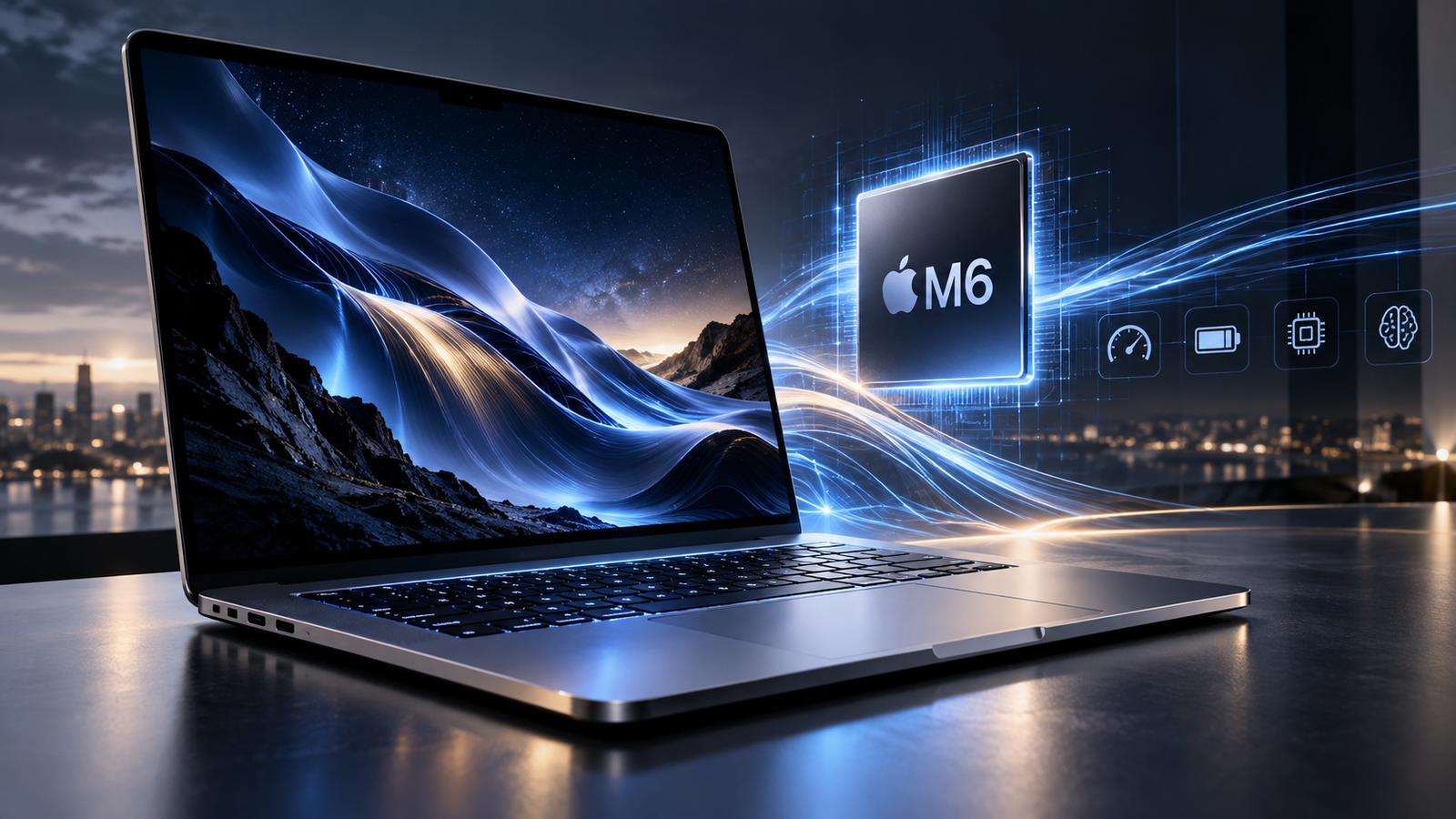
Apple M6 MacBook Pro has officially been announced, bringing a faster processor, improved on-device artificial intelligence performance, updated wireless connectivity and up to 24 hours of claimed battery life to the company’s 14-inch professional laptop. Apple unveiled the machine on October 27, 2026, with pre-orders opening October 28 and retail availability scheduled for November 6. The base model starts at $1,999 in the United States. Apple’s announcement focuses on a 12-core CPU and 12-core GPU, higher memory bandwidth and support for AI features built into macOS 27. Here is what the confirmed specifications mean for creators, developers, students and other prospective buyers.
Apple M6 MacBook Pro: Key Facts and Specifications
Product: Apple 14-inch MacBook Pro with M6.
Announcement: October 27, 2026.
Pre-orders: October 28, 2026, in eligible markets.
Scheduled retail availability: November 6, 2026.
US starting price: $1,999; eligible US education price: $1,899.
Processor: M6 with 12-core CPU and 12-core GPU.
AI hardware: GPU Neural Accelerators and Dual 16-core Neural Engine.
Memory: 16GB unified memory standard, configurable up to 32GB.
Memory bandwidth: Up to 170GB/s.
Storage: 1TB base storage according to MacRumors; configuration up to 4TB.
Battery life: Up to 24 hours under Apple’s specified testing conditions.
Wireless: Wi-Fi 7 and Bluetooth 6.
Display: 14-inch Liquid Retina XDR, optional nano-texture finish.
Camera: 12MP Center Stage.
Speakers: Six-speaker sound system.
Operating system: macOS 27 Golden Gate.
Colors: Space Black and Silver.
Pakistan price and official availability: Not confirmed by Apple’s global launch statement.
What Did Apple Announce?
Apple introduced the standard M6 version of its 14-inch MacBook Pro on Tuesday, October 27. The announcement upgrades processing and wireless technologies without presenting a completely new laptop category. Apple positioned the machine for people working across productivity, software development, photography, design and AI-assisted workflows. Importantly, this launch is for the base M6 chip; it is not an announcement of M6 Pro or M6 Max configurations. That distinction matters for buyers comparing different MacBook Pro tiers. The new model is available for pre-order in 35 countries and regions beginning October 28, with sales and deliveries scheduled from November 6.
How Much Does the Apple M6 MacBook Pro Cost?
The official US starting price is $1,999, with eligible education customers offered a starting price of $1,899. Those are US reference prices, not universal prices. Taxes, storage and memory upgrades, regional retail policies and currency exchange rates can affect the final amount paid. Apple’s India newsroom lists a starting price of ₹239,900, illustrating why simply converting the US figure does not produce an official local price in another market. Apple’s press release does not provide a Pakistan-specific retail price or confirmed official local sales date. Consumers should verify listings and warranty conditions with an authorized channel before ordering.
M6 Processor: What Changed From M5?
The M6 uses a 12-core CPU and 12-core GPU, compared with the ten-core CPU and GPU configuration used in Apple’s specified M5 comparison system. Apple says the M6 graphics subsystem can deliver up to 30 percent higher graphics performance and up to 25 percent faster performance in selected AI workloads than that M5 system. These are manufacturer claims based on defined tests, not guaranteed speed improvements for every application. Everyday responsiveness will depend on workload, memory needs, software and thermal conditions. Still, greater core counts and bandwidth suggest the greatest advantages may arise during sustained creative work, complex compiling and demanding AI tasks.
What Is the Dual 16-Core Neural Engine?
Apple describes the M6 as featuring a Dual 16-core Neural Engine alongside Neural Accelerators in each GPU core. The specialized hardware is intended to accelerate machine-learning operations, including processing used by AI features and certain creative applications. The company claims the Neural Engine can be up to 1.9 times faster than that of M5 in its selected tests. Buyers should distinguish Neural Engine benchmarks from general app speed; a program must be designed to take advantage of the relevant hardware before it benefits fully. AI processing can also depend on available memory, model size, storage speed and the software framework used.
On-Device AI and Running Language Models Locally
One of Apple’s major selling points is stronger performance for AI tasks that can run locally on the laptop. In principle, local processing can reduce dependence on a remote server for some jobs and allow eligible operations to use information without sending it to a cloud service. Apple specifically highlights on-device large language model workloads, image enhancements and other AI-assisted functions. However, not every Apple Intelligence or Siri feature runs entirely on-device, and certain server-backed tools have their own service conditions and usage limits. Running a large model locally also requires enough memory and appropriate software. Performance varies significantly with model size, precision and task.
Apple’s Claimed Creative and Developer Benchmarks
Apple’s release includes comparisons to older M1 systems and the previous 14-inch M5 model. For its selected tasks, it claims up to 13 times faster time to first token in LLM prompt processing than the older 13-inch M1 MacBook Pro and up to 1.3 times faster than the M5 14-inch model. In Blender ray-tracing rendering, the respective claimed improvements are up to 11.7 times and 1.3 times. The company also lists up to 3.3 times faster image processing in Affinity than M1 and up to 1.2 times compared with M5, and up to 2.5 times faster Xcode project builds than M1 and 1.3 times versus M5. These are task-specific comparisons, not universal multipliers.
How Much Memory and Storage Does It Offer?
The M6 MacBook Pro begins with 16GB of unified memory, with configurations up to 32GB. Apple reports memory bandwidth as high as 170GB per second. Unified memory is shared among components such as the CPU, GPU and AI accelerators, which can improve the handling of certain integrated workflows. It also means capacity needs careful consideration because memory is part of the system architecture rather than an ordinary user-replaceable laptop module. MacRumors reports a 1TB starting SSD and storage options reaching 4TB. Large media projects, local AI models and development environments can quickly consume both storage and memory, making configuration choices particularly important for professional buyers.
Battery Life: What Does Up to 24 Hours Mean?
Apple quotes up to 24 hours of battery life, describing it as the longest achieved in a Mac. The number reflects testing under specified conditions; it should not be interpreted as a promise of 24 hours of heavy video rendering, gaming or continuous large-model inference. Display brightness, wireless activity, connected accessories, ambient temperature and app demands can all change runtime. Apple’s marketing emphasizes performance whether the computer is connected to power or working from its battery. A prospective buyer should compare test methods with their own usage patterns and wait for independent testing if endurance under a particular professional workload is a deciding factor.
Display, Camera, Sound and Connectivity
The machine retains a 14-inch Liquid Retina XDR display with an optional nano-texture treatment, designed to improve usability under challenging lighting conditions. It also includes a 12MP Center Stage camera, six-speaker sound system and a selection of physical ports. The new wireless configuration supports Wi-Fi 7 and Bluetooth 6, upgrades over the previous generation’s Wi-Fi 6E and Bluetooth 5.3 in standard-model comparisons. Faster wireless standards can be useful for network-intensive workflows, but real-world performance depends on compatible routers, devices and local networks. Buyers should check the precise number and specification of available ports against the product’s technical specification page before committing to a particular accessory setup.
macOS 27 Golden Gate and Siri AI
The M6 MacBook Pro ships with macOS 27 Golden Gate. Apple highlights a more conversational Siri AI experience, expanded contextual tools, improved Spotlight integration and Apple Intelligence features across supported applications. The company also mentions improvements in Safari tab organization, website-change alerts, Shortcuts automation and photo editing. Availability is not uniform across languages, regions or software versions. Apple states that Siri AI is in beta in macOS 27.2 and requires a supported language and eligible device. Some server-based features may face usage limits. The existence of a hardware AI accelerator therefore does not mean every advertised AI feature is immediately available to every buyer in every country.
Is the M6 MacBook Pro Worth Upgrading From M5?
For owners of the immediately preceding M5 system, the manufacturer-reported increases in graphics, selected AI work and wireless capabilities may be attractive if those workloads consume a meaningful part of the working day. But a 25 or 30 percent peak benchmark claim does not automatically justify the price of replacing a recently purchased computer. The decision depends on whether current tasks are constrained by processing capacity, memory, network standards or battery endurance. People performing mainly web browsing, documents and video calls may see fewer practical benefits. Professionals whose jobs depend on rendering, compiling or local AI experimentation have more reason to examine task-specific benchmarks and total upgrade costs.
What About Buyers Moving From an M1 MacBook?
The gap is more substantial for users with an older M1-based MacBook, particularly for work involving modern graphics or local AI tools. Apple’s stated comparisons show much larger improvements than those measured against M5, although the M1 and M6 machines also differ in chassis, memory options and software generation. Owners should consider battery health and whether existing software still runs acceptably on their current hardware. A replacement could deliver value through connectivity, screen, camera and storage improvements alongside processing speed. However, older-model trade-in value, local resale prices and workflow compatibility can influence the economics as much as headline benchmark claims.
What Does the Launch Mean for Students and Creators?
The M6 configuration targets a range of users, but not every student needs a professional laptop costing nearly $2,000. University learners who compile large projects, work with design or video editing, or experiment with AI models may appreciate the additional performance. Creators could benefit from graphics improvements, fast internal storage and a color-capable display. Buyers focused on note-taking, research and everyday office tasks should compare lower-cost alternatives as well. Apple’s education price applies to eligible customers under its regional rules, and cannot be assumed to be available through every reseller. A laptop should be selected for actual software requirements, budget and warranty support.
Pakistan Price and Availability: What Is Confirmed?
Apple’s October 27 newsroom release names pre-orders in 35 countries and regions but does not confirm an official Pakistan price. It would be misleading to multiply $1,999 by a prevailing exchange rate and present the result as a verified Pakistan retail listing. Imported devices may involve additional duties, local reseller margins, warranty differences and currency fluctuations. Pakistani consumers should check the exact configuration, invoice, power adapter, keyboard layout and return policy before making a purchase. Availability through a third-party store is also not the same as direct official Apple Store distribution. An official local offer should be reported only after evidence appears from a reliable authorized sales channel.
Business and Technology Impact of the M6 Release
The launch underscores the competition among major computer manufacturers to improve personal AI performance and reduce reliance on remote computation for selected tasks. Apple is promoting its vertically integrated combination of silicon, operating system and applications. This approach can create smoother product integration, although it also places users within Apple’s hardware and software ecosystem. For developers, better local AI performance could make experimentation more convenient; for businesses, procurement decisions will still depend on security controls, compatibility, support and operating costs. The presence of specialized AI hardware does not establish that every organization will achieve a positive return on upgrading its computers.
Environmental Claims and Repairability
Apple says the M6 MacBook Pro contains 45 percent recycled content overall, including fully recycled aluminum in the enclosure and recycled cobalt in the battery. The company states that production uses 60 percent renewable electricity across the supply chain and that its paper packaging is fiber-based. These are manufacturer-reported sustainability figures. They should be distinguished from an independent full lifecycle assessment of the device or a guarantee that the product has no environmental impact. Longer service life, access to repairs and responsible recycling are also important considerations. Buyers assessing sustainability may wish to compare the environmental cost of replacing working equipment against the advantages of a new system.
When Do Pre-Orders and Sales Begin?
Apple says pre-orders open Wednesday, October 28, 2026, through its online store and Apple Store app in eligible regions. The company schedules delivery and sales through Apple Stores and authorized resellers from Friday, November 6. MacRumors reports a specific opening time of 10:10 a.m. Pacific Time for pre-orders. Order availability can vary by configuration and market, and delivery estimates may change with demand. The announcement confirms planned availability, not that every configuration will ship immediately to every buyer. Customers should rely on the current checkout page for final delivery terms, taxes, availability and local warranty conditions.
What Happens Next?
The coming retail release will allow reviewers and customers to test Apple’s claims in real-world applications, especially sustained graphics workloads, local AI processing, thermal behaviour and battery endurance. Independent testing will be useful for comparisons with the M5 version and other professional laptops. Buyers should also monitor regional pricing and compatibility with their existing accessories and software. The 2026 launch announcement offers detailed specifications, but it cannot by itself determine whether the M6 will be the right long-term value for every user. Mukhbir will distinguish official benchmark claims from later independent review findings when additional information becomes available.
Conclusion
The Apple M6 MacBook Pro represents a measured but important update to the 14-inch professional laptop: a 12-core CPU, 12-core GPU, more specialized AI processing, faster connectivity, higher memory bandwidth and up to 24 hours of claimed battery life. Starting at $1,999 in the US, it enters pre-orders on October 28 ahead of November 6 availability. The most consequential changes are likely to matter to people using demanding creative and AI workflows. Consumers should weigh confirmed specifications against real requirements and regional prices rather than assume manufacturer benchmark gains apply equally to all tasks.
Frequently Asked Questions
When was the Apple M6 MacBook Pro announced?
Apple officially introduced the 14-inch MacBook Pro with M6 on October 27, 2026.
When do Apple M6 MacBook Pro pre-orders start?
Pre-orders begin October 28, 2026, in eligible countries and regions.
What is the Apple M6 MacBook Pro release date?
Apple schedules retail availability and initial deliveries from Friday, November 6, 2026.
How much does the M6 MacBook Pro cost?
The 14-inch model starts at $1,999 in the United States, with eligible US education pricing starting at $1,899.
What CPU and GPU are in the M6 MacBook Pro?
The base M6 configuration has a 12-core CPU and a 12-core GPU, according to Apple’s launch announcement.
How long does the battery last?
Apple claims up to 24 hours under its testing conditions; actual runtime varies by use and configuration.
Is the M6 MacBook Pro faster than the M5?
Apple reports up to 30 percent faster graphics and up to 25 percent faster selected AI workloads than its specified M5 comparison system.
What is the official Apple M6 MacBook Pro price in Pakistan?
Apple’s launch statement does not list a confirmed Pakistan retail price. Any local figure requires separate verification.
About The Author