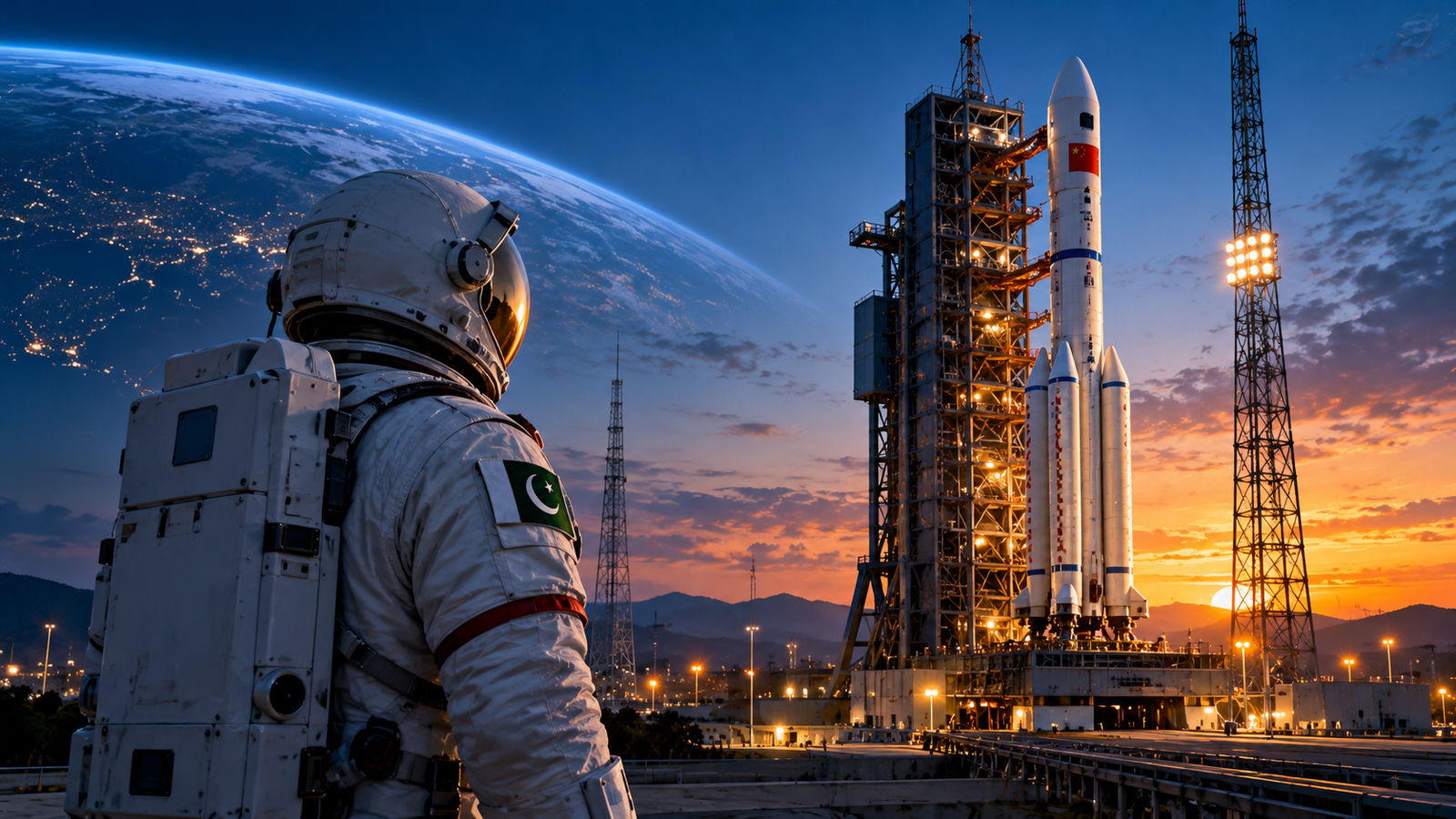
ISLAMABAD, October 19, 2026 – Pakistan is preparing for a landmark step in space exploration. Planning Minister Ahsan Iqbal has announced that the country’s first astronaut is scheduled to undertake a space mission from a Chinese space centre on November 25, 2026.
The Pakistan first astronaut mission 2026 announcement was made during the closing ceremony of World Space Week in Narowal on October 18. The Ministry of Planning published the statement, and Dawn, Business Recorder, ProPakistani and Geo News covered the development. The announcement is a major milestone, but readers should understand its status. November 25 is the date announced by Pakistan’s planning minister. The mission has not yet launched, and a separately verified Chinese launch schedule naming the Pakistani astronaut was not established in the reviewed reports.
Pakistan First Astronaut Mission 2026: Key Facts
Announcement: October 18, 2026.
Announced departure date: November 25, 2026.
Announcing official: Federal Minister for Planning Ahsan Iqbal.
Partner country: China.
Pakistani space agency: Space and Upper Atmosphere Research Commission (SUPARCO).
Chinese partner: China Manned Space Agency (CMSA).
Candidates reported in training: Zeeshan Ali and Khurram Daud.
Expected role: Scientific payload specialist.
Intended destination under the bilateral astronaut programme: China’s Tiangong space station.
Final selected astronaut: Not independently confirmed in the latest reporting.
Additional national ambition: A lunar landing by 2035.
The planned Moon landing is a separate long-term goal, not part of the November 2026 astronaut mission.
What Did Ahsan Iqbal Announce?
At the World Space Week closing ceremony in Narowal, Ahsan Iqbal said Pakistan’s first astronaut would begin a mission from China’s space centre on November 25. Pakistan’s Press Information Department published his remarks. The minister linked the planned mission to the country’s growing cooperation with China in science and advanced technology.
He also said Pakistan was aiming for a Moon landing by 2035 and wanted to encourage the next generation to study space science. The statement establishes the government’s announced schedule. It does not identify the final astronaut by name or publish the detailed Chinese flight plan.
Who Could Become Pakistan’s First Astronaut?
Two Pakistani pilots, Zeeshan Ali and Khurram Daud, have been undergoing training in China. Reuters previously reported their preparations based on interviews with Pakistani space officials. The training includes work designed to prepare candidates for spacecraft operations, life in weightlessness and communication during a space mission.
The final candidate matters because only one of the two trainees is expected to fly under the first mission arrangement. Some media reports discuss the pilots by name, but mentioning a candidate is not the same as confirming that he has been selected. A final announcement from the responsible space agencies will be needed.
Why Is China Helping Pakistan?
Pakistan and China signed a formal agreement on astronaut cooperation on February 28, 2025. SUPARCO’s official programme page describes the arrangement with the China Manned Space Agency. The agreement was designed to allow Pakistani candidates to receive astronaut training in China, with a selected candidate preparing to conduct scientific work aboard the Chinese space station.
This cooperation builds on other space-related projects between the two countries, including satellites and research partnerships. The astronaut mission is therefore not a sudden idea introduced in October. It is part of an existing programme that has been developed over several years.
What Is the Tiangong Space Station?
Tiangong is China’s space station in low Earth orbit. Astronauts live and work there while conducting experiments in an environment where they experience microgravity. A space station is different from a rocket. A rocket launches the spacecraft, while the station provides a place where astronauts can work after reaching orbit.
Research in space can help scientists study how physical and biological systems behave when gravity’s everyday effects are greatly reduced. SUPARCO’s agreement identifies the Chinese space station as the planned destination for Pakistan’s first astronaut programme. Final mission arrangements should still be checked against later official notices.
What Does a Payload Specialist Do?
A payload specialist is an astronaut who focuses on specific scientific or technical tasks during a mission. Instead of being responsible for piloting a spacecraft, the specialist may operate equipment, monitor experiments and collect data for researchers on Earth.
Reuters reported that Pakistan’s selected astronaut was expected to carry out scientific experiments in orbit. Such work could include studying materials or biological processes under microgravity, although a final official experiment list for the November mission was not provided in the latest ministerial announcement.
Why Does Astronaut Training Take So Long?
Spaceflight is demanding even for highly experienced pilots. Astronauts must learn how spacecraft systems work and what to do when conditions are unexpected. Training may involve simulators, centrifuge exercises, safety procedures and practice moving and working in confined environments.
Astronauts also need to understand how everyday activities change in weightlessness. Eating, sleeping and using equipment in orbit are different from doing them on Earth. Reuters reported that the Pakistani trainees have been learning Mandarin to work within China’s space programme. These preparations help explain why an astronaut mission requires long-term cooperation.
What Is Microgravity?
Microgravity describes conditions where people and objects experience a near-weightless environment while orbiting Earth. Gravity has not disappeared in orbit. A spacecraft and its occupants are continuously falling around Earth together, creating the appearance of weightlessness inside.
This environment allows scientists to study phenomena that are harder to examine on the ground. For example, researchers may study how fluids behave, how materials form or how organisms respond when they are not subject to the same everyday gravitational forces.
How Could the Mission Help Pakistan’s Scientists?
A space mission could give Pakistani researchers access to a new environment for experiments. It might also encourage collaboration between universities, engineers and institutions involved in life sciences, materials research and space technology.
However, the benefits depend on which experiments are actually selected, the results collected and whether researchers are able to publish and use the findings. The minister’s announcement should not be described as proof that new discoveries have already been made in orbit.
What Is Pakistan’s Moon Landing Goal for 2035?
Ahsan Iqbal said Pakistan aims to achieve a lunar landing by 2035. This is an ambition for a future mission rather than a completed technical achievement. A lunar landing requires spacecraft capable of travelling to the Moon and reaching its surface safely. The design, budget, payload and international partnerships would all be important parts of such a programme.
Reuters has separately reported that Pakistan is involved in plans for a rover on China’s Chang’e-8 mission around 2028. A robotic lunar rover mission and a human landing are not the same. The government statement does not confirm that a Pakistani astronaut will walk on the Moon in 2035.
What Other Space Projects Does Pakistan Have?
SUPARCO is Pakistan’s national space agency. Its work relates to satellites, remote sensing, atmospheric research and international cooperation. Satellites can help provide information for telecommunications, agriculture, environmental monitoring and disaster management.
A human spaceflight mission would add a different kind of capability, involving astronaut training and scientific work in orbit. These fields support one another, but sending an astronaut does not automatically mean Pakistan can independently design or launch every type of spacecraft.
Why Is Space Technology Important for Agriculture?
Satellite observations can help researchers study crop conditions, water availability and changing land use. Images from orbit can support planning by showing large areas that would take much longer to inspect on the ground.
For Pakistan, such information could be useful when monitoring drought, irrigation needs and flood-affected farmland. The minister identified agriculture as one of the areas where space technology matters. He did not announce a specific new crop-monitoring service as part of the November astronaut flight.
Space Research and Climate Monitoring
Pakistan faces major environmental challenges, including floods, drought and changing mountain glacier conditions. Satellites can help collect information about weather patterns, land cover and bodies of water. This information can support scientific analysis and public planning.
Space research alone cannot prevent natural disasters, but reliable observations can improve understanding and preparedness. The upcoming astronaut mission may also encourage broader scientific interest, even though remote sensing and human spaceflight involve different equipment and objectives.
What Is the Proposed Space Museum in Narowal?
Ahsan Iqbal announced plans to establish Pakistan’s first Space Museum at the University of Narowal. The proposed museum is intended to help students and members of the public learn about astronomy and space technology.
The minister also highlighted the university’s performance at the Islamabad Science Festival. The museum is an announced project. The latest reports do not provide a verified public opening date or confirm that the completed museum is already welcoming visitors.
Why the Mission Matters for Young Pakistanis
Space exploration brings together physics, mathematics, engineering, computing, medicine and other subjects. A national astronaut programme may encourage students to think about careers they have not considered before.
Not every student needs to become an astronaut to contribute to space science. Software engineers, technicians, researchers and educators all play valuable roles. The best long-term outcome would be stronger opportunities to learn, experiment and participate in research across Pakistan.
Is November 25 a Guaranteed Launch Date?
No launch date should be treated as guaranteed until the responsible mission operators confirm the final schedule. Rocket launches can be delayed by technical inspections, weather conditions, safety reviews or changes in mission readiness.
Pakistan’s planning minister has announced November 25, and official Pakistani reporting confirms that statement. But the final mission assignment, flight designation and Chinese operational confirmation should be checked again before publishing a countdown or describing the launch as certain.
How Competitors Covered the News
Dawn and Business Recorder focused on the minister’s announcement and the November 25 schedule. ProPakistani highlighted the first-astronaut milestone and the Moon-landing target. Geo News connected the mission with the planned space museum and Pakistan–China cooperation.
Reuters’ earlier reporting added deeper context about astronaut selection, training and the expected scientific role. Mukhbir’s approach is to combine the verified announcement with a clear explanation of what remains pending, rather than treating a planned flight as a mission already completed.
What Happens Next?
The next important development will be confirmation of which Pakistani candidate will fly. Readers should also watch for a Chinese mission announcement, flight details, the science programme and an updated launch schedule.
If the flight goes ahead, reporting can then move from preparation to the astronaut’s actual activities and research in orbit. Until that point, the headline should continue to say the mission is planned or scheduled, based on the Pakistani minister’s statement.
Conclusion
Pakistan’s first astronaut mission is scheduled for November 25, 2026, according to Planning Minister Ahsan Iqbal. The programme builds on a formal partnership between SUPARCO and China’s human spaceflight agency. Two Pakistani candidates have undergone training, but the final flyer has not been independently confirmed in the reviewed reports.
The announcement gives Pakistan an important scientific goal and has strong educational value. Its success will be measured by the confirmed launch, the scientific work completed and the opportunities created for future researchers.
Frequently Asked Questions
When is Pakistan’s first astronaut mission planned?
Planning Minister Ahsan Iqbal announced November 25, 2026, as the planned date.
Who will be Pakistan’s first astronaut?
Zeeshan Ali and Khurram Daud are the two reported candidates. The final flyer has not been independently confirmed in the latest reporting.
Which country is helping Pakistan?
China is supporting the programme through cooperation between SUPARCO and the China Manned Space Agency.
Will the Pakistani astronaut go to the Moon?
The immediate astronaut programme concerns spaceflight and work linked to China’s space station, not a confirmed human Moon landing.
What is a payload specialist?
An astronaut who performs specialised scientific or technical tasks during a mission.
Is the November 25 launch date final?
It is an officially announced Pakistani government schedule, but launch operations and exact timing may still change.
When does Pakistan plan to land on the Moon?
Ahsan Iqbal announced a national lunar-landing target for 2035.
Is Pakistan opening a space museum?
The government has announced plans for a Space Museum at the University of Narowal; an opening date was not confirmed.
About The Author