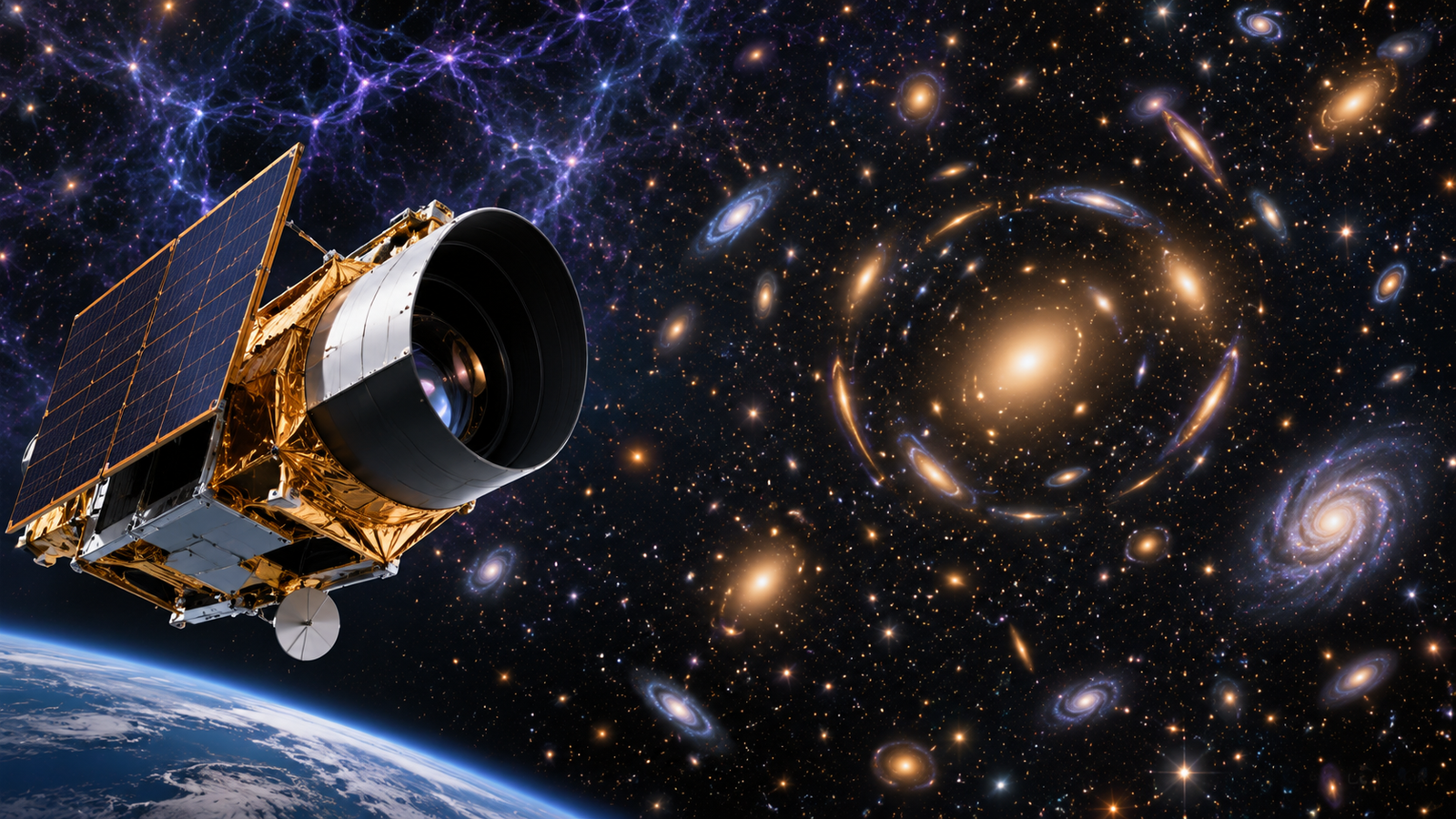
The European Space Agency (ESA) has released one of the most significant astronomical datasets in recent years through its Euclid space telescope, providing scientists with an extensive new view of the universe. The first major data release, named DR1-Foundation, contains observations covering more than 900 million galaxies and a vast collection of other cosmic objects. The release marks an important step towards building a detailed three-dimensional map of the universe and improving scientific understanding of dark matter, dark energy and the large-scale structure of space.
Published on November 12, 2026, the dataset represents approximately 13 months of observations collected by Euclid. It covers around 1,900 square degrees of the sky, an area equivalent to approximately 9,500 full Moons as viewed from Earth. The European mission has also identified around 15,000 candidates for strong gravitational lensing and more than 60 million quasar candidates, while providing spectra from over 160 million sources.
The release is important because Euclid is not simply producing attractive images of distant galaxies. Its observations are designed to help researchers measure the distribution of matter, estimate cosmic distances and investigate how the universe has evolved over billions of years. The new dataset gives scientists a much larger collection of observations with which to study the invisible components that influence the formation and expansion of the cosmos.
Although the release represents a major achievement, it is not the completion of Euclid’s mission. The DR1-Foundation dataset covers only about 14 percent of the sky area planned for the telescope’s six-year survey. Additional observations and scientific data products are expected in the coming years, with the full Data Release 1 planned for mid-2027.
What Is the Euclid Space Telescope?
Euclid is a space science mission developed and operated by the European Space Agency to investigate the structure and evolution of the universe. The telescope was launched in July 2023 with a long-term objective of examining the cosmic web, studying dark matter and dark energy, and understanding how galaxies are distributed across space.
The mission uses advanced imaging and spectroscopy instruments to observe distant galaxies across large areas of the sky. Unlike observations made through ground-based telescopes, which must deal with the effects of Earth’s atmosphere, Euclid operates in space and can collect detailed visible and near-infrared observations without atmospheric interference.
Its survey strategy combines wide observations of large regions with repeated observations of selected deep fields. This approach allows scientists to identify enormous numbers of cosmic objects while also examining selected areas in greater detail.
Euclid’s mission is particularly valuable because many of the questions surrounding dark matter and dark energy cannot be answered by observing individual galaxies alone. Researchers need information about how galaxies are distributed, how their shapes and positions relate to one another, and how these structures have changed over cosmic time.
By collecting observations across a large portion of the sky, Euclid is designed to provide the statistical information needed to investigate these questions. The new DR1-Foundation release is the first major step towards achieving that objective.
What Does the New Euclid Data Release Contain?
The DR1-Foundation release includes an extensive collection of images, catalogues, spectra and distance-related measurements gathered during approximately 13 months of observations. According to ESA, the dataset covers around 1,900 square degrees of the Euclid Wide Survey and also includes observations from the mission’s Deep Fields and calibration activities.
One of the most notable findings is the identification of more than 900 million galaxies. The release also contains approximately 15,000 strong gravitational lensing candidates, more than 60 million quasar candidates and spectra from over 160 million sources.
The overall dataset amounts to approximately 1.7 million gigabytes of information. It includes visible and near-infrared space-based imaging, along with supporting observations and measurements that allow researchers to investigate the properties and distances of cosmic objects.
These numbers demonstrate the scale of the mission’s first major data release. They also provide scientists with a large collection of objects that can be studied together rather than treating unusual galaxies or gravitational lenses as isolated discoveries.
The data are intended for use by the wider scientific community. Researchers can examine the released material to investigate galaxy formation, gravitational lensing, cosmic structures and the distribution of matter throughout the universe.
How Euclid Is Helping Scientists Study More Than 900 Million Galaxies
Galaxies are enormous systems containing stars, gas, dust and dark matter. Studying their distribution across the universe can help scientists understand how cosmic structures developed and how matter is organised on the largest scales.
Euclid’s observations provide information about the positions, appearances and light from enormous numbers of galaxies. By combining these observations with distance measurements, researchers can begin placing galaxies within a three-dimensional representation of the universe.
The telescope uses visible and near-infrared observations to capture information from objects that are extremely distant and faint. Light from these objects has travelled for millions or billions of years before reaching the telescope, meaning that astronomers are observing them as they existed in the distant past.
This allows researchers to investigate different stages of cosmic history. By comparing galaxies at different distances, scientists can study how their properties and distribution have changed over time.
The large number of galaxies in the DR1-Foundation release is particularly useful because it improves the ability to study patterns across large populations. Instead of relying on a limited number of examples, researchers can investigate how galaxies behave across different environments and distances.
However, identifying galaxies is only one part of the scientific process. Researchers must also analyse their measurements, account for observational limitations and compare the results with theoretical models before drawing conclusions about the evolution of the universe.
Why the Discovery of 15,000 Gravitational Lensing Candidates Matters
One of the most important elements of the new Euclid release is its collection of approximately 15,000 strong gravitational lensing candidates. These systems provide scientists with a valuable way to study the distribution of mass in galaxies and galaxy clusters.
Gravitational lensing occurs when the gravity of a massive object bends the path of light travelling from a more distant object. A foreground galaxy or galaxy cluster can therefore distort and magnify the light of a background galaxy, producing curved arcs, rings or multiple images.
The effect is predicted by Albert Einstein’s theory of general relativity. It also provides a scientific tool for investigating matter that cannot be observed directly through ordinary light.
A major reason gravitational lensing is important is that it allows scientists to estimate the mass of objects, including the contribution of dark matter. By examining how light is distorted, researchers can investigate how matter is distributed within galaxies and surrounding structures.
The Euclid release contains the largest catalogue of strong gravitational lenses reported by ESA, exceeding previous catalogues combined. It includes different types of systems, such as compound lenses, spiral galaxy lenses and lensed quasars.
Compound lenses are particularly interesting because multiple background galaxies at different distances can be distorted by the same foreground object. These systems can create more complex patterns of arcs and rings, offering additional information about the gravitational field responsible for the distortion.
The catalogue could help researchers study dark matter distributions, galaxy structure and the expansion of the universe. Nevertheless, the objects are identified as candidates requiring further scientific analysis, and their inclusion in the dataset does not mean every candidate has already been fully confirmed.
Understanding Dark Matter Through Euclid’s Observations
Dark matter is one of the major unresolved questions in modern astronomy. Scientists infer its presence through gravitational effects on visible matter, including the movement of stars, the behaviour of galaxies and the bending of light from distant objects.
Although dark matter does not emit or reflect light in the same way as ordinary matter, its gravitational influence can be detected through observations. This makes gravitational lensing an especially useful technique for investigating its distribution.
Euclid’s large collection of gravitational lensing candidates gives researchers more opportunities to study how dark matter is distributed around individual galaxies and within larger cosmic structures.
By examining the way background light is distorted, scientists can estimate the mass responsible for the lensing effect. They can then compare these measurements with the visible matter observed in the same systems.
This research could help scientists test different models of dark matter and improve understanding of how it influences galaxy formation. It may also provide information about how dark matter is organised across large cosmic structures.
However, the new dataset does not represent a direct discovery of dark matter particles. The telescope is observing gravitational effects and collecting evidence that scientists can use to investigate the nature and distribution of this invisible material.
Further analysis will be required to determine how the new observations compare with existing theories.
How Euclid Could Help Explain Dark Energy
Dark energy is another major mystery that the Euclid mission is designed to investigate. Scientists use the term to describe the unknown component associated with the accelerating expansion of the universe.
Observations of distant galaxies and other cosmic structures provide information about how the universe has expanded over time. By measuring distances and studying the distribution of galaxies, researchers can investigate whether the expansion history matches existing cosmological models.
Euclid’s wide survey is particularly valuable because it is designed to collect consistent observations across a very large area of the sky. This can help scientists examine large-scale patterns that would be difficult to study using smaller datasets.
The DR1-Foundation release provides the initial material needed for this wider scientific programme. Its galaxy catalogues, spectra and other measurements can support research into cosmic distances and the structure of the universe.
The full scientific analysis will require additional observations and specialised measurements. ESA has explained that the forthcoming full DR1 release will add important products, including weak gravitational lensing measurements and other information related to galaxy clustering and galaxy clusters.
These future data products will help scientists investigate the relationship between cosmic structure and the expansion of the universe in greater detail.
How Spectroscopy Helps Measure Cosmic Distances
Another important part of the Euclid mission is spectroscopy, a technique used to analyse the light received from distant objects.
When light from a galaxy enters a spectroscopic instrument, it can be separated into different wavelengths, creating a pattern similar to a rainbow. Scientists examine the features within this spectrum to identify information about the object, including its composition and movement.
For distant galaxies, spectroscopy is especially useful because it can help researchers estimate how far away an object is. As the universe expands, light travelling through space becomes stretched towards longer wavelengths. This effect is known as redshift.
By measuring redshift, scientists can estimate the distance and cosmic period associated with many distant objects. These measurements help researchers place galaxies within the larger three-dimensional structure of the universe.
According to ESA, the DR1-Foundation release includes spectra from more than 160 million sources. Euclid’s observations will allow researchers to study features such as hydrogen-alpha emission from star-forming regions in distant galaxies.
These measurements are important because a three-dimensional map requires more than knowing where objects appear in the sky. Scientists also need information about their distances to understand how they are distributed through space.
Why This Is Only the Beginning of Euclid’s Mission
Despite the enormous scale of the first major data release, the new dataset represents only a fraction of Euclid’s planned survey.
The DR1-Foundation observations cover approximately 1,900 square degrees, which ESA describes as around 14 percent of the mission’s total six-year survey target. The released observations were gathered over roughly one year, from spring 2024 to spring 2025.
The full Data Release 1 is expected in mid-2027. ESA says this future release will add additional scientific products, including shape measurements, weak gravitational lensing information, galaxy clustering data and galaxy cluster catalogues.
These additional measurements will be important for analysing the large-scale structure of the universe and extracting more detailed cosmological results.
The mission’s continued observations will also increase the amount of sky covered and improve the scientific value of the overall dataset. As more observations become available, researchers will be able to compare larger populations of galaxies and investigate rarer cosmic structures.
This means that the November 2026 release should be viewed as an important foundation for future discoveries rather than the final result of the Euclid mission.
What the Euclid Release Means for Global Science
The new data release demonstrates how large-scale space missions are changing the way scientists study the universe. Modern astronomy increasingly depends on combining advanced space telescopes, powerful data-processing systems, machine learning and international scientific collaboration.
The Euclid dataset is large enough to support research by scientists working in different fields, including cosmology, astrophysics, galaxy evolution and gravitational lensing. Its catalogues and observations can be analysed by research teams to investigate questions that cannot be answered through a single image or individual observation.
The release also highlights the importance of making scientific data available to the wider research community. Publicly accessible scientific archives allow researchers at universities and institutes to work with mission data and develop independent studies.
The mission involves the European Space Agency, the Euclid Consortium and international partners. NASA has also contributed detectors for Euclid’s Near-Infrared Spectrometer and Photometer instrument.
Such cooperation demonstrates how major scientific projects depend on contributions from multiple countries, research organisations and technical teams.
Conclusion
The European Space Agency’s Euclid space telescope has taken an important step towards creating a detailed three-dimensional map of the universe with the release of its first major dataset. Containing more than 900 million galaxies, approximately 15,000 strong gravitational lensing candidates and over 60 million quasar candidates, the DR1-Foundation release provides scientists with an extensive collection of observations for studying the cosmos.
The dataset could help researchers investigate dark matter, dark energy, galaxy formation and the large-scale structure of the universe. Its gravitational lensing catalogue is particularly valuable because it offers new opportunities to study how mass is distributed in galaxies and how invisible matter influences the path of light.
However, the release is not the completion of Euclid’s mission. It covers only around 14 percent of the planned survey area, while additional scientific products are expected with the full Data Release 1 in mid-2027.
For now, the achievement lies in making an unprecedented volume of astronomical observations available for scientific investigation. As researchers continue analysing the data, Euclid could provide important new evidence about some of the biggest unanswered questions in modern science.
What is the Euclid Space Telescope?
Euclid is a European Space Agency mission designed to study dark matter, dark energy and the large-scale structure of the universe through wide-area space observations.
How many galaxies are included in Euclid’s first major data release?
ESA’s DR1-Foundation release includes observations of more than 900 million galaxies.
When did ESA release the Euclid DR1-Foundation dataset?
The European Space Agency published the first major Euclid data release, DR1-Foundation, on November 12, 2026.
What is gravitational lensing?
Gravitational lensing occurs when the gravity of a massive foreground object bends and distorts light coming from a more distant object.
How many gravitational lensing candidates did Euclid identify?
The DR1-Foundation release includes approximately 15,000 strong gravitational lensing candidates.
How can Euclid help scientists study dark matter?
Euclid’s observations of gravitational lensing can help researchers estimate how mass is distributed around galaxies, including the contribution of invisible dark matter.
How much of the sky has Euclid surveyed in its first major release?
The DR1-Foundation dataset covers approximately 1,900 square degrees, representing around 14 percent of the mission’s planned six-year survey area.
When is Euclid’s full Data Release 1 expected?
ESA expects the full Data Release 1 in mid-2027, with additional measurements and scientific products beyond those included in DR1-Foundation.
About The Author