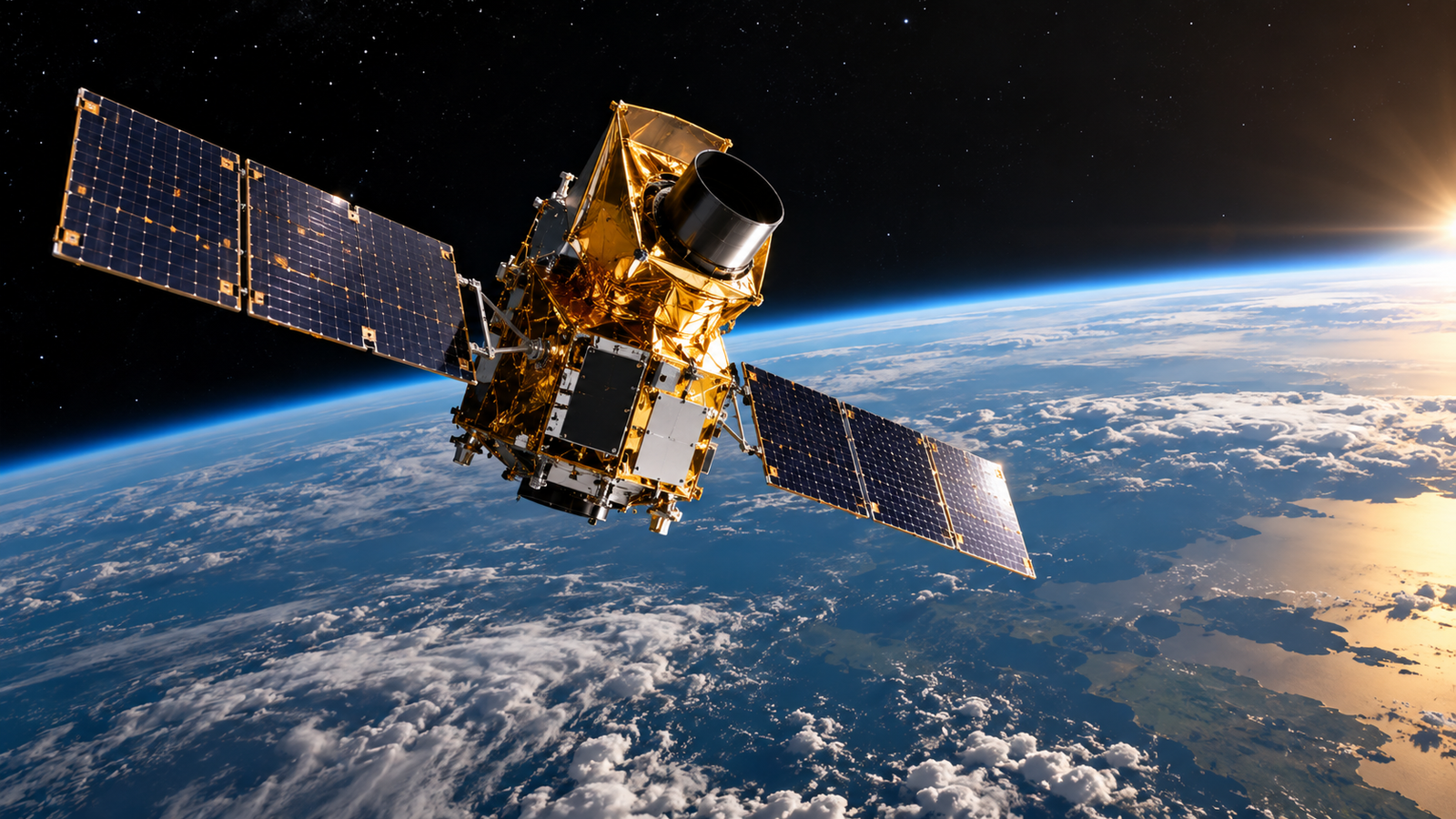
NASA has confirmed the end of science operations for its Neil Gehrels Swift Observatory after almost 22 years studying violent and rapidly changing events across the universe. The spacecraft carried out its last scientific observation on October 20, 2026, when its orbit had descended to roughly 171 miles (275 kilometres) above Earth. On October 23, NASA announced that the satellite could re-enter Earth’s atmosphere within the coming weeks. The re-entry was still a future event at the time of the announcement.
Swift was originally designed for a two-year primary mission after its November 2004 launch. Instead, it operated for more than a decade beyond that target, observing gamma-ray bursts, supernovae, active galaxies and other cosmic events. The end of operations does not erase its scientific legacy: NASA says a large archive of telescope measurements and images will remain available to researchers.
What Did NASA Announce on October 23?
NASA said Swift’s scientific mission had ended because the spacecraft was no longer able to maintain the stable pointing needed to observe astronomical targets. Its final observation occurred on October 20. The mission team subsequently placed the satellite into an end-of-operations configuration in preparation for atmospheric re-entry.
The official announcement came three days after the last observation. These dates should not be conflated, and neither means the spacecraft had already burned up. NASA described re-entry as expected over the following weeks, without establishing an exact moment or location.
Why Did Swift Stop Operating?
Swift had been orbiting Earth at progressively lower altitudes. At lower heights, even the extremely thin upper atmosphere creates drag that reduces orbital energy. NASA reported that increased solar activity intensified this effect, accelerating the observatory’s descent. The spacecraft’s ability to compensate and point its telescopes was eventually exhausted.
On October 20, Swift reached about 275 kilometres and entered safe mode. The operations team at Pennsylvania State University then transmitted a command that effectively ended operations. This was a controlled operational decision made after the observatory’s orbit became unsuitable for reliable science; it should not be described as an unexpected explosion or a crash on Earth.
What Was the Neil Gehrels Swift Observatory?
Swift was a space observatory developed for fast observations of gamma-ray bursts, extraordinary flashes of high-energy radiation originating from distant cosmic events. It launched on November 20, 2004, as an international mission led by NASA with partners in Italy and the United Kingdom. It later received the name Neil Gehrels Swift Observatory in honour of the scientist who played a major role in the project.
Unlike a telescope dedicated to a single wavelength, Swift combined instruments that could detect bursts of gamma rays and then study their afterglows in X-rays, ultraviolet and visible light. This approach gave astronomers a more complete picture of evolving events.
How Swift Responded to Gamma-Ray Bursts
Gamma-ray bursts can appear and fade quickly, making rapid follow-up essential. Swift’s Burst Alert Telescope monitored wide areas of the sky for high-energy flashes. When it detected a suitable event, the spacecraft could automatically turn toward the source, allowing its other instruments to collect information while the afterglow was still bright.
That responsiveness was one of the observatory’s defining capabilities. NASA reported that its planning system could accommodate as many as 75 independent targets per day and respond to some special requests from the ground within minutes. Fast access helped scientists capture phases of cosmic explosions that slower observing programmes might have missed.
More Than 2,000 Gamma-Ray Bursts Observed
NASA credits Swift with observations of more than 2,000 gamma-ray bursts during its long working life. Such bursts can result from extreme events, including the collapse of massive stars and mergers involving compact stellar remnants. Observing them across different wavelengths helps astronomers study their environments and understand how matter behaves under extraordinary conditions.
The figure describes the mission’s accumulated science record, not new bursts discovered on the final day. The research value also extends beyond detection counts: archived observations can be reanalysed as astronomical theories and methods improve.
Swift Also Studied Supernovae and Black Holes
Gamma-ray bursts were a central objective, but Swift contributed to many other areas of astronomy. According to NASA, it observed more than 1,400 supernova explosions, tracked active galaxies, studied stars torn apart by black holes and examined comets and asteroids. It also supported observations of transient X-ray sources and changing cosmic activity.
These projects demonstrate why scientists valued the spacecraft’s flexible scheduling and varied instruments. A changing source discovered by another observatory could often be investigated quickly with Swift, creating opportunities for coordinated international research.
The Three Instruments That Made Swift Different
Swift carried the Burst Alert Telescope, X-ray Telescope and Ultraviolet/Optical Telescope. The Burst Alert Telescope searched for gamma-ray transients over a wide field. Its X-ray instrument measured high-energy afterglows with finer positional information, while the ultraviolet and optical telescope monitored the longer-wavelength light associated with changing sources.
Combining these observations was important because an individual wavelength reveals only part of an event. Different signals can help constrain distances, the surrounding environment and physical processes. Swift was especially valuable for observations that needed to begin promptly after a new outburst.
What Happened to NASA’s Rescue Attempt?
NASA explored the possibility of raising Swift into a higher orbit to extend its operating life. Katalyst Space developed the robotic LINK spacecraft for an ambitious servicing attempt, which launched in July 2026. However, attitude-control problems prevented the planned capture and orbital boost. NASA confirmed in August that the mission would not lift Swift to a safer altitude.
The inability to complete the boost did not mean the servicing demonstration had no value. NASA’s September review emphasized technical and operational lessons from the rapid-development mission. The distinction is that the planned rescue objective was not achieved, while some in-orbit testing still contributed experience relevant to future servicing work.
Why Did Swift Resume Observations After the Rescue Was Abandoned?
During preparations for the proposed boost, the Swift team adjusted observing behaviour to reduce atmospheric drag and prolong the time available for intervention. Following the cancellation of the orbit-raising attempt, scientists restarted observations and re-enabled more flexible pointing so that the remaining mission time could produce useful data.
NASA said Swift subsequently examined hundreds of targets, including stellar remnants, active black holes and objects within the solar system. Returning to the preferred science attitude also increased atmospheric drag, helping explain why the final period of activity was short. The team chose to use the remaining opportunity for research rather than preserve the orbit at the expense of observations.
What Does Atmospheric Re-Entry Mean?
An orbiting satellite gradually loses altitude when upper-atmosphere drag removes energy from its motion. Eventually, it can encounter denser atmosphere and heat intensely during descent. Many spacecraft components burn up, while whether anything survives depends on the vehicle and trajectory.
NASA’s October 23 release did not announce a completed Swift re-entry or a confirmed impact location. Readers should avoid sharing predicted locations or dramatic videos as genuine Swift footage without an official source. The mission’s end is verified; its precise future atmospheric descent remained uncertain at publication time.
A Scientific Archive That Will Outlive the Satellite
NASA said the Swift archive comprises almost 22 years of brightness measurements, spectral information and more than 1.5 million images from its Ultraviolet/Optical Telescope. The agency estimated the archive at approximately 12 terabytes, representing substantial scientific material that can be used long after onboard observing has ceased.
Open access to historical observations allows researchers to revisit discoveries, compare old results with new telescopes and test emerging ideas. In some cases, a scientific mission’s datasets remain productive for decades because new instruments and analysis techniques reveal patterns that were not previously understood.
What Will Astronomers Do Without Swift?
The end of Swift means researchers lose a particularly adaptable space telescope that could quickly follow unpredictable events. NASA has said it is considering how other operating facilities, potential commercial capabilities and future missions might help preserve rapid-response astronomy. Other telescopes already contribute important observations, but they do not automatically reproduce every aspect of Swift’s capabilities.
The gap is especially relevant for transient astronomy, where hours or minutes can determine what measurements are possible. Astronomers can coordinate ground observatories and other spacecraft, while mission planners study new approaches for responding to short-lived bursts.
Why Swift’s Long Life Matters
Swift was designed for two years yet generated science for nearly 22. That longevity is a reminder that robust spacecraft engineering, ongoing operations support and a valuable scientific mission can deliver benefits far beyond an original timetable. NASA characterised the observatory as providing a lasting scientific return on the investment made in its development and operation.
However, extended service cannot overcome orbital decay indefinitely. Swift’s closure illustrates the tension between productive science operations and the physical limitations faced by satellites at low altitudes, especially during periods of stronger solar activity.
Does Swift’s Mission Ending Affect People in Pakistan?
The event is an international science story rather than an announcement of a Pakistan-specific satellite programme. Researchers, universities and students around the world can nevertheless learn from published Swift observations, particularly because its archive is publicly accessible. The data are relevant to education in astronomy, astrophysics and space technology.
There is no verified reason to claim the mission’s end will interrupt Pakistani telecommunications, weather forecasts or ordinary satellite services. Swift was a dedicated astronomy observatory, and its shutdown does not imply a wider failure of NASA’s spacecraft network.
What Should Readers Watch Next?
Readers can monitor NASA’s Swift mission blog for updates about orbital descent and any eventual confirmation of re-entry. A confirmed timestamp or assessed debris outcome should only be reported when supported by the relevant space-tracking or agency information. Claims circulating online in advance should be treated as speculation.
Science coverage can also follow studies that use the existing archive, as new work may continue to reveal important results even without fresh observations. The observatory’s lasting contribution is the body of data and discoveries it enabled, not only the date its instruments stopped collecting information.
Conclusion
NASA ended operations of its Neil Gehrels Swift Observatory after the satellite’s orbit fell to approximately 275 kilometres on October 20, 2026. The agency confirmed the mission closure on October 23 and said atmospheric re-entry was expected within weeks. A previously planned commercial boost had been unable to raise the spacecraft’s orbit.
The mission’s near-22-year history includes more than 2,000 gamma-ray burst observations, studies of over 1,400 supernovae and a large public archive. Swift’s end is a significant change for rapid-response astronomy, but its scientific contribution will remain useful to researchers long after the spacecraft is gone.
Frequently Asked Questions
When did NASA end the Swift Observatory mission?
Swift made its final scientific observation on October 20, 2026. NASA publicly confirmed the mission had ended on October 23.
Has the Swift satellite re-entered Earth’s atmosphere?
NASA said on October 23 that re-entry was expected within the next few weeks. That announcement did not confirm a completed re-entry.
Why was the Swift mission shut down?
Atmospheric drag lowered its orbit until the spacecraft could no longer maintain stable telescope pointing.
When was the Swift Observatory launched?
It launched on November 20, 2004.
What did Swift primarily study?
Its principal focus was gamma-ray bursts, alongside observations of supernovae, active galaxies, black holes and other transient events.
How many gamma-ray bursts did Swift observe?
NASA reported that Swift observed more than 2,000 gamma-ray bursts during its lifetime.
Why was the spacecraft rescue unsuccessful?
Attitude-control difficulties with the servicing spacecraft prevented the planned capture and orbit-raising operation.
Can scientists still use Swift data?
Yes. NASA maintains an extensive public archive containing images, measurements and other scientific observations.
About The Author