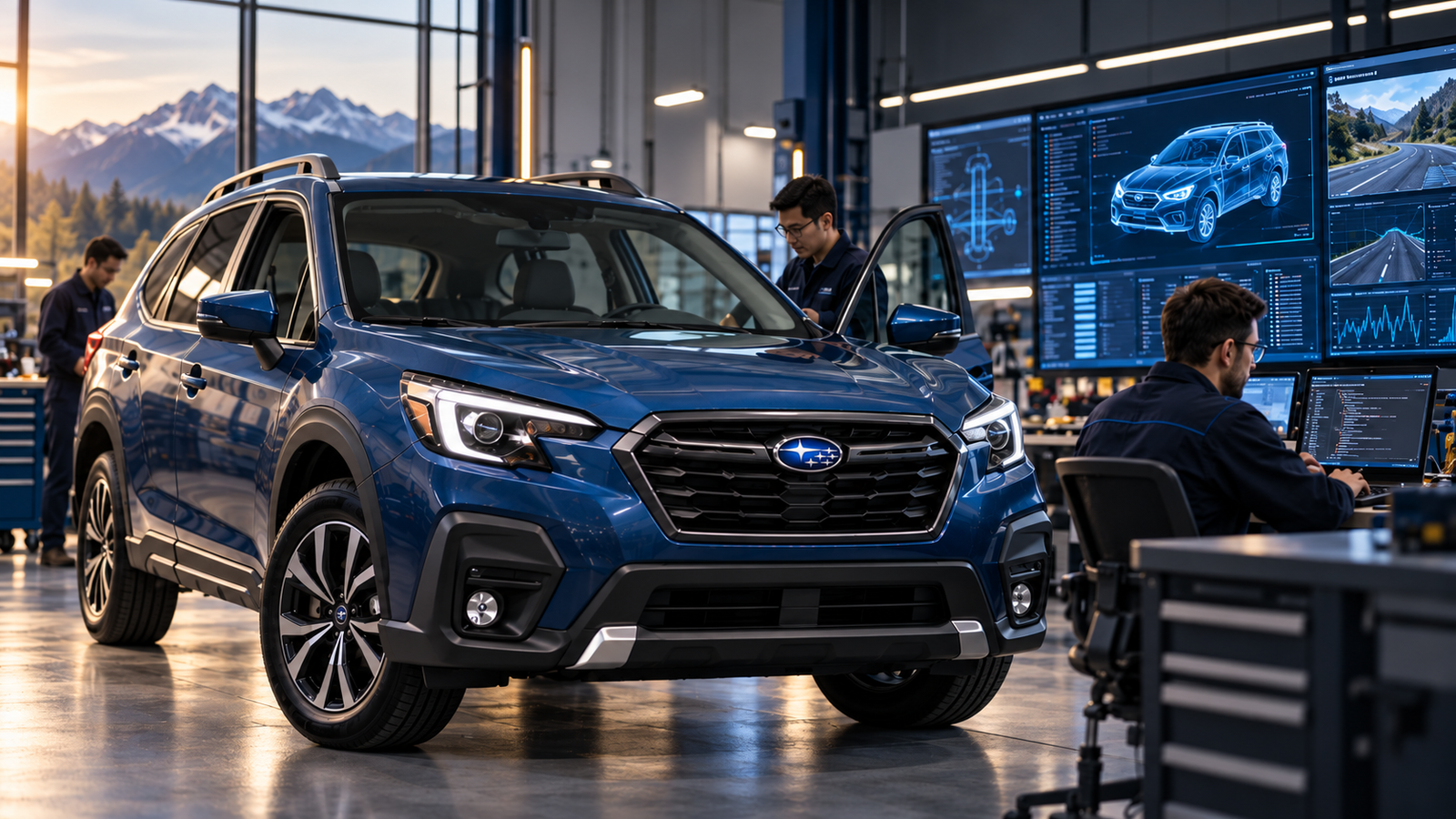
SANO, Japan, October 19, 2026 – Subaru has announced plans to introduce software-defined vehicles in the second half of the 2020s and reduce the time needed to develop new cars by around 40%. The Japanese automaker is changing how it designs electronic systems, tests vehicles and prepares them for production. The Subaru software defined vehicles plan was outlined at a strategy briefing held on October 18 at the company’s research centre in Sano City, north of Tokyo. Reuters reported the announcement on October 19, and Business Recorder published the same verified development for its readers.
The company wants cars that can receive software updates after purchase, with improvements to driver-assistance systems, automated-driving functions and vehicle performance. However, the 40% reduction is a future target. Subaru has not announced that it has already achieved this saving or delivered a completely new production model under the strategy.
Subaru Software Defined Vehicles: Key Facts
Company: Subaru Corporation, Japan.
Announcement: Strategy briefing on October 18, reported October 19, 2026.
Main goal: Introduce software-defined vehicles in the second half of the 2020s.
Development target: Reduce the time taken to develop vehicles by approximately 40%.
Core technology: A newly developed integrated electronic control unit, or ECU.
Chip development partner: Advanced Micro Devices (AMD), United States.
Planned functions: Over-the-air updates for driver assistance, automated driving and vehicle performance.
Vehicle types: Electric, hybrid and petrol models.
Toyota Arene platform: Subaru says it has no current plan to adopt it.
The company has not announced a final consumer price, exact first model or guaranteed launch date for a new software-defined Subaru in these reports.
What Exactly Has Subaru Announced?
Subaru wants to change the way electronic systems are built into its cars. Traditionally, different vehicle functions often use several specialised controllers and separate software systems. The new strategy aims to bring more of that control together through an integrated electronic architecture. This may allow engineers to develop and update vehicle functions more efficiently.
Subaru also plans to use more digital simulation and perform design, testing and manufacturing preparation at the same time where practical. This does not mean the automaker is closing its factories or eliminating physical safety tests. Real vehicles still need to be evaluated under demanding driving and regulatory conditions.
What Is a Software-Defined Vehicle?
A software-defined vehicle, often called an SDV, is a car in which software plays a greater role in controlling and improving important functions. Modern cars already contain computers. The difference is that software-defined designs make it easier to update more of the vehicle’s capabilities after it has been sold.
For example, a manufacturer may improve a driver-assistance feature through a wireless software update, rather than requiring a complete hardware replacement. But new software cannot magically add equipment that a vehicle does not have. A car without the required sensors or components cannot gain every advanced feature through an update alone.
How Could Cars Improve After Purchase?
Subaru wants its future vehicles to receive over-the-air updates. These are software updates delivered through a network connection, similar in principle to updates for smartphones. Depending on the hardware and approvals, an update could improve how a supported driver-assistance function behaves or adjust certain vehicle control features.
That could allow manufacturers to address some software issues without asking every owner to visit a dealership. However, a vehicle update must be safe and carefully tested. It can also depend on network connectivity, the customer’s vehicle configuration and local regulations.
What Is the New Integrated ECU?
ECU stands for electronic control unit. It is a computer that manages a particular set of functions inside a car. A conventional vehicle may use many ECUs to operate different systems. An integrated ECU allows more functions to be coordinated through a common computing platform.
Subaru says it will gradually introduce its newly developed integrated ECU across its model lineup. This should be understood as a planned rollout, not confirmation that all existing Subaru cars already contain the new chip.
Why Is Subaru Working With AMD?
Subaru says the chip at the centre of its integrated ECU was jointly developed with US semiconductor company AMD. A central computing chip has to process information reliably from vehicle systems and help software perform its tasks. Car technology places strict demands on performance, reliability and safety.
Working with a semiconductor specialist could help Subaru create a more capable and unified electronic system. The announcement does not disclose a final price for the chip or a confirmed list of Subaru models that will receive it first.
Does This Make Subaru Cars Fully Self-Driving?
No. Software-defined vehicles and fully autonomous cars are different ideas. A software-defined vehicle can support updates to driving functions, but it does not automatically drive itself without a human.
Subaru says the planned architecture may support improvements to driver assistance and automated-driving technology. That should not be confused with a guarantee of completely driverless operation. Drivers must continue to follow the rules and supervision requirements attached to the vehicle’s actual approved features.
What Is Subaru EyeSight?
EyeSight is Subaru’s name for its driver-assistance technology, which has historically used cameras and other systems to help drivers respond to road conditions. Depending on the model and market, functions may include warnings or assistance with certain driving situations.
Subaru’s software-defined strategy could make it easier to develop future improvements to supported safety and assistance technologies. But exact features will depend on the final vehicle hardware and software. The October strategy briefing does not establish a universal new EyeSight feature available immediately to every owner.
Why Does Subaru Want to Cut Development Time by 40%?
Developing a new car involves design, engineering, prototypes, testing and production preparation. Traditionally, some stages happen mainly one after another. Subaru wants to use digital tools so different teams can work on parts of the process in parallel.
For example, engineers could test aspects of a proposed design through computer simulation while manufacturing specialists study how parts might be produced. The company aims to shorten overall development time by around 40%. That is an ambition, and the final result will only become clear after the new process is used for actual products.
What Role Will Digital Simulations Play?
Computer simulations can help engineers test potential designs without building a physical prototype for every small change. They may be used to examine how a component responds under certain conditions or to compare different approaches before investing in hardware.
This can potentially save time and help teams discover problems earlier.
Still, virtual testing has limits. Vehicles must be tested in real weather, on real roads and in controlled physical safety programmes to confirm that systems behave as expected.
Will Petrol Cars Also Receive This Technology?
Yes, that is part of Subaru’s announced strategy. The company plans to standardise electronic platforms across electric, hybrid and petrol vehicles. Software-defined design is not limited to battery-electric cars. Vehicles with conventional engines also depend on computers for many functions.
A shared electronic platform could simplify development across several types of powertrain. It does not mean Subaru is converting every petrol model into an electric car or discontinuing combustion engines immediately.
What Is Toyota’s Arene Platform?
Toyota has developed a software platform called Arene as part of its own plans for software-defined vehicles. Reuters reported on October 16 that Toyota expects Arene to appear in 10 million new vehicles annually across 50 models by 2030.
Toyota also has an approximately 21% shareholding in Subaru, making the relationship between their technology plans notable. Despite those ties, Subaru said it currently has no plan to use Arene for its new architecture. The two companies are therefore pursuing different software platforms for now.
How Does Subaru’s Strategy Compare With Toyota’s?
Both companies are working toward cars that rely more heavily on software and receive updates over time. Toyota has described ambitious plans to expand its Arene platform across a large number of models. Subaru is focusing on a new integrated ECU and the reduction of its development cycle.
The announced strategies are not identical, and neither proves which company’s products will be better in real driving conditions. Customers will ultimately judge actual features, safety, cost, reliability and long-term support.
Could Faster Development Mean Cheaper Cars?
Not necessarily. A shorter engineering process could help a manufacturer control some development expenses, but vehicle prices depend on many other factors. Battery costs, materials, exchange rates, shipping, labour, taxes and competition can all affect the final price.
Subaru has not promised a 40% reduction in retail car prices.
The 40% figure refers to the time taken to develop vehicles, not prices, manufacturing costs or fuel consumption.
Why Does This Matter for Car Buyers?
A well-designed software platform could allow supported vehicles to receive improvements after purchase. That may help manufacturers fix certain issues more quickly and keep selected functions updated.
On the other hand, buyers will want clear information about how long updates will continue, what they cost, whether data is collected and what happens when software support ends. Subaru has not announced final terms for all future update services. Customers should avoid assuming lifetime free updates or a specific feature package.
What About Cybersecurity and Privacy?
Cars with increasingly connected software must also protect their computer systems. Potential risks include unauthorised access, insecure updates and improper handling of personal or driving data.
Manufacturers need careful testing, secure delivery of updates and ways to respond when vulnerabilities are discovered. An integrated ECU may simplify some engineering, but it also makes strong cybersecurity design important. Subaru’s strategy announcement does not establish that every future risk has already been eliminated.
Why Is the Auto Industry Moving Toward Software?
Drivers increasingly expect features they already know from connected devices: updated navigation, improved digital interfaces and continued software support. Manufacturers also want systems that are easier to develop across several vehicle models.
Software-defined designs can help separate some vehicle functions from fixed hardware arrangements, giving companies more flexibility. However, mechanical quality, crash safety and dependable after-sales support remain essential. A car still needs to perform reliably as a vehicle, not just as a computer.
What Does It Mean for Pakistan?
Subaru’s new plan is a global automotive technology development, with relevance to Pakistani enthusiasts, importers and technology professionals. Software-enabled vehicles may create opportunities for developers, vehicle technicians and specialists who understand electronic systems.
But the October report does not announce an official Subaru SDV launch, pricing or rollout schedule in Pakistan. Local availability would depend on future models, market plans, imports and applicable regulations.
How Did Competitors Cover the Announcement?
Reuters focused on Subaru’s technology strategy, the 40% development-time target, AMD’s chip role and the company’s decision not to adopt Toyota’s Arene platform. Business Recorder published the story on October 19 with the same key points for its business and technology readership.
That reporting supports a straightforward news headline, not a claim that Subaru has already launched a fully autonomous car. Mukhbir’s approach is to explain the term software-defined vehicle in everyday language while making clear what is planned and what has already happened.
What Should Readers Watch Next?
The next major developments will include the first announced production model, the actual rollout of the integrated ECU and official details about the available software-update features. It will also be important to see whether Subaru achieves a measurable reduction in development time.
Independent vehicle tests can help show how the new systems perform in everyday conditions. Until those details emerge, Subaru’s announcement is best understood as a technology roadmap rather than a completed consumer product launch.
Conclusion
Subaru plans to introduce software-defined vehicles during the second half of the 2020s, using an integrated electronic control unit whose core chip was developed with AMD. The automaker wants wireless updates for selected driving and performance functions and aims to reduce vehicle development time by approximately 40%.
The strategy could help Subaru respond faster to changing automotive technology. But the timeline, development savings and customer benefits remain targets that will need to be tested against future production vehicles.
Frequently Asked Questions
What are Subaru software defined vehicles?
They are planned Subaru vehicles with a more integrated software and computing architecture, designed to support ongoing updates to selected functions.
When will Subaru launch its software-defined cars?
The company is targeting the second half of the 2020s, without a confirmed exact model launch date in the October report.
Has Subaru already reduced development time by 40%?
No. The 40% reduction is a company target, not a completed result.
Is AMD developing technology for Subaru?
Yes. Subaru says it jointly developed the chip at the core of its integrated ECU with AMD.
Will these cars drive themselves?
Not necessarily. Software-defined capability does not automatically mean a vehicle has fully autonomous driving.
Will petrol Subaru cars receive the new system?
Subaru plans to standardise the new electronic platform across petrol, hybrid and electric vehicles.
Is Subaru using Toyota’s Arene platform?
No. Subaru says it currently has no plan to adopt Toyota’s Arene platform.
Will these vehicles be available in Pakistan?
No Pakistan-specific launch or price was confirmed in the sources reviewed.
About The Author