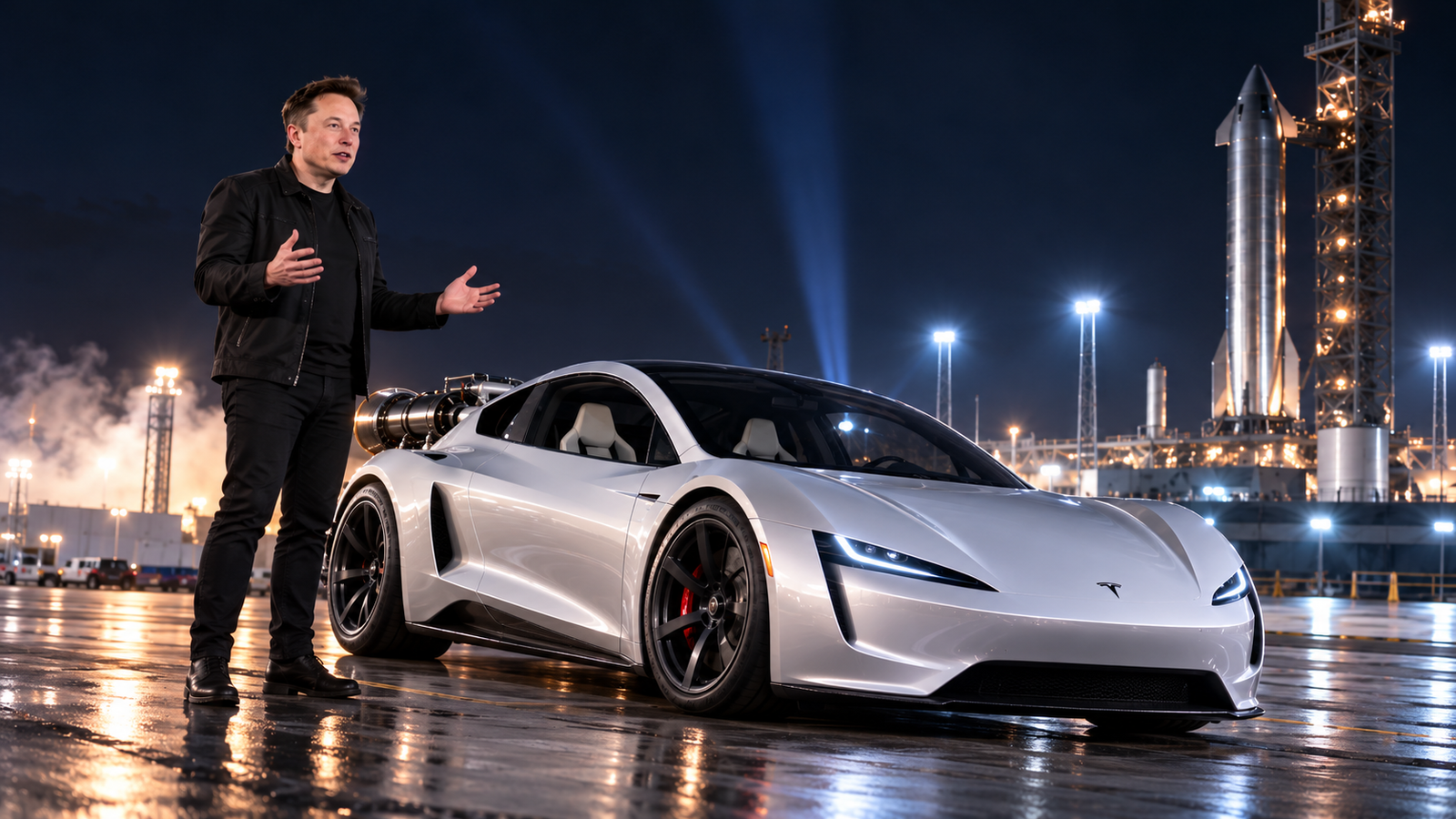
TEXAS, October 18, 2026 – Elon Musk has unveiled a dramatically redesigned Tesla Roadster prototype that can briefly leave the ground using SpaceX-inspired technology. At an October 15 event in Texas, Tesla demonstrated extreme acceleration, airborne movements and an unusual system that helped the car grip a steep surface.
The Tesla Roadster 2026 demonstration attracted global attention because it looked unlike an ordinary electric sports car. Reuters, Associated Press, The Verge, ProPakistani and PakWheels reported the event. Tesla is now targeting 2028 to start production, after years of delays.
The biggest detail for buyers is simple: Tesla has unveiled and demonstrated a prototype, not launched a finished car for public delivery. Its flying-equipped Rocket version is not approved for ordinary roads, and key specifications have not been independently verified in a production model.
Tesla Roadster 2026: Key Facts
Unveiling date: October 15, 2026. Location: SpaceX facility in Texas, United States. Vehicle: Next-generation Tesla Roadster electric sports car. Main technology: Compressed-air or cold-gas thrusters and a powerful suction system. Demonstrated 0–60 mph acceleration: About 0.81 seconds. Planned production: 2028. Final retail pricing: Not announced. Flying/Rocket version: Invitation-only and not approved for public roads. Customer deliveries: No confirmed date.
These figures describe Tesla’s demonstration and reported plans. They are not independently certified performance results for a vehicle already on sale.
What Happened at the Roadster Unveiling?
Tesla held an attention-grabbing demonstration at a SpaceX facility. Instead of only displaying a sports car on a stage, the company showed it moving through several extreme maneuvers.
The Roadster accelerated rapidly, climbed a steep ramp and briefly moved through the air. Reports also described the prototype rotating while airborne and passing above several other Tesla vehicles.
A fan-powered suction system helped the car remain attached to a surface during an inverted driving demonstration. Cold-gas thrusters provided extra force for some movements.
These scenes are designed to show what Tesla engineers are trying to achieve. They do not prove that customers will be able to perform such stunts safely or legally on public streets.
Can the New Tesla Roadster Actually Fly?
The answer depends on what ‘fly’ means. Tesla demonstrated brief airborne maneuvers, but there is no confirmed evidence that the Roadster can operate as a practical aircraft over long distances.
An aeroplane uses wings to generate lift while travelling through the air. A helicopter uses spinning rotors. Tesla’s special Roadster prototype instead uses powerful jets of compressed air to create short bursts of force.
Those bursts can lift or redirect the vehicle for a limited period. That is different from taking off, travelling over a city and landing like a conventional aircraft.
Calling it a flying car makes an exciting headline. A more accurate description is an electric sports-car prototype capable of brief thruster-assisted airborne stunts.
How Do SpaceX-Inspired Thrusters Work?
The system uses gas stored under very high pressure. When that gas is released through a nozzle, it produces force in the opposite direction.
Think of what happens when air rushes out of an inflated balloon: the balloon moves the other way. Cold-gas thrusters use a controlled version of that basic physical idea.
ProPakistani reports that the special design incorporates multiple thrusters and high-pressure storage tanks. Unlike a conventional rocket engine, the system described in these reports does not depend on burning rocket fuel to produce each thrust.
The technology adds weight, complexity and important safety requirements. It is still unclear how practical the full system would be for everyday ownership or repeated use.
What Is the Roadster’s Suction System?
The other unusual technology is a fan-powered suction system beneath the car. It is designed to create extra downforce, pressing the vehicle against the driving surface.
Downforce helps tyres maintain grip. Racing cars usually create downforce with aerodynamic shapes and wings. A fan system can add force even when a car is travelling more slowly.
Tesla used this approach in an extreme demonstration involving an inverted surface. The stunt illustrated the power of the system, but it was performed in controlled conditions.
Ordinary roads have bumps, debris, pedestrians and unpredictable conditions. Nothing in the demonstration means such a stunt would be permitted or safe in regular traffic.
How Fast Is the Tesla Roadster 2026?
One of the most widely shared claims is acceleration from zero to 60 miles per hour in 0.81 seconds. That is approximately zero to 97 kilometres per hour in less than one second.
For comparison, even very fast road cars normally take more time than that to reach the same speed. Tesla’s figure therefore attracted enormous interest among auto enthusiasts.
However, the time came from a manufacturer demonstration, not an independently verified test of a customer-ready production vehicle. Results may depend on track preparation, equipment, software and the version being tested.
Reuters also reported a claimed top speed above 230 mph and a range of about 300 miles, both of which should be treated as announced performance targets or specifications until independently verified.
What Roadster Versions Has Tesla Described?
Coverage from ProPakistani and Reuters describes different configurations intended to serve different buyers. The Performance version focuses on high-speed electric driving, while the Thrust version adds extra acceleration technology.
The most extreme Rocket configuration reportedly adds a fuller set of thrusters and short airborne capability. This special version is described as invitation-only and not approved for public-road use.
These versions should not be assumed to have identical seats, range, performance or road certification. Tesla may also revise specifications before production begins.
A prospective buyer should wait for final order documents explaining exactly what equipment each version includes.
Tesla Roadster Price and Reservation Details
Tesla has not announced a final retail price for the new production Roadster. Some reports mention prices above $200,000, but a firm universal sale price for every new version has not been established.
Reuters and ProPakistani report reservation arrangements involving substantial deposits. The Performance version has been associated with a $50,000 deposit and the more specialised Thrust version with $250,000.
A reservation deposit is not the same as the final purchase price. It also does not guarantee that production and delivery will happen on a particular date.
Anyone considering a reservation should examine Tesla’s current official terms, including eligibility, refund rules and the exact version being reserved.
Why Is Production Planned for 2028?
The next-generation Roadster is not a new idea. Tesla originally showed a version in 2017 and indicated it might be delivered around 2020.
That earlier timeline passed without the vehicle entering normal customer production. Over the following years, Tesla focused attention and resources on other vehicles and technologies.
The company has now proposed a 2028 production start. Reuters and AP report that the Roadster has experienced repeated delays.
The 2028 date is a company target. It should not be presented as a guaranteed first delivery date, because engineering work, testing, regulation and manufacturing plans can still change.
Why the 2017 Roadster and 2026 Prototype Are Different
The Roadster first previewed in 2017 was promoted mainly as an extremely fast electric sports car. Tesla’s newer prototype takes a much more experimental approach.
The updated demonstration combines intense acceleration with compressed-air propulsion, suction-assisted handling and stunt capabilities not normally associated with electric cars.
The newer concept also appears to differ from earlier range and equipment promises. Reports indicate that the latest cited range is around 300 miles rather than the longer figure discussed when the earlier concept was introduced.
For buyers, the updated car is best understood as an evolving project rather than a vehicle whose specifications were fixed in 2017.
Could You Drive the Rocket Roadster on Public Roads?
The special airborne version is not approved for ordinary public-road use. A car that produces thrust and leaves the ground creates challenges for safety authorities and transport regulations.
Regulators would need to consider the risks to the driver, passengers, other road users and nearby property. The exact rules differ by country and by how a vehicle is classified.
A successful demonstration on private property is not a public-road safety certification. It also does not establish that the vehicle could legally cross over traffic or operate in public airspace.
Any future customer version will need clear rules about where its capabilities can be used.
How Safe Is the Tesla Roadster Prototype?
AP reported that Tesla used autonomous control for the demonstration as a precaution and that Musk presented the Roadster largely as an exciting engineering showcase.
Thrusters, compressed-gas storage and extreme acceleration introduce design challenges beyond those of a typical electric sports car. Reliable safety engineering must account for failure modes, system control and emergency procedures.
Tesla has not published independent production-car safety-test results showing that customers can safely repeat the demonstrated maneuvers.
The Roadster should therefore be judged on verified production specifications and regulatory approvals rather than dramatic demonstration footage alone.
Why Is Tesla Working With SpaceX Technology?
Elon Musk leads both Tesla and SpaceX, making collaboration between vehicle engineers and aerospace specialists a natural part of the project’s identity.
Spacecraft rely on precision systems, lightweight engineering and careful control of forces. Some of those ideas can inspire new automotive technologies.
However, successfully applying an aerospace concept to a road car is not automatic. A vehicle for consumers must also be durable, serviceable, affordable enough for its intended market and compliant with road regulations.
The Roadster is a useful demonstration of technical experimentation, even if many of its more extreme features remain unsuitable for ordinary roads.
Is the Roadster Tesla’s Last Human-Driven Car?
Musk has said Tesla plans to place increasing emphasis on autonomous driving and robotics. AP reported his comment that the Roadster could be Tesla’s last car designed primarily for human driving.
That statement describes the company’s ambition, not proof that every future Tesla vehicle will be fully autonomous in every location.
Tesla is simultaneously developing robotaxi concepts and humanoid robotics. The Roadster sits at the other end of the driving experience, putting performance and excitement at the centre.
The difference illustrates why the Roadster may matter more as a demonstration of engineering than as a high-volume vehicle business.
What Competitors Say About the Roadster
ProPakistani focused on the flying demonstration but cautioned that the most extreme version is not road-legal. PakWheels explained the airborne tricks and the long wait until production.
The Verge compared the current prototype with Tesla’s older promises and highlighted the 0.81-second demonstration result. Reuters and AP examined the product’s likely financial importance and practical limitations.
These outlets agree on the main development: the prototype has been unveiled, but 2028 production is still a plan.
Mukhbir’s headline uses ‘unveiled’ instead of ‘launched for sale’ so readers can tell the difference immediately.
Will the Roadster Be Available in Pakistan?
The reviewed reports do not announce an official Pakistan launch, local price or confirmed delivery plan.
Pakistani car enthusiasts may follow the Roadster for its engineering, acceleration and unusual SpaceX connection. But the US dollar reservation figures are not official Pakistani on-road prices.
Any eventual import would involve separate questions about eligibility, duties, registration, support and whether the particular version meets applicable rules.
It would be misleading to publish a confirmed Pakistan booking date or price without an official announcement.
What Does the Roadster Mean for the EV Industry?
Electric cars can deliver very quick acceleration because electric motors respond rapidly to power commands. Tesla’s prototype attempts to push that performance idea further through additional systems.
The Roadster may encourage debate about how far performance-focused EV engineering should go. Other brands are also building increasingly capable electric sports cars.
Still, most EV buyers care more about price, charging access, range, reliability and safety than flying stunts. A special prototype will not necessarily change everyday electric transport.
The largest question is whether Tesla can turn its dramatic demonstration into a reliable production vehicle while meeting its stated timeline.
What Happens Next?
The next useful updates would include official production specifications, validated performance results, a final pricing structure, road approval information and a confirmed manufacturing timetable.
Tesla has targeted 2028, but customers should watch for evidence of production preparation rather than assume deliveries will begin on a guaranteed date.
The rocket-assisted version may also need separate approval arrangements or remain limited to private facilities and demonstrations.
Until those details are published, the Roadster’s most extreme claims should be described as prototype capabilities.
Conclusion
The Tesla Roadster 2026 unveiling offered a dramatic look at what an electric sports car might achieve using SpaceX-inspired thrusters and advanced suction technology. Tesla demonstrated rapid acceleration and brief airborne stunts that generated international attention.
But the project is not yet a commercially delivered flying car. The Rocket version is not approved for public roads, final prices are not confirmed and the company is targeting production in 2028 after earlier delays.
For readers, the news is exciting because of the engineering. The next test will be whether the features can become safe, reliable and commercially available.
Frequently Asked Questions
Has the Tesla Roadster 2026 officially launched for customers?
No. Tesla unveiled a prototype in October 2026. Production is currently targeted for 2028.
Can the new Tesla Roadster really fly?
It demonstrated brief thruster-assisted airborne maneuvers, not sustained travel like a normal aircraft.
What was its 0–60 mph acceleration time?
Tesla demonstrated approximately 0.81 seconds. It is not yet an independently verified production-car result.
How do the SpaceX thrusters work?
They release compressed gas to generate short bursts of force that can help accelerate or move the prototype.
Is the Rocket version road-legal?
No. Reports describe it as not approved for ordinary public-road use.
How much will the Roadster cost?
Tesla has not confirmed final retail prices for every version. Reported reservation deposits are not the same as purchase prices.
When will Tesla make the new Roadster?
The company says it is targeting production in 2028, but no delivery date is guaranteed.
Can people buy the Roadster in Pakistan?
No official Pakistan pricing, launch or customer-delivery programme was confirmed in the sources reviewed.
About The Author