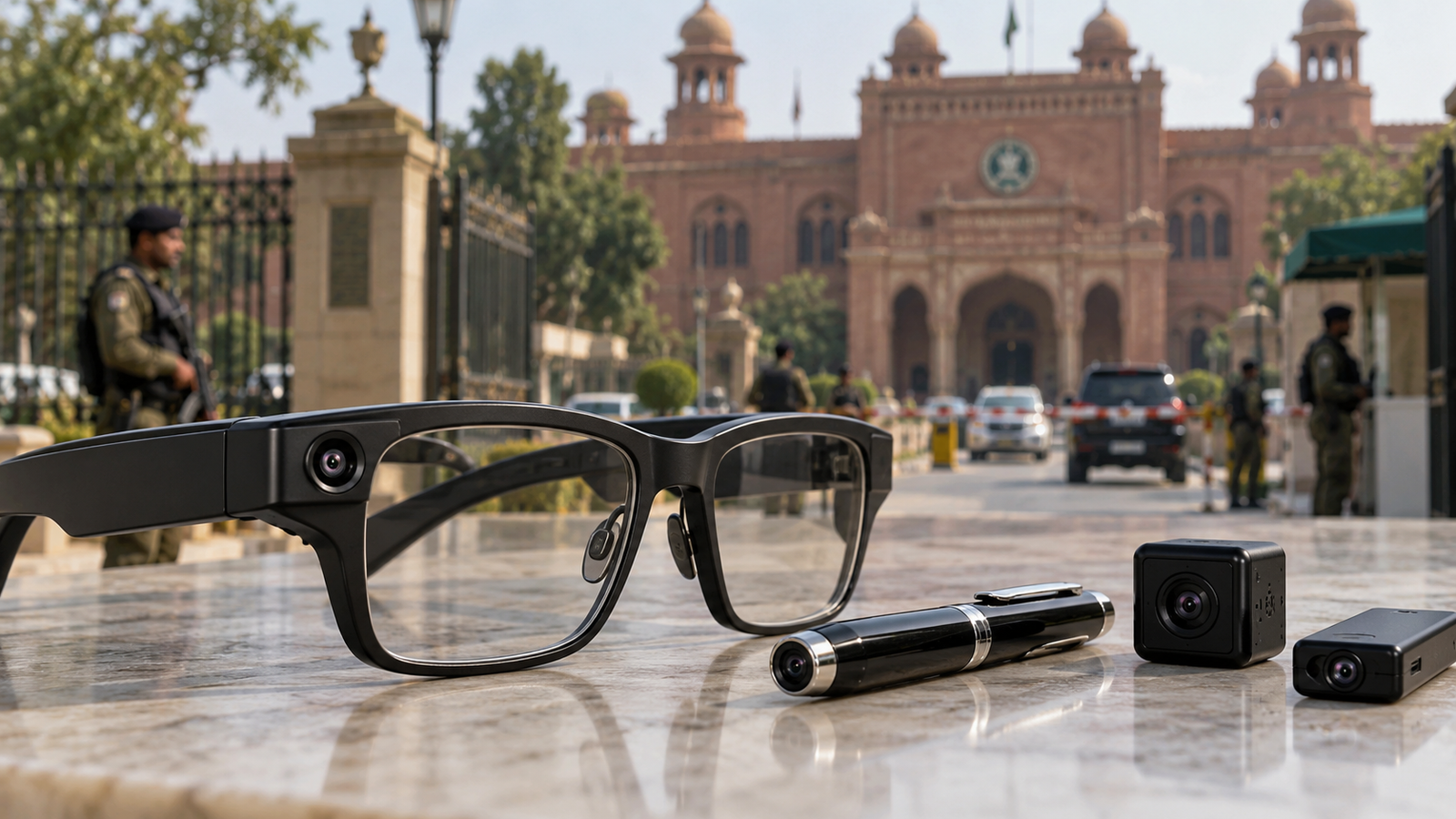
Punjab has imposed a 30-day restriction on the use and sale of smart glasses with hidden-recording capabilities and miniature cameras disguised as ordinary objects, according to an order issued by the provincial Home Department on October 20, 2026. The directive, reported by Dawn on October 21, was issued under Section 144 of the Code of Criminal Procedure, 1898, and applies across Punjab. It targets devices that can secretly capture images, sound or video, including recording equipment concealed in glasses, pens and keychains.
The move is significant for a growing consumer-technology market where wearable cameras and compact surveillance devices are becoming easier to obtain. Provincial authorities say unregulated covert recording could threaten privacy, security and the dignity of individuals, especially women and children. However, the reported order should not be misread as an unrestricted ban on every pair of smart glasses or on ordinary smartphones: its stated focus is devices with concealed recording capability, while specified everyday electronics are excluded.
What Has Punjab Officially Banned?
The Home Department order prohibits wearing or operating camera-enabled smart glasses that have hidden-recording ability. It also covers miniature recording cameras concealed in everyday objects such as pens, keychains and similar items. The language matters: the restriction is framed around hidden recording and the potential to capture or transmit information without people’s knowledge, rather than around all eyewear or all consumer electronics.
The order also restricts retailers, wholesalers, traders and distributors from offering the specified devices for sale, whether in physical shops or online. Dawn reported that the directive was issued with immediate effect for 30 days unless withdrawn earlier. Express Urdu separately reported the Section 144 notification on October 20. Consumers should consult the precise notification and any subsequent government clarification when determining whether a particular product falls within its wording.
Why Did the Government Take This Step?
The provincial government cited threats to public order, individual privacy, sensitive information and the security of important facilities. A device that appears to be an ordinary pen or pair of glasses may be able to record images and audio without attracting attention. Authorities said that such capabilities could enable harassment, secret monitoring or unauthorised sharing of protected information.
The order specifically referred to heightened concerns in airports, examination centres, government establishments, healthcare facilities, shopping malls, courts and public places. These settings have different security requirements, but they share a risk that people may be recorded without awareness or consent. The government described the directive as a preventive measure to protect the public and maintain order, particularly in relation to women and children.
How Long Will the Smart Glasses Restriction Last?
The restriction is scheduled to remain in force for 30 days from the issuance of the October 20, 2026 order, unless the Punjab government withdraws it earlier. A temporary Section 144 directive does not automatically prove that a permanent province-wide prohibition has been enacted. Any extension, revision or expiration should be checked against fresh notifications when this article is updated.
The decision was preceded by government discussion about surveillance gadgets. Dawn reported on October 19 that Punjab planned controls over recording devices disguised as everyday objects. At that stage the formal order had not yet been issued; the October 20 notification therefore represents a meaningful change from a proposal to an operative restriction. Mukhbir is treating these stages separately rather than describing the earlier announcement as the final legal instrument.
Are All Smart Glasses Banned in Punjab?
The available text of the reported order does not establish a blanket prohibition on all smart glasses, prescription spectacles or camera-free wearable devices. It singles out camera-enabled smart glasses with hidden-recording ability. Some commercially sold smart glasses use indicator lights or other recording notifications, but whether a particular design is covered should not be guessed from its brand name alone.
One widely discussed product category is AI-enabled eyewear that combines cameras, microphones and voice assistants. Such technology can provide legitimate accessibility or hands-free features alongside privacy risks. Enforcement depends on how the provincial order is interpreted and applied. Readers should avoid assuming that every product sold as ‘smart glasses’ has identical hardware or legal status.
Which Devices Are Exempt?
According to Dawn’s account of the Home Department directive, laptops, handheld tablets, mobile phones and terminal equipment approved by the Pakistan Telecommunication Authority are excluded from the specified restriction. The order also exempts authorised law-enforcement personnel from the restriction on use of the named hidden-recording devices. The exception is not a licence for all people to carry disguised cameras or to disregard privacy rules.
It is equally important not to confuse this provincial restriction with a general ban on recording in every public place. The directive applies to specified devices, and any separate laws governing privacy, data protection or use in sensitive institutions may operate alongside it. The exact device and context matter.
Does the Restriction Apply to Online Shops?
Yes, the reported directive extends to offering covered devices for sale both online and off the shelf. This means digital listings and conventional retail outlets may be affected where the products meet the specified description. The order refers to traders and distributors as well as retailers, indicating that the measure is not limited to individual buyers at an airport or courtroom.
Businesses that sell technology accessories may need to review product descriptions and stock to determine whether a camera or recording function is concealed within an ordinary object. Reporting has not established that every wearable-electronics retailer is violating the order, and no blanket assumption of wrongdoing should be made without evidence.
What Is Section 144 and Why Was It Used?
Section 144 of Pakistan’s Code of Criminal Procedure allows an authorised authority to issue temporary preventive orders under specified circumstances involving urgency and public order. Punjab’s Home Department secretary used powers under this provision to notify the restrictions. The resulting order is a time-limited legal intervention rather than a new act passed by the provincial legislature.
The legal basis and the scope of a particular Section 144 order should be read from the text of that directive. News readers may be familiar with Section 144 in the context of assemblies or security restrictions, but its use here focuses on covert electronic recording devices. The specific prohibitions must not be broadened to unrelated activities without supporting documentation.
How Does This Affect Privacy and Consumer Technology?
Wearable devices have reduced the size and visibility of cameras, making the distinction between ordinary accessories and recording equipment less obvious. That creates genuine privacy questions, particularly when bystanders cannot readily tell whether they are being photographed or filmed. At the same time, smart eyewear has emerging uses in navigation, communication, accessibility and content creation.
A narrow, clearly explained restriction can help users understand where the law draws a line between legitimate devices and concealed surveillance tools. Technology policy also benefits from transparency: consumers and sellers should be able to determine which functions are prohibited, what counts as hidden recording and how authorised exemptions work. Ambiguity can lead to confusion even when a government identifies a valid public-safety concern.
What Did the Lahore High Court Say?
A public-interest petition before the Lahore High Court raised concerns about the unregulated import and sale of smart glasses with cameras and microphones. Dawn reported that the court had questioned the government’s readiness to protect privacy and, during an October hearing, directed the federal government to forward a prepared summary to the federal cabinet.
That litigation provides important context but is distinct from the Punjab Home Department’s Section 144 order. The court proceedings concerned questions about import regulation and related privacy protections, while the provincial order deals with specified use and sale within Punjab for a limited period. The case should not be described as a final judicial ban on all smart eyewear unless an actual judgment or binding order establishes that outcome.
Are Meta or Ray-Ban Smart Glasses Specifically Prohibited?
Public debate and court filings have discussed Ray-Ban Meta and other camera-equipped smart glasses, particularly because they can resemble ordinary eyewear. Yet the order wording reported by Dawn describes categories of devices rather than publishing a comprehensive list of prohibited brands and models. It would be misleading to declare that a specific manufacturer’s entire product range is banned without a clear notification or enforcement guidance naming the products.
Potential buyers should focus on whether a device has the hidden-recording capability described in the order, not on social-media posts that group all smart glasses together. People who already own such technology should seek current guidance from Punjab authorities when there is uncertainty over a particular model.
What Happens If Someone Violates the Order?
Punjab authorities have warned of legal action over breaches of the restriction. However, the accessible reporting does not provide a complete penalty schedule for every type of violation, and this article does not invent fines, imprisonment terms or automatic confiscation rules. Enforcement outcomes depend on applicable law, the facts of an incident and any procedures established by authorities.
A reliable report should distinguish a warning of enforcement from a documented arrest or prosecution. As of the sources reviewed for October 21, the verified development is the issue of a province-wide temporary notification; readers should not assume that raids, penalties or named prosecutions have occurred unless subsequently confirmed.
How Can Consumers and Businesses Respond?
People planning to purchase wearable technology should review the device’s camera and audio functions and seek authoritative local advice before using it in Punjab during the order’s effective period. Sellers should examine whether they stock miniature cameras disguised as pens, keychains or similar objects and check official compliance guidance for online and physical sales.
Consumers should also take privacy seriously irrespective of this particular notification. Visible recording indicators, consent practices and careful use around sensitive settings reduce risks for bystanders. If a user suspects unlawful secret recording, reporting the matter to an appropriate authority is safer and more effective than attempting to seize devices or confront strangers.
What Remains Unclear About the Ban?
The reported text leaves practical questions about how enforcement officers will identify hidden-recording ability, how models with visible recording indicators will be treated, and whether provincial authorities will publish more detailed classification guidance. These are areas where further official information would be valuable, particularly for retailers and people using wearable technology for legitimate reasons.
It is also not yet established whether the 30-day order will be renewed, modified or allowed to lapse. A future policy change would require a new update, not simply an extension assumed from the first notification. Mukhbir will keep a distinction between the existing restriction and possible future measures.
Conclusion
Punjab’s October 20, 2026 directive introduces a 30-day restriction on hidden-recording smart glasses and miniature cameras disguised as everyday objects, covering both use and sale. Issued under Section 144, it aims to address threats to privacy, dignity and sensitive information while expressly excluding some ordinary electronics and authorised law-enforcement use.
For residents and retailers, the most important point is precision. The action concerns identified covert-recording capabilities, not a confirmed universal ban on all smart glasses or mobile cameras. The full impact will depend on implementation and any later clarification or renewal from the Punjab Home Department.
Frequently Asked Questions
Has Punjab banned smart glasses?
Punjab has restricted camera-enabled smart glasses with hidden-recording ability for 30 days; a blanket ban on every smart-glasses product has not been established.
When was the ban imposed?
The Punjab Home Department issued the reported order on October 20, 2026, with immediate effect.
How long will the restriction remain in force?
It is scheduled for 30 days unless withdrawn earlier, subject to any later government update.
Which other devices are covered?
Miniature recording cameras disguised as pens, keychains and similar everyday objects are included.
Can shops and online sellers still sell these gadgets?
The reported order restricts offering the covered covert-recording devices for sale online or in physical shops.
Are mobile phones and laptops banned?
No. The reported order specifically excludes mobile phones, laptops, tablets and certain PTA-approved terminal devices.
Are police allowed to use covered recording devices?
The order includes an exemption for authorised law-enforcement personnel for the specified use restrictions.
Does the order permanently ban Ray-Ban Meta glasses?
The reporting does not establish a permanent brand-wide ban. The temporary order describes specified recording capabilities rather than an exhaustive model list.
About The Author