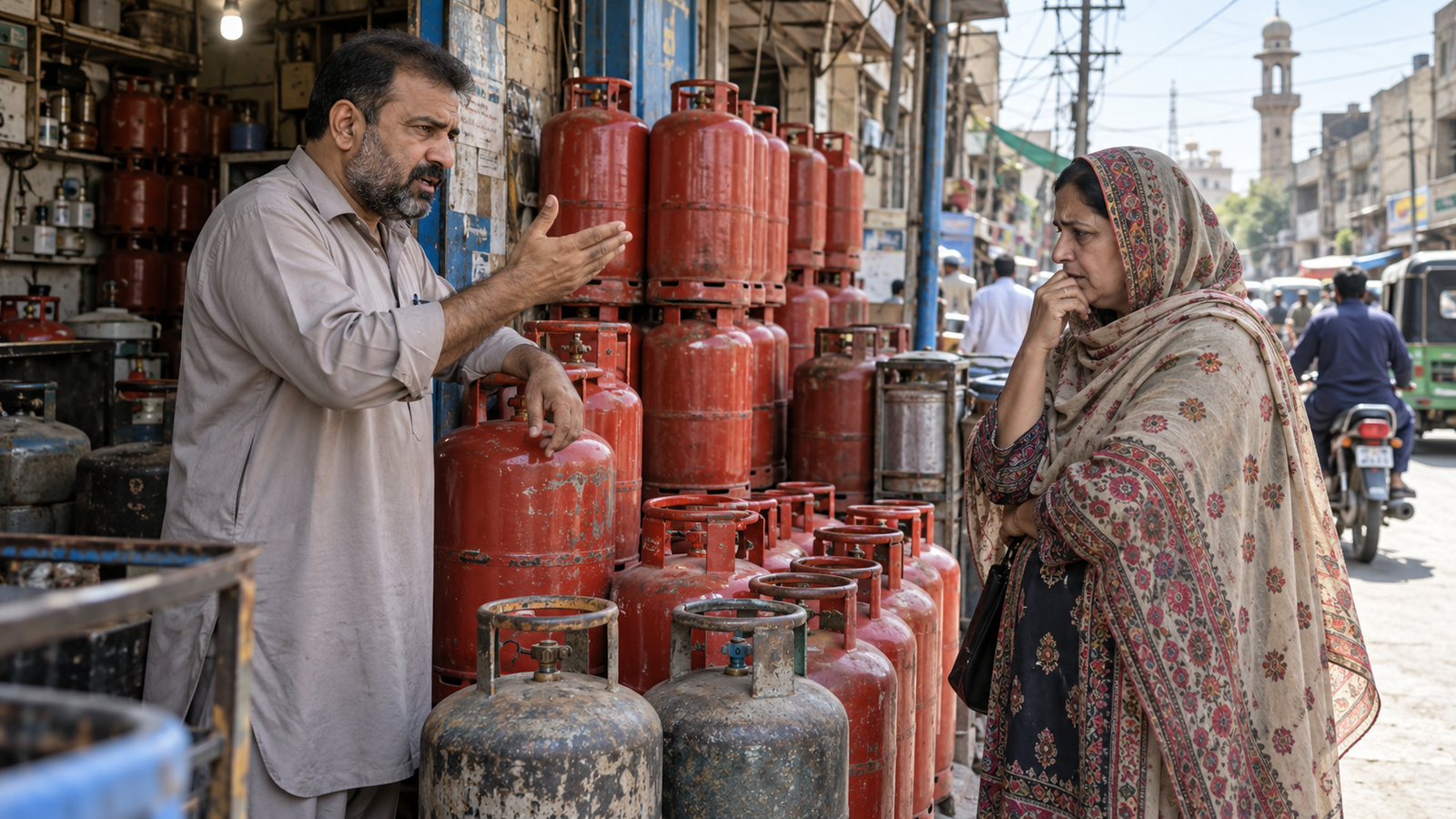
Liquefied petroleum gas (LPG) is selling for as much as Rs600 per kilogram in some parts of Pakistan as disruptions in supplies from Iran and rising seasonal demand put pressure on the domestic market, according to reporting published on October 21, 2026. The highest quoted prices were reported in colder and hilly areas, while buyers in parts of Punjab and Khyber Pakhtunkhwa were facing rates closer to Rs500 per kilogram. That is far above the official rate notified for October by the Oil and Gas Regulatory Authority (OGRA), estimated in reports at approximately Rs279 per kilogram.
The gap between regulated and reported market prices matters for millions of consumers, particularly households that depend on LPG for cooking or heating because piped natural gas is unavailable or inconsistent. The News and Dawn both reported a sharp escalation in retail prices. These are observed or reported market quotations, not new nationwide government prices. Readers should distinguish the price charged locally by an individual seller from the regulatory benchmark before making comparisons.
Pakistan LPG Price Today: What Are Consumers Paying?
Dawn’s October 21 report placed the highest reported open-market rate at Rs600 per kilogram in hilly regions and said prices had reached about Rs500 per kilogram in Punjab and Khyber Pakhtunkhwa. It also reported domestic cylinder prices of up to Rs7,200 in the most expensive markets and around Rs6,000 in the two provinces. The News likewise reported a price band of Rs500–600 per kilogram, significantly above the regulator’s notified rate.
Prices may differ by city, district, stock availability, delivery charges and individual dealers. A headline saying ‘LPG now costs Rs600 everywhere’ would therefore exaggerate the evidence. The record price illustrates the upper end of the reported market, not a uniform rate across Pakistan. Consumers should check current local quotations and the official notice because both the supply situation and selling prices can change quickly.
OGRA Notified Rate Versus Open-Market Prices
For October 2026, newspaper reports cited an OGRA-notified LPG rate of roughly Rs279 per kilogram and a domestic cylinder benchmark near Rs3,350. The News gave the more precise cited figure of Rs279.34 per kilogram. These amounts represent the regulated reference and should not be confused with the substantially higher quotations currently being reported by distributors and consumers.
At Rs500 per kilogram, the reported street price is about 79 percent higher than Rs279.34; at Rs600, the difference is roughly 115 percent. Such comparisons illustrate the size of the gap rather than implying a single official nationwide overcharge verdict against every seller. OGRA maintains a public page listing monthly LPG notifications, including an October 2026 notice, and that original notification should remain the primary reference for formal pricing details.
Why Is There an LPG Shortage in Pakistan?
A major reported factor is the severe reduction in incoming LPG supplies from Iran. Pakistan’s border trade and overland supply channels have been disrupted by regional tensions and restrictions, leaving buyers dependent on reduced stocks and alternative sources. Dawn described negligible Iranian supplies and the closure of trading points as significant contributors to the sudden retail surge.
Market availability is also influenced by transport costs, local distribution constraints, storage and seasonal buying patterns. A disruption near the border does not translate into an identical shortage in every province, but it can rapidly influence expectations and wholesale quotations. Some industry representatives have also raised concerns about how regulated prices respond to more expensive replacement supplies. Their claims about the precise causes should be attributed rather than treated as independently proven.
How Much LPG Does Pakistan Need Each Day?
Dawn reported that average daily LPG demand typically runs around 4,000 to 4,500 tonnes, climbing to an estimated 6,000 to 7,000 tonnes during the peak winter season. Domestic production was described at approximately 2,000 to 2,500 tonnes a day, with additional volumes historically coming through imports and cross-border trade, including flows from Iran.
These figures explain why disruptions can matter even before the coldest weather arrives. With demand already strong and winter approaching, supply interruptions could leave wholesalers competing for a smaller amount of available fuel. Exact production, import and demand figures may vary by source and reporting period, so they should be read as industry estimates rather than live meter readings for October 21.
Why Winter Could Make the Situation Worse
LPG demand often rises as temperatures fall, especially in northern Pakistan and mountainous regions where cooking and heating require additional fuel. Seasonal pressure also occurs in areas connected to piped gas networks when households experience reduced supply during peak consumption periods. Consumers may switch to LPG cylinders as a backup, increasing demand at precisely the time transportation and supply can become more challenging.
This combination of weaker imports and higher expected demand creates a risk of further market volatility. However, it is not possible to state with certainty that the price will reach a particular future level. Any forecast should identify the assumptions behind it, including border reopening, alternative imports, storage levels and regulatory intervention.
Why Are Domestic LPG Cylinders So Expensive?
A commonly used household LPG cylinder contains approximately 11.8 kilograms. On the basis of a Rs500 per kilogram market quotation, the LPG content alone comes to about Rs5,900; at Rs600 per kilogram, it is roughly Rs7,080. These straightforward calculations are consistent with media reports of domestic cylinders selling for approximately Rs6,000 to Rs7,200 in the affected markets, though dealers may calculate retail totals differently.
The official benchmark reported for a domestic cylinder was approximately Rs3,350 for October. A jump of several thousand rupees per refill can quickly undermine a family’s monthly budget, particularly where gas cylinders are a primary rather than an occasional source of energy. Readers should not confuse a full cylinder’s price with the separate purchase or deposit cost of the metal cylinder itself.
Impact on Low-Income Households and Small Businesses
The surge affects households that use LPG for cooking daily, especially those without reliable piped gas access. Higher refill expenses may force families to reduce other spending or look for different fuels. Small restaurants, tea stalls, food vendors and bakeries that depend on LPG can also face immediate cost pressure, potentially passing part of the increase on to customers.
Rural communities and cold-weather regions may be particularly exposed because consumers have fewer convenient fuel alternatives. Inflationary effects are not uniform across the economy, but a sharp change in basic energy costs can have a disproportionate impact on people with limited disposable income. The central public-interest question is whether adequate supplies can be restored without leaving vulnerable users unable to afford cooking fuel.
What LPG Distributors Are Saying
Dawn cited LPG Distributors Association chairman Irfan Khokhar, who warned that prices could rise further if the supply imbalance persists. He criticised the disparity between notified prices and prevailing retail quotations and called for measures to improve imports and pricing arrangements. His comments are important as an industry viewpoint but are not a substitute for official findings about each market participant.
Distributors have called for a pricing mechanism that accounts for both domestic and imported gas when calculating a practical market benchmark. A regulated price that differs sharply from replacement supply costs can generate arguments about availability, enforcement and the incentives facing traders. Whether the proposed changes would improve affordability is a separate policy question requiring transparent data and regulatory analysis.
What Has OGRA Said About the Official Rate?
OGRA’s publicly accessible LPG-notified-prices page lists an indigenous LPG price notification for October 2026, providing an official route for checking the regulator’s published benchmark. Newspaper accounts on October 21 cited the monthly rate as approximately Rs279 per kilogram and the domestic cylinder amount as around Rs3,350.
The reports also contain criticism of regulatory oversight from an industry representative, but that does not establish OGRA’s agreement with the accusation. It would be inaccurate to present a distributor’s criticism as an official admission of failure. Likewise, this article does not claim that a fresh OGRA price revision to Rs600 has occurred; that higher number is a reported retail quotation in certain markets.
Could Imports From Iran Resume Soon?
Pakistan’s LPG situation is linked in part to conditions on trade routes and the broader regional security environment. A sustained recovery in regular deliveries could increase supply and reduce market pressure, while continued disruption could prolong shortages. As of the reporting reviewed on October 21, there was no verified timetable guaranteeing a full restoration of the usual LPG flow to Pakistani distributors.
Newsrooms should avoid suggesting that an announced border negotiation automatically means LPG supplies have already recovered. Physical cargo arrivals, customs clearance, storage and distribution to domestic markets would all matter. The most useful future update would combine an official account of reopened trade arrangements with independently corroborated supply and price data.
Is the Rs600 Price an Official Nationwide Rate?
No. The Rs600 figure refers to the high end of open-market prices reported in affected areas, not to the rate formally notified by the government for every consumer in Pakistan. The official monthly OGRA reference cited in October 21 coverage was approximately Rs279 per kilogram. The difference is central to understanding the story and to avoiding misleading headlines on social media.
Consumers may see lower prices in one town and much higher prices in another. It is therefore better to say ‘prices reach up to Rs600 per kilogram in some areas’ rather than claiming all LPG retailers nationwide charge that amount. This cautious language communicates the seriousness of the surge without overstating what was measured.
How Can Consumers Check Prices and Buy LPG Safely?
Consumers can compare local dealer quotations with OGRA’s latest published LPG notification and request a clear breakdown of the refill charge. They should use reputable suppliers and ensure a cylinder is in safe condition, with an appropriate valve, secure connection and no obvious signs of damage or leakage. Consumers should avoid informal decanting operations or unsafe refilling practices.
If a family suspects dangerous equipment or questionable selling practices, contacting appropriate local authorities or the regulator is preferable to confronting a seller. The immediate challenge is affordability, but safety should not be sacrificed while households search for cheaper fuel. Anyone who smells gas should stop using the appliance, avoid ignition sources, move away from the area and seek professional help.
What Could Help Bring Prices Down?
Improved imports, stable trade routes, predictable wholesale distribution and clear enforcement of applicable pricing rules could ease supply pressure. Industry representatives have urged OGRA and the federal government to address the gulf between regulated rates and replacement costs, while consumer protection requires transparency about margins and the availability of essential fuel.
A long-term response would also benefit from better monitoring of regional shortages before winter peaks. Short-term measures can have unintended effects if they are not matched by actual stock. At present, no specific policy response can be guaranteed to lower the price by a fixed amount or date, but the difference between the official and market figures highlights the urgency of the issue.
Conclusion
Pakistan’s LPG supply squeeze has pushed reported retail prices to as much as Rs600 per kilogram in certain hilly markets and around Rs500 per kilogram in parts of Punjab and Khyber Pakhtunkhwa. These quotations, published on October 21, 2026, stand well above the approximately Rs279 per kilogram OGRA reference for the month. Disrupted supplies from Iran and the prospect of stronger winter demand are central factors in the market’s current pressure.
For readers, the essential distinction is between an official notified price and what sellers are reportedly charging in particular locations. The effects on household budgets and small businesses are immediate, while any lasting price relief will depend on actual supply improvement, transparent regulation and updated market conditions. Mukhbir will treat future prices as time-sensitive and revise them only after checking reliable current sources.
Frequently Asked Questions
What is the LPG price in Pakistan on October 21, 2026?
Reports describe up to Rs600 per kilogram in some hilly areas and around Rs500 per kilogram in parts of Punjab and Khyber Pakhtunkhwa. These are not uniform national retail rates.
What is OGRA’s notified LPG rate for October 2026?
News reports cite approximately Rs279.34 per kilogram and around Rs3,350 for a domestic cylinder; the official October notification is listed on OGRA’s website.
Why have LPG prices risen so sharply?
Reduced supplies linked to interrupted Iranian trade routes, combined with distribution pressures and anticipated winter demand, are cited as leading factors.
How much is a domestic LPG cylinder costing?
Reports cite around Rs6,000 in parts of Punjab and KP and up to Rs7,200 in some hilly areas, compared with a notified benchmark near Rs3,350.
Is Rs600 per kilogram an official government price?
No. It is a reported upper-end market quotation, not an OGRA-notified rate for the entire country.
How much LPG does Pakistan need daily?
Dawn reported average demand of roughly 4,000–4,500 tonnes per day, potentially increasing to 6,000–7,000 tonnes in peak winter.
Will LPG prices rise further in winter?
Demand generally rises in winter, but future prices depend on imports, border conditions, domestic supply and regulation; a specific increase cannot be confirmed in advance.
Where can consumers check official LPG rates?
The Oil and Gas Regulatory Authority publishes monthly LPG price notifications at ogra.org.pk under LPG Notified Prices.
About The Author