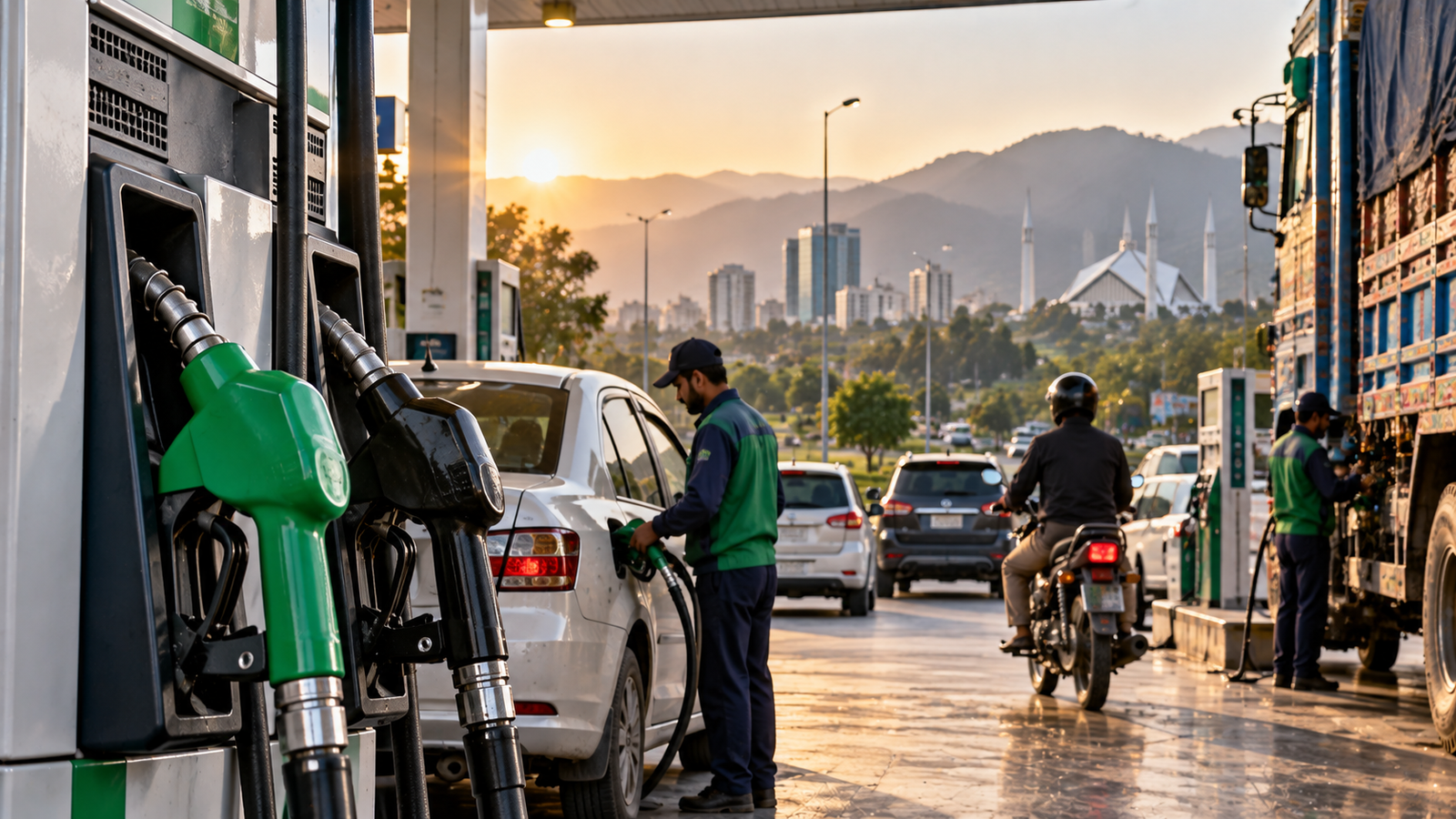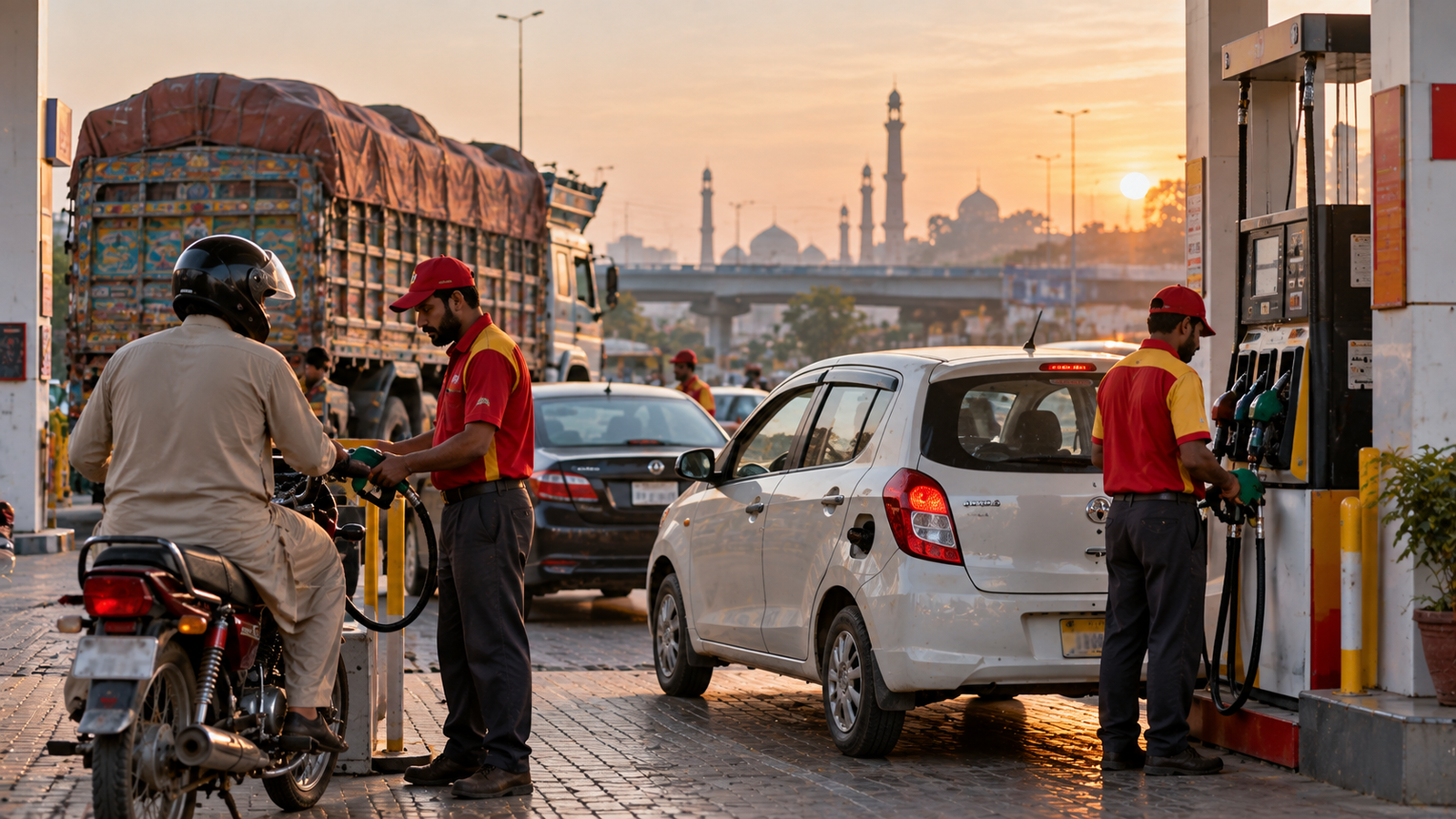
The petrol price in Pakistan on 29 October 2026 has increased to Rs377.91 per litre after a rise of Rs1.85, according to a Petroleum Division announcement issued on Wednesday, October 28. High-speed diesel has also increased by Rs1.75 per litre to Rs399.82. The revised rates apply from Thursday, October 29, under the federal government’s daily petroleum price-review framework. The official announcement was reported by the Associated Press of Pakistan, Dawn and Geo News, while dated price listings corroborate both figures. The changes reverse the previous day’s petrol reduction and move diesel close to the Rs400 threshold. These are effective-date prices, not a forecast for subsequent days.
Petrol Price in Pakistan 29 October 2026: Quick Facts
Effective date: Thursday, October 29, 2026.
Announcement date: Wednesday, October 28, 2026.
Petrol (motor gasoline) new price: Rs377.91 per litre.
Petrol previous price: Rs376.06 per litre.
Petrol change: Increase of Rs1.85 per litre.
High-speed diesel new price: Rs399.82 per litre.
High-speed diesel previous price: Rs398.07 per litre.
Diesel change: Increase of Rs1.75 per litre.
Source of notification: Federal Petroleum Division, reported by APP.
Pricing authority and publication: OGRA framework and dated fuel-price publications.
Other dated reference rates: Kerosene Rs330.96 and light diesel Rs275.24 per litre, according to PSO/OGRA-sourced price archives.
Policy: Daily petroleum price reviews based on international market-related components.
Important limitation: The October 29 rate must not be described as guaranteed for subsequent days.
Latest Petrol and Diesel Price Comparison
Product | October 28 price | October 29 price | Daily change
Petrol | Rs376.06/L | Rs377.91/L | +Rs1.85/L
High-speed diesel | Rs398.07/L | Rs399.82/L | +Rs1.75/L
These rates describe the difference between two consecutive effective dates. A comparison against October 27 would produce different changes: petrol was then Rs379.25 and diesel Rs395.82. Readers should always identify the dates being compared rather than treating any single rise or fall as a monthly movement.
What Did the Petroleum Division Announce?
The Petroleum Division said the prices of motor gasoline and high-speed diesel would rise for October 29. Associated Press of Pakistan reported that the revision followed international developments, including movements in Platts benchmark rates, premiums and incidental costs. The new petrol rate is Rs377.91, up from Rs376.06, while high-speed diesel is Rs399.82, up from Rs398.07. Independent reports published on October 28 repeated the notified figures. This is a current pricing announcement rather than a political prediction or a market rumor. The Petroleum Division’s stated explanation should be attributed to the division, not presented as an independently established cause for every rupee of the change.
Why Did Petrol Rise Only a Day After Falling?
On October 28, petrol had fallen by Rs3.19 per litre. The next published rate increased by Rs1.85. Under a daily review system, the direction of the change can shift as the pricing formula responds to updated market inputs. Refined-product benchmarks, supplier premiums, import-related costs and duties do not necessarily move in a straight line. A daily rise following a daily cut does not, by itself, prove an error in the formula. It means consumers need to check the applicable effective date. The October 29 rate remains Rs1.34 lower than the October 27 price of Rs379.25, illustrating why the chosen comparison period matters.
Diesel Moves Closer to Rs400 per Litre
High-speed diesel reached Rs399.82 per litre after the Rs1.75 increase. This is 18 paisa below Rs400, a psychologically notable price threshold, but the exact notified figure remains Rs399.82. It would be inaccurate to state that diesel officially crossed Rs400 on October 29. Diesel is important to many heavy vehicles, freight operators, agricultural machines and certain industrial uses. The direct cost increase for a specific operator is determined by consumption: 100 litres cost Rs175 more than at the previous rate, assuming the same quantity. Wider price effects depend on businesses’ decisions and market conditions rather than automatically following the pump-price change.
What Is Pakistan’s Daily Fuel Pricing System?
News reports describe a government-approved framework under which OGRA publishes more frequent petroleum price updates rather than relying only on older fortnightly reviews. The purpose, according to official explanations, is to reflect international market movements more promptly and improve transparency. More frequent publication can also introduce additional price variability for households and businesses. Not every daily update must necessarily change every fuel price. Nor should a consumer assume a rate displayed in an old article continues to apply weeks later. For Mukhbir’s reporting, including the exact effective date in the headline, opening paragraph and comparison table prevents old information from being mistaken for the latest price.
How International Benchmarks Affect Local Fuel Rates
Petrol and diesel retail prices reflect costs associated with refined petroleum products, freight, premiums, the exchange rate, domestic distribution and government charges. The Petroleum Division cited international Platts movements and incidental import costs in its explanation for the October 29 revision. These factors can vary between petrol and diesel because each product has different demand, supply and trading conditions. A rise in the domestic rate does not prove that crude oil moved by an identical percentage. Likewise, a product’s benchmark price is not itself the final retail cost paid by a driver in Pakistan. Breaking down the components improves understanding of the pricing mechanism.
Taxes, Levies and Distribution Costs
An archived copy of the October 29 OGRA price build-up identifies the petrol petroleum levy at Rs80 per litre and the climate support levy at Rs5 per litre, alongside customs duty of Rs20.56. It also lists oil marketing company margins, dealer commission and an inland freight equalisation margin as contributors to the final petrol price. These are parts of the existing announced price—not separate amounts that every driver needs to add to Rs377.91 at the pump. Different products have different component values. Readers needing detailed accounting should consult the actual dated OGRA document rather than infer tax rates from broad statements about international oil.
What Does the Increase Cost a Motorcycle Rider?
A motorcycle rider buying 10 litres of petrol at the October 29 rate pays Rs3,779.10, compared with Rs3,760.60 at the October 28 price. That is Rs18.50 more for the same volume. If a rider buys 20 litres over a period in which this price is in effect, the difference from the previous rate is Rs37. These illustrations do not establish how much petrol every motorcycle uses monthly, and they do not account for future daily price changes. Fuel efficiency, distance, traffic and maintenance remain major determinants of real transport spending. Any separate targeted petrol discount must be evaluated under its own eligibility criteria.
How Much More Will Car Owners Pay?
The increase is Rs1.85 for each litre of petrol purchased. For a 30-litre fill, the extra cost relative to October 28 is Rs55.50. At 40 litres, the difference is Rs74; at 50 litres it is Rs92.50. These examples show the direct effect of the newly notified change on fuel purchases of the same size, not an increase in annual ownership cost. Vehicle expenses also include insurance, servicing, tires, financing and repairs. The overall price remains above Rs377 per litre, so the burden of petrol can remain substantial even when individual daily adjustments appear relatively small.
Why Diesel Prices Matter to Freight Businesses
Trucking and delivery companies often consume large quantities of diesel, making small per-litre changes meaningful across fleets. At the October 29 increase of Rs1.75, a business purchasing 500 litres of high-speed diesel pays Rs875 more than at the preceding day’s price; at 1,000 litres, the difference is Rs1,750. Fuel contracts, route efficiency and maintenance can influence how companies manage such movements. A higher diesel rate does not automatically mean every logistics provider has increased its customer charges. Businesses may absorb the short-term movement, change fuel-purchasing schedules or use pre-agreed fuel adjustment terms depending on commercial circumstances.
Could Food and Transport Prices Increase?
Diesel is used in the movement of agricultural goods, food, building materials and other products, and petrol is important for many small transport services. Rising costs can add pressure on supply chains, but final retail prices depend on the scale of fuel consumption, competition, wages, inventory and market conditions. It would overstate the evidence to say that all grocery items or public-transport fares have already risen because of the October 29 adjustment. Any actual fare change should be attributed to a competent transport authority or operator. Similarly, inflation effects require broader official data, not assumptions drawn from one day’s fuel notification.
How the Change Affects Inflation Expectations
Petroleum costs can influence household budgets directly and the cost of production and distribution indirectly. Analysts may therefore monitor frequent fuel-price revisions as one of several indicators of cost pressures in Pakistan’s economy. However, a single daily increase is not enough to calculate a new national inflation rate. Statistical inflation measures reflect a basket of goods and services over a specified period, with many other factors affecting outcomes. It is also possible for particular products to become cheaper while fuel prices rise. Mukhbir should distinguish a confirmed pump-price increase from speculative statements about future inflation or monetary policy.
Are Rates the Same Across Pakistani Cities?
OGRA’s price framework includes mechanisms intended to equalize certain transport costs across locations. The dated national reference rate applies in the context of the official notification, while consumers should still check a station’s displayed and legally applicable prices. An individual outlet’s service conditions or a verified local rule may create questions that require direct confirmation. This article does not invent different official petrol rates for Karachi, Lahore, Islamabad or Quetta. Its figures are those publicly announced for the national effective date, supported by the Petroleum Division release and dated price records.
How to Verify the Official Rate Before Refueling
Drivers can review OGRA’s official price-publication portal or current notifications from the relevant government and fuel companies. Checking the effective date is critical because a screenshot from October 28 now shows outdated petrol and diesel rates for October 29. A trustworthy update should specify the product name and unit, particularly because petrol, high-speed diesel, kerosene and light diesel are separate products. Consumers should compare official records with the pump display and receipt where necessary. If a social-media account shares an unverified increase for tomorrow, it should not be treated as binding without a new dated official source.
Petrol Relief Schemes Are Different From the Retail Price
News coverage has separately discussed targeted fuel assistance for eligible motorcycle, rickshaw and small-car users. Such programs, where active, involve specific rules and should not be confused with the general notified petrol rate of Rs377.91 per litre. A person may not qualify simply because they own a vehicle of a particular type, and the scale or duration of assistance may change through later notifications. The October 29 price update alone does not establish universal eligibility or a fresh subsidy payment. To publish a practical guide, Mukhbir would need the latest official eligibility criteria, registration arrangements and approved benefits.
Why Traders and Small Businesses Need Dated Prices
Restaurants, delivery companies, small retailers and service providers may use fuel in their operations even when energy is not their main business. More frequent changes make it useful to document actual filling costs, mileage and purchasing dates. A business estimating future expenses may use scenarios rather than a single permanent price assumption. The effect depends on the share of transport in its overall cost structure. An enterprise selling digital services may experience only an indirect impact, while a local delivery fleet may be more sensitive. A general news report cannot infer profit changes for a particular business from the fuel rate alone.
What Does the October Price Trend Show?
Publicly archived fuel notifications show that petrol has moved both upward and downward during October 2026. For example, it stood at Rs379.25 on October 27, Rs376.06 on October 28 and Rs377.91 on October 29. Diesel increased across those dates, moving from Rs395.82 to Rs398.07 and then Rs399.82. A three-day comparison is useful for identifying recent direction, but it does not establish a longer-term trend or predict the next price. Wider interpretation would require a longer data series and reliable analysis of international product costs, exchange-rate effects and taxation.
Government Policy and Neutral Economic Reporting
The revised rates are an administrative economic development. The Petroleum Division attributes changes to international product-market conditions and related pricing components. Reporting those statements does not require supporting or opposing any political party. At the same time, the impact on motorists, households and businesses is relevant public-interest information. Mukhbir presents the notified figures, the government’s stated rationale and conditional economic implications without unsupported accusations against political leaders or state institutions. Disagreement about fuel levies or subsidy policy can be reported through verified official statements while keeping news reporting separate from political advocacy.
What Should Consumers and Businesses Watch Next?
The immediate priority is the next applicable dated price publication because the framework allows frequent changes. Drivers can monitor notified rates, and businesses can compare actual fuel purchases with previous costs. Analysts may watch movements in international benchmark prices, the rupee exchange rate, freight and relevant fiscal policy. No future direction should be promised on the basis of this day’s figures. The fact that diesel is 18 paisa below Rs400 does not establish that it will cross that level on the next update. Mukhbir will need a new source and timestamp before publishing any later revision.
Conclusion
The petrol price in Pakistan on 29 October 2026 is Rs377.91 per litre, up Rs1.85 from the previous day, while high-speed diesel has risen Rs1.75 to Rs399.82. The Petroleum Division’s announcement and multiple independent reports confirm these rates. The immediate effect can be measured for a given quantity of fuel, but broader economic consequences depend on spending patterns, contracts and subsequent prices. With a daily review framework, the date of each notification is as important as the number itself. Readers should rely on current official publications and avoid treating an older article as a permanent fuel-price reference.
Frequently Asked Questions
What is the petrol price in Pakistan on 29 October 2026?
The notified petrol price is Rs377.91 per litre for October 29, 2026.
What is the high-speed diesel price on October 29?
High-speed diesel is Rs399.82 per litre for the stated effective date.
How much did petrol increase from October 28?
It increased by Rs1.85 per litre from Rs376.06 to Rs377.91.
How much did diesel increase?
Diesel increased by Rs1.75 per litre from Rs398.07 to Rs399.82.
When was the new fuel price notification issued?
The Petroleum Division announced the revision on October 28 for October 29 implementation.
Has diesel officially reached Rs400 per litre?
No. The notified rate is Rs399.82, which is 18 paisa below Rs400.
Why did the government revise the prices?
The Petroleum Division cited changes in international Platts product rates, premiums and other import-related cost components.
Where can people check the next price update?
Consult OGRA’s dated fuel price publications and verified government or petroleum-company notices rather than an older social-media post.
About The Author