Pakistan food supply gap is an increasingly important economic and public-health problem: the country has enough of some staple food groups relative to national dietary benchmarks, yet supplies of vegetables, fruits, roots and tubers, and legumes and pulses remain substantially below the levels required for a balanced diet. A Food and Agriculture Organization of the United Nations (FAO) policy assessment, highlighted in Dawn’s October 26, 2026 coverage, explains why producing calories is not the same as making healthy diets accessible.
The assessment, titled Food Supply for Healthy Diets in Pakistan, compares national food availability with the quantities implied by Pakistan’s food-based dietary guidelines. The report covers supply data from 2010 through 2023, rather than claiming that researchers counted every meal eaten by families in October 2026. It identifies a structural mismatch between agricultural supply and nutritional requirements at population scale.
According to FAO findings, more than 60 percent of Pakistanis cannot afford a healthy diet. That is an affordability estimate; it does not mean 60 percent of people never eat, have no food at all, or are necessarily classified as acutely food insecure. For households, businesses and policymakers alike, the question is how to improve access to a diverse, safe and affordable basket of foods.
Pakistan Food Supply Gap: Key Findings at a Glance
Report: Food Supply for Healthy Diets in Pakistan, FAO policy assessment.
Fresh reporting date: October 26, 2026; earlier FAO-related reporting appeared in October and FAO discussed the structural problem in March 2026.
Data examined: National food supply compared with dietary requirements for 10 food groups over 2010–2023.
Population reference: Around 189.3 million in 2010 and 235.2 million in 2023 in the assessment.
Healthy-diet affordability: More than 60% unable to afford a healthy diet, according to the FAO-related findings reported by Dawn.
Under-supplied groups: Vegetables, fruits, roots and tubers, and legumes and pulses.
Above estimated dietary need: Cereals and sugar in the food supply comparison.
Areas showing improvement: Milk, dairy, meat and eggs in the report’s historical assessment.
Policy priorities: Diversified agriculture, investment in cold-chain logistics, reduced food loss, appropriate consumer information and targeted nutritional protection.
Crucial caveat: A population-level food-group supply gap is not identical to an individual’s nutrient deficiency or an observed shortage on every market stall.
What Does a National Food Supply Gap Mean?
In the FAO comparison, a gap arises when the overall quantity available for a particular food group is lower than the quantity implied by dietary recommendations for the entire population. This method is useful for identifying whether a national food system is structurally aligned with healthy eating, but it is not the same as a household expenditure survey or a direct clinical nutrition assessment.
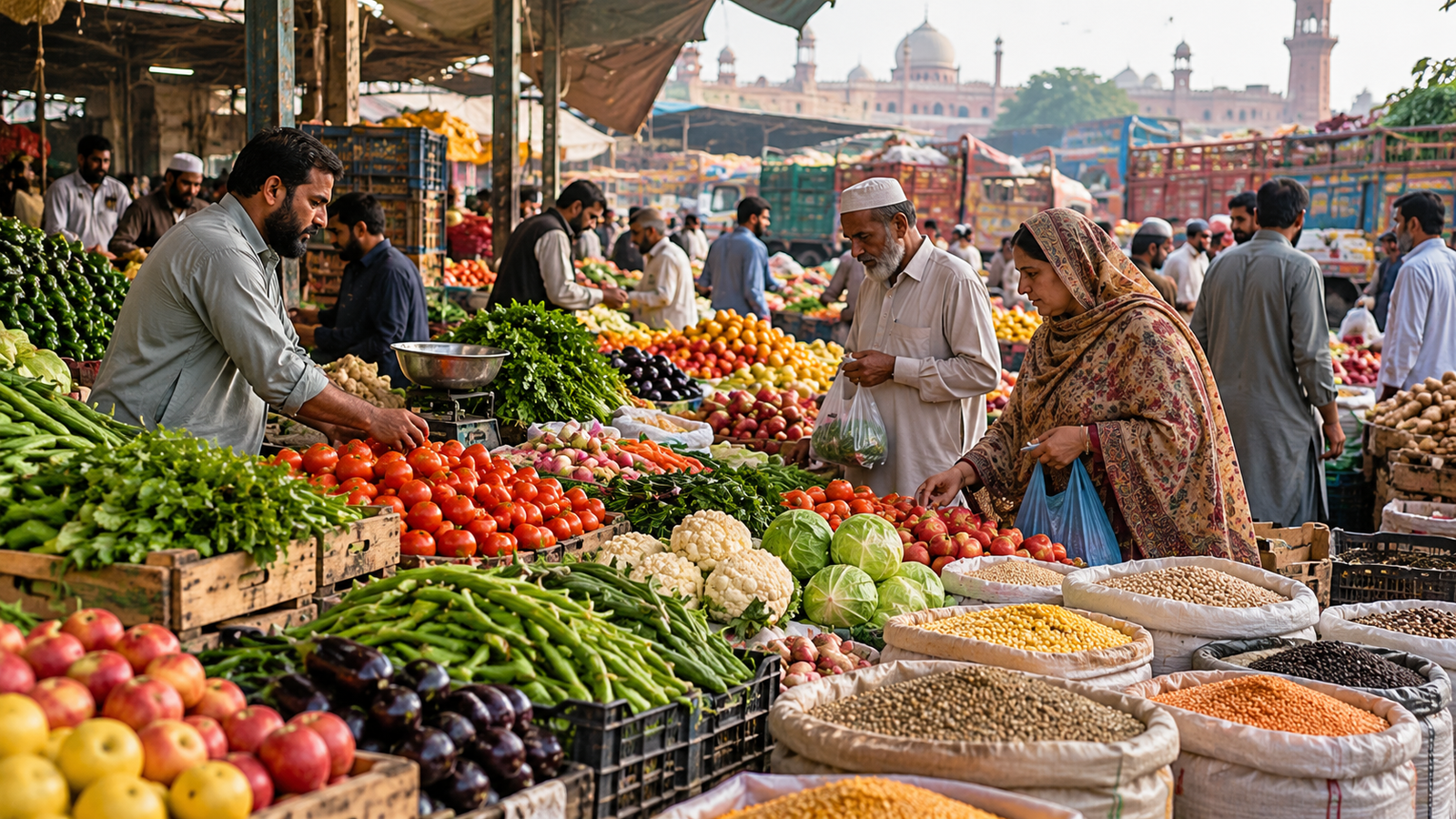
For example, markets can display large piles of vegetables while national availability is still inadequate for everyone to consume recommended quantities. Distribution is not equal across districts or income groups, and food may be wasted before reaching consumers. Conversely, an aggregate surplus of cereals does not prove that every household can afford sufficient grain.
FAO’s analysis therefore examines the supply side of the food economy, while its affordability estimate highlights the separate problem of purchasing power. The two problems interact, but they should not be collapsed into a single claim that Pakistan has no food or that every citizen eats an identical diet.
Which Foods Are Most Under-Supplied in Pakistan?
The assessment identifies persistent shortfalls in vegetables, fruits, roots and tubers, and legumes and pulses when their national availability is compared with dietary requirements. These categories include foods that contribute fibre, micronutrients and diversity to meals, although the exact nutrients differ substantially between individual varieties.
Dawn’s October 26 report cites vegetable shortfall estimates of 10.9 million to 17.8 million tonnes in 2010, widening to 13 million to 21.6 million tonnes in 2023. For fruit, the reported range increased from 1.9 million to 10.3 million tonnes in 2010 to 3.9 million to 14.3 million tonnes in 2023. Those are ranges across dietary benchmark assumptions, not a single precise tonnage of produce that disappeared from wholesale markets.
These findings do not mean Pakistan produces no fruits or vegetables. The country has significant horticultural activity, but the total quantities available remain insufficient against the healthy-diet benchmark used in the analysis. Improving both production and movement of food to consumers is central to addressing the imbalance.
Why Are Cereals and Sugar Reported Above Recommended Needs?
The assessment finds that cereals and sugar appear in quantities above what Pakistan’s population would require under its dietary guidelines. This reflects a food system historically shaped around staple crops and calorie availability. Staples play a fundamental role in food security, but their availability alone cannot provide the range of nutrients in a balanced diet.
A surplus relative to a recommended dietary pattern is not equivalent to a farmer having no buyers or a warehouse containing unwanted food. Food availability statistics include complex supply and utilisation relationships, and different regions can experience different conditions. Likewise, there is no automatic justification for ending staple crop support solely because aggregate dietary benchmarks show an oversupply.
The broader economic question is how public investment, research, price signals and market infrastructure can support greater diversity without destabilising essential food access. Any transition would need to consider water, land, farmer income, trade requirements and the effect on low-income households.
Why More Than 60% Cannot Afford a Healthy Diet
The FAO-related findings cited by Dawn say that more than 60 percent of the population cannot afford a healthy diet. In affordability analysis, the price of a nutritionally adequate food basket is compared with people’s resources for food after allowing for essential non-food needs. This is a different concept from total food availability or whether a person can purchase enough calories to avoid immediate hunger.
Rising living costs can push households toward cheaper and less varied foods even when nutritious items are physically present. Urban families may face high housing, transport and energy bills, while rural households can face volatile farm earnings, seasonal shortages or transport barriers. The exact pattern varies and cannot be established for every family from one national statistic.
This distinction matters for reporting. A headline saying ’60 percent of Pakistanis have no food’ would be unsupported. The defensible finding is that a healthy diet remains financially out of reach for more than 60 percent, as estimated in the referenced FAO analysis.
How Population Growth Intensifies the Challenge
Dawn reports that the assessment’s population reference rose from around 189.3 million in 2010 to 235.2 million in 2023, with a projection of roughly 330 million by 2050. These figures are contextual estimates used in the report, not a new real-time population census. They illustrate the challenge of supplying a larger population with adequate dietary diversity.
If more people need vegetables, fruits and pulses, agricultural production, distribution networks and purchasing power must expand accordingly. Merely maintaining the same total volume of nutritious food could widen a per-capita gap over time. Improvements in productivity, logistics and reduction of losses can help prevent such pressures from translating into worse access.
Population growth also affects food demand geographically as cities expand and consumption patterns change. Investment decisions therefore need to account for urban wholesale markets, transport distances and cold storage as well as what happens on farms.
Why Food Loss and Cold Storage Matter
Fresh produce is vulnerable to damage and spoilage between harvest and sale. Delayed transport, unsuitable storage temperatures, weak packaging and poor handling can reduce the amount of food that reaches consumers in marketable condition. The consequences can include lower farmer earnings and higher prices for the volume that survives.
FAO recommends investment in storage, cold chains and market infrastructure, alongside reducing post-harvest losses and waste. Such improvements could increase effective supply without requiring every additional unit of food to come from more cultivated land. They may also help producers access markets farther from their farms.
However, cold-chain investment has costs: electricity, maintenance, finance, transport coordination and reliable facilities. An improvement programme should evaluate where losses occur and whether the benefits reach both growers and consumers. Not all types of produce require the same handling or storage technology.
What the Report Means for Farmers and Agriculture Businesses
A policy shift toward dietary diversity could create demand for agricultural inputs, horticultural seedlings, improved storage, grading, packaging, logistics and processing. Businesses in these areas may see opportunities if investment incentives, market access and consumer purchasing power improve. The analysis does not establish that any particular company will become profitable or that a proposed venture has secured funding.
For farmers, diversification decisions involve commercial risk. Vegetables and fruits can have different planting cycles, perishability and price volatility compared with major field crops. Credit, insurance, water availability, reliable buyers and extension services influence whether growing more nutritious crops is economically sensible.
The goal should not be interpreted as a blanket instruction to replace staples. A resilient system needs both dependable calorie sources and wider nutritional options, with farmers able to respond to demand without carrying disproportionate financial exposure.
Could Food Prices Change If Policy Priorities Shift?
In principle, greater supply of a desired food can ease shortages over time, while lower wastage can make more of what is already produced available to households. Yet prices also depend on demand, fuel, transport, retail margins, currency conditions, storage costs, weather and seasonal patterns. No single FAO recommendation guarantees that fruit or vegetables will become cheaper on a specific date.
Some policies, such as improved market infrastructure, can require initial investment and have benefits that develop gradually. Others, such as nutrition-related taxes, may deliberately influence purchasing behaviour but could create affordability concerns unless designed carefully and accompanied by appropriate measures.
Economic reporting should avoid promising immediate price reductions merely because FAO has recommended reform. Policymakers would need to measure whether changes reduce the effective cost of a healthy food basket for different income groups.
What Does FAO Recommend for Pakistan?
FAO outlines several complementary actions. It recommends aligning agriculture and trade priorities more closely with the food groups required for healthy diets; improving storage and distribution; reducing food waste; and supporting demand for nutritious products. It also calls for reviewing the country’s existing food-based dietary guidelines to reflect current nutrition, health and environmental considerations.
Consumer-oriented recommendations include clearer front-of-package labelling and evidence-based fiscal measures addressing products high in sugar, salt and unhealthy fats. The report also supports education and nutrition programmes that make healthy food choices more understandable and accessible. These are recommendations, not evidence that the government has enacted every proposed measure.
Policy design should include safeguards for vulnerable consumers. Taxes, marketing restrictions and product reformulation require careful assessment of public-health goals, business compliance and household costs. The broad objective is to create conditions in which healthy diets are both available and financially achievable.
The Role of Food Labelling and Processed Food Companies
Front-of-package nutrition labels are intended to help consumers compare packaged products and notice important nutritional characteristics without deciphering lengthy ingredient tables. In the FAO assessment, labelling belongs to a broader package of consumer information and industry reform rather than serving as a complete solution to malnutrition.
Manufacturers might be encouraged to reduce excess salt, added sugar and unhealthy fats in appropriate product categories while maintaining food safety and quality. The commercial effects would vary by product, consumer preferences, production cost and regulatory design. Clear rules could help businesses plan, but labelling requirements also need meaningful enforcement to be useful.
It is also important to remember that much of Pakistan’s fruit and vegetable supply is sold without factory packaging. Better information about packaged products must therefore complement, not replace, practical improvements in access to fresh and minimally processed foods.
How School Meals and Social Protection Fit In
The FAO assessment recommends attention to vulnerable populations, including expanding nutritious school meal programmes and strengthening social protection mechanisms. These policies may help address affordability barriers among families who cannot consistently purchase a healthy range of foods on their own.
Effective programmes need clear eligibility, reliable funding, safe food handling and monitoring of outcomes. School meals can support a child’s access to nourishing foods during school hours, while targeted assistance may increase household purchasing power. But their actual nutritional and educational impact must be established through programme design and evaluation, not assumed.
Such demand-side interventions should accompany improvements in agriculture and logistics. Providing resources to buy nutritious foods is less effective if those foods are unavailable locally, and expanding supply may not help households that cannot afford market prices.
Are There Health Consequences to the Supply Imbalance?
FAO describes persistent undernutrition alongside increasing diet-related noncommunicable diseases. A population can face both conditions when diets lack variety or quality despite containing substantial calories. Nutritional risk depends on many factors, including disease exposure, maternal and child care, sanitation, household income and access to healthcare.
A national supply analysis cannot diagnose an individual with anaemia, stunting, diabetes or any other condition. It does, however, suggest that the broader food system may make recommended diets hard to achieve consistently. This supports FAO’s call to connect agricultural policy with health and nutrition objectives.
For individuals, dietary decisions should take account of their circumstances and professional medical advice where needed. This article focuses on the economics and policy of food availability rather than prescribing diets or treating population estimates as personal diagnoses.
Why the Analysis Uses Data Through 2023
Although Dawn’s detailed article appeared on October 26, 2026, FAO’s comparison draws on annual supply data spanning 2010 to 2023. This is a familiar distinction in economic and development reporting: a newly published discussion can analyse several years of earlier data. The figures should not be described as if all gaps were independently measured in the week of publication.
The historical comparison is useful because it shows the direction of change rather than a one-day market condition. The reported widening ranges for fruit and vegetable gaps suggest structural pressure that cannot be understood from a single wholesale price quotation.
More current food balance sheets, nutrition surveys and regional market data may refine the picture. Publishers should update an article when newer authoritative evidence becomes available, retaining the original measurement period for older statistics.
Business Opportunities and Risks in a Nutrition-Focused Food System
The strongest potential commercial themes lie in food supply chains: affordable cold storage, better transport scheduling, digital wholesale market information, agricultural inputs adapted to diverse crops, grading services and safe food processing. These opportunities are logical implications of the gaps highlighted by FAO, not announced government investment projects.
Financing remains a challenge. Fresh-produce businesses may face thin margins, spoilage risk, variable prices and difficult access to affordable working capital. Investors need evidence of reliable sourcing and customer demand. Policies that expand food production without improving distribution could leave farmers facing low farmgate prices while consumers continue to pay high retail prices.
A balanced business outlook therefore requires attention to both infrastructure and household purchasing power. More supply can be beneficial, but its value depends on the food being delivered safely, bought at affordable prices and sold under sustainable conditions for producers.
What Should Policymakers and Businesses Monitor Next?
Useful indicators include changes in supply of the major food groups relative to dietary guidelines, food prices as a share of household income, post-harvest losses, storage capacity and the reach of nutrition assistance. It is also important to monitor provincial differences because national averages may hide substantial variation in access and production.
Government announcements should be separated from completed action. A draft policy, funding pledge or conference recommendation is not the same as an operational programme with published results. Businesses may also need details on market regulation, electricity availability, cold-chain financing and data quality before committing capital.
An updated assessment could examine whether a larger proportion of families can afford a healthy basket and whether production gains in vegetables, fruits and pulses are translating into actual availability. These outcomes are more informative than simply tracking tonnes produced.
Conclusion
Pakistan’s food supply gap is a structural challenge that links agriculture, food businesses, household incomes and public health. FAO’s assessment, examined in renewed October 26 reporting, identifies inadequate national availability of vegetables, fruits, roots and tubers, and pulses relative to recommended dietary requirements. At the same time, cereal and sugar supplies exceed those benchmarks.
The key finding is not that Pakistan has no food. It is that the composition and affordability of food available to its population do not reliably support healthy diets. More than 60 percent of people are estimated to be unable to afford a healthy diet, and FAO recommends coordinated reforms in production, markets, storage, consumer information and social support. For businesses and policymakers, success would mean improving access to nutritious food while protecting viable livelihoods across the supply chain.
Frequently Asked Questions
What is the Pakistan food supply gap?
It is the difference between the national availability of various food groups and the quantities that would be required for the population to meet Pakistan’s food-based dietary guidelines.
Which nutritious foods are reported to be under-supplied?
FAO identifies notable gaps in vegetables, fruits, roots and tubers, and legumes and pulses.
Did FAO say 60% of Pakistanis have no food?
No. The reported estimate says more than 60% cannot afford a healthy diet. That is not the same as having no food.
When was the data collected?
The assessment compares annual national supply with dietary requirements across 2010–2023. Dawn published renewed coverage on October 26, 2026.
What are the reported vegetable and fruit supply gaps?
For 2023, Dawn reports estimated gaps of 13 million to 21.6 million tonnes for vegetables and 3.9 million to 14.3 million tonnes for fruits, depending on the benchmarks used.
Why does Pakistan have enough cereal but lack nutritious foods?
The findings point to a structural mismatch between food production and healthy-diet needs. Historically strong attention to staples is one relevant policy consideration, but production, distribution and affordability all matter.
What changes does FAO recommend?
FAO recommends more support for diverse nutritious crops, reduced post-harvest loss, stronger market infrastructure, healthier consumer information and targeted nutrition-related support.
Does this report mean fruit and vegetable prices will fall?
No. It identifies potential reforms, not a guaranteed future change in prices. Real prices depend on many economic and supply-chain conditions.
About The Author