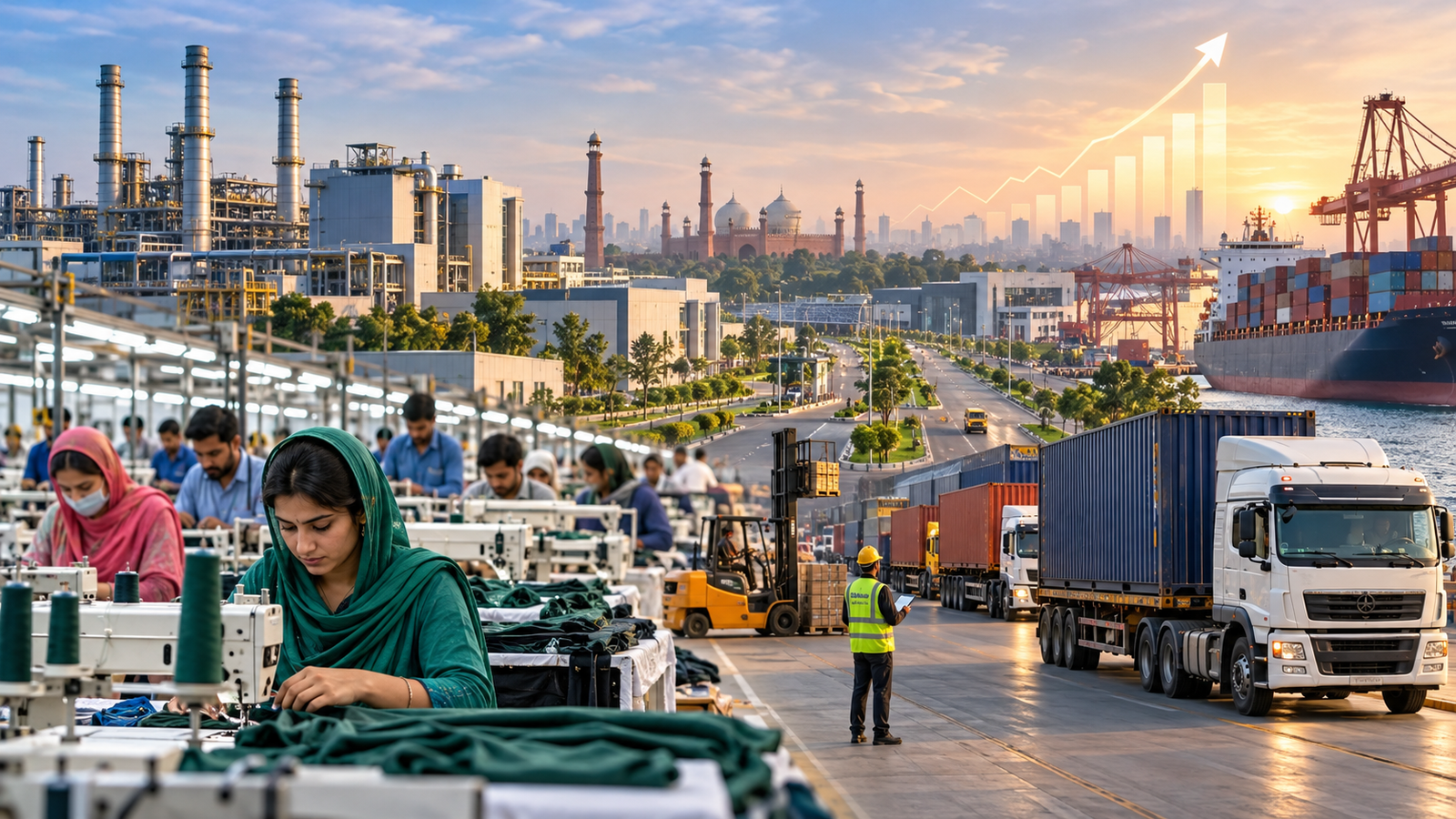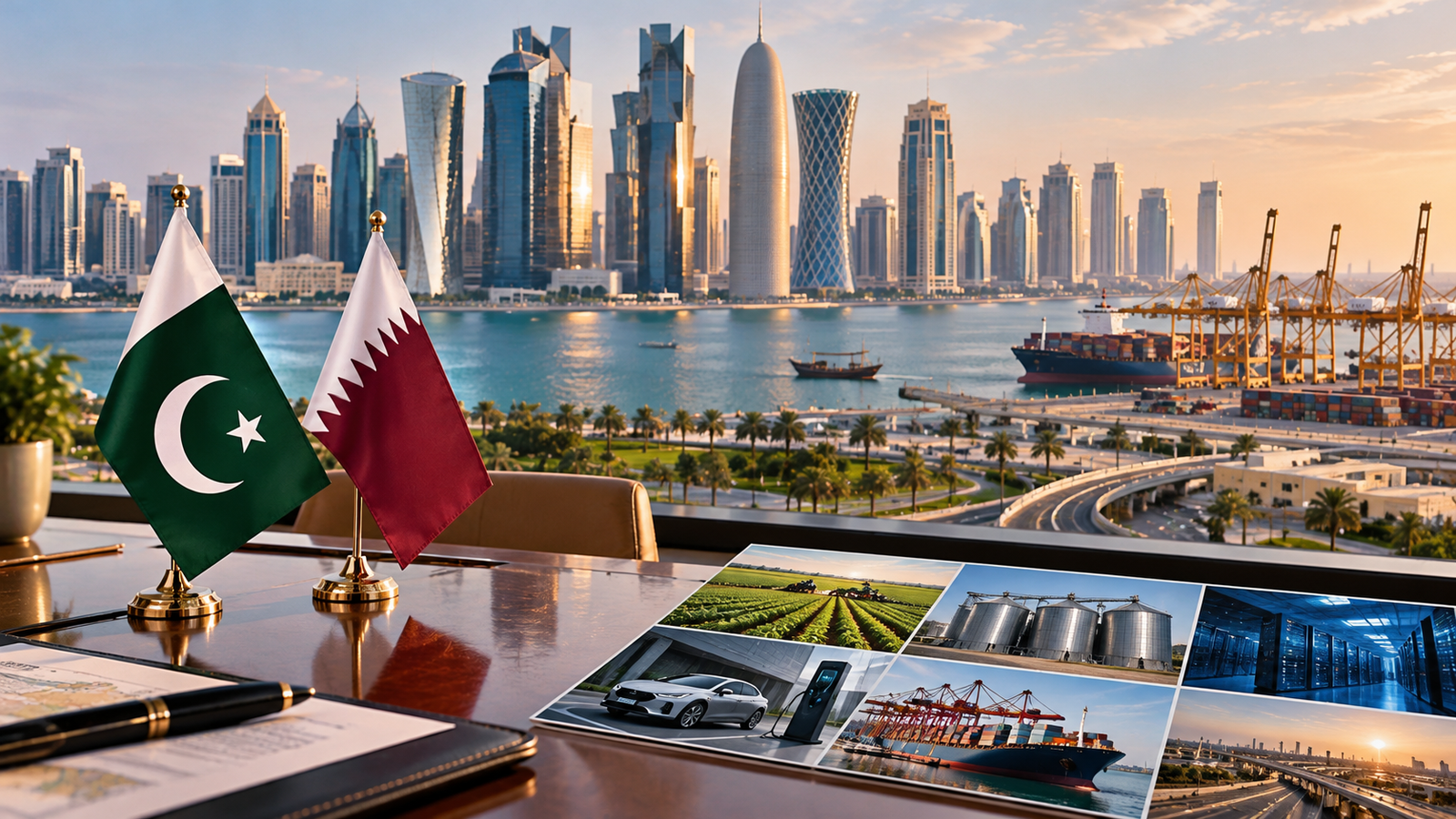
Pakistan Qatar investment talks 2026 have placed agriculture, electric vehicles, information technology, maritime transport and infrastructure among the central areas of proposed bilateral economic cooperation. Senior officials from both countries met in Doha on October 24, 2026, for the second meeting of their Joint Task Force on Trade and Investment, following the group’s inaugural session in April.
Pakistan’s Press Information Department published the official account on October 25, while Dawn and ProPakistani carried further reporting on October 26. The discussions were co-chaired by Federal Minister for Commerce Jam Kamal Khan and Qatar’s Minister of State for Foreign Trade Affairs Dr Ahmad bin Mohammed Al-Sayed. Relevant Pakistani ministries participated virtually, with the Special Investment Facilitation Council, or SIFC, coordinating the process as the task force’s secretariat.
The meeting identified several potential investment and trade opportunities. However, it is important not to treat these invitations or expressions of interest as completed deals. The signed document highlighted in the official statement was the minutes of the task force’s first meeting, not a final investment agreement covering the proposals presented in Doha.
Pakistan Qatar Investment Talks 2026: Key Facts
Event: Second Pakistan–Qatar Joint Task Force on Trade and Investment meeting.
Meeting date: October 24, 2026.
Location: Doha, Qatar.
Official Pakistan government statement: October 25, 2026.
Dated media follow-up: October 26, 2026.
Co-chairs: Pakistan Commerce Minister Jam Kamal Khan and Qatar’s Minister of State for Foreign Trade Affairs Dr Ahmad bin Mohammed Al-Sayed.
Secretariat: Pakistan’s Special Investment Facilitation Council (SIFC).
Areas discussed: Agriculture and food security, electric vehicles and industrial partnerships, IT and digital infrastructure, maritime transport, logistics, aviation and road infrastructure.
Trade proposal: Pakistan sought Qatar’s support for the early signing of the Pakistan–Gulf Cooperation Council Free Trade Agreement.
Agricultural trade proposal: A rice-supply memorandum between the Trading Corporation of Pakistan and Hassad Food was awaiting Pakistan’s federal cabinet approval.
Working groups: Eleven technical working groups identified during the first meeting were to be made operational.
What was signed: Minutes of the task force’s first meeting.
What was not verified: A binding multibillion-dollar investment agreement, actual disbursement, final motorway financing or implementation of the proposed investment fund.
What Happened at the Doha Joint Task Force Meeting?
The October meeting reviewed progress since the inaugural task force session held in April 2026 and considered ways to build more substantial trade, investment and industrial relationships between Pakistan and Qatar. The Pakistani delegation presented sectors in which Qatari businesses or investment institutions might take part, while the Qatari side raised opportunities for stronger cooperation in aviation and air traffic.
The task force format is intended to move beyond general diplomatic declarations by assigning technical follow-up responsibilities. According to the official statement, Pakistan had shared the proposed composition of 11 working groups and asked Qatar to nominate counterparts so that their work could begin.
Those groups are expected to identify concrete opportunities, address unresolved matters and prepare recommendations before the next task force meeting, which Pakistan is scheduled to host. That next phase will be significant because detailed project proposals, financing arrangements and implementation plans are more meaningful than broad sector descriptions alone.
Why Pakistan Is Seeking Qatari Investment in Agriculture
Agriculture and food security were prominent items at the Doha meeting. Pakistan invited investment in modern farming, grain storage, silos, cold-storage facilities, integrated cold-chain infrastructure and advanced agricultural technologies. These are areas that can affect how crops move from production to consumer markets and how food is protected against spoilage.
Grain silos and warehouses can improve the handling of bulk commodities when appropriately designed and managed. Cold-chain systems are especially relevant to perishable goods, which may lose quality during transportation or storage. Modern equipment, irrigation techniques, crop-management technology and improved supply-chain information could also offer commercial opportunities.
Yet the official statement does not identify a final Qatari financial commitment to any specific farm, silo or cold-storage facility. A project would still need to establish its location, commercial structure, cost, expected returns, energy requirements and regulatory approvals. Presenting the discussion as an existing nationwide agriculture investment programme would go beyond the verified record.
Rice Supply Discussions With Qatar’s Hassad Food
One specific agricultural proposal involved a memorandum of understanding between the Trading Corporation of Pakistan and Qatar’s Hassad Food for the supply of Pakistani rice. According to the Pakistan government’s statement and Dawn’s reporting, the proposed arrangement had been submitted for federal cabinet approval.
This is potentially relevant for exporters, mills, growers and food-security planners because a government-to-government channel may provide another structure for managing supply relationships. However, a proposed memorandum is not the same as a signed purchase order or a confirmed export shipment. Its precise commercial terms, quantities, prices and delivery schedule should not be presumed.
If the cabinet approves the proposal and the relevant parties subsequently finalise an agreement, additional information would be needed to assess its business impact. Until then, Mukhbir should report it as a rice-supply proposal awaiting approval, not a completed Qatar rice export deal.
Electric Vehicles and Joint Automotive Manufacturing
Pakistan’s delegation presented opportunities in new-energy vehicles, including electric vehicles, under the country’s EV policy framework. The sectors highlighted included joint manufacturing, industrial partnerships and technology transfer. This could be commercially relevant because assembly plants, component supply chains, charging infrastructure and workforce development often require coordination between several types of investors and manufacturers.
Qatari participation could take different forms if discussions progress: financing, partnerships with an existing manufacturer, support for supply-chain assets or participation in related infrastructure. The public account does not identify a named Qatari automaker or investor that has signed a binding vehicle manufacturing agreement arising from this meeting.
The potential economic benefits would depend on local demand, imported-component costs, electricity availability, tariff rules, product quality, competition and skills development. Simply describing a sector as open for investment is not evidence that a new factory has been approved or that thousands of jobs have already been created.
Information Technology and Digital Infrastructure
Pakistan invited Qatari interest in information technology, digital infrastructure and technology partnerships. The official statement referred to Pakistan’s expanding IT-export ambitions and possibilities for growth in digital services. Such projects could involve business-service partnerships, network and data infrastructure, software development, training or technology-enabled export activities.
These are broad commercial categories rather than a list of signed contracts. No specific data-centre capacity, startup funding amount or nationwide digital-infrastructure project was confirmed as a completed outcome of the second task force meeting.
For Pakistani technology companies, the useful development is the possibility of a structured channel for business engagement with Qatari partners. Any credible follow-up would identify the investors, counterparties, funding arrangements and commercial timetable. Official announcements or registered company disclosures should be checked before attributing new capital inflows to these talks.
Maritime Transport, LNG Carriers and Trade Connectivity
Maritime cooperation formed another part of Pakistan’s presentation. Officials highlighted investment opportunities related to securing oil tankers, liquefied natural gas carriers and container vessels. The government described these as important for energy security and the movement of goods linked to international trade.
Vessel ownership, leasing, chartering and port logistics involve significant capital, long-term contracts, insurance and operational requirements. A foreign partnership might contribute finance or technical expertise, but the details would vary greatly from project to project. No publicly verified agreement for a specified fleet of ships emerged from the meeting description.
The maritime agenda connects with wider plans to improve links between seaports, roads and regional markets. For investors, such links can affect logistics efficiency and market access, while also bringing financing, regulatory and demand risks that require assessment.
Karachi–Hyderabad Motorway Presented as an Opportunity
Pakistan presented the proposed new Karachi–Hyderabad Motorway to Qatar as a possible investment opportunity. Government reporting described the project as intended to strengthen the connection between Pakistani ports and the national road network while supporting trade corridors toward Central Asia.
Road projects can be structured through public funding, private financing or partnerships with contractual arrangements defining construction, maintenance, traffic risk and returns. Those choices have large implications for taxpayers, road users and investors. The official Doha statement, however, did not announce a completed financing agreement with Qatar for this motorway.
The distinction is essential for coverage: a proposed motorway being offered to investors is not equivalent to construction beginning, funding closing or a new toll-road concession being awarded. Each subsequent stage would need independent confirmation.
Pakistan–GCC Free Trade Agreement: What Is the Status?
Pakistan asked Qatar to support the early signing of the proposed free trade agreement with the Gulf Cooperation Council, or GCC. According to Dawn and ProPakistani, Pakistan said it completed domestic approval steps and sent the approved agreement text to the GCC Secretariat on December 31, 2025. Outstanding formalities remained the subject of diplomatic engagement.
A trade agreement could change market access and the commercial environment for exporters and importers once concluded and implemented. But the country having completed its domestic process does not prove that the full agreement was signed or that tariff benefits are already available to businesses.
Companies should therefore continue to follow applicable customs and trade rules until authorities formally announce the agreement’s entry into force and publish its operational provisions. Any forecast about which products will benefit requires the final text and implementation schedule, not just a meeting summary.
Meat Export Restrictions and Market Access
Pakistan also raised restrictions affecting bone-in meat exports to Qatar. Officials said a technical dossier addressing animal health and food-safety concerns had been shared with the relevant Qatari authorities, and Pakistan requested an early resolution.
Such trade restrictions can involve veterinary rules, disease controls, certification and food-safety procedures. Resolution may require technical assessment and regulatory clearance by the importing country. The existence of a dossier or discussion does not establish that the restrictions were lifted during the meeting.
For meat processors and exporters, the practical development to monitor is a formal change in Qatar’s import requirements or issuance of official permissions. Until that happens, statements about unrestricted market access or immediate shipment volumes would be premature.
What Is the Proposed Pakistan–Qatar Investment Fund?
Pakistan presented the concept of an investment fund that could support Qatari participation in infrastructure, agriculture, industrial development, information technology and other priority sectors. A fund can be used to organise financing across multiple projects, but its governance, investment mandate, contributors and legal structure determine how it functions.
The government described a concept, not an operational vehicle with a verified amount of committed capital. Neither a fund size nor a completed launch was established in the October 25 official release. Readers should be cautious about large numerical claims that do not identify a signed instrument or funding source.
Future disclosures would need to identify whether an actual fund is constituted, who manages it, how projects are selected and what protections exist for public and private participants. Those details would be necessary for a serious investment assessment.
Eleven Working Groups Could Determine the Next Steps
The two countries identified 11 technical working groups covering sectors including logistics, aviation, advanced manufacturing, mining and minerals, agriculture, tourism, financial technology, healthcare, education, industrial development, information technology and startups. The official statement groups certain topics under broad sector descriptions, so the list should be understood as the announced coverage rather than proof that every named industry has a separate formally launched committee.
Pakistan requested nominations from Qatar to allow the groups to begin work. Their expected role is to develop practical recommendations, resolve obstacles and prepare sector-level progress reports ahead of the third Joint Task Force meeting in Pakistan.
This process may help distinguish ideas with realistic commercial potential from broad diplomatic ambitions. However, no timetable for individual project completions was verified, and there is no basis to claim that all 11 groups have already delivered investment agreements.
The Role of SIFC and Government Institutions
The Special Investment Facilitation Council served as the secretariat of the Joint Task Force, coordinating Pakistani participation from relevant ministries and agencies. The Ministry of Commerce led the discussion at ministerial level, with other officials joining virtually. These institutional roles matter because foreign investment projects often require approvals or information from multiple government departments.
A coordinating institution may help investors identify counterparts and navigate sector-specific procedures, but it cannot eliminate every business or policy risk. Relevant permits, contractual terms, financial scrutiny and legal requirements would still apply to actual projects.
The government has characterised the engagement as part of its effort to improve investment facilitation and trade relationships. Whether those efforts result in measurable new capital inflows will be judged by completed transactions and publicly verifiable project milestones rather than meeting attendance alone.
What Was Actually Signed in Doha?
At the conclusion of the second meeting, Jam Kamal Khan and Dr Ahmad bin Mohammed Al-Sayed formally signed the minutes of the first Pakistan–Qatar Joint Task Force meeting, according to the official Press Information Department statement and accompanying APP photograph coverage.
Meeting minutes document discussions and agreed points of record. They are not necessarily investment contracts. The signed minutes should not be described as the signing of the rice-supply MoU, a motorway financing agreement, an EV factory agreement or a multibillion-dollar funding arrangement.
This is particularly important for social-media headlines, where images of officials signing documents can be misunderstood without precise captions. The accurate public-interest story is that the countries advanced a framework for discussion and follow-up while several proposals remained under consideration.
Possible Business Impact in Pakistan
If these discussions develop into actual projects, several sections of Pakistan’s economy could be affected. Agricultural investment might improve storage and distribution, EV partnerships could support industrial activity, digital-sector cooperation could connect service providers with new customers, and transport investment could support trade logistics.
Those are possibilities rather than confirmed benefits. Investors will evaluate regulations, financing costs, commercial demand, exchange-rate exposure, infrastructure reliability and the ability of counterparties to meet contractual obligations. Public projects also require safeguards for cost, quality and accountability.
The most credible next indicators are approved project proposals, signed agreements with identifiable counterparties, disclosed capital commitments, regulatory approvals, construction progress or documented export shipments. Without such evidence, the economic impact remains prospective.
Qatar’s Interest and the Bilateral Economic Relationship
Pakistan and Qatar maintain a wider relationship spanning energy, employment, trade and investment discussions. Qatar is an important Gulf economic partner for Pakistan, and the two governments have previously discussed large investment ambitions. Arab News cited a 2022 announcement that the Qatar Investment Authority intended to invest $3 billion in Pakistan.
That earlier statement should not be recycled as if it were a new October 2026 commitment or presented as proof that the full sum was disbursed. Historical investment aspirations and funds actually deployed into specific projects are different metrics.
For the October 2026 Joint Task Force, the source-backed development is a detailed discussion of sector priorities and mechanisms for further cooperation. Specific completed investments will require separate verification as they arise.
What Should Businesses and Investors Watch Next?
The next milestones include the formal activation of working groups, confirmation of Qatari nominations, sector reports, progress on the proposed Pakistan–GCC free trade agreement and any official decision on the rice-supply memorandum. Additional details on possible agriculture, automobile, IT or infrastructure projects would help businesses assess genuine opportunities.
For the proposed investment fund, a credible launch announcement should state the amount, investors, structure, governance and expected investment process. For the motorway, a credible financing announcement should identify the project, parties, costs and financing mechanism. For exports, businesses should look for binding purchase terms or regulatory clearance rather than expressions of intent.
Future articles should distinguish signed contracts from memoranda, authorised project launches from invitations, and completed expenditure from headline commitments. This approach helps readers assess commercial relevance without overstating progress.
Conclusion
Pakistan Qatar investment talks 2026 brought agriculture, electric vehicles, information technology, shipping, aviation and infrastructure to the centre of bilateral economic discussions. The second Joint Task Force meeting in Doha on October 24 helped define priority sectors and practical follow-up mechanisms, including plans to activate technical working groups.
The meeting also addressed the proposed Pakistan–GCC free trade agreement, restrictions on bone-in meat exports and a rice-supply arrangement that remained subject to cabinet approval. Both countries reaffirmed interest in strengthening economic cooperation. However, the available official record does not establish that new sector-specific investment deals were finalised at this meeting.
For readers, the most meaningful development is a clearer pipeline of proposals and engagement. Actual business impact will depend on whether future negotiations produce transparent, financed and implemented projects.
Frequently Asked Questions
When were the Pakistan–Qatar investment talks held?
The second Joint Task Force on Trade and Investment meeting took place in Doha on October 24, 2026. Pakistan issued its official statement on October 25.
Which investment sectors were discussed?
The agenda included agriculture, grain storage, electric vehicles, industrial partnerships, IT, digital infrastructure, shipping, aviation and the proposed Karachi–Hyderabad Motorway.
Did Qatar sign a new multibillion-dollar investment deal?
No such agreement was verified in the official account. The two ministers signed minutes of the first Joint Task Force meeting, while specific projects remained proposals.
Is the Pakistan–GCC free trade agreement signed?
Pakistan sought Qatar’s help to complete the remaining steps. The October meeting account does not confirm final signing or implementation.
What is the status of the Hassad Food rice proposal?
A proposed rice-supply memorandum involving the Trading Corporation of Pakistan and Hassad Food was awaiting Pakistan’s federal cabinet approval.
Is Qatar funding the Karachi–Hyderabad Motorway?
The motorway was presented as a potential investment opportunity. The available record does not establish a signed financing contract.
What are the eleven technical working groups for?
They are intended to identify concrete trade and investment opportunities, address sector problems and prepare recommendations before the next task force meeting.
What happens next in Pakistan–Qatar investment cooperation?
Authorities will seek to operationalise working groups, pursue project proposals and prepare for the third Joint Task Force meeting, which Pakistan is expected to host.
About The Author