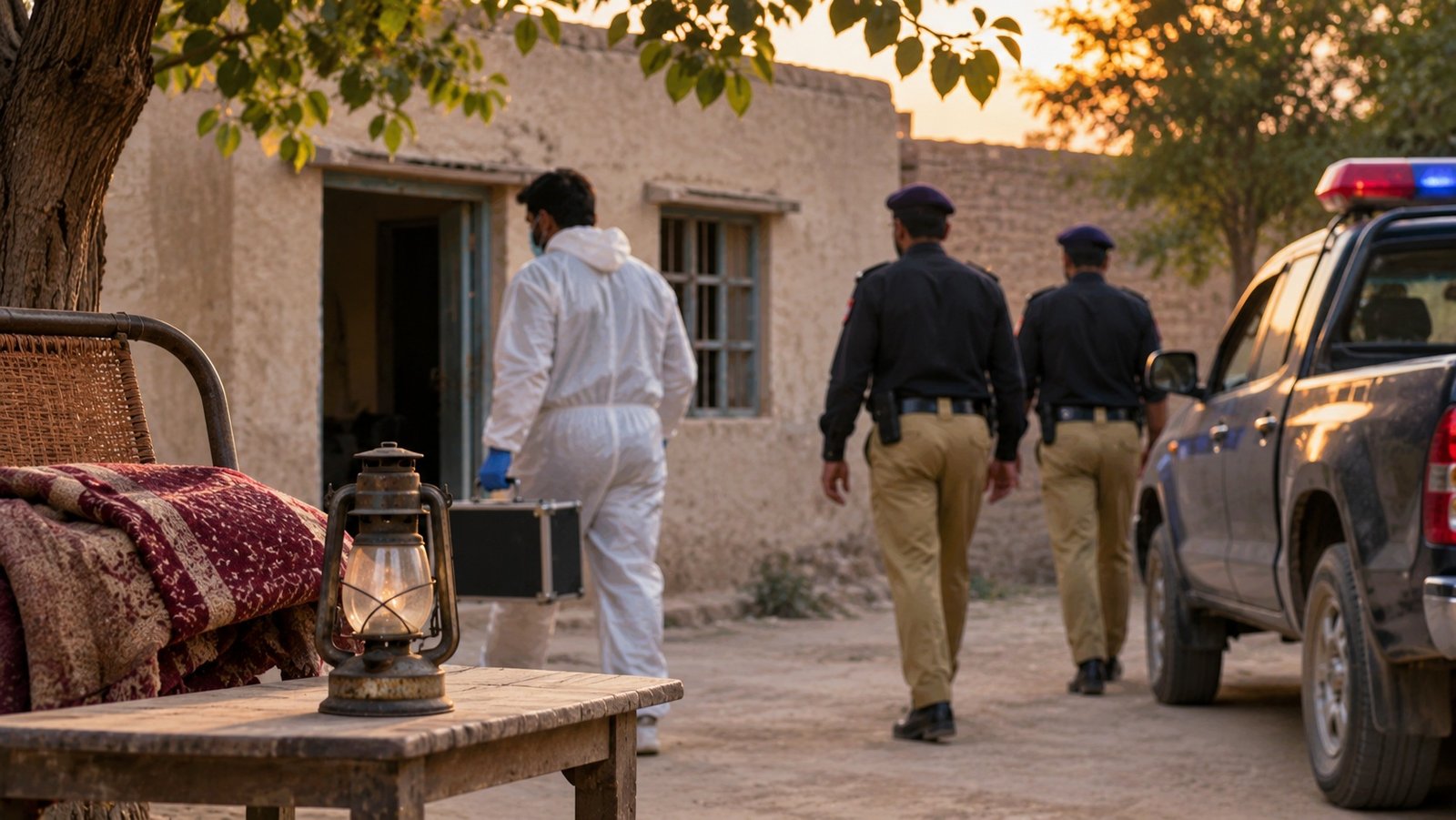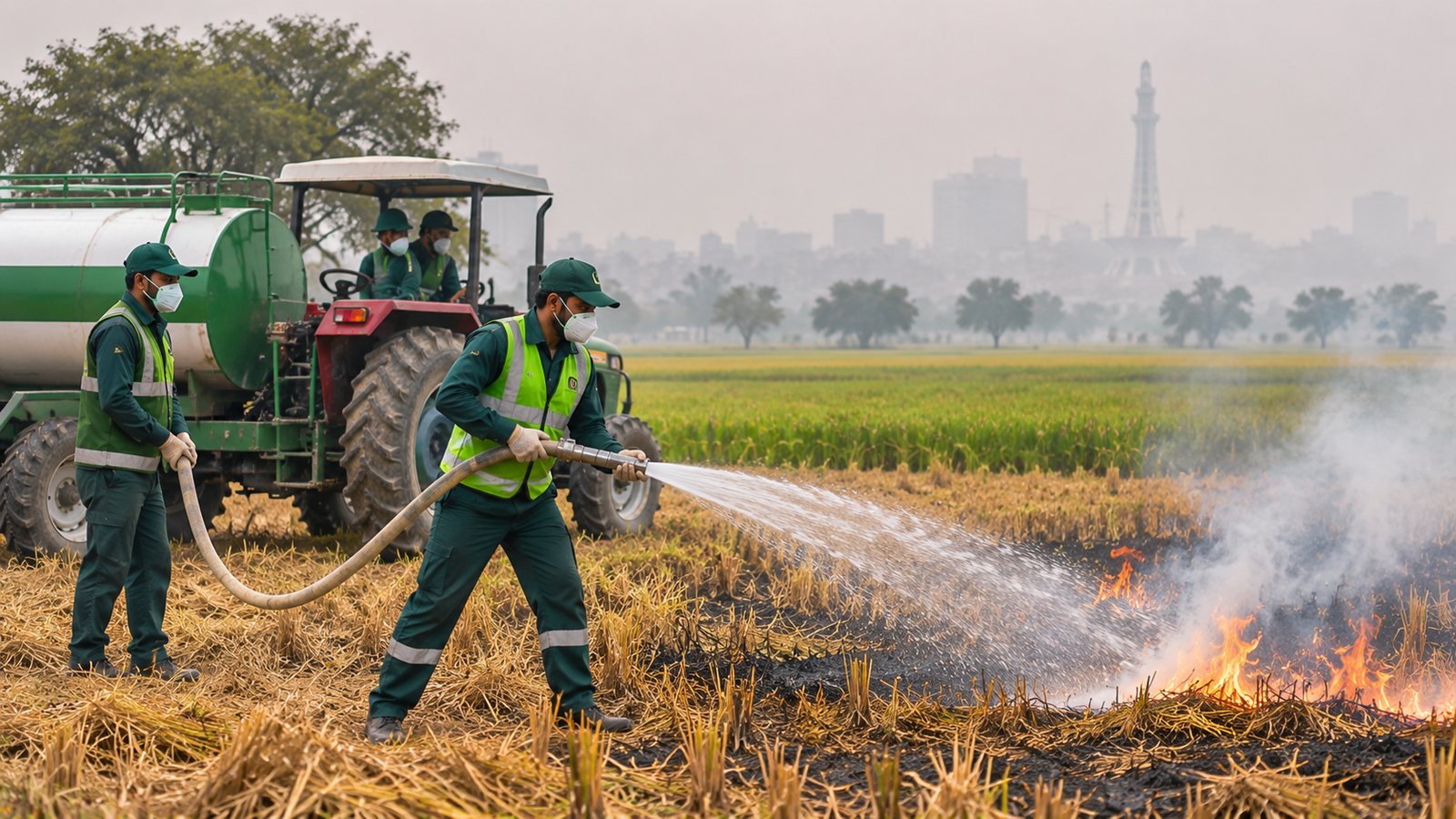
The Punjab anti-smog response units 2026 operation has intensified as the provincial government steps up efforts to control crop-residue fires during the winter smog season. The Punjab Environment Protection Agency (EPA) has deployed 67 Quick Response Crews across eight districts, while its latest monitoring dashboard recorded 898 farm-fire anomalies during the 24-hour reporting period updated on November 14. The figures, reported by Dawn on November 15, highlight the scale of the monitoring challenge as authorities attempt to prevent stubble burning from adding to already serious air pollution across Punjab.
The latest dashboard showed that 820 incidents had been attended and 823 fires were reported as extinguished, with an overall response rate of 91.3 per cent. However, 96 detected anomalies were still listed as pending for response. Hafizabad was the largest hotspot, recording 430 anomalies, followed by Sheikhupura with 172 and Nankana Sahib with 120. Together, these three districts accounted for 722 of the 898 reported anomalies, making them central to the province’s anti-stubble-burning operation.
The latest figures come after Reuters reported on November 14 that Punjab had formed a 750-member force divided into 67 rapid-response units across major rice-growing districts. The teams aim to reach reported field fires within 10 to 15 minutes. In a separate 24-hour reporting period cited by Reuters, officials said the department had received 679 field-fire reports and extinguished 650 of them. These figures relate to a different reporting period and should not be combined with the later EPA dashboard totals.
The provincial operation also includes field patrols, satellite-based fire monitoring, senior officers supervising divisional operations, penalties for illegal crop-residue burning and subsidised machinery intended to give farmers alternatives to burning. The government says the response teams are designed to detect fires quickly and prevent smoke from spreading. However, the continuing number of reported incidents shows that enforcement alone may not be enough unless farmers can access affordable and practical ways to manage crop residue.
Punjab Anti-Smog Response Units 2026: What Has the Government Deployed?
Punjab’s anti-smog response operation includes 67 Quick Response Crews supported by a reported force of 750 personnel. According to Reuters, the units are operating across major rice-growing districts and are expected to respond to reported field fires within 10 to 15 minutes. Their work includes monitoring agricultural areas, responding to complaints and extinguishing fires caused by the burning of crop residue.
The EPA’s latest dashboard, reported by Dawn on November 15, also confirmed the deployment of 67 quick response crews in the eight districts covered by the monitoring report. These crews form part of a wider enforcement arrangement involving the EPA, agriculture department and district administrations. The objective is to identify farm-fire incidents, send teams to affected locations and take action against those responsible for illegal stubble burning.
The response system is not limited to emergency visits after a fire has started. Officials are also using surveillance and field monitoring to identify potential hotspots. The agency has deployed headquarters-based directors to different divisions to supervise operations and coordinate with local officers. Their assignments cover Gujrat, Sahiwal, Faisalabad, Lahore and Gujranwala divisions for November 14 and 15.
This arrangement is intended to improve accountability and reduce delays between detecting a fire and responding to it. Senior officers have been asked to verify reported incidents, identify operational gaps and submit field visit reports to the EPA director general. The effectiveness of the system will depend on how consistently these teams can operate across large agricultural areas, particularly in districts reporting the highest number of fire anomalies.
EPA Dashboard Reports 898 Farm-Fire Anomalies Across Eight Districts
The latest EPA Punjab dashboard, updated on November 14 and reported by Dawn the following morning, recorded 898 farm-fire anomalies across eight districts. The report said 820 incidents had been attended and 823 fires were reported as extinguished. It placed the overall response rate at 91.3 per cent, while 96 detected anomalies remained pending for response.
Hafizabad accounted for the largest share of reported activity, with 430 anomalies, representing approximately 47.9 per cent of the provincial total. The district had nine Quick Response Crews deployed, and 381 incidents were listed as attended and extinguished. A further 49 anomalies were shown as pending. The high number of detected incidents relative to the number of deployed crews indicates the pressure faced by response teams in the district.
Sheikhupura recorded 172 anomalies, with 154 attended and extinguished and 18 pending. The dashboard listed 22 Quick Response Crews in the district and a response rate of 89.5 per cent. Nankana Sahib recorded 120 anomalies, of which 95 were attended and extinguished, leaving 25 pending. Its reported response rate was 79.2 per cent, the lowest among districts with substantial activity in the report.
Faisalabad recorded 93 anomalies, with 90 attended and extinguished and three pending. Its reported response rate was 96.8 per cent. Kasur recorded 70 detected anomalies, while the dashboard listed 88 attended and extinguished. Sialkot recorded 10 detected anomalies but listed 13 extinguished. Sargodha recorded two anomalies, both attended and extinguished, while Gujranwala reported one anomaly that remained unattended at the time of reporting.
These district-level figures require careful interpretation. Some entries, including the Kasur and Sialkot figures, show more attended or extinguished incidents than detected anomalies. The overall pending figure also does not directly reconcile with the difference between the reported detected and attended totals. The dashboard figures should therefore be presented as reported by the EPA, with the apparent inconsistencies noted rather than silently corrected.
Hafizabad, Sheikhupura and Nankana Sahib Are the Main Hotspots
The latest monitoring data identifies Hafizabad, Sheikhupura and Nankana Sahib as the districts requiring particular attention. Together, they account for 722 of the 898 anomalies recorded in the eight-district dashboard. This concentration means that response resources, field supervision and preventive measures in these locations are especially important.
Hafizabad recorded 430 anomalies, the highest number among the districts. The report listed nine Quick Response Crews deployed there, with 381 incidents attended and extinguished and 49 still pending. The scale of reported activity suggests that the district’s response teams face a substantial workload, particularly during periods when farmers are clearing fields after the rice harvest.
Sheikhupura recorded 172 anomalies, making it the second-largest hotspot in the dashboard. It had 22 crews deployed, with 154 incidents attended and extinguished. Nankana Sahib recorded 120 anomalies and had 25 pending incidents in the report. Its 79.2 per cent response rate was lower than the other districts with substantial recorded activity.
These differences show why district-level monitoring matters. A province-wide response rate can provide a broad picture, but it may hide pressure points where crews face a higher volume of incidents or where pending reports remain unresolved. Local deployment decisions need to reflect the number of reported fires, the distance between affected fields and the availability of response equipment.
The EPA has said that senior officers are supervising operations in the divisions to identify such gaps. Continued reporting on district-level incidents will help show whether additional crews, machinery or preventive measures are needed in the most affected agricultural areas.
How the Quick Response Teams Are Tackling Stubble Burning
The rapid-response teams are intended to reach reported field fires quickly and prevent burning crop residue from producing additional smoke. Reuters reported that the units aim to reach incidents within 10 to 15 minutes, depending on location. Officials said complaints can be received through multiple channels, while teams also patrol agricultural areas to identify fires.
When a fire is reported, response personnel can be mobilised with firefighting equipment, including tractor-mounted water bowsers. The aim is to extinguish the burning residue before smoke spreads further or the fire becomes more difficult to control. The teams also coordinate with EPA field formations and district administrations to address violations.
The system combines public reporting, field surveillance and monitoring of fire anomalies. Satellite-generated alerts can help identify possible hotspots, while on-ground teams are required to verify incidents and take action. This combination is important because a satellite alert may identify a possible fire location, but field verification is needed to establish what is happening and whether intervention is required.
The EPA’s latest reporting also describes the use of motorway beat vehicle monitoring. During the separate 24-hour period covered by the November 15 Dawn report, 20 fire anomalies were recorded through motorway beat vehicle monitoring, of which 13 were attended and seven remained pending. The reported response rate for this monitoring stream was 65 per cent.
The results suggest that the operation relies on several monitoring channels rather than a single response mechanism. Its long-term effectiveness will depend on the accuracy of detection, the speed of dispatch, the availability of equipment and the ability of teams to prevent repeated burning in the same agricultural areas.
What Penalties Do Farmers Face for Burning Crop Residue?
Punjab authorities have warned that farmers caught burning crop residue can face financial penalties and legal action. Reuters reported that farmers caught burning stubble face fines of Rs15,000 per acre. Those who fail to pay the fines may also face prosecution and a possible jail term of up to six months.
The penalties are intended to discourage a practice that officials identify as one contributor to seasonal air pollution. However, enforcement is only one part of the policy response. Farmers often burn residue because they consider it a fast and inexpensive way to clear fields after harvesting rice and prepare land for the next crop.
A penalty-based approach may deter violations, but it does not automatically remove the practical reasons that lead farmers to burn crop residue. If machinery is unavailable, too expensive or difficult to access within the short period between crops, farmers may continue using the quickest method available despite the risk of punishment.
This is why the government has also introduced subsidised machinery and other support measures. A durable reduction in stubble burning will require both enforcement and accessible alternatives that allow farmers to manage crop residue without setting fields on fire.
Government Subsidises Super Seeders to Give Farmers an Alternative
Alongside enforcement, Punjab has distributed more than 10,000 subsidised super seeders, according to Reuters. Under the reported arrangement, the government pays 60 per cent of the machinery cost while farmers contribute the remaining 40 per cent. The equipment is intended to help farmers manage crop residue and prepare fields without burning leftover rice stalks.
Super seeders can help incorporate or manage crop residue while preparing land for the next crop. This provides an alternative to burning, which farmers often choose because it clears fields quickly. Access to suitable machinery can make it easier for farmers to change practices without losing valuable time during the agricultural season.
Reuters quoted a farmer who said that switching to a subsidised super seeder and other machinery had significantly improved his wheat yield per acre. This is an individual farmer’s account, not evidence that every farm will experience the same result. Outcomes can vary according to soil conditions, crop management, machinery use and local agricultural practices.
The report also noted that adoption remains uneven. Some farmers continue to view burning as the cheapest and fastest way to clear fields. This highlights the importance of making subsidised equipment accessible when and where farmers need it, along with providing practical guidance on its use.
For the programme to achieve wider results, machinery availability, maintenance, operator training and timely access will matter. Farmers need workable options during the narrow window between harvesting one crop and preparing for the next.
Why Stubble Burning Adds to Punjab’s Winter Smog
Stubble burning releases smoke and fine particles into the atmosphere. During the winter season, these emissions can combine with pollution from vehicles, industrial activity, construction dust and other sources. Cold weather and atmospheric conditions can also contribute to the accumulation of pollution near the ground.
Crop-residue burning is therefore one part of a wider air-quality problem. Reuters reported that farmers commonly burn leftover rice residue after the October harvest, adding smoke to a mix of industrial emissions, vehicle exhaust and construction dust. The report also noted that many residents continue to experience breathing and eye irritation even as officials describe efforts to control agricultural fires.
It is important not to attribute all of Lahore’s smog to stubble burning alone. Air pollution is produced by multiple sources, and the relative contribution of each source can vary by location, weather conditions and time of year. Controlling farm fires can reduce one source of emissions, but broader improvements require action on transport, industry, construction dust, waste burning and other contributors.
The issue also extends beyond a single city or province. Seasonal air pollution affects large parts of South Asia, and cross-border movement of air pollution can complicate efforts by individual governments. Reuters reported that Punjab officials had raised the issue with Indian officials at international forums, while noting that India’s foreign ministry did not respond to a request for comment.
A comprehensive response therefore needs both local enforcement and wider regional cooperation. Reducing crop-residue fires is a practical step, but sustained improvements in air quality require multiple sectors to reduce emissions at the same time.
What Do the Latest Health Figures Say About Smog?
The health impact of seasonal smog remains a major concern for residents of Lahore and other affected areas. Reuters reported that Punjab Environment Protection Department Director General Abdullah Nayyar cited health department data showing that smog-related throat hospitalisations in October were at 69 per cent of the level recorded in October 2025.
That figure was presented by the official as an indication of a change in reported hospitalisations compared with the same month in the previous year. It does not mean that air pollution has been eliminated or that residents are no longer experiencing health problems. Reuters also reported patients at Lahore hospitals describing breathing difficulties, blocked noses and eye irritation during the current smog period.
The distinction between official health statistics and individual experiences is important. Hospitalisation figures can provide one measure of health-system demand, while residents’ reports and air-quality monitoring provide other information about the situation. No single indicator gives a complete picture of exposure or health risk.
The reported decline in one category of hospitalisations should therefore be interpreted cautiously. It does not establish that all pollution-related illnesses have declined by the same amount, nor does it prove that the anti-smog operation alone caused the change. Weather conditions, pollution levels, healthcare access and other factors can also influence reported figures.
For policymakers, the key challenge is to monitor air quality and health outcomes over time while addressing the sources of pollution. Preventing farm fires can contribute to this effort, but it must be part of a broader strategy.
Can 67 Response Units Solve Punjab’s Smog Problem?
The deployment of 67 response units represents a significant operational effort, but the number of teams alone cannot determine whether Punjab’s smog problem will be solved. The latest dashboard still recorded hundreds of farm-fire anomalies, including 96 listed as pending for response. This shows that detection and extinguishing operations continue to face a substantial workload.
The teams can help respond to fires after they are reported or detected, but preventing incidents before they begin is equally important. Farmers need practical alternatives to burning, while enforcement agencies need reliable information and the capacity to follow up on repeated violations. Without these measures, the same areas may continue to experience crop-residue fires during the harvest season.
The government will also need to address pollution sources beyond agriculture. Transport emissions, industrial activity, construction dust and waste burning can continue to affect air quality even if farm fires are reduced. Effective smog control requires coordination across environment, agriculture, transport, industry and local government departments.
Public reporting can support this work by helping authorities identify fires quickly. However, monitoring systems must also provide clear and consistent data. The apparent inconsistencies in some district-level dashboard entries underline the importance of accurate reporting, transparent definitions and regular verification.
The performance of the response units should ultimately be judged through measurable outcomes, including fewer fires, faster response times, lower repeat incidents, better access to residue-management machinery and sustained improvements in air quality.
What Happens Next in Punjab’s Anti-Smog Operation?
The EPA has deployed headquarters-based directors across different divisions to supervise anti-stubble-burning activities on November 14 and 15. Their responsibilities include monitoring field teams, coordinating with district officers and relevant departments, reporting violations with supporting evidence and submitting field visit reports to the EPA director general.
The agency is also combining district monitoring dashboards, motorway beat vehicle surveillance and field-based quick response crews. This approach is designed to identify possible fire incidents through different channels and ensure that teams are dispatched where required.
The next important test will be whether the operation can reduce repeated burning in the districts with the highest number of reported anomalies. Hafizabad, Sheikhupura and Nankana Sahib account for most of the incidents in the latest dashboard, making them important locations for continued monitoring and preventive work.
The government will also need to sustain support for farmers who want to adopt alternatives to burning. Subsidised super seeders and other residue-management equipment can help, but their impact will depend on availability, affordability and timely access during the crop cycle.
Future updates should provide clear information on the number of fires detected, the number verified, the number extinguished, pending cases, response times and district-level trends. Consistent data will help the public assess whether the anti-smog operation is producing measurable results.
Conclusion: Punjab’s Anti-Smog Response Needs Enforcement and Farmer Support
Punjab’s deployment of 67 Quick Response Crews and a reported 750-member force marks a major effort to control crop-residue fires during the winter smog season. The latest EPA dashboard, reported on November 15, recorded 898 farm-fire anomalies across eight districts, with 820 incidents attended and 823 fires reported as extinguished. Hafizabad, Sheikhupura and Nankana Sahib accounted for the largest share of the reported activity.
The operation combines rapid field response, satellite and district monitoring, senior-officer supervision, penalties and subsidised agricultural machinery. These measures are intended to reduce stubble burning while giving farmers alternatives to the practice. The reported 10-to-15-minute response target and the distribution of more than 10,000 subsidised super seeders are important parts of this approach.
However, the latest dashboard also contains some district-level figures that do not fully reconcile, and the continuing number of reported anomalies shows that the challenge remains significant. The government will need transparent data, consistent enforcement and practical support for farmers to demonstrate sustained progress.
Most importantly, crop-residue management is only one part of Punjab’s air-pollution challenge. Long-term improvements will require action across transport, industry, construction, waste management and regional cooperation. The success of the 67 response crews should be measured not only by fires extinguished, but by whether fewer fires occur and whether air quality improves over time.
How many anti-smog response units has Punjab deployed in 2026?
Punjab has deployed 67 Quick Response Crews as part of a reported 750-member force operating across major rice-growing districts.
How many farm-fire anomalies were reported in Punjab?
The EPA dashboard updated on November 14 and reported by Dawn on November 15 recorded 898 farm-fire anomalies across eight districts.
Which Punjab district reported the highest number of farm fires?
Hafizabad recorded the highest number, with 430 anomalies, followed by Sheikhupura with 172 and Nankana Sahib with 120.
How quickly are Punjab’s anti-smog teams expected to respond to fires?
According to Reuters, the rapid-response teams aim to reach reported field fires within 10 to 15 minutes, depending on the location.
What is the fine for stubble burning in Punjab?
Reuters reported that farmers caught burning stubble can face fines of Rs15,000 per acre, prosecution and a possible jail term of up to six months.
How is the Punjab government helping farmers avoid stubble burning?
The government has distributed more than 10,000 subsidised super seeders, paying 60 per cent of their cost while farmers pay the remaining 40 per cent.
Why does stubble burning contribute to winter smog?
Burning crop residue releases smoke and particles that add to pollution from vehicles, industries and construction. Winter weather can also contribute to pollution accumulating near the ground.
Can Punjab’s 67 response units eliminate the smog problem?
The response units can help control agricultural fires, but long-term air-quality improvement also requires action on transport emissions, industrial pollution, construction dust, waste burning and other pollution sources.
About The Author