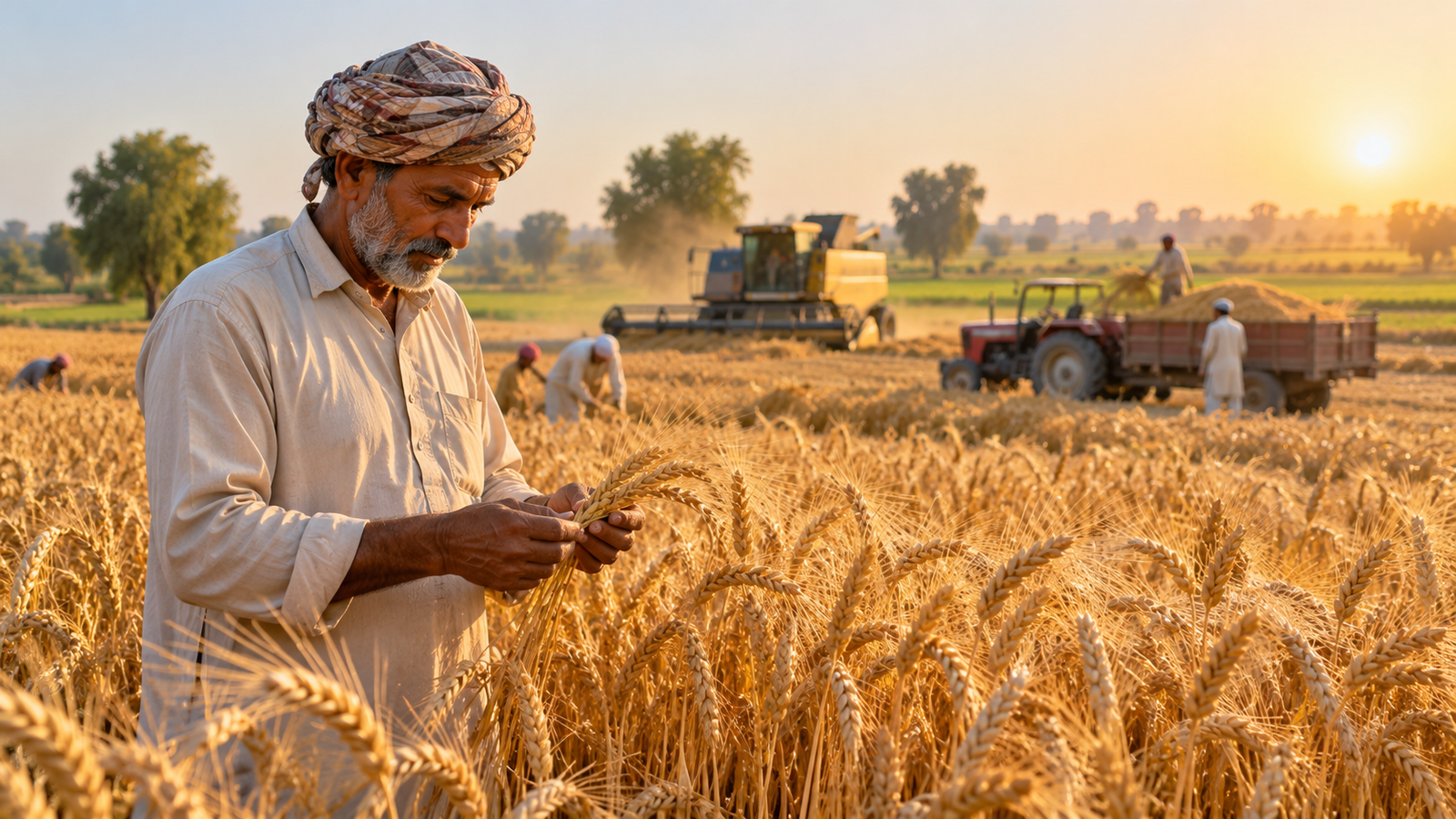
Pakistan has announced an indicative wheat price of Rs4,500 per maund, equivalent to 40 kilograms, for the 2027 crop as the government seeks to encourage cultivation and ease financial pressure on farmers. Prime Minister Shehbaz Sharif announced the figure on Friday, October 23, 2026, according to the Prime Minister’s Office as reported by Radio Pakistan, Dawn and The Express Tribune. The benchmark is Rs1,000 higher than the previous Rs3,500 figure, an increase of approximately 28.6 percent.
The announcement is significant for growers preparing for the next season, grain traders, flour millers and consumers concerned about food inflation. However, an indicative price is not necessarily the transaction price offered in every grain market, and it is not a new fixed retail price for flour or bread. Questions remain about procurement arrangements, implementation across provinces and whether the benchmark will cover the production costs farmers actually face.
What Did the Government Announce?
The Prime Minister’s Office said the proposed wheat benchmark would be Rs4,500 for each 40kg of the 2027 crop. The announcement followed consultations with federal and provincial leadership, including officials in Punjab and Sindh. The stated objective is to provide growers with a clearer pricing signal before planting decisions, while encouraging more domestic production.
Dawn and Radio Pakistan used the terms ‘indicative’ or ‘illustrative’ price, while some headlines called it a support price. Readers should pay attention to that distinction. The announcement identifies an intended price benchmark, but the reports reviewed do not establish that every private buyer must purchase every bag of wheat at exactly that amount.
How Much Has the Price Increased?
The new figure is Rs4,500 per 40kg, against Rs3,500 the previous year. That is an increase of Rs1,000 per maund, or around 28.6 percent. A one-maund measure in this context means 40 kilograms, so quoting the figure as a price per kilogram or per 100kg bag would materially change its meaning.
The rise is intended to respond to farmers’ higher input costs. The announced benchmark should not be confused with the price of finished flour at a retail shop, which can include processing, transport, distribution and other market costs. A national benchmark alone cannot tell consumers what they will pay for an individual loaf of bread.
Why Is Wheat Pricing Important in Pakistan?
Wheat is central to Pakistan’s agricultural economy and daily food consumption. Many farming households depend on grain revenue to finance seeds, fertiliser, machinery, labour and the next growing cycle. Price uncertainty can affect how much land farmers allocate to wheat compared with other crops.
A predictable indicative price may help growers plan, but the outcome also depends on weather, irrigation water, seed quality, credit access and actual market conditions. Government policymakers have linked the new rate to food security and reduced dependence on imported supplies. Whether output rises will become measurable only after planting, growing and harvesting.
What Did the Prime Minister’s Office Say About Farmer Costs?
According to the official statement carried by Radio Pakistan, the government sees rising petroleum prices, general inflation and more expensive agricultural inputs as major reasons for the increase. Prime Minister Shehbaz Sharif said the intention was to help farmers recover costs and potentially earn a reasonable return, while creating an incentive to cultivate wheat.
These are the government’s stated objectives rather than independent proof that the new price will be profitable on every farm. A farmer’s costs vary by acreage, irrigation method, land tenure, crop yield, credit terms and local input markets. A useful assessment must compare actual harvest revenue with those costs.
Why Did Farmers Ask for Rs5,000?
Farmer representatives had called for a higher wheat support rate before the announcement. Dawn reported that Pakistan Kissan Ittehad demanded Rs5,000 per 40kg and warned that low returns could discourage sowing. A National Assembly standing committee also recommended a minimum wheat support price of Rs5,000 or more in early October.
The announced Rs4,500 is therefore Rs500 below that demand. Reporting both figures helps explain the difference between the government’s current benchmark and the position taken by agricultural stakeholders. It does not establish that every farmer supports the same target or that either figure will produce an identical outcome across all regions.
What Does ‘Indicative Price’ Mean?
An indicative price provides a reference or signal for market participants and planting decisions. It is not necessarily the same as a universal legally enforced minimum purchase price. The practical effect depends on later rules, procurement policy, government buying arrangements and private market behaviour.
Farmers should check whether a province has announced a procurement programme, who is authorised to buy grain, what quality standards apply and how payments are made. The October 23 national announcement, by itself, does not establish those operational details for every district. Treating a policy announcement as a guaranteed sale contract could mislead growers.
Could the New Price Encourage Wheat Sowing?
The government hopes a higher benchmark will encourage farmers to allocate land and resources to wheat. In principle, stronger expected selling prices can improve the perceived return from planting, particularly when growers compare possible earnings across different crops. But production decisions involve more than the headline price.
Water access, fertiliser affordability, machinery availability, pest risks, financing and the timing of sowing all affect outcomes. Farmers might still reduce their wheat acreage if they expect other crops to provide better returns or cannot afford essential inputs. The announcement’s influence on total production will need to be assessed with actual planting and harvest data.
What About Food Security and Wheat Imports?
The Prime Minister’s Office connected the benchmark to domestic food security and the ambition to reduce reliance on foreign wheat. Pakistan’s grain supply depends on production, stocks, consumption and trade decisions, and government officials have discussed the costs of importing wheat over previous seasons.
Higher domestic production could improve supply resilience if growing conditions and market incentives align. Still, no responsible report should claim that wheat imports have ended permanently because a price was announced. Import needs are determined by actual harvests, carryover stocks, consumption and future policy choices, not by a single pre-season target.
Will Flour and Roti Prices Rise Automatically?
No automatic retail flour or bread price change follows directly from an indicative crop price. Wheat is an important input in flour production, but the final consumer price also depends on existing inventories, transport, milling, labour, distribution, energy and provincial market arrangements. Governments may separately announce release prices or other measures to manage food markets.
That means the Rs4,500 per maund figure should not be presented as a new flour-bag price. Consumers need city-specific, dated retail price information before conclusions can be drawn about household expenses. Changes in wheat procurement costs may influence later prices, but their scale and timing are not predetermined.
How Does This Relate to Provincial Wheat Policy?
Agriculture and grain marketing involve both federal and provincial responsibilities. The October announcement referenced consultations with Punjab and Sindh authorities, which matters because regional administration and procurement processes can differ. Provincial governments may also use separate measures for storage, grain releases and market monitoring.
Dawn reported earlier October arrangements involving Sindh’s release of government wheat stocks at a set price. Such stock-release decisions serve a different purpose from the 2027 indicative crop price. Combining their figures or dates in one headline would create confusion about what farmers receive versus what traders or millers pay.
Could the Benchmark Benefit Small Farmers?
An announced price can provide useful information to small growers trying to plan an upcoming season, especially if market buyers recognise it and official procurement systems are accessible. However, the benefit may be uneven. Small farmers can face higher borrowing costs, limited storage and pressure to sell soon after harvest when they need cash.
The practical value of the policy may therefore depend on timely implementation, transparent buying procedures and access to affordable inputs. Without details of who purchases the crop and how farmers get paid, it is too early to conclude that every small grower will receive Rs4,500 for every maund.
What Does It Mean for Grain Traders and Flour Mills?
Grain businesses may use the indicative rate when planning purchases and estimating crop availability. The announcement could influence expectations before the new harvest, while actual bids will still reflect supply, quality, location, storage and demand. Millers must also account for operating expenses and finished-product sales conditions.
The policy’s effect on traders should not be treated as evidence of immediate profiteering or a uniform market response. Any allegation of hoarding or illegal pricing would require transaction data, inspection records or official enforcement findings. A balanced business article focuses on documented market mechanisms rather than assigning motives without evidence.
Market Prices Can Differ by Region
Wheat prices in physical markets may vary between districts because of transport costs, local supply, grain quality and buyer demand. A nationwide policy benchmark does not eliminate those differences overnight. This is particularly relevant where grain moves between production zones and major urban consumption markets.
Farmers and traders should distinguish a reported policy rate from real-time mandi quotations, which require a precise date and location. A news article written on October 24 should not recycle a price from another month or province as though it were today’s live price everywhere in Pakistan.
What Are the Main Policy Risks?
A higher indicative price could encourage cultivation, but other pressures may reduce its effect. Production costs could continue to rise, government procurement funding may be limited, or market prices could diverge from the intended benchmark. Weather and irrigation uncertainty remain major agricultural risks beyond pricing policy.
For consumers, policymakers must consider both farmer incentives and the affordability of wheat-based food. Those objectives need not be treated as mutually exclusive, but managing them requires detailed implementation and reliable data. The October announcement is a policy signal, not a complete assessment of the eventual economic trade-offs.
What Should Farmers Check Next?
Farmers should monitor official federal and provincial agriculture notices for practical instructions covering procurement agencies, quality rules, collection centres, payments and any application procedures. They should also compare the announced benchmark with credible local grain quotations and input costs while planning the upcoming season.
No national registration link, payment date or guaranteed purchase allocation was established in the sources reviewed. Websites promising instant payments or requiring personal information based solely on the indicative price announcement should not be assumed genuine without government verification.
What Happens After the Announcement?
The next meaningful updates will include provincial implementation plans, sowing statistics, official procurement arrangements and later wheat production forecasts. These developments can clarify whether the government’s stated objectives are being achieved. Price monitoring and household food inflation data will be needed to examine any effect on consumers.
The announcement is dated October 23, 2026, and concerns the 2027 crop. Articles should not present it as a new harvest already completed or claim that every district has begun procurement at the announced rate. Mukhbir will distinguish confirmed policy decisions from projected results.
Conclusion
Pakistan’s government has announced an indicative wheat rate of Rs4,500 per 40kg for the 2027 crop, up Rs1,000 from the previous year. The stated aims are to ease pressure on growers, encourage planting and strengthen domestic grain supply. However, the benchmark remains Rs500 below the Rs5,000 per maund requested by important farmer representatives.
For readers, the essential distinction is between an indicative policy price, the rate paid in a particular grain market and the eventual retail cost of flour. The announcement matters for Pakistan’s business and agricultural outlook, but actual benefits and consumer effects will depend on implementation, market conditions and the next harvest.
Frequently Asked Questions
What wheat price did Pakistan announce for 2027?
The government announced an indicative rate of Rs4,500 per maund, or 40 kilograms, for the 2027 wheat crop.
When was the new wheat rate announced?
Prime Minister Shehbaz Sharif announced the rate on October 23, 2026, according to the Prime Minister’s Office.
How much did the rate increase?
It increased by Rs1,000 per 40kg from the previous Rs3,500 benchmark, approximately 28.6 percent.
Is Rs4,500 guaranteed to every wheat farmer?
The reports describe an indicative or illustrative rate. Actual procurement terms and market transactions require separate confirmation.
How much did farmer organisations demand?
Pakistan Kissan Ittehad sought Rs5,000 per 40kg; a National Assembly committee also recommended at least that level.
Does the rate mean flour now costs Rs4,500 per bag?
No. The figure is a wheat crop benchmark per 40kg, not a fixed retail flour price.
Why did the government raise the wheat benchmark?
The government cited higher production costs, petroleum prices, inflationary pressure and the goal of encouraging domestic cultivation.
What should farmers check next?
They should watch for official procurement and provincial implementation details, quality conditions and local verified grain prices.
About The Author