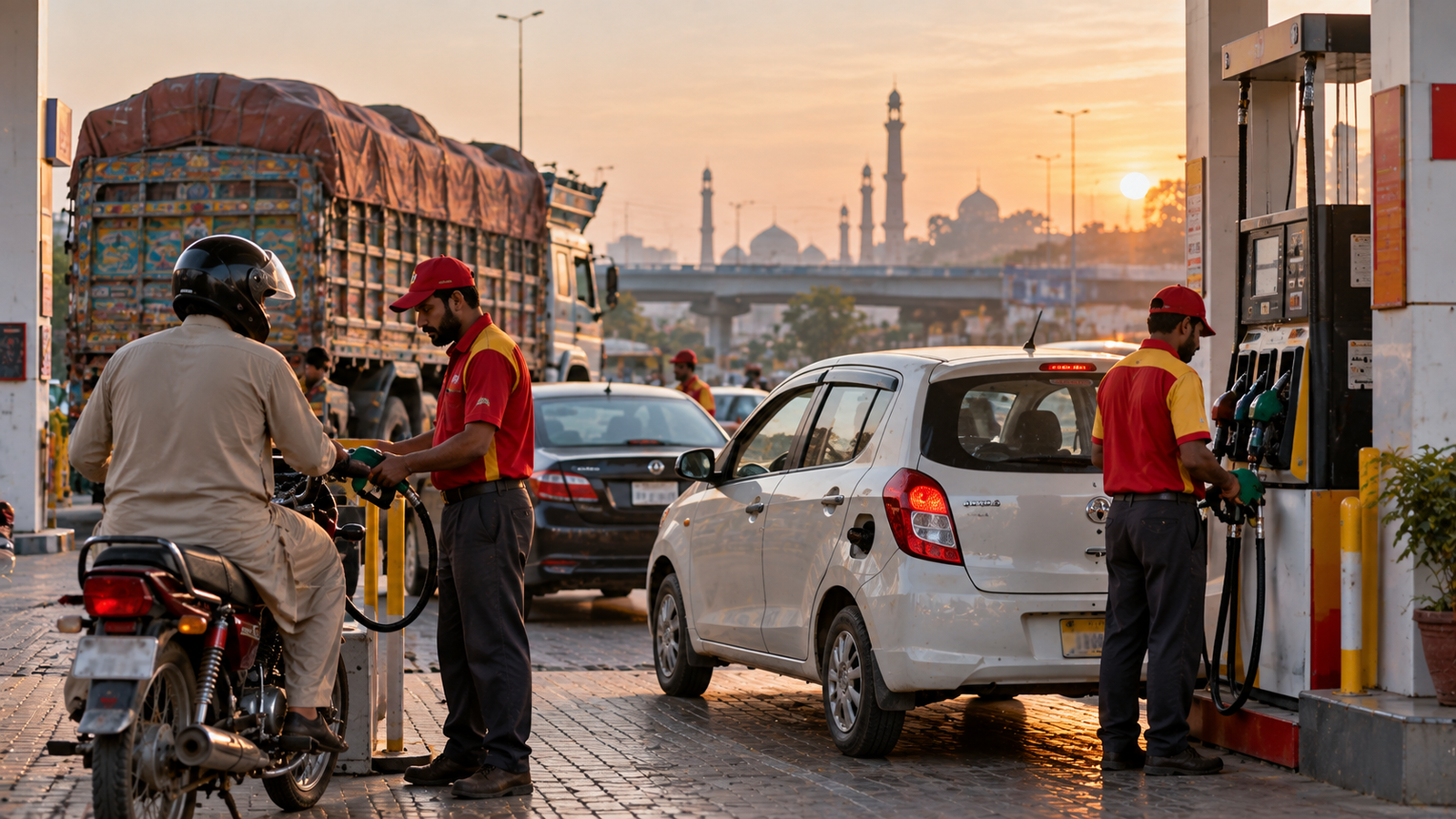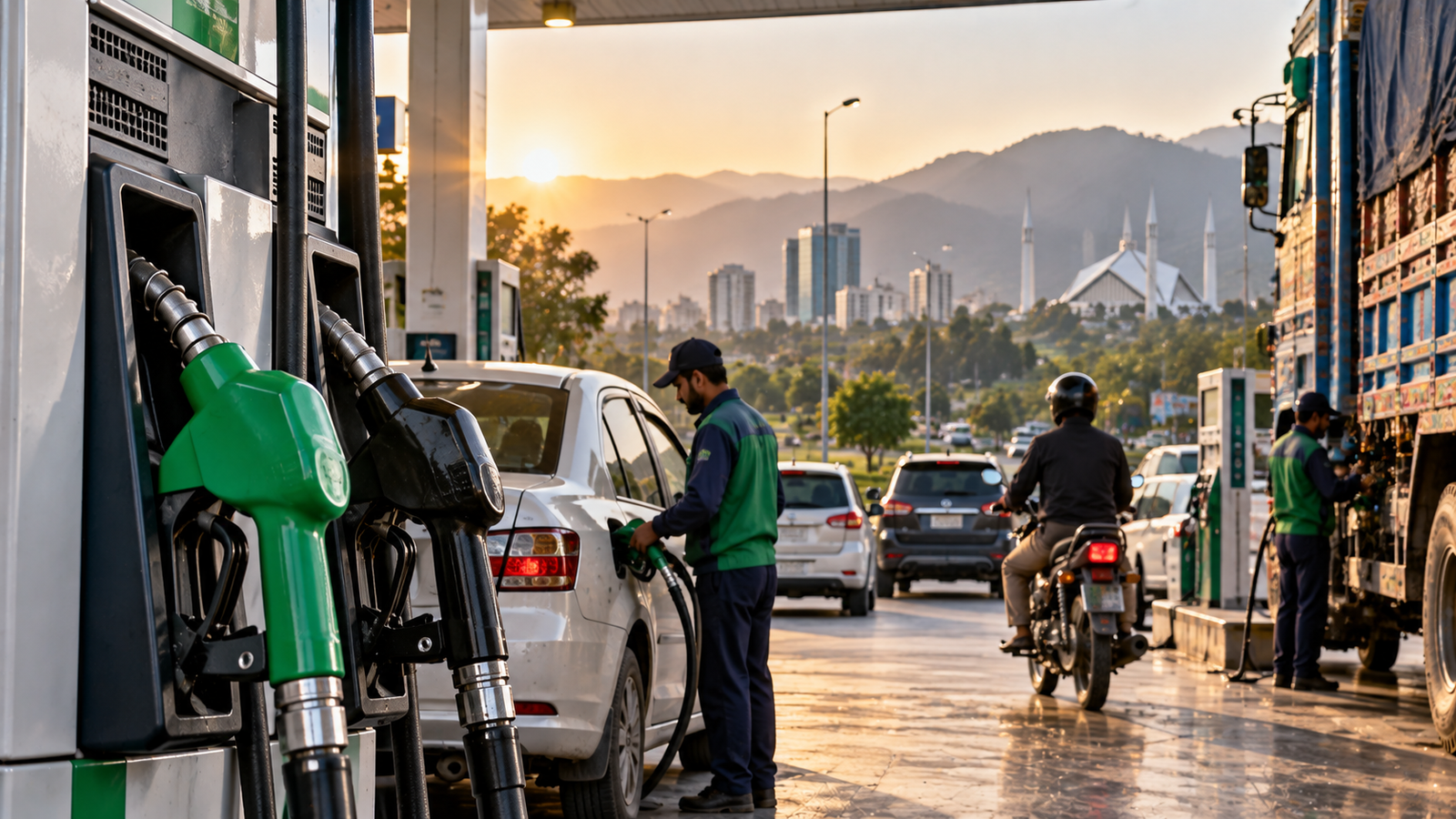
The petrol price in Pakistan on October 28, 2026, has been reduced by Rs3.19 per litre to Rs376.06, while the price of high-speed diesel has increased by Rs2.25 to Rs398.07 per litre. The Oil and Gas Regulatory Authority (OGRA) published the revised rates under the government’s daily petroleum pricing framework after a notification issued on October 27. The new prices apply for October 28 and are subject to subsequent daily revisions. The contrasting changes offer limited direct savings to petrol users but raise the per-litre fuel cost for diesel-powered transport and equipment. Any broader effect on fares, food prices or inflation will depend on how businesses respond.
Pakistan Fuel Prices: October 28 Quick Facts
Effective date: Wednesday, October 28, 2026.
Petrol (motor gasoline): Rs376.06 per litre.
Previous petrol price: Rs379.25 per litre.
Petrol change: Decrease of Rs3.19 per litre.
High-speed diesel: Rs398.07 per litre.
Previous diesel price: Rs395.82 per litre.
Diesel change: Increase of Rs2.25 per litre.
Government authority: Oil and Gas Regulatory Authority (OGRA) and Petroleum Division.
Announcement date: October 27, 2026.
Pricing approach: Daily reviews based on international market benchmarks and related costs.
Petroleum levy reported by Business Recorder: Rs80 per litre on each product.
Climate support levy reported: Rs5 per litre.
Next price update: May occur on a subsequent day under the daily framework; no later price is claimed here.
What Changed in Pakistan’s Petrol and Diesel Prices?
The government lowered the ex-depot petrol rate from Rs379.25 to Rs376.06 per litre, a difference of Rs3.19. High-speed diesel moved in the opposite direction, rising from Rs395.82 to Rs398.07, a difference of Rs2.25. The rates were confirmed by OGRA’s October 28 price publication and widely reported by Dawn, Geo News, ARY News and Business Recorder. This is a daily revision and should not be presented as a fixed rate for the entire month or the next fortnight. Petrol and diesel are different refined products, and their prices can move separately even when they are influenced by the same international oil market.
Official Fuel Price Comparison Table
Product | Previous rate | New rate | Change
Petrol | Rs379.25/L | Rs376.06/L | -Rs3.19/L
High-speed diesel | Rs395.82/L | Rs398.07/L | +Rs2.25/L
These are announced retail-rate reference figures for October 28. The change is from the previous listed rates, not from the price a consumer paid weeks earlier. A customer’s receipt should be checked against the applicable rate and purchase date.
Why Did Petrol Become Cheaper While Diesel Rose?
OGRA cited international market developments, including changes in Platts benchmark prices, premiums and incidental import costs. Refinery and distribution economics can differ between petrol and diesel; prices need not always increase or decrease together. Business Recorder reported that customs duty on petrol was reduced by Rs5.71 per litre from Rs26.27 to Rs20.56, helping offset pressures in the benchmark market. Meanwhile, the import cost of diesel increased. This combination explains why consumers saw a lower petrol price on October 28 but a higher diesel price. The comparison does not imply that all international oil prices were falling.
How Pakistan’s Daily Petroleum Price Review Works
Pakistan has shifted to more frequent petroleum price announcements, with OGRA publishing daily price publications on its official portal. Reports describe a mechanism informed by a rolling seven-day average of international prices, which means changes in global markets may be reflected more quickly than under older fortnightly or weekly reviews. Daily publication does not mean every benchmark change will produce an identical movement at the pump. Freight, duties, supplier premiums, currency conditions and the pricing formula all contribute. For an exact rate on any given date, the safest reference is the dated official publication rather than a previously shared social-media graphic.
When Did the New Rates Take Effect?
The October 27 notice set the rates for Wednesday, October 28. Multiple news reports identify the effective day consistently. Because the mechanism allows daily revisions, readers should attach the date whenever sharing petrol or diesel prices. A headline simply saying ‘petrol price today’ becomes misleading when copied days later. Mukhbir therefore identifies the exact date in its SEO title, lead and price table. Consumers planning purchases on later dates should consult OGRA’s newest rate publication rather than assume the October 28 figure remains applicable.
What Does the Petrol Reduction Mean for Motorcyclists?
Petrol is commonly used in motorcycles and smaller private cars, so a per-litre reduction can lower fuel expenses for those drivers. For a simple illustration, buying 10 litres at the new rate costs Rs31.90 less than purchasing 10 litres at the previous price. A 20-litre purchase saves Rs63.80, assuming the same quantity is purchased and no separate discount is applied. These are calculations from the stated rate difference, not estimates of typical monthly savings for all households. The benefit depends on how much fuel an individual actually purchases and how long the revised rate remains in place.
How Much Will Car Owners Save?
For a 40-litre petrol purchase, the reduction of Rs3.19 per litre corresponds to Rs127.60 in savings compared with the previous posted rate. Filling 50 litres would cost Rs159.50 less than at Rs379.25 per litre. However, an individual driver’s total expense may still be high because the absolute petrol price remains above Rs376 per litre. Traffic conditions, driving style, vehicle efficiency and trip frequency determine monthly spending. A lower pump price also does not automatically mean transport services will reduce their fares; providers consider maintenance, labor and other costs alongside fuel.
Why the Diesel Increase Matters to Businesses
High-speed diesel is used across goods movement, parts of public transport, agricultural machinery and some commercial or industrial activities. Even a relatively small per-litre increase can add to operating costs when equipment consumes hundreds or thousands of litres over time. A fleet that purchases 1,000 litres at the newly announced rate pays Rs2,250 more than at the immediately previous rate for the same quantity. That example shows a direct arithmetic effect, not proof that the operator will raise prices. Contract terms, competition, inventory planning, route efficiency and other costs influence what businesses eventually charge customers.
Will Higher Diesel Prices Raise Food Prices?
Diesel can be an input to freight and agricultural operations, so higher costs may put pressure on supply chains. A truck carrying vegetables, flour or consumer goods faces fuel expenses alongside wages, maintenance, tolls and storage charges. Whether a Rs2.25 per litre increase meaningfully raises the shelf price of a particular product depends on the distance travelled, fuel use, load size and how costs are shared. It would be inaccurate to say that all food items will immediately become more expensive because of this single adjustment. More complete inflation data and business pricing evidence are needed to measure any eventual impact.
Transport Operators and Freight Companies
The diesel change is relevant to long-distance logistics and daily passenger operations, but the financial effect varies widely. A high-utilization bus company may be more sensitive to fuel changes than a business with mostly electric equipment. Some operators have fuel-adjustment clauses that pass changes through to clients; others may absorb short-term variations. In competitive markets, companies often respond through route planning or operating adjustments rather than instantly revising tariffs. Readers should look for verified announcements from transport authorities or operators before assuming bus, trucking or delivery rates have officially changed.
How Fuel Prices Affect Pakistan’s Broader Economy
Petroleum products are important imported energy inputs for Pakistan. Changes in international prices and currency values can influence the country’s import bill, distribution costs and domestic price pressures. Lower petrol prices may marginally ease household spending, while higher diesel prices can affect business costs. The overall macroeconomic impact depends on many factors beyond one day’s adjustment, including fuel consumption volumes, monetary policy, taxes, trade flows and supply conditions. This October 28 revision should be understood as a short-term development within a changing energy market, not a reliable forecast of inflation or economic growth for the year.
What Taxes and Levies Are Included in Fuel Prices?
Business Recorder’s October 28 report lists a petroleum levy of Rs80 per litre and a climate support levy of Rs5 per litre on petrol and high-speed diesel. It also identifies dealer and oil marketing company margins and the inland freight equalisation margin. For petrol, the report lists customs duty of Rs20.56 per litre after a reduction. These items help explain why a retail pump rate differs from an international benchmark or refinery-related cost. The figures are components of the price mechanism, not additional charges that consumers necessarily pay separately at the pump. Their exact combination should be confirmed from the dated OGRA schedule before detailed accounting use.
Customs Duty Adjustment on Petrol
The reported reduction in petrol customs duty was a notable element of this specific revision. According to Business Recorder, the amount fell from Rs26.27 per litre to Rs20.56, a decrease of Rs5.71. That adjustment helped reduce the final petrol retail rate even as some international product prices increased. The final pump-price change was Rs3.19, not Rs5.71, because the overall formula reflects more than customs duty alone. It would be incorrect to claim that the government removed every petrol tax or eliminated all duties. Both levies and other components continued to apply in the published breakdown.
Are International Oil Prices Responsible?
The regulator attributed the revision partly to world-market developments, including changes in relevant benchmark rates, premiums and incidental costs. Geopolitical risks in major energy-producing and shipping regions can influence international fuel prices and transport charges. However, a single domestic price move should not be explained by one unverified incident or political motive. Different petroleum products have distinct supply-and-demand patterns. Pakistan’s currency exchange rate, import terms and domestic duties also matter. Readers should distinguish between a verified regulator explanation and broader market analysis about what may be driving oil prices globally.
What Is the Effect of More Frequent Price Changes?
Daily adjustments could help prices respond faster to international movements, in either direction. They can also make budgeting more complex for commercial fuel buyers, commuters and delivery services because the amount payable may vary from day to day. Businesses that purchase large volumes may monitor official rates more closely, while households may simply need to check the current price before a routine fill. The policy’s ultimate benefits and costs cannot be judged from a single day’s prices. Transparent publication and consistent enforcement are important for customers who want confidence that stations are charging the currently applicable rates.
How Consumers Can Check Official Petrol Prices
OGRA’s fuel pricing portal publishes dated price publications, including an entry effective October 28, 2026. Consumers should select the relevant date and read the current petrol and high-speed diesel figures. Retailers’ displayed prices and receipts can then be compared with the legally applicable schedule. When sharing information online, include the effective date and avoid mixing a screenshot from one day with a different day’s rates. If prices do not match the applicable official notification, consumers can seek clarification from the relevant station or responsible authority. An unofficial calculator or social post should not replace a current regulatory notice.
Why the Government’s Petroleum Pricing Policy Matters
The federal government, through the established petroleum pricing process, determines the framework within which retail prices are notified. Officials say more frequent updates are intended to provide timely transmission of relevant market changes. At the same time, citizens and businesses need clear information about which portion of the price comes from imported fuel, taxes, levies and distribution costs. Mukhbir’s reporting focuses on documented policy decisions and their practical effects, not partisan judgments about government officials. A short-term petrol reduction and diesel increase are both facts of the same announcement and should be reported together.
What About the Petrol Relief Scheme?
Reports from ARY News and Dawn describe a separate targeted petrol relief arrangement for eligible motorcycles, rickshaws and small cars, along with discussions about its possible expansion. This scheme should not be confused with the universal ex-depot petrol price of Rs376.06. A targeted discount may apply only to people and quantities meeting official eligibility rules, and the exact process should be checked through government channels. This article does not treat every motorcyclist or car owner as automatically eligible for an additional discount. A full guide would need confirmation of the current registration rules, quotas, available funds and any later policy changes.
How Much Can a Business Save or Lose?
A company operating mainly petrol vehicles might see a small reduction in per-litre expense, whereas a diesel-dependent company faces a rise. For illustration, purchasing 500 litres of petrol at the new rate costs Rs1,595 less than the previous rate. Purchasing 500 litres of high-speed diesel now costs Rs1,125 more. Businesses buying both fuels should calculate their weighted effect from actual volumes rather than comparing one headline rate with the other. These examples omit changes in volume, taxes specific to an individual business, discounts and future daily revisions. Actual profitability depends on numerous costs and revenues.
Why Diesel and Petrol Prices Sometimes Move Differently
Petrol and diesel are produced from crude oil, but they serve different customers and respond to different product-market conditions. Demand for road freight, farming, passenger travel and seasonal industrial operations can vary, as can inventory, refining and shipping costs. Local duties may be changed separately as well. A petrol decline therefore does not require a diesel decline on the same date. The October 28 figures illustrate that distinction: petrol decreased Rs3.19 after the formula’s adjustments, while high-speed diesel increased Rs2.25. Explaining the difference accurately helps readers avoid the assumption that all fuels always move together.
What Should Businesses Monitor Next?
Import-dependent firms, transport operators and traders should watch official daily price publications, relevant currency moves and changes to supply and freight costs. Budget calculations may be more accurate when using scenarios rather than assuming a single petrol or diesel rate will remain unchanged for several weeks. A company that has fuel surcharge clauses in customer contracts should apply the exact contractual mechanism rather than arbitrary increases. Consumers should similarly separate the confirmed price at the pump from unverified claims about future fares or grocery prices. Neither the regulator nor the cited reports guaranteed what tomorrow’s fuel rates will be.
Conclusion
Pakistan’s October 28 fuel pricing decision provides a modest Rs3.19 per-litre reduction for petrol consumers but raises high-speed diesel by Rs2.25. The resulting announced rates are Rs376.06 for petrol and Rs398.07 for diesel. OGRA’s dated publication and multiple independent reports confirm those figures. The mixed movement demonstrates how imported fuel costs, customs duty and the broader pricing formula can affect two petroleum products differently. For families and businesses, the direct arithmetic is clear, while wider changes in transport charges and inflation remain uncertain. Readers should confirm subsequent daily prices from the regulator rather than relying on older headlines.
Frequently Asked Questions
What is the petrol price in Pakistan on October 28, 2026?
The notified petrol price is Rs376.06 per litre for October 28, 2026.
What is the diesel price in Pakistan on October 28?
High-speed diesel is priced at Rs398.07 per litre on the announced effective date.
3. How much did the petrol price decrease?
Petrol became Rs3.19 per litre cheaper compared with the previous price of Rs379.25.
How much did diesel increase?
High-speed diesel rose by Rs2.25 per litre from Rs395.82 to Rs398.07.
When were the revised prices announced?
The revision was announced on October 27, 2026, for prices effective October 28.
Why did petrol fall while diesel rose?
The regulator cited international benchmark changes and import-related costs; reporting also identified a reduction in petrol customs duty.
How can consumers confirm tomorrow’s petrol price?
They should check OGRA’s dated fuel price publications, because the daily review framework may produce subsequent revisions.
Does a diesel price rise automatically increase food prices?
No. It can increase some transport costs, but the effects on retail prices depend on supply chains, competition and other expenses.
About The Author