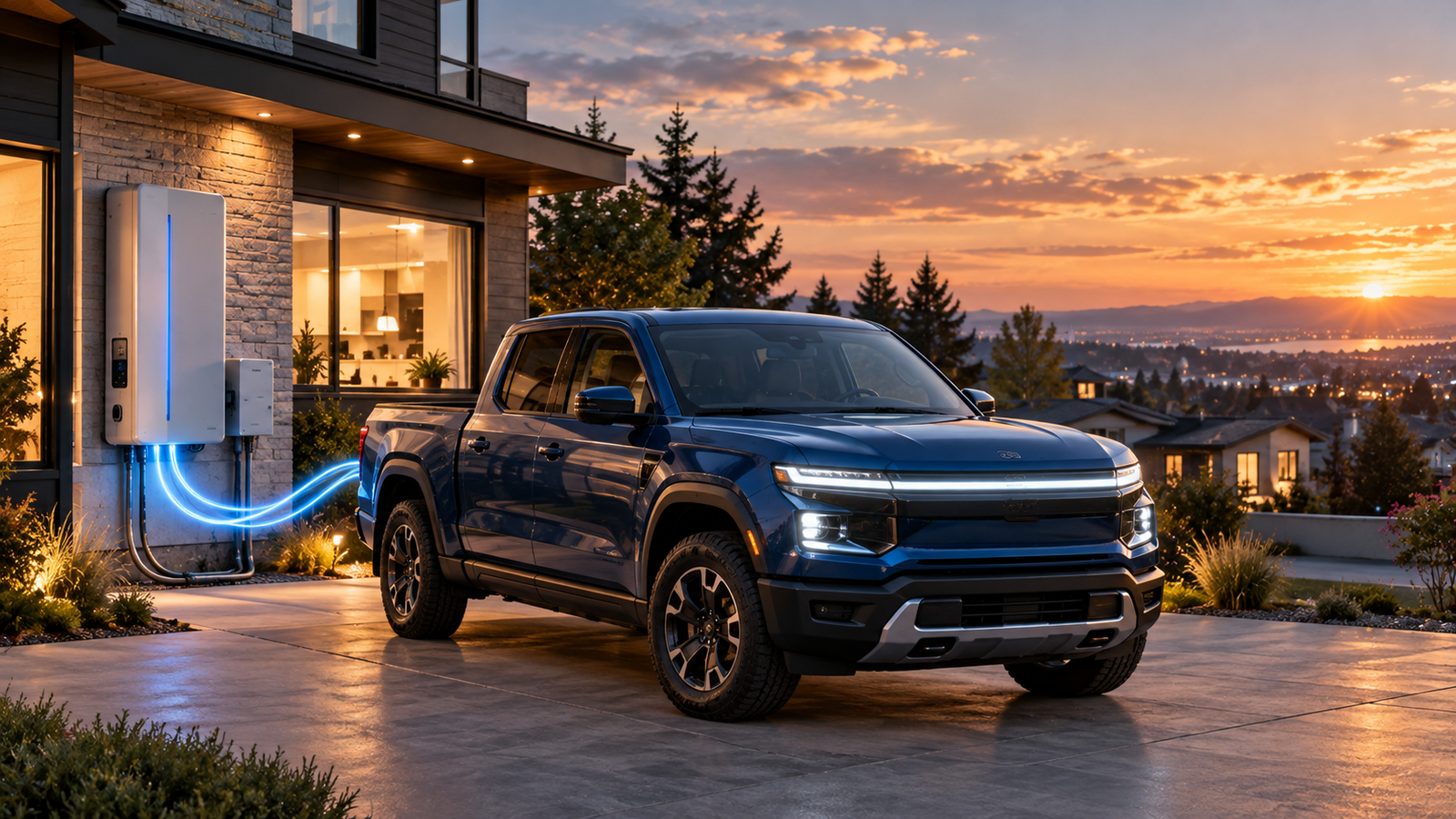
The Ford Fathom electric truck is being positioned as a more affordable way for drivers to combine daily transportation with backup electricity for their homes. In an October 27, 2026 announcement, Ford said its upcoming 2027 midsize electric pickup would offer available bidirectional AC power, with a projected output of more than 10 kilowatts to a home without requiring a separate wall-mounted inverter. The standard-range model carries a starting US manufacturer’s suggested retail price of $28,350, excluding destination and other charges. The technology is promising, but the vehicle is not yet on sale, home backup requires additional hardware, and Ford has not published an official EPA driving-range estimate.
Ford Fathom Electric Truck: Key Facts
Company: Ford Motor Company.
Model: Ford Fathom midsize electric truck.
Latest home-power announcement: October 27, 2026.
Planned availability: 2027.
Pre-orders: Expected to begin early 2027.
US starting MSRP: $28,350 for the standard-range version.
Additional destination and delivery: $1,595, according to Ford.
Projected home AC output: More than 10 kW with compatible equipment.
Power capability: Available bidirectional AC power.
Home Power Management hardware: Ford Home Power Station, active trial or plan, and required utility approval.
Home Backup Power hardware: Home Power Station plus Home Backup Power Panel, potentially subject to utility notice or approval.
Driving range: EPA-estimated figure not yet announced.
Charging times and battery capacity: Not specified in the October 27 home-power announcement.
Platform: Ford Universal Electric Vehicle Platform.
Other announced features: BlueCruise-capable hardware, digital key, Apple Maps integration, Apple CarPlay and Android Auto compatibility.
Pakistan launch or local price: Not announced by Ford in the cited US sources.
What Did Ford Announce on October 27?
Ford’s latest statement provides more detail about how the Fathom’s electrical system is intended to power a house. The company said the truck could send more than a projected 10 kW of alternating-current power through suitable home equipment. Its central claim is about system design: by supplying AC power from the vehicle, Ford aims to avoid an additional separate wall-mounted inverter that has been part of some older bidirectional installations. The statement builds on the previously revealed model name, platform and starting price. It does not announce a completed consumer rollout, deliver verified field results or confirm a universal installation cost for every household.
How Much Will the Ford Fathom Cost?
Ford lists $28,350 as the starting US MSRP of the standard-range Fathom. Its official Fathom product page lists $1,595 for destination and delivery. Those figures add to $29,945 before applicable taxes, title, registration, dealer documentation charges, optional equipment and any dealer-specific selling price. The MSRP is not the same as an out-the-door quote. Buyers interested in home backup power must also account for the appropriate home equipment and installation. A low vehicle starting price should not be misreported as the complete cost of a truck-and-house energy system. Ford has not given a verified Pakistan retail price or local booking process.
What Is Bidirectional Power?
A conventional EV draws electricity from an external source to recharge its battery. Bidirectional charging lets energy flow the other way too, allowing a suitably equipped vehicle to deliver power to external devices or a building. The truck’s battery effectively becomes a mobile energy-storage resource. There are several possible operating modes, and they should not be confused: vehicle-to-home power supplies a house, vehicle-to-load powers equipment, and vehicle-to-grid services may involve providing energy or flexibility to an electrical network through approved programs. Ford’s October announcement specifically explains home power management and backup power, with utilities and regulators playing a role in eligibility.
Why the Built-In AC Approach Matters
Most EV battery systems store energy in direct current, whereas ordinary households use alternating current. Converting between the two often requires an inverter, and some existing bidirectional home installations have relied on costly external conversion hardware. Ford says the Fathom’s approach will supply AC power without a separate wall-mounted inverter, a design intended to lower the complexity and price of the equipment needed. That is a claim about removing a particular component, not a statement that no home equipment or electrical work is necessary. Consumers would still need Ford’s specified power station and possibly an additional backup panel, depending on the intended function.
How Home Power Management Could Reduce Electricity Bills
Ford describes Home Power Management as a way to charge the Fathom during cheaper electricity periods and use stored energy in the home when electricity rates are higher. This strategy is sometimes known as time-of-use energy shifting. It could save money for customers whose electricity tariffs provide a meaningful difference between off-peak and peak prices. Actual savings depend on local tariffs, the amount of energy transferred, equipment and installation costs, battery losses, vehicle use and the price or terms of any required Ford plan. Ford says the Home Power Station is expected to cost about half as much as its first-generation bidirectional charger. No universal monthly saving is guaranteed.
What Home Backup Power Would Do During an Outage
Home Backup Power is a separate function designed to deliver electricity from the truck when grid power fails. Ford’s explanation says this requires both a Home Power Station and a Home Backup Power Panel. The panel is part of safely managing the connection to a home during an outage, rather than simply plugging a household into an ordinary vehicle socket. The company expects the necessary home backup hardware to cost at least 60 percent less than its first-generation equipment. That is a comparison with Ford’s earlier product, not an exact retail price for the new system. Home installation and approvals can add costs and vary by property.
Does More Than 10 kW Mean a Truck Can Power Every Home?
No. Kilowatts indicate the rate at which electrical power can be supplied, not the duration for which it can be sustained. An output of over a projected 10 kW may support multiple household appliances, but what can operate simultaneously depends on actual available output, electrical loads and any surge requirements. The length of backup time is influenced by usable battery energy, the truck’s remaining charge and household consumption. Because Ford has not disclosed the production Fathom’s full battery specifications or a guaranteed home-backup duration in the October 27 release, no precise claim such as ‘three days of whole-home electricity’ can be verified from that announcement.
What Additional Equipment Will Customers Need?
Ford distinguishes between two home-energy functions. Home Power Management requires the available Ford Home Power Station, utility approval and an active Ford trial or plan. Home Backup Power requires the Home Power Station plus a Home Backup Power Panel, and utility notice or approval may also apply. Customers should not assume these items come included with the vehicle’s base MSRP. Qualified installation may be necessary to meet building and electrical safety rules. The company has presented projected cost reductions compared with its earlier home-power products, but final installed costs depend on the home, installer and local requirements. These details matter when comparing the Fathom with other EVs.
What Does Ford’s 2027 Timeline Actually Mean?
The company says the Fathom will be available in 2027 and that pre-orders are scheduled to start early that year. That is a planned commercial timeline rather than proof that vehicles are already being delivered in October 2026. Ford’s website invites interested customers to register for preorder updates. It has not announced an exact delivery day for every configuration or region. Production schedules, final specifications and dealer availability remain subject to later information. An article published now should use future-tense language when discussing sales, range tests and customer installations rather than treating them as current services.
Battery Range and Charging: What Has Not Been Disclosed?
Ford’s official Fathom FAQ explicitly says projected EPA-estimated driving-range figures are not yet available. The current announcement also does not establish a definitive production battery capacity or charging time. Consequently, any exact range number quoted without a new authoritative source would be speculative. Range will depend on the battery, drivetrain, wheels, speed, load, weather and other variables. Backup use will also draw energy that might otherwise be available for driving. Customers considering an electric pickup as a home-energy solution should examine future specifications for reserve-charge settings and how the system manages the balance between mobility and emergency electricity.
Design, Interior and Driving Technology
Ford describes the Fathom as a midsize, five-seat electric truck built on its Universal EV Platform. The company says its cabin is projected to offer more passenger volume than a Toyota RAV4, while retaining both a front trunk and a pickup bed for cargo. It also advertises a large touchscreen, digital key, remote functions through the Ford app and compatibility with Apple CarPlay and Android Auto. The truck will have hardware supporting the next generation of BlueCruise hands-free highway assistance. That system still requires an attentive driver and applicable road conditions; the BlueCruise-capable description should not be mistaken for fully autonomous driving.
Why Ford Is Targeting a Lower EV Price
The Fathom’s planned price puts it in a different part of the market from premium electric pickups and certain high-end bidirectional home-energy solutions. The intent is to make an EV attractive to buyers who need a practical truck as well as the flexibility of an electric power source. Price alone will not establish affordability for every household: vehicle financing, insurance, charging access and maintenance expectations all matter. Nor does a comparatively low starting MSRP mean advanced equipment is standard. Buyers will need to confirm which home-power functions come with the final trim and how much additional hardware costs before making a full cost comparison.
How Vehicle-to-Home Technology Compares With a Generator
A truck battery can provide power without running a petrol, diesel or gas engine while electricity is being drawn, and it may create less noise and no tailpipe exhaust at the property during that process. Traditional fuel generators have different strengths, including refueling options during prolonged outages. Battery backup is limited by stored energy and charging availability, while generators require fuel, safe placement and maintenance. A detailed comparison should consider required loads, outage duration, purchase and installation costs, local fuel or electricity prices and safety. The Fathom should not be described as a universal replacement for all backup generators before real-world testing and full specifications are available.
Utilities, Grid Rules and Customer Eligibility
Home energy equipment that can send power to or manage a residence needs coordination with electrical standards and sometimes the local utility. Ford’s technical statement specifically mentions utility approval for Home Power Management and possible notice or approval for backup operation. The company also sees broader opportunities to work with utilities on programs such as virtual power plants, in which many distributed resources can help the electricity network. However, participation in a future grid program is separate from using home backup during an outage. Customers should not assume they can earn income by selling electricity to the grid simply because a vehicle supports bidirectional power.
Potential Impact on the Electric Vehicle Market
Bidirectional power adds an energy-services dimension to the typical competition over battery range, charging speeds and in-car technology. If reliable home-power capability reaches lower-priced vehicles, buyers may begin to evaluate their EV as part of their household electricity planning. That could create opportunities for automakers, equipment installers, utilities and energy management providers. But achieving broad adoption will require accessible installation, suitable tariffs and straightforward operation. Ford’s claims about lower equipment costs are meaningful targets; the market impact will be determined by actual consumer prices and performance after production vehicles and their home systems become available.
What Does the Ford Fathom Mean for Pakistan?
The October 27 announcement is focused on the United States. Ford has not confirmed a Pakistan-specific Fathom launch, authorized retail price, local home-equipment offer or regulatory approval for bidirectional installations. Pakistan’s interest in electric mobility and household backup power makes the technology relevant as an international development, but that should not be misrepresented as a domestic rollout. Electricity tariffs, grid reliability, home wiring standards and import costs differ from the US. Even if an individual vehicle were imported in future, its home-power capability would require compatible equipment and compliance with local rules. Readers should wait for official local information before assuming availability.
Questions Buyers Should Ask Before Preordering
A prospective customer should distinguish the price of the vehicle from the cost of the complete home-energy system. Important questions include which trim supports the desired functionality, whether the equipment is included or optional, and whether an authorized installation is available locally. Buyers should also review future range and charging data, expected battery warranty coverage, towing and payload ratings, and whether the vehicle is compatible with their utility. Since these details were not all confirmed in the October 27 home-power announcement, it would be premature to assume the Fathom can meet every particular household or commercial requirement.
What Happens Next for the Ford Fathom?
Ford’s next milestones will be the opening of pre-orders in early 2027, publication of additional specifications and the eventual start of sales and deliveries. Independent reviews can then test real-world performance, charging, driving range and how the home-energy system works in ordinary properties. Installation costs and customer experiences will be especially important to assessing the company’s affordability claims. Ford has also scheduled its third-quarter 2026 earnings event for October 28, but this article does not present future earnings figures as if they had already been published. All launch-related claims here are based on information available as of the article date.
Conclusion
The Ford Fathom electric truck combines a planned $28,350 starting MSRP with an ambitious home-power feature that Ford says can supply over a projected 10 kW of AC electricity without a separate wall-mounted inverter. The October 27 announcement advances the story of the company’s 2027 midsize EV, but does not make the vehicle or its home-backup system commercially available today. Additional equipment, utility requirements and installation costs remain important. Until Ford publishes final range, battery and delivery details, buyers should regard the Fathom as a promising announced product whose real-world value remains to be demonstrated.
Frequently Asked Questions
What is the Ford Fathom electric truck?
It is Ford’s announced midsize electric pickup, planned as the first vehicle on its Universal Electric Vehicle Platform.
What is the starting price of Ford Fathom?
Ford quotes $28,350 US MSRP for the standard-range version, excluding destination, taxes and other charges.
When will Ford Fathom be available?
Ford plans to make the truck available in 2027, with pre-orders expected to begin early that year.
Can the Ford Fathom power a house?
Ford says available bidirectional technology is designed to supply over a projected 10 kW of AC power to a home when supported by appropriate equipment.
Does the home backup system come with the $28,350 truck?
Ford requires additional Home Power Station and Home Backup Power Panel hardware for backup operation; the base MSRP does not establish that these are included.
What is the Ford Fathom driving range?
Ford has not yet announced an EPA-estimated driving-range figure for the vehicle.
Can a Ford Fathom reduce electricity bills?
Ford says time-of-use charging and home power management could help under suitable tariffs, but savings are not guaranteed and require eligible equipment and plans.
Is Ford Fathom available in Pakistan?
The cited Ford announcements do not confirm a Pakistan launch date or official local price.
About The Author