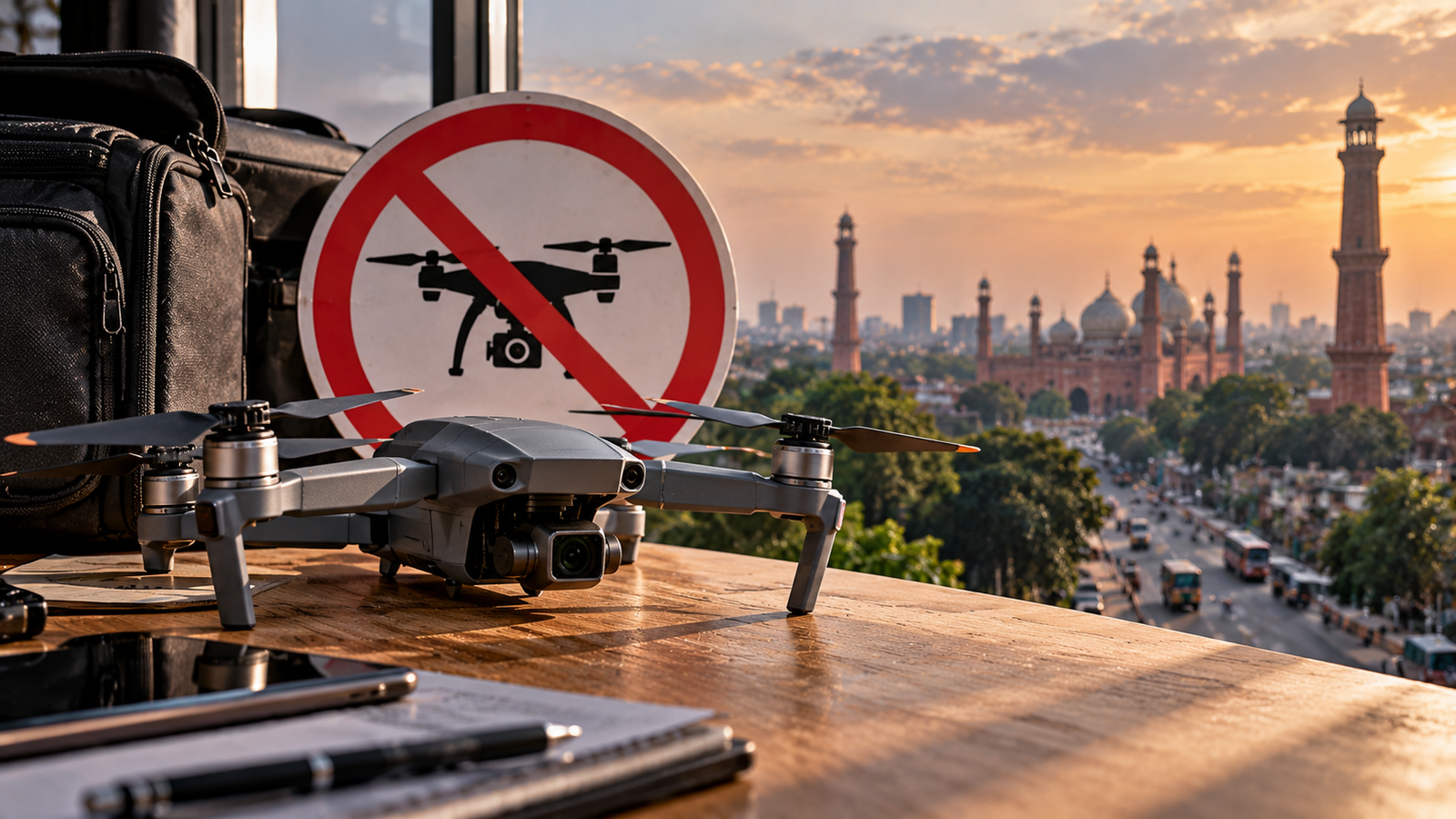
The Punjab drone ban October 2026 has been renewed through a 30-day restriction on outdoor drone flights across the province, according to a Punjab Home Department notification reported on October 28. The order, issued under Section 144(6) of the Code of Criminal Procedure, 1898, cites public-safety and security concerns. Limited small-drone use inside halls and marquees remains permitted, while intelligence and law-enforcement agencies are exempt. Agricultural, irrigation and research-related outdoor flights may be authorized through written permission from district-level Safe Drone Usage Committees. The order follows similar restrictions reported in September and earlier in 2026, so it should be described as a new restriction period or continuation rather than Punjab’s first-ever drone ban.
Punjab Drone Ban: Essential Facts
Province: Punjab, Pakistan.
Latest reported notification: Wednesday, October 28, 2026.
News follow-up: October 29, 2026.
Duration: 30 days, subject to the notification and any early withdrawal or subsequent change.
Legal provision cited: Section 144(6), Code of Criminal Procedure, 1898.
General rule: Outdoor drone operation is restricted across Punjab.
Indoor event exception: Limited use of small drones inside halls and marquees, with organisers responsible for safe operations.
Institutional exemptions: Intelligence and law-enforcement agencies.
Conditional exemptions: Agricultural, irrigation and research purposes with district committee’s written approval.
Permission authority named: District Safe Drone Usage Committee.
Implementation: Provincial district administrations and police instructed to enforce the order.
Exact final calendar date: Check the signed notification; reports identify the 30-day duration but do not reproduce its complete validity clause.
Fine or penalty amount: Not specified in the cited October news reporting.
What Did the Punjab Government Announce?
Dunya News reported on October 28 that the provincial Home Department had issued a fresh notification limiting open-air drone flights for 30 days. The News and Express Tribune carried follow-up coverage on October 29. Their accounts agree on the stated duration, legal basis and principal exceptions. The decision applies province-wide and is framed by the department as a public-safety measure. Importantly, media descriptions are not a substitute for the full signed government notification. The specific wording of any conditions, start-time provisions and enforcement instructions should be checked against the original document when it becomes available. No separate prohibition on all photography or all personal technology follows from this order.
Why Is the Outdoor Drone Restriction Being Applied?
The Punjab Home Department cited security concerns, protection of public and private property, maintenance of order and the safety of residents. Consumer and professional drones can fly near crowds, roads, buildings and sensitive locations, and their operation may create concerns about accidents or unauthorized activity. These are the department’s stated reasons, not proof that every drone owner poses a danger. The news reports do not identify one specific incident as the sole reason for the October restriction. A balanced account should report the government’s security rationale while also explaining how lawful users may seek permission for activities the notification expressly allows.
Is This a Completely New Ban?
No. Earlier Punjab restrictions were publicly reported in February, March, June, August and September 2026, with repeated 30-day periods. Dawn documented a September 29–30 extension under Section 144 with the same broad indoor-use and institutional exceptions. The October 28 news is relevant because it reports another current notification. Treating the order as an unprecedented crackdown would omit material history. Conversely, the existence of older restrictions does not establish the exact wording or effective dates of the new notification. Readers should be told both that the policy has precedent and that they need the latest rules for present-day activities.
What Does Section 144 Mean in This Context?
Section 144 of the Code of Criminal Procedure, 1898, provides a legal mechanism for temporary preventive orders in specified public-order circumstances. The Punjab Home Secretary is reported to have issued the drone restriction under subsection 144(6). The relevance for drone operators is practical: the order is framed as a temporary restriction on a particular activity, rather than a declaration that civilian drone ownership itself is universally illegal. Legal requirements can depend on the actual notification and other aviation or local regulations. Citizens should not assume that every Section 144 order has identical exemptions, duration or penalties simply because it uses the same legal provision.
Which Drone Flights Are Restricted?
The general restriction addresses flying drones outdoors in the territorial limits of Punjab. This covers the type of aerial filming that might take place over streets, open fields, wedding venues with outdoor spaces, tourist locations or private property. The press summaries do not provide a universal weight cutoff that automatically exempts small drones outdoors. An individual who owns a lightweight drone should not infer that it is permitted for a park or rooftop flight without authorization. Likewise, permission from a private landowner is not necessarily enough to override a province-wide public order. Operators should confirm whether their planned activity falls within an approved exception.
Are Indoor Wedding and Event Drones Allowed?
The Home Department spokesperson, as reported by Dunya and The News, clarified that small drones may be used in a limited way for coverage of events held within halls and marquees. The organiser bears responsibility for safe usage. This exception is linked to a confined indoor setting and does not automatically authorize flying outside a wedding hall or over arriving guests in an open area. Even for indoor events, normal safety considerations remain important: the device should be managed carefully around people, lighting fixtures and enclosed structures. Event organisers should confirm any other applicable venue or local conditions before commissioning aerial-style filming.
How Can Agricultural Drone Users Seek Permission?
The reported order provides a route for agricultural applications, including tasks related to farming, subject to approval from a district-level Safe Drone Usage Committee. The news reports say the relevant committee may grant written permission. They do not provide one universal application form, fee, processing period or office address for every district. Agricultural businesses should therefore contact their district administration or the competent authority to confirm the current procedure and documents required. Operators should keep the written authorization available when conducting an approved activity and follow all conditions stated in it. A pending application is not the same as approval.
Are Irrigation and Research Drones Exempt?
Irrigation and research activities are among the purposes for which the committee can reportedly give written approval. This distinction is important for universities, survey teams, environmental researchers and agricultural technology firms. It would be inaccurate to claim that all scientific drones are automatically exempt merely because a project has educational value. The condition reported in the October coverage is written authorization by the relevant district committee. Project managers should verify the geographic scope, dates, equipment and operating conditions included in any authorization. An approval for one research task should not be assumed to cover unrelated commercial drone use.
What Are Safe Drone Usage Committees?
The Home Department has described district-level Safe Drone Usage Committees as bodies responsible for regulating or authorizing certain drone operations. Their relevance is that they create a documented route for exceptions instead of leaving operators to decide for themselves whether an activity is acceptable. The October 28 news summaries do not publish a complete membership list, all contact details or standardized approval criteria. Applicants should avoid unofficial middlemen who claim to provide guaranteed permissions without verifiable documents. A formal written decision from the appropriate committee is the point emphasized in the reported order.
What About Police and Intelligence Agencies?
Reports consistently state that intelligence and law-enforcement institutions are exempt from the restriction. The exemption concerns official institutional activity; it should not be confused with permission for a private person to operate a drone simply because they say they are working with a security-related project. Government agencies remain subject to their own operational and safety procedures. Mukhbir’s article presents the exemption as part of the publicly reported policy, without suggesting that the order reflects misconduct by any state institution. There is no need to introduce unrelated allegations about the military or political organizations to explain a civilian drone rule.
How Could Photographers and Videographers Be Affected?
Professional photographers use drones for outdoor weddings, property footage, event marketing, documentaries and commercial videos. During the restriction period, they may need to change production methods, postpone a flight or pursue permission where an eligible purpose exists. The news does not establish that every photography business must close or that all indoor filming is prohibited. Creative teams can still use conventional cameras and other lawful equipment, while the small-drone indoor exception may help particular event productions. Contracts should reflect potential regulatory limitations, especially where the job specifically requires outdoor aerial footage. It is advisable to discuss the restriction with clients before promising a flight.
What Does the Rule Mean for Drone Owners and Hobbyists?
People who fly drones recreationally should check the current restriction before visiting a park or open area. A drone purchased legally is not automatically licensed to fly wherever its owner chooses. Safety rules may also exist independently of this temporary order. For hobbyists, a practical response is to avoid unauthorized outdoor launches during the announced period and seek clarification from the relevant district administration if unsure. Unverified social-media advice about a blanket exemption for toy drones could be misleading. The reported notification describes outdoor drone flights broadly, and no official weight-based recreational exemption was identified in the sources reviewed.
Could the Ban Affect Agriculture and Business Innovation?
Drones have legitimate uses in crop monitoring, irrigation planning, land surveys, mapping and academic research. A broad outdoor restriction can complicate scheduling and add administrative steps for these activities. The government has addressed some of that concern by establishing a written-approval mechanism for agriculture, irrigation and research. The practical effectiveness of the approach will depend on how efficiently applications are reviewed and how clearly requirements are communicated. There is not enough data in the October reports to quantify the economic impact, number of permits granted or value of delayed projects. Both the stated safety objective and the needs of lawful operators deserve accurate coverage.
How Should Media Organizations Report This Policy?
Newsrooms may want drone footage of public events, landscapes or buildings, but the press reports do not identify a blanket exemption for media companies. Journalists should therefore verify the applicable conditions before using an unmanned aircraft outdoors. Photography using hand-held cameras is a different activity and should not be conflated with drone operations. A news headline should also distinguish an imposed order from an enforcement incident. There is no evidence in the reviewed stories that every media drone has already been seized or that all photographic coverage is prohibited. Where an organization receives formal permission, its allowed operations should be described based on that authorization.
What Are the Enforcement Responsibilities?
The Home Department reportedly directed district authorities and police across Punjab to implement the notification. These instructions indicate that the restriction is intended to have practical effect, rather than serve only as advice. The October news accounts, however, do not confirm a specific new fine, sentence, confiscation rule or number of enforcement actions. It would be irresponsible to invent monetary penalties or suggest all drone owners will be arrested. The legal response to an alleged violation depends on the relevant law, order and circumstances. Citizens needing precise compliance advice should seek the signed notification or clarification from a competent authority.
How Long Will the October Drone Ban Last?
The reported October 28 notification imposes a 30-day restriction. That indicates a temporary period of approximately one month, but a publication should not calculate a legally definitive expiration hour without examining the signed document’s commencement clause. Orders may also be withdrawn, replaced or extended by further action. Readers should monitor official updates as the announced period approaches its end. Previous extensions throughout 2026 underline why relying on an older screenshot can cause confusion. Mukhbir will describe the policy as a 30-day order and avoid promising a fixed end date or automatic expiry that the underlying notification has not been directly reviewed to establish.
Is This Restriction Limited to Lahore?
No. The October reports say the notification applies to outdoor drone flights across Punjab, not just the provincial capital Lahore. This distinction matters for operators in Rawalpindi, Faisalabad, Multan, Gujranwala, Sialkot and other districts. The existence of district committees suggests that particular approvals may be handled locally, but it does not make the general restriction a Lahore-only measure. Islamabad is a separate federal territory with its own administrative context, so the Punjab order should not be presented as the governing notification for every drone flight in Islamabad. Users should consult the competent authority for the location where they intend to fly.
What Does the Policy Say About Public Safety?
The Home Department spokesperson described protection of the public, maintenance of law and order, and safeguarding property as policy priorities. The government has the responsibility to consider potential safety risks from unmanned aircraft, particularly where drones could interfere with sensitive locations or crowds. At the same time, implementing a temporary restriction benefits from transparent notification, clear exceptions and predictable permission channels. This article does not declare the decision inherently successful or unsuccessful. Its purpose is to explain what was announced, why authorities say they issued it, and what ordinary users and businesses should do to comply.
Political Neutrality and Verified Reporting
The new order is a government-policy development, not a campaign statement by a political party. Reporting it accurately does not require endorsing or opposing the ruling party, the provincial administration or security institutions. Mukhbir presents the Home Department’s stated reasons as attributed official claims and describes possible consequences for residents and businesses as conditional analysis. No unsupported criticism of the federal or provincial government, Pakistan Army or any party is included. Equally, neutrality does not mean hiding material rules or legitimate questions about permissions and implementation. Readers are best served by verifiable information and clear separation between the notification and commentary.
What Should Drone Operators Do Before Flying?
An operator should identify whether the planned flight is outdoors or inside a qualifying event space, then check the current provincial notification and any other applicable regulations. For agricultural, irrigation or research projects, the reported path is to obtain written approval from the district Safe Drone Usage Committee. Organisers of confined indoor events should supervise any permitted small-drone operation safely and verify venue rules. Businesses should document their permissions and keep clients informed of restrictions. None of these steps replaces formal legal advice where a complex regulatory question arises. The safest approach is to verify permission before rather than after a flight.
What Happens Next?
The restriction is expected to operate during the stated 30-day period unless modified by government action. New public information may include full notification text, committee application procedures, district contact details or later extensions. These developments should be reported as updates with exact dates rather than recycled as brand-new bans. Newsrooms should also distinguish policy announcements from any separate enforcement incidents that arise. Mukhbir’s next review should seek the signed October notification to confirm precise commencement, expiry and any additional conditions not captured in media summaries. Until then, the broad rule and exceptions are supported by consistent reporting from multiple established outlets.
Conclusion
Punjab’s October 28, 2026 notification renews a 30-day restriction on outdoor drone flights under Section 144(6), according to Dunya, The News and Express Tribune. Officials cite security and public-safety concerns, while the order reportedly permits limited small-drone use in indoor venues, exempts intelligence and law-enforcement agencies, and provides written-permission routes for agricultural, irrigation and research activities. The ban is not entirely new; similar orders were issued earlier in 2026. Drone operators should check current local requirements instead of relying on social-media assumptions, and any future change to the restriction should be confirmed from an authoritative notice.
Frequently Asked Questions
Is outdoor drone flying banned in Punjab in October 2026?
Yes. News reports describe a fresh 30-day restriction under Section 144 following an October 28 Home Department notification.
How long will the Punjab drone restriction last?
It is described as a 30-day order. The exact validity dates should be checked against the signed notification and any later changes.
Does the restriction apply only to Lahore?
No. The reports describe a Punjab-wide order covering the province’s outdoor drone operations.
Are indoor wedding drones permitted?
Limited use of small drones inside halls and marquees is reported as permitted, with organisers responsible for safe operation.
Can farmers use drones during the restriction?
Agricultural use may receive a written exemption through the relevant district Safe Drone Usage Committee.
Are university research drones automatically exempt?
No. Research-related outdoor operations require written approval under the process described in the reports.
Are police and intelligence agencies exempt?
Yes. The reported notification exempts intelligence and law-enforcement agencies.
What penalty applies for violating the drone ban?
The cited October reports do not specify a universal fine or sentence. The original order and applicable law should be checked for enforcement details.
About The Author