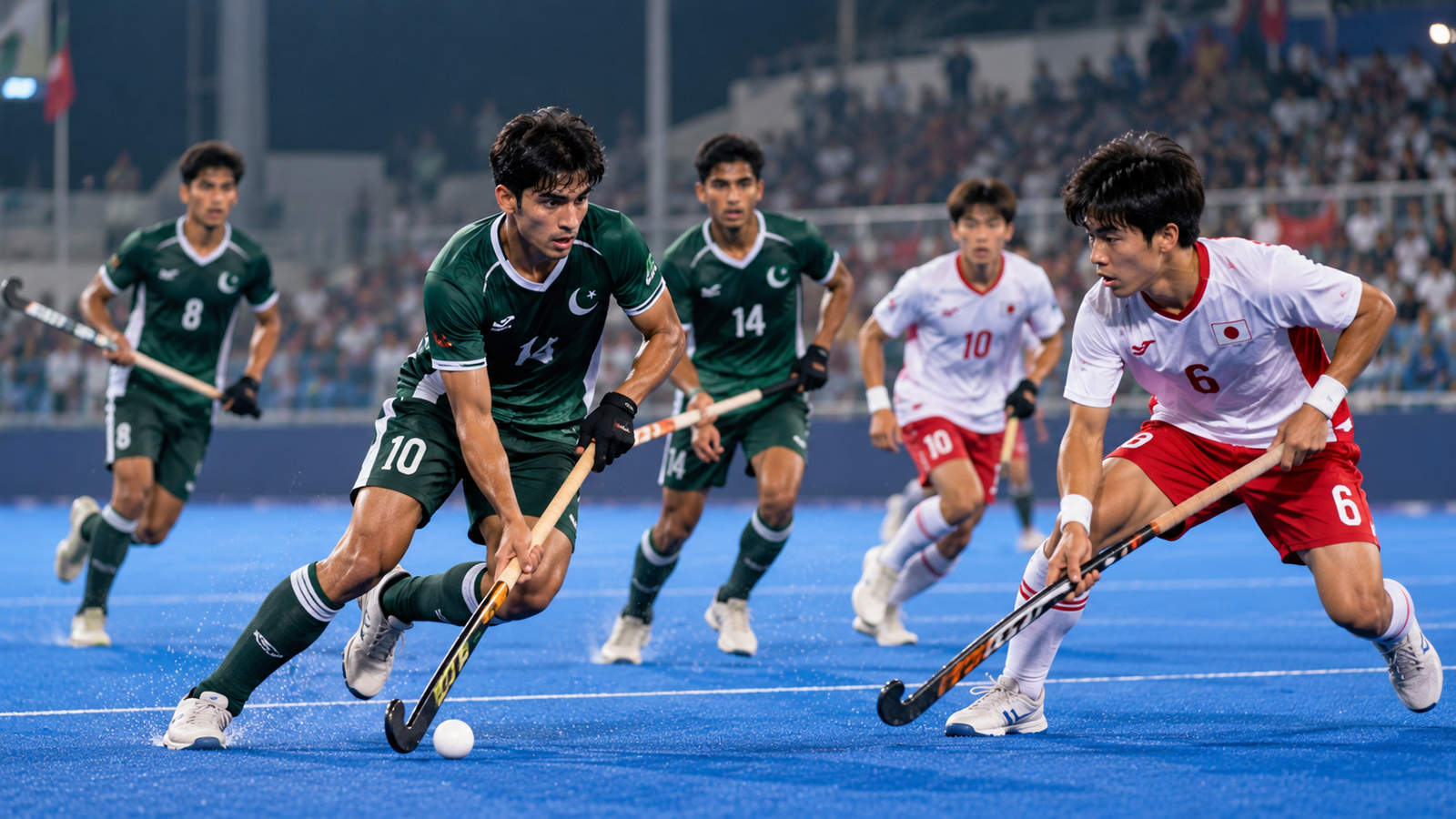
Pakistan’s junior men’s hockey team booked a place in the 2026 Sultan of Johor Cup final after drawing 2-2 with Japan in their last round-robin match at Taman Daya Hockey Stadium in Johor Bahru, Malaysia, on Friday, October 23. Pakistan came from behind twice, with Hamza Fayyaz equalising in the 34th minute and Ghulam Mustafa scoring again in the 43rd. The result was independently reported by Dawn, ARY News and Dunya News and is reflected in the International Hockey Federation’s official match record.
Pakistan and Japan completed the group stage level on seven points with the same goal difference of plus eight. Pakistan progressed because they had scored 18 goals across their four matches, compared with Japan’s 16. Hosts Malaysia secured the other final spot, setting up a title match scheduled for Saturday, October 24. The final outcome had not been confirmed in the sources checked for this article, so this report focuses on verified qualification and the upcoming contest, not an assumed championship result.
Pakistan vs Japan: What Happened in the Match?
Japan took the lead in the 18th minute through Seia Yamada, putting Pakistan under pressure after a goalless first quarter. Pakistan responded after halftime, when Hamza Fayyaz converted a penalty corner in the 34th minute. Japan then regained the advantage through Kazuki Nakai in the 42nd minute, only for Ghulam Mustafa to level the match just one minute later.
The final score remained 2–2. The goal timings and identities were reported by Associated Press of Pakistan material published in Dawn and match coverage from other outlets. The pattern of two recoveries is particularly notable because Pakistan needed a favourable result to stay in the race for the top two places. The draw provided the necessary point but did not, by itself, give Pakistan a larger goal difference than Japan.
How Pakistan Qualified With the Same Points as Japan
Both sides ended the preliminary round with seven points from four games. Each had a positive eight-goal difference, leaving them inseparable by those measures. The next relevant comparison was goals scored: Pakistan had 18 and Japan 16. Pakistan therefore finished above Japan in the table and advanced to the final against Malaysia.
This is why a simple headline suggesting Pakistan qualified merely because they drew with Japan leaves out an important part of the story. The team’s scoring record throughout the tournament mattered. Neither team earned a special bonus point for the match, and the reported result was not a penalty-shootout victory.
Pakistan’s Group-Stage Results
Pakistan opened their campaign with an emphatic 8–3 victory over China and then beat Canada 6–2. They lost narrowly to hosts Malaysia by 3–2 before the final-round 2–2 draw against Japan. Those four scorelines produce 18 goals scored and 10 conceded, matching the plus-eight goal difference cited in contemporary reporting.
Two victories, one draw and one defeat provided seven points. The high-scoring wins over China and Canada proved significant because they gave Pakistan an advantage over Japan on goals scored after the other major comparison measures were tied. It was the combined effect of several matches, rather than one isolated performance, that determined qualification.
Hamza Fayyaz’s Important Equaliser
Hamza Fayyaz scored Pakistan’s first goal against Japan in the 34th minute, converting a penalty corner to make the score 1–1. At that stage, Japan had led since the 18th minute. His goal restored the balance shortly after the start of the second half and kept Pakistan’s qualification prospects alive.
A penalty corner is a set-piece opportunity awarded under field hockey rules following certain defensive infringements. Converting one requires accurate delivery and execution amid close defensive pressure. The official scoreline credits Pakistan with the goal; no unsupported claim about additional assists or a player-of-the-match award is made here.
Ghulam Mustafa Responds to Japan’s Second Goal
Japan went ahead again through Kazuki Nakai in the 42nd minute, but Ghulam Mustafa equalised in the 43rd. That rapid response was crucial to the final 2–2 result. Without another goal, Pakistan would have finished the encounter behind Japan on points.
Mustafa’s contribution stands alongside Fayyaz’s in the match narrative. Each goal arrived when Pakistan was trailing. The dramatic timing makes the draw an engaging sports story, but it is not evidence of a final victory: the fixture ended level and the qualification decision was made through the group table.
Why the Goals-Scored Tiebreaker Matters
In round-robin tournaments, teams commonly receive three points for a win and one for a draw. If two teams finish level on points and goal difference, further tournament criteria may be required to rank them. Pakistan and Japan shared seven points and plus eight in this competition, and the reports agreed that the superior total of goals scored placed Pakistan ahead.
Pakistan’s 18 goals compared with Japan’s 16 gave them the edge. It is more precise to use the phrase ‘goals scored’ than a vague claim of a better goal difference, since their goal differences were identical. The distinction is an important detail for readers looking up the table.
Where the Sultan of Johor Cup Is Being Played
The tournament is being contested at Taman Daya Hockey Stadium in Johor Bahru, Malaysia. Johor Bahru is the city hosting the matches; some media accounts loosely refer to Malaysia more generally, but the stadium location helps identify the actual venue. The final between Pakistan and Malaysia was scheduled for October 24 at the same ground.
The event offers younger international squads a competitive opportunity to play multiple fixtures within a short period. Performance across the entire round-robin stage determines which teams reach the final. As such, the competition tests preparation, recovery and consistency as well as the ability to handle individual match pressure.
Pakistan vs Malaysia Final: What Is Confirmed?
Malaysia entered the title match unbeaten in the preliminary round and had already beaten Pakistan 3–2 earlier in the event. That prior result provides useful context but cannot predict the outcome of the final. Tournament matches may differ in tactics, team selection, conditions and execution.
The final was scheduled for Saturday, October 24, 2026. As the championship fixture was upcoming in the reporting reviewed, no winning score, trophy presentation or final player performance is included here. Mukhbir should update this article after a reliable official result becomes available, rather than publishing an unverified result in advance.
What Can Pakistan Learn From the Earlier Malaysia Match?
Pakistan’s previous 3–2 loss to Malaysia demonstrates that the teams have already contested a close match in this tournament. Pakistan found the net twice but conceded three goals. That performance is a factual starting point for discussing the rematch, without implying that the same scoreline or tactical pattern is inevitable.
A title match offers an opportunity to address defensive organisation and take advantage of scoring chances. Those observations are general hockey analysis, not alleged instructions from Pakistan’s coaching staff. Any specific change in lineup or match plan should be reported only if confirmed through official team information.
Why This Qualification Matters for Pakistan Hockey
Reaching the final of an international junior tournament gives Pakistan’s developing players exposure to pressure against strong regional opponents. For a country with a long association with field hockey, the result provides welcome attention to the next generation of athletes. The team demonstrated attacking production, resilience after conceding and the ability to recover from a narrow previous defeat.
At the same time, youth competition results should not be used as proof of a turnaround in every part of the country’s senior hockey programme. Progress depends on continued coaching, player development, competitive fixtures and institutional support. The immediate, verified achievement is reaching this particular tournament’s final.
The Role of High-Scoring Victories
Pakistan’s 8–3 win over China and 6–2 victory against Canada contributed fourteen of their eighteen group-stage goals. This total became decisive in comparison with Japan once points and goal difference were level. The performances also show the side’s ability to create goals against different opponents.
However, large wins do not guarantee success against every team. The 3–2 defeat against Malaysia shows that matches against stronger opposition can remain tight. The final will require execution on the day, rather than reliance on previous goal totals.
What the Official Hockey Match Record Confirms
The International Hockey Federation’s tournament management system carries the Japan–Pakistan result as 2–2 and identifies the relevant participants and event. The competition’s official website also lists the October 24 title fixture in its schedule. These sources provide a primary record that supports the core match and fixture facts.
Some tournament website entries can display older fixtures or delayed updates, so an editorial report should cross-check the date and stage before describing a match as completed. Mukhbir has treated the official Japan draw and confirmed final qualification separately from any later result that had not yet been verified.
Why Fans Should Avoid Premature Final-Result Claims
Sports stories can change quickly when a scheduled final takes place later the same day. A match preview written in the morning can become outdated in the evening. Social-media graphics may also circulate scores without showing whether they refer to a previous group-stage encounter, a live match or the actual final.
For the October 24 coverage, the safe approach is to publish the verified qualification story with a clear match date and update the headline only after the final result is confirmed. A result should be attributable to the organiser, the International Hockey Federation’s match system or reliable on-the-ground reporting.
Pakistan’s Junior Players and Future Development
The tournament has given young Pakistani players opportunities to compete against China, Canada, Malaysia and Japan. Competing repeatedly at international level can help athletes gain experience in set-piece execution, game management and recovery between fixtures. The qualification illustrates the importance of collective performances over a group stage.
Individual goals are part of the story, but the squad’s broader contribution also matters. No unsupported roster changes, player age claims, injuries or future senior-team selections are inferred from the tournament results. Long-term development outcomes will be clearer through later competitions and official selection decisions.
The Broader South Asian Sports Angle
Pakistan’s qualification may attract audiences across South Asia because field hockey has a significant history in the region and Asian junior competitions showcase emerging talent. The story’s appeal is sporting rather than political: players from different countries are competing according to the same tournament rules.
Neutral sports coverage should recognise Malaysia’s earlier victory, Japan’s close competition and Pakistan’s goals-scored advantage. A convincing account of Pakistan’s achievement does not require dismissing opponents or overstating a draw as a win.
What Happens After the Final?
Once the title fixture is completed, the result can be added as a clearly dated update identifying the teams, final score, scorers and any official awards. Further analysis could compare Pakistan’s performance across the round-robin stage and the championship match, based on verified match records.
The current article remains a report on the October 23 qualification and the scheduled October 24 match. Readers should check the tournament’s official fixture listings and updated credible sports coverage for the eventual result.
Conclusion
Pakistan reached the 2026 Sultan of Johor Cup final after an entertaining 2–2 draw against Japan on October 23 in Johor Bahru. Hamza Fayyaz and Ghulam Mustafa scored the equalisers, helping Pakistan finish the round-robin stage on seven points with a plus-eight goal difference. Goals scored made the difference: Pakistan netted 18 in four matches compared with Japan’s 16.
The result earned Pakistan a final against hosts Malaysia, scheduled for October 24. It represents a significant achievement for the junior squad, while the championship outcome remains a separate result to be verified after the match. This report is grounded in the official match record and consistent contemporary reporting.
Frequently Asked Questions
Did Pakistan qualify for the Sultan of Johor Cup 2026 final?
Yes. Pakistan qualified after drawing 2–2 with Japan on October 23, 2026.
Who scored Pakistan’s goals against Japan?
Hamza Fayyaz scored in the 34th minute and Ghulam Mustafa equalised in the 43rd minute.
Why did Pakistan advance ahead of Japan?
Both teams had seven points and a plus-eight goal difference, but Pakistan scored 18 goals compared with Japan’s 16.
Who will Pakistan face in the final?
Pakistan is scheduled to face hosts Malaysia.
When is the Sultan of Johor Cup final scheduled?
The final is scheduled for Saturday, October 24, 2026, in Johor Bahru.
How did Pakistan perform against Malaysia earlier?
Pakistan lost its group-stage match to Malaysia by 3-2.
What were Pakistan’s other group-stage results?
Pakistan beat China 8-3 and Canada 6-2 before losing to Malaysia and drawing with Japan.
Has Pakistan won the 2026 final?
The final result was not established by the sources checked for this qualification article. A win should not be claimed without the completed match record.
About The Author