A young man allegedly took Rs41,000 from a female bank cashier in Karachi’s New Town-Sharafabad area after asking to examine a bundle of Rs1,000 currency notes, according to news reports published on November 2 and 3, 2026. ARY News reported that the individual approached the counter, spoke with the cashier and asked to see a packet of banknotes. When the cash was handed over, he reportedly left the bank with the money, prompting the cashier to raise the alarm. CCTV footage of the encounter has circulated and was referenced by ARY News, Express News and Dunya News. Police were informed, but the available reporting does not establish a confirmed arrest or recovery of the money. Some headlines characterise the incident as involving ‘hypnosis’; the public accounts do not provide independent evidence of hypnosis or any medical assessment. The supported account is that the cashier was distracted through conversation before the reported theft. No individual has been convicted in the information reviewed. The case highlights basic cash-counter security questions, but it should not become a basis for blaming the cashier, identifying an uncharged person or alleging a wider criminal network without proof.
Karachi Bank Rs41,000 Theft: Key Facts
Location: New Town-Sharafabad, Karachi, Sindh, Pakistan.
Reported incident: Unauthorised removal of cash at a private bank counter.
Reported amount: Rs41,000.
Banknote denomination: Rs1,000 notes.
Person at counter: Female cashier.
Reported suspect description: Young man in shalwar kameez and cap, according to news accounts.
CCTV: Bank security-camera footage was reported and broadcast.
Initial news publication: November 2, 2026.
Further coverage: November 3, 2026.
Police: Informed of the reported incident.
Confirmed arrest: Not established in reviewed sources.
Confirmed money recovery: Not established.
Confirmed FIR registration: Source accounts are not consistent; final status unverified.
Bank identity: Not independently established in the reviewed coverage.
Use of weapon: Not reported in this incident.
Hypnosis claim: Not independently demonstrated.
Court finding of guilt: None identified.
Image: AI illustration, not original CCTV.
What Happened at the Karachi Bank?
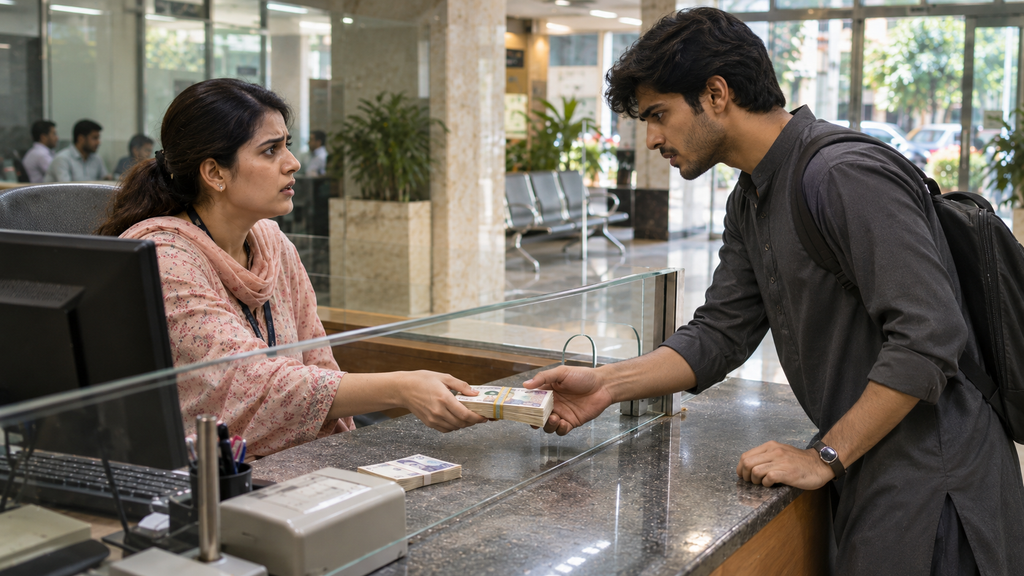
According to ARY News on November 2, a young man entered a bank in New Town-Sharafabad and approached the counter staffed by a woman. Reports describe him engaging the cashier in conversation and asking to see a bundle of Rs1,000 notes. The news outlet says he subsequently left with cash estimated at Rs41,000. Dunya News repeated this account on November 3, while Express Urdu reported that security-camera footage had come to light. The available accounts establish what was reported about a bank-counter encounter, but they do not provide an authenticated incident log or the testimony of everyone involved. Readers should view the sequence as a reported incident under police attention rather than a legally proven reconstruction of every movement.
Where in Karachi Was the Incident Reported?
The reports identify the New Town-Sharafabad area of Karachi. They describe a private bank but do not reliably establish its public name or precise branch address in the available articles. Mukhbir therefore does not name a bank or provide a guessed street location. Sharafabad is a neighbourhood associated with the broader New Town area, and that level of geographic detail is sufficient to identify the news story without risking a false accusation against an unrelated institution. A verified bank statement or police document could eventually clarify the exact branch; until then, the supported location is the area named by the news organisations.
How Was the Money Reportedly Taken?
The reported approach involved conversation at the cashier’s counter followed by a request to examine a bundle of notes. Once the cash was handed over, the person allegedly left with the money. This sequence has been described as distraction or deception in contemporary coverage. It is not a technical demonstration of a supernatural or medical process, and the reporting does not establish that the cashier was physically incapacitated. The important verified point is the claimed unauthorised removal of a specified cash amount during a customer-facing interaction. Investigators would need original footage, transaction records and statements to determine the precise mechanics and legal character of the event.
How Much Cash Was Reportedly Lost?
Multiple reports cite Rs41,000 as the amount taken. The banknotes were described as Rs1,000-denomination currency, although that does not automatically establish the entire composition of the alleged missing cash from a full audit. News organisations may repeat figures from initial reports before an institution completes its internal reconciliation. Therefore Mukhbir describes Rs41,000 as the reported amount rather than an independently audited final financial loss. No reliable source consulted has established that larger sums were taken or that customers’ account balances across the bank were affected. The story concerns a specific counter-level incident.
What Does the CCTV Footage Establish?
ARY News said CCTV video showed a person at the bank’s counter and recorded the interaction preceding the alleged removal of money. Express News and Dunya News also referred to the footage. CCTV can provide valuable visual evidence about movements and timing, but a clip does not necessarily show everything that happened before or after the recorded sequence. A full investigation may require the original recording, camera timestamps and corroborating records. Journalists should not use a short online clip to assert a person’s identity, criminal history or guilt. The footage is relevant reported evidence, not a court verdict. The image accompanying this Mukhbir article is a separate AI-generated illustration and must never be passed off as that CCTV recording.
Did the Cashier Raise the Alarm?
Contemporary accounts state that the female cashier shouted after realising that the person was leaving with the money. Dunya News and ARY News describe her attempt to alert others, but do not establish an immediate recovery of the cash. It would be unfair to infer negligence or deliberate cooperation by the cashier solely because she was reportedly deceived. Cash-counter roles involve frequent interactions, requests and handling of notes, and any investigation into bank procedures must consider the actual circumstances and applicable protocols. No verified disciplinary decision or wrongdoing by the employee was reported in the sources reviewed for this article.
Was Anyone Hypnotised?
Some Express Urdu reporting used the word ‘hypnotised’ in the headline or opening description. That wording is not supported by a published clinical assessment, a verified expert examination or detailed police finding in the accessible reporting. Other contemporaneous outlets simply describe the suspect as keeping the cashier occupied in conversation. A distracting interaction should not automatically be called hypnosis. Mukhbir therefore avoids treating that label as a demonstrated fact. A careful reader can understand that the alleged deception involved conversation and a request to handle a note bundle without assigning a medical or psychological mechanism that has not been established.
What Is the Police Investigation Status?
ARY News reported that police had been informed. Express Urdu stated that bank management requested a case and recovery action, while other reporting said it was not yet clear whether a formal first information report had been registered. These accounts do not establish a completed criminal inquiry or final procedural status. In the absence of an official dated police statement or a verified FIR copy, this article avoids declaring that charges have been filed, a person is in custody or the cash has been recovered. A later update should identify the police station, case number or official announcement before describing a development as confirmed.
Has the Suspect Been Arrested?
No arrest was confirmed in the November 2 and 3 reports reviewed for this story. Express Urdu reported that police were looking for the individual shown in the footage, but that does not prove a later arrest or establish his identity. Social-media claims may circulate images or names, and those should not be repeated without official corroboration. The principle is simple: a person shown in a crime-related video can be a subject of inquiry, but legal guilt requires an appropriate process. Mukhbir will update the article only when credible evidence establishes the next development, rather than predict that police will necessarily find the person within a particular time.
Was a Weapon Reportedly Used?
The accounts about this incident describe a request for cash and an alleged escape from the bank. They do not describe a firearm being used during the reported interaction. This distinguishes the case from separate armed robberies in Karachi that have also appeared in recent news. Mixing the details of unrelated events could wrongly exaggerate the risk posed to the cashier or other people inside the branch. A responsible headline focuses on the reported cash removal and CCTV, not a gunpoint robbery that has not been documented for this case. Any later claim of a weapon would require a separate credible source.
Why the Incident Raises Cash-Counter Security Questions
Banks handle cash in environments where staff need to serve customers efficiently while protecting money and sensitive information. An allegation involving a request to view currency notes raises questions about when cash can be handed across a counter, which interactions require verification and how staff can request assistance. The incident itself does not prove that the affected bank lacked proper procedures. Those matters would require review by the bank and any relevant investigating authorities. General cash security practices may help reduce exposure, but Mukhbir does not claim that a particular missing control definitively caused the reported loss.
What Are the Possible Risks of Distraction During Transactions?
A person handling a high volume of customers may be interrupted by questions, requests and movements in a busy branch. Distracting conversations can make it harder to focus on a transaction, but the cause of any specific incident should not be assumed from general human-factors observations. Banks commonly use transaction records, controlled cash areas and supervisory systems to maintain accountability. Staff training, clearly defined procedures and support when an interaction becomes unusual can strengthen resilience. This is a general operational explanation, not an allegation against the cashier or a claim that every reported bank theft follows the same pattern.
What Could a Bank Investigate Internally?
A bank reviewing a reported cash discrepancy may compare security-camera records, counter activity, cash reconciliation and relevant staff statements. It might also check whether customers or other employees witnessed the interaction. The objective would be to determine what actually happened and identify any improvements warranted by the evidence. None of those steps should be presumed completed in the absence of an official result. News coverage must also respect the privacy of employees and customers who may appear on footage. A bank’s internal assessment and police investigation can have different purposes and evidentiary standards.
How Should Customers Respond to Unusual Cash Requests?
People visiting a bank can help protect their own money by dealing through authorised counters, reviewing receipts and avoiding unnecessary sharing of account or identity information. If another visitor asks to handle their cash or paperwork, they can decline and seek assistance from bank staff. Customers should also report suspicious behaviour using established branch or service channels. These suggestions are for general awareness and do not imply that the female cashier in Karachi failed to follow any particular rule. An unusual interaction may be innocent, so accusations should be based on actual conduct rather than appearance, dress or age.
Does the Incident Involve a Customer’s Account?
The reviewed reports describe cash taken from a female cashier at a counter, not a verified electronic theft from customer accounts or a breach of the bank’s digital systems. There is no evidence in these sources of a compromised mobile banking application, stolen debit-card database or mass loss of customer deposits. It would therefore be incorrect to frame the event as a cyberattack or announce that bank customers should expect their balances to disappear. The immediate issue is a reported cash-handling incident. Separate claims about account security should be assessed on their own evidence.
Why Should News Outlets Avoid Naming an Unidentified Person?
Publicly identifying someone as a criminal without adequate corroboration can cause serious harm. CCTV stills can be misinterpreted, and ordinary people may resemble those shown in blurry images. The reports available to Mukhbir do not provide an officially verified personal identity or a court outcome. Describing the individual as a suspect or a young man seen in the reported footage is more appropriate than giving an invented name. It is also important to avoid implying that wearing a cap or traditional clothing makes anyone suspicious. Clothing is mentioned only because contemporary news reports used it as a descriptive detail.
Why Is This a Public-Interest Story?
Cash-handling security affects the confidence of people who use banks for savings, salaries and business payments. A relatively small reported loss can become widely discussed when the interaction occurs at an ordinary teller counter and CCTV footage circulates. The story is relevant to Karachi residents and to readers elsewhere in Pakistan who want to understand reported security incidents. Its public value lies in accurate reporting, not in dramatic claims about hypnosis, magical influence or a widespread bank crime wave. The fact that footage circulated does not establish how often similar incidents occur nationally.
How Has the Incident Been Reported Across Outlets?
ARY News published the principal report on November 2, saying a young man allegedly took Rs41,000 after asking to see a bundle of Rs1,000 notes. UrduPoint and Pakistan Point reproduced the story with the CCTV and police-notification details. Dunya News covered it on November 3, and Express Urdu published a story that included management’s reported request to police. Across those sources, the core account is consistent: a reported cash removal at a private bank in New Town-Sharafabad. Differences appear in language describing distraction, hypnosis and the formal complaint’s stage. Those differences are reasons to attribute rather than silently combine all claims as proven facts.
How Should Viral CCTV Clips Be Verified?
A credible newsroom should look for the earliest original report, confirm the location and date where possible, compare the video description with trustworthy coverage and seek an official response when available. A clip shared on social media may have been cropped, recorded earlier or given a misleading caption. For this case, the bank’s CCTV was discussed in multiple dated news reports, but the complete authenticated file and police case documents were not independently obtained. Mukhbir therefore identifies the reported footage and avoids claims about a precise recording time or complete sequence beyond those descriptions. The article’s own illustrative image is explicitly labelled AI-generated.
Was the Cash Recovered?
No confirmed recovery was identified in the reviewed reporting. The absence of a reported recovery is not proof that recovery will never occur, and it would also be incorrect to invent a later handover of money. A dated police or bank statement would be the appropriate source for any confirmed development. For the moment, the reliable amount remains the reported Rs41,000, and the next factual question is what investigators establish through original records and follow-up inquiries. Headlines promising that the suspect has been caught or that all money has been returned would go beyond the information verified here.
What If a Formal Case Is Registered Later?
If authorities register a case, a useful follow-up should state the relevant police station, date, legal allegations and status as documented by an official source. Registration of an FIR is a procedural event, not a criminal conviction. Police may investigate witnesses, review footage or pursue recovery, but the outcome remains uncertain until further verified information emerges. Anyone accused is entitled to the applicable legal process. Mukhbir will not describe a suspect as guilty simply because an allegation is recorded. Equally, the cashier’s reported complaint or alarm should be treated seriously without prejudging the outcome of an investigation.
Can Bank Security Be Improved Without Blaming Staff?
Yes. Financial institutions can assess procedures, provide ongoing staff support and improve reporting processes based on actual incidents. A review might consider transaction verification, supervisory assistance and the handling of unexpected requests. General procedural improvements are possible without assuming that an employee acted negligently or dishonestly. The accessible reporting does not establish a violation of a specific bank rule by the female cashier. A fair article should separate the need for effective safeguards from the question of any individual’s responsibility. Workplace processes and the circumstances of the event would need to be reviewed before drawing conclusions.
What Should Police and Banks Clarify for the Public?
A useful official update would confirm the reported amount, the date and location, whether a formal complaint or FIR was registered, and whether the person in the footage has been identified or apprehended. It could also clarify whether the cash amount was verified through the branch’s records. Bank and police communication should protect employee privacy and avoid disclosing security-sensitive details unnecessarily. Until such information appears, news outlets should focus on the facts already supported by reporting. Public confidence is best served through precise updates rather than speculation about motives or dramatic explanations for the cashier’s behaviour.
How Does This Case Differ From Armed Street Crime?
Karachi has seen separate reports of robberies involving motorcycles, weapons and threats to pedestrians. The Sharafabad bank-counter allegation is distinct: the reports describe conversation, a request for currency notes and a person leaving with money, without a reported weapon. Combining these incidents would be misleading and could lead readers to overestimate what is known about this specific event. Different types of alleged offences require different evidence and appropriate legal classification. Mukhbir describes the conduct reported by credible sources and avoids attaching unrelated incidents or criminal histories to an unidentified person.
What Remains Unverified?
The suspect’s legal identity, age, possible arrest, whether cash has been recovered, the bank’s exact name, the final FIR status and any claim of hypnosis remain unverified in the sources reviewed. The reported Rs41,000 figure and the Sharafabad location are supported by multiple dated news articles, but this does not constitute an independent forensic audit. Mukhbir has not personally inspected the original security-camera file or interviewed the cashier. Those limits matter because a factual article must not turn a preliminary account into a full criminal finding. Further official evidence could clarify or correct details as the inquiry proceeds.
What Happens Next?
Police were reportedly alerted to the incident, and Express Urdu said officials were looking for the person visible in the CCTV. The most important next developments will be a documented case status, a confirmed identification or arrest if one occurs, and verified information about any recovery of the alleged missing money. No time frame for those outcomes has been established. Readers should avoid spreading personal accusations or identifying people from screenshots on their own. If an official update is issued, Mukhbir can publish a dated follow-up distinguishing new findings from the earlier reported sequence.
Conclusion
The Karachi bank cashier Rs41,000 theft story has been reported by ARY News, Express Urdu and Dunya News, with CCTV described as showing a young man at a female cashier’s counter in New Town-Sharafabad. He allegedly requested to examine Rs1,000 notes and left with money, after which the cashier raised the alarm. Police were reportedly informed. Claims that the cashier was hypnotised have not been independently demonstrated, and no confirmed arrest or recovery was established in the material reviewed. The case merits public attention to cash-counter security and proper investigation, but it should be reported without assigning guilt to an unidentified person or blame to the cashier before evidence supports such a conclusion.
Frequently Asked Questions
What happened at the Karachi bank in November 2026?
A young man allegedly took Rs41,000 after asking a female cashier to show a bundle of currency notes in New Town-Sharafabad.
How much cash was reportedly taken?
Multiple reports put the alleged amount at Rs41,000.
Which bank did the incident occur in?
Reports identify a private bank in New Town-Sharafabad, but the exact bank was not reliably confirmed in the reviewed sources.
Is CCTV footage available?
ARY News and other outlets reported and discussed footage of the person at the counter.
Was the female cashier hypnotised?
Some headlines use that description, but independent evidence of hypnosis was not provided; distraction through conversation is the better-supported account.
Has the suspect been arrested?
No confirmed arrest was established in the reports reviewed for November 2–3, 2026.
Has the money been recovered?
No verified recovery was identified in the sources reviewed.
Did police register a case?
Police were informed, but reporting did not consistently establish the final FIR registration status.
About The Author