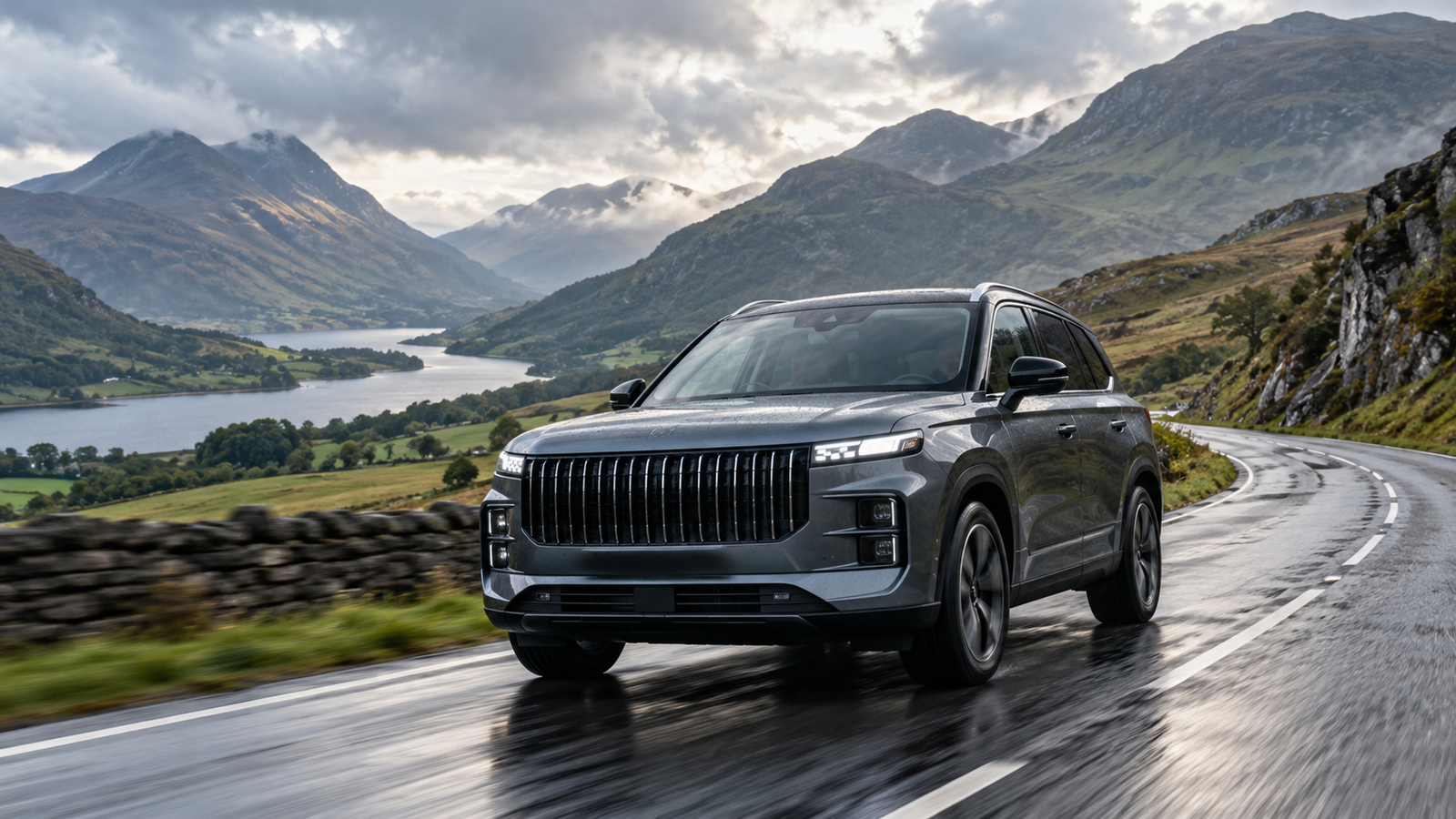
7 SHS-P fuel efficiency has attracted renewed attention after a production plug-in hybrid SUV completed the United Kingdom’s National Three Peaks Challenge with a Guinness World Records-verified average of 4.11 litres per 100 kilometres. The figure is equivalent to approximately 24.3 kilometres per litre or 68.7 imperial miles per gallon. During the monitored journey, the vehicle covered 469.5 miles, or about 756 kilometres, across Scotland, England and Wales.
The record attempt took place on September 19–20, 2026, and was described by the UK’s RAC motoring organisation on October 8. Pakistani outlets ProPakistani and Startup Pakistan covered the achievement on October 24, giving the result renewed local relevance. This October 26 article explains the verified outcome and the technology behind it without portraying a September event as a new October test.
The central consumer warning is straightforward: a controlled record result is not a promise that every owner will achieve 24.3 km/L. Fuel consumption for a plug-in hybrid depends heavily on battery charging, route conditions, driving style, temperature and how efficiency is calculated. The manufacturer explicitly says the record figure is not an official WLTP test result.
JAECOO 7 SHS-P Guinness Record: Key Facts
Vehicle: Standard-production JAECOO 7 SHS-P plug-in hybrid SUV.
Record category: Lowest fuel consumption while completing the UK National Three Peaks Challenge in a production plug-in hybrid SUV.
Record attempt: September 19–20, 2026.
RAC news report: October 8, 2026.
Pakistan competitor coverage: October 24, 2026.
Verified recorded road distance: 469.5 miles, approximately 756 kilometres.
Fuel consumption: 4.11 L/100 km.
Equivalent economy: Approximately 24.3 km/L or 68.7 imperial mpg.
Route: Ben Nevis in Scotland, Scafell Pike in England and Yr Wyddfa/Snowdon in Wales.
Drivers: Kevin Booker and Sam Clarke.
Mountain climber: Television presenter Ben Shephard.
Verification: Guinness World Records adjudication, RAC witnessing and Webfleet monitoring.
Important limitation: The result is an efficiency record for one defined journey, not an official combined-cycle vehicle rating.
What Happened During the UK Three Peaks Challenge?
The National Three Peaks Challenge typically combines ascents of the highest peaks in Scotland, England and Wales with lengthy transfers by road. For this special attempt, television presenter Ben Shephard climbed Ben Nevis, Scafell Pike and Yr Wyddfa while specialist efficiency drivers Kevin Booker and Sam Clarke transported the team between the mountains in a JAECOO 7 SHS-P.
The route involved motorways, smaller roads, mountain passes and changing weather. The journey continued through the night, and drivers encountered rain, sunshine and high winds. The manufacturer reports that the vehicle covered 469.5 miles without stopping to refuel or recharge after the start of the monitored attempt.
The mountain climbs were an essential component of the Guinness category, although the vehicle’s measured fuel consumption relates to its driven road journey rather than the distance climbed on foot. That distinction is important when interpreting the event’s promotional language.
How Was the 4.11 L/100 km Result Verified?
JAECOO’s official United Kingdom record page says the fuel filler and charging port were sealed at the beginning and opened at the finish in a process witnessed by the RAC. GPS and Webfleet tracking were used to document the journey. The Guinness World Records adjudicator confirmed the outcome at the finish, according to the company and the RAC’s published coverage.
The RAC independently reported the event and its involvement, making its account particularly useful as corroboration beyond manufacturer marketing. The vehicle was identified as an unmodified standard-production example, rather than a specially modified experimental prototype. That supports the integrity of the particular record category.
Nevertheless, Guinness verification does not transform a single route into a universal automotive efficiency test. It verifies the stated record under the applicable challenge conditions. Readers should not interpret it as evidence that an average Pakistani commuter, motorway driver or mountain tourist will automatically match the figure.
Understanding 24.3 km/L, 68.7 mpg and 4.11 L/100 km
Fuel economy appears in different units depending on the country. The reported 4.11 litres per 100 kilometres means approximately 4.11 litres of petrol were consumed for every 100 kilometres under the record’s measurement method. Inverting that figure gives roughly 24.3 kilometres per litre.
The UK’s 68.7 mpg uses the larger imperial gallon, not the US gallon. Comparisons between UK and US mpg figures without converting units can produce misleading conclusions. For Pakistani audiences, km/L is generally easier to understand because local motoring discussions often describe how many kilometres a vehicle travels per litre.
In a plug-in hybrid, petrol consumption may also be influenced by electrical energy drawn from a previously charged battery. Therefore a single petrol-economy number does not by itself describe total energy costs or the electricity required to restore the charge. The record’s starting charge, restrictions and verification methodology are essential context.
What Is the JAECOO 7 SHS-P Super Hybrid System?
The SHS-P designation refers to a plug-in hybrid system combining a petrol engine with electrically driven components and a battery that can be recharged from an external power supply. Depending on conditions, the vehicle may use electric drive, petrol power or a combination of the two. This can improve fuel consumption during certain journeys, particularly where the owner regularly charges the battery.
A plug-in hybrid differs from a conventional hybrid because it can generally receive electricity directly from an external charger and may offer a more substantial electric-only operating range. It also differs from a fully electric car because it retains a petrol engine for propulsion or other powertrain functions.
The balance between these modes is managed by vehicle software and hardware. It can depend on accelerator demand, battery charge, temperature, speed and the driver’s selected operating mode. The exact hardware configuration and equipment available can vary by market or specification.
Does the Record Prove the Vehicle Delivers This Mileage in Pakistan?
No. Although the reported record is meaningful for the specified test, its result should not be presented as a guaranteed Pakistani fuel-consumption figure. City traffic in Lahore, Karachi or Islamabad can differ substantially from a UK record journey. Frequent braking, air-conditioning use, passenger load, tyre pressure, terrain and stop-start patterns all affect consumption.
A driver who charges the plug-in hybrid regularly and undertakes short trips may rely more heavily on electric power than someone who seldom charges. Conversely, long motorway runs, steep roads or sustained high speeds can alter the balance between battery and petrol use. Comparing outcomes fairly would require an agreed measurement method and a disclosure of charging behaviour.
Prospective buyers should prioritise local test drives, official market-specific specifications, warranty terms, charging access and independent long-term owner data rather than projecting a Guinness result directly onto everyday ownership costs.
Why Is the Record Relevant to Pakistan?
JAECOO has an established commercial connection to the Pakistani automobile market through the OMODA & JAECOO operation associated with NexGen Auto and Nishat Group. Its J7 SHS-P is promoted locally as a plug-in hybrid SUV. Because fuel prices and operating costs matter to Pakistani motorists, a verified international efficiency record can attract legitimate consumer interest.
That relevance has limits. The record was completed in the United Kingdom, not on Pakistani roads, and the tested production vehicle’s exact market specification may differ from a model sold locally. Readers should not assume that equipment, battery capacity, charging standards, official economy ratings or warranty conditions are identical across countries without checking the relevant local specification sheet.
Pakistan’s expanding hybrid and electric-vehicle market also means drivers have more technology choices to evaluate. For a balanced comparison, owners should include purchase price, petrol cost, home or public charging expenses, after-sales access, battery-warranty conditions and resale considerations.
Can a Plug-In Hybrid Save Money on Long Trips?
A plug-in hybrid offers the convenience of a petrol-powered drivetrain while allowing electric propulsion during suitable periods. On a long trip with limited charging opportunities, its petrol engine can provide flexibility; however, operating costs will depend on the available charge, route profile and energy prices.
A useful illustration is a hypothetical 100 km drive: at 4.11 L/100 km, the measured petrol component would be about 4.11 litres. That is simply the arithmetic expression of the verified result, not a forecast for a Pakistan trip. Battery electricity and any other energy inputs must be considered separately to estimate full running costs.
Buyers should not calculate guaranteed annual savings from the 24.3 km/L record without relevant local measurements. A practical comparison should account for real usage patterns and clearly state assumptions rather than claiming a universal payback period.
What Were the Conditions and Restrictions of the Attempt?
JAECOO’s UK campaign describes a standard production vehicle, no modifications, sealed filler and charge port, continuous route monitoring and verification by a Guinness adjudicator. The RAC confirms its involvement and reports that Webfleet monitored the road route. Conditions involved changing weather and mountain roads as well as motorway driving.
Some promotional materials vary in the number of miles shown, with isolated dealer pages listing a slightly different total. For consistency, this report follows the vehicle manufacturer and RAC’s mutually supported 469.5-mile figure rather than combining incompatible promotional distances.
A record attempt with professional efficiency drivers can differ from everyday driving behaviour. Such a result is best treated as a measured achievement under disclosed conditions, not as a replacement for independent consumer testing.
What Is the Difference Between a World Record and an Official WLTP Figure?
WLTP stands for Worldwide Harmonised Light Vehicles Test Procedure, a standardised testing framework intended to make vehicle fuel-consumption and emissions measurements more comparable under specified laboratory procedures. Plug-in hybrid measurements use additional calculations reflecting how petrol and electrical energy contribute under the test framework.
A Guinness record can be based on a unique real-world challenge with its own entry requirements. It may capture a demanding route, but it is not inherently comparable to an official WLTP combined-cycle number for competing vehicles. JAECOO explicitly advises that the record’s 4.11 L/100 km value is not a WLTP figure.
This distinction does not undermine the record; it explains what the measurement means. News headlines can report a Guinness result accurately while still making clear that formal homologation figures and independent everyday consumption tests answer different questions.
What Should Pakistani Buyers Check Before Choosing a PHEV?
Before choosing any plug-in hybrid, confirm the vehicle’s Pakistan-market price, registration and tax implications, available variant, battery capacity, electric range, charger compatibility and charging speed from current official documents. Specification numbers from UK advertisements should not automatically be treated as binding for local imports or assembled models.
After-sales service matters especially for an electrified powertrain. Buyers should ask about hybrid-system diagnostics, battery coverage, repair facilities and the availability of approved components. A charging arrangement at home or work may change the ownership experience substantially compared with depending on occasional public charging.
It is also wise to ask whether published efficiency statistics show petrol usage alone, electricity usage or both. Financial comparisons that ignore one energy source can significantly overstate savings, even when every individual number quoted is technically correct.
What the Record Does Not Establish
The verified result does not establish that the JAECOO 7 is the most efficient SUV across all markets or every test category. Guinness awards titles for specific defined achievements. It also does not prove a particular Pakistani dealer’s advertised ownership claims, determine resale value or establish how the vehicle performs after years of battery degradation.
Nor does it provide a comprehensive reliability study or crash-safety assessment. Reliability requires evidence from extended use across many vehicles, while safety assessments involve separate testing and regulatory procedures. It would be inappropriate to infer either from a fuel-economy event.
Finally, the result should not be reported as an October 26 record attempt. The September driving dates and subsequent October reporting dates must remain clearly distinguished.
Conclusion
The JAECOO 7 SHS-P completed a Guinness World Records-verified UK National Three Peaks efficiency challenge with an average of 4.11 L/100 km, approximately 24.3 km/L, across 469.5 miles. The result was documented through the involvement of Guinness World Records, the RAC and route-tracking technology, and it was widely discussed again by Pakistani motoring outlets in October.
For Pakistan, the news illustrates the possibilities of plug-in hybrid technology without establishing a guaranteed fuel-saving figure for local conditions. The strongest consumer takeaway is to treat the record as one credible demonstration of a production SUV’s performance, then assess actual Pakistani specifications, driving behaviour, electricity use and service support before making a purchase decision.
Frequently Asked Questions
What fuel-economy record did the JAECOO 7 SHS-P set?
It achieved the Guinness World Records-recognised lowest fuel consumption for the UK National Three Peaks Challenge in a production plug-in hybrid SUV, averaging 4.11 L/100 km.
Is 4.11 L/100 km the same as 24.3 km/L?
Yes, approximately. Both express the same recorded petrol-use rate using different units.
When did the record attempt take place?
The drive took place on September 19–20, 2026. UK and Pakistani publications reported it on subsequent October dates.
How far did the JAECOO 7 travel?
The manufacturer and RAC report 469.5 miles, or about 756 kilometres, across Scotland, England and Wales.
Who verified the achievement?
Guinness World Records adjudicated the result, the RAC witnessed key verification steps and Webfleet monitored the route.
Does the record guarantee 24.3 km/L for Pakistani drivers?
No. Actual consumption depends on road conditions, charging habits, battery state, speed, traffic and driving style.
What is SHS-P?
It refers to JAECOO’s Super Hybrid System Plug-in, which combines rechargeable battery-electric capability with a petrol-powered drivetrain.
Is the record the SUV’s official WLTP fuel-economy rating?
No. The manufacturer explicitly distinguishes the Guinness record result from the official WLTP test figure.
About The Author