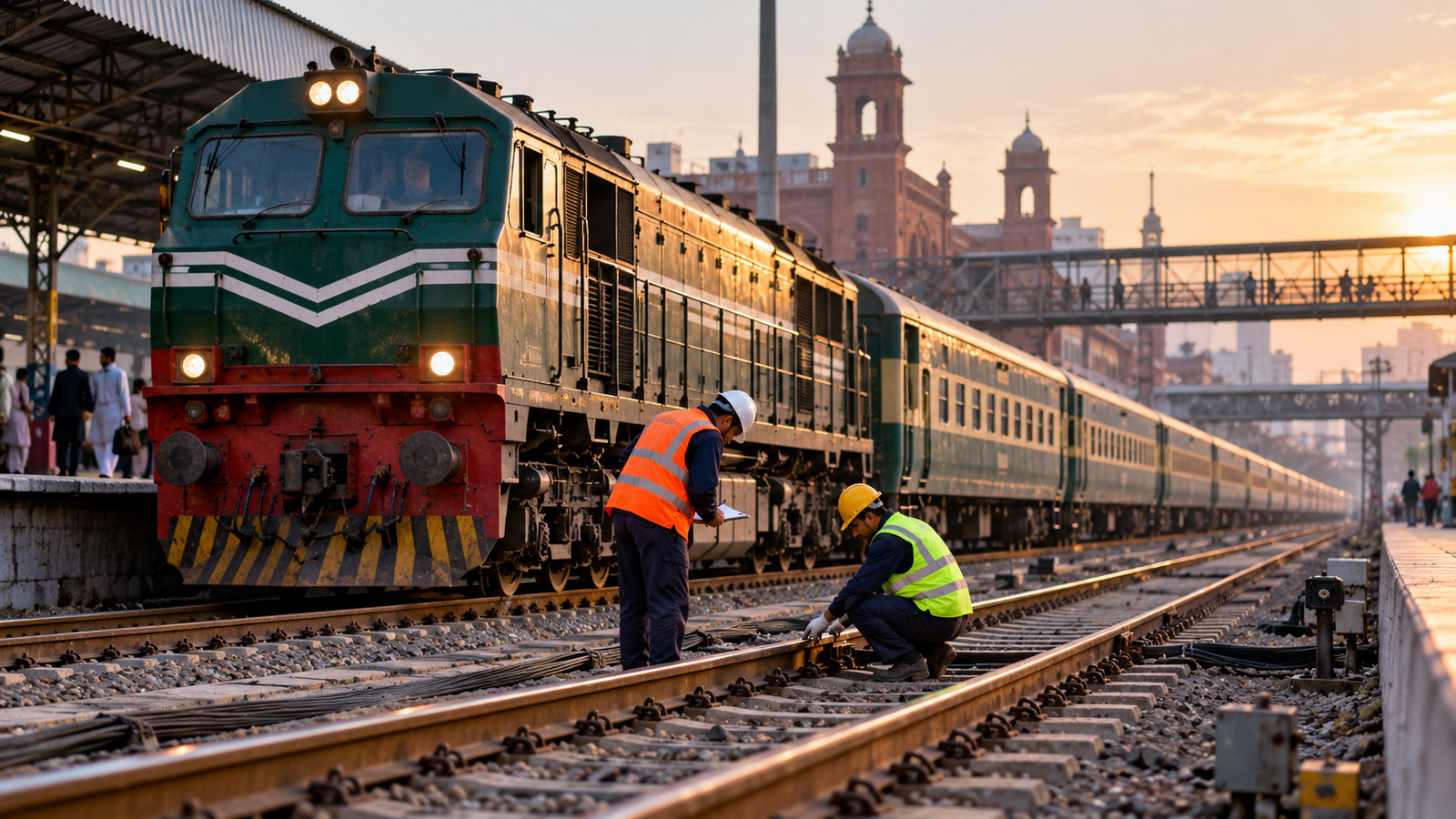
Pakistan Railways has introduced an operational emergency lasting until December 31, 2026, after a series of train accidents and concerns about safety and maintenance. Federal Minister for Railways Muhammad Hanif Abbasi directed railway officers to conduct closer field supervision, submit daily safety reports and address defects in rolling stock and infrastructure. The decision took effect on Saturday, October 24, and was subsequently detailed in reporting published on October 25.
The emergency applies to the management and operations of the national railway system. It is not a constitutional state of emergency across Pakistan, nor does it mean that all passenger train services have been suspended. Instead, authorities say the measures are intended to make trains safer by increasing inspections and accelerating repairs. Radio Pakistan and the Associated Press of Pakistan reported the official directives, while Dawn and Business Recorder published additional details.
Why Did Pakistan Railways Declare an Emergency?
The directive follows repeated derailments and accidents involving passenger and freight trains in different parts of Pakistan. Dawn reported on October 25 that recent accidents had focused attention on deteriorating tracks, defective coaches and wagons, manual point systems, maintenance shortcomings and human error. Several incidents have also raised concern about the availability of parts and the speed of repairs.
The ministry’s response is to intensify operational oversight through the end of December. Rail safety depends on equipment condition, track integrity, signalling, operational procedures and personnel decisions; no single measure can eliminate all hazards. Announcing an emergency signals a policy priority, but the effectiveness of the initiative will depend on whether defects are identified, resources are supplied and improvements are implemented.
When Did the Emergency Begin and End?
According to Radio Pakistan, the emergency was announced on October 24, 2026 and is scheduled to remain in force until December 31, 2026. Although some reports describe a cancellation of field officers’ leave for three months, the clearly stated end date is December 31. News publishers should use the dated order rather than assume the restrictions automatically continue for three full months beyond October.
The minister said railway personnel responsible for operations would be required to work through weekends and holidays during the emergency. Dawn reported that medical leave is an exception to the general leave restrictions described in the instructions. This is an administrative arrangement affecting specified railway personnel; it does not automatically change the timetable of every train or impose new restrictions on ordinary passengers.
What Changes for Railway Officers?
Field officers were instructed to monitor railway operations more actively, including visiting operational sites on Sundays. Under the measures reported by Radio Pakistan, leave was cancelled for field staff and officers were told to pay direct attention to operating conditions rather than rely solely on office reporting. Dawn described the restrictions as extending to public holidays and weekends, with medical leave excepted.
There are also new requirements for official travel. Railway officials travelling to other cities for official duties must use trains, enabling them to observe conditions in the system they administer. Business Recorder reported that routine air travel and official-vehicle travel for such tours were prohibited or would no longer be reimbursed. Dawn reported the minister reserved exceptions for extreme emergencies. These rules concern the department’s official trips, not passengers’ ability to choose their own travel methods.
Daily Safety Reporting Requirements
The civil and mechanical chief engineers must provide daily reports to the Ministry of Railways about work within their respective areas. The head of safety has also been asked to submit daily updates. Radio Pakistan’s official summary identifies these reporting obligations as central parts of the emergency package.
A useful safety report should help managers understand which defects have been identified, where repairs are pending and whether safety-critical work is on schedule. However, the public reports available on October 25 do not contain a complete template for the submissions or the full inspection outcomes. The existence of a reporting requirement should not be confused with proof that every operational problem has already been corrected.
What Equipment Will Be Inspected?
Dawn reported that the minister directed officials to address deficiencies in passenger coaches, goods wagons, locomotives, signalling and other railway infrastructure before the year ends. Faulty or brakeless rolling stock was identified as an important concern. The ministry intends to remove defective equipment from service and arrange repairs rather than permit avoidable risks to continue.
The minister said a condition assessment covering 1,546 coaches and wagons had been completed, while inspections of approximately another 3,000 were targeted for completion by November 10. Those counts and deadlines are ministerial claims and targets reported by Dawn. They should not be presented as independently audited repair completions. Inspecting a vehicle is only one step; any necessary maintenance and successful safety checks must follow.
Parts Procurement and Maintenance Backlogs
The minister said parts for coaches, wagons and locomotives had started arriving, including 36,000 brake cylinders. He also directed railway workshops to manufacture components locally where feasible and instructed staff to meet the requirement for concrete and wooden sleepers by November 30. Dawn separately reported on October 17 that an inquiry had been ordered into delays in the purchase of maintenance parts and equipment.
Such steps reflect concerns about a maintenance backlog, but the reported availability of parts does not prove that installation work is complete or that all stock will be operational by a target date. Procurement efficiency, workshop capacity, inspection quality and funding will help determine what can be achieved before December 31.
How Many Train Accidents Were Reported in 2026?
Several news organisations, including ProPakistani and Arab News Pakistan, cited railway-source figures indicating more than 55 accidents involving passenger and freight trains since January 2026. This is an attributed media-reported total, not an independently checked database assembled by Mukhbir. The figure may include events with different levels of severity, and the reporting does not provide a uniformly categorised public list of all incidents.
Dawn reported seven accidents and derailments during July alone and described an October derailment near Multan among recent safety concerns. Casualty counts for individual events should be drawn from verified incident-specific reporting rather than aggregated casually. Whatever the precise total, repeated disruption and injuries explain why public scrutiny has grown.
What Are the Main Safety Concerns?
Problems cited in reporting include the condition of aging tracks, defective rolling stock, manual railway point operations, inadequate maintenance and human error. The railway network covers long distances and varied terrain, and safe operations depend on coordination between mechanical, engineering, signalling and operations teams.
It would be misleading to attribute every derailment to one cause without an accident investigation. A damaged track, an equipment fault or a decision taken during operations may each play a role in different incidents. The emergency programme is designed to address a range of vulnerabilities, while investigations into individual accidents remain necessary to determine their specific causes.
What Does the Decision Mean for Passengers?
For ordinary passengers, the stated objective is improved reliability and safety. The government’s directives do not constitute an announcement that all trains are cancelled or that railway travel must stop through December. Normal schedules, delays or service changes should be checked through the railway’s official communication channels for the relevant route and date.
Passengers may still be affected if an unsafe coach is withdrawn, inspections reveal repair needs or operational changes become necessary. However, the October 24 order does not provide a complete list of service cancellations or revised departure times, so none should be invented. Travellers should confirm bookings and train status before departure and report immediate safety concerns to authorised staff.
Why Official Train Travel Was Made Mandatory
Requiring railway officers to travel by train for official duties can expose decision-makers to passenger and operational conditions firsthand. They may observe cleanliness, overcrowding, equipment performance, station procedures and delays from inside the system. The directive also has an administrative cost-control element, with official air travel and vehicle use curtailed in routine cases.
These are possible practical benefits of the rule, not proof that such travel will automatically resolve technical problems. Effective oversight still requires measured inspection results, repair records and transparent follow-up. Business Recorder described the travel restrictions as austerity measures, while the ministry placed them within the broader push for safety.
Minister Hanif Abbasi’s Position
Hanif Abbasi said the government intends to provide safer journeys and instructed officers to meet year-end deadlines for fixing operational problems. In remarks covered by Dawn, he warned that officers who failed to address deficiencies could face action. He also said he intended to travel by train himself on the Rawalpindi–Lahore route during the emergency.
Those statements describe the minister’s position and announced management approach. They do not establish that the entire rail network will be free of defects by January 1. A balanced account should report government commitments alongside the operational issues that made the measures necessary.
Public Accountability and Measuring Progress
A meaningful evaluation of the emergency should examine changes in the condition of tracks, coaches, brakes, signalling equipment and daily inspection records. It should also ask whether the railway has reduced delays caused by mechanical failures and whether accident rates improve over a sufficiently long period.
An announcement is easier to verify than its eventual outcomes. Reporters can establish that an order was issued and targets were set, but should not report targets as achievements before documentation is available. Progress updates from the Ministry of Railways, independent accident investigations and published safety statistics would provide stronger evidence of whether the effort is working.
Impact on Freight and the Wider Economy
Pakistan Railways carries freight as well as passengers, so reliability matters to businesses moving goods between industrial areas, dry ports and seaports. Equipment faults and line closures can increase uncertainty for shippers and create indirect economic costs. Better maintenance could strengthen confidence in rail transport over time, though this outcome is not guaranteed by the emergency alone.
The October directives do not quantify the expected commercial benefit, repair cost or reduction in freight delays. Claiming a specific economic saving without a published estimate would go beyond the evidence. Businesses should therefore treat the programme as a potentially relevant operational development rather than an assured financial outcome.
What Happens Before December 31?
The stated deadlines include completion of further coach and wagon inspections by November 10, steps to address sleeper requirements by November 30 and correction of identified operational deficiencies by December 31. Daily engineering and safety reports are expected throughout the emergency. If later updates alter these dates, reports should distinguish the original target from the revised schedule.
The next substantive news will be evidence that work has been completed, the outcome of procurement inquiries or independently reported changes in service safety. A future review should also examine whether restrictions on leave and official travel are lifted, extended or modified when the announced emergency period ends.
Conclusion
Pakistan Railways has declared an operational emergency until December 31, 2026, to strengthen oversight and accelerate repairs after a period of safety concerns and repeated accidents. The measures include restrictions on leave for officers, Sunday field inspections, train travel for official duties and daily reports from engineering and safety managers.
The ministry has also set targets for inspecting additional coaches and wagons and correcting defects in equipment and infrastructure. The announcement is confirmed by official reporting, but its effectiveness will become clear only as repair work and safety outcomes are verified. It is a railway management emergency, not a nationwide declaration of emergency.
Frequently Asked Questions
Why has Pakistan Railways declared an emergency?
The ministry says the measures respond to concerns about train accidents, maintenance and safer passenger and freight operations.
When did the Pakistan Railways emergency start?
The operational emergency took effect on October 24, 2026.
When will the emergency end?
The announced end date is December 31, 2026, unless authorities subsequently change it.
Are all passenger trains suspended?
No. The announcement concerns operational supervision and safety measures, not a blanket suspension of passenger services.
Have railway officers’ holidays been cancelled?
Reports say leave and public holidays were restricted for relevant railway officers, with medical leave identified as an exception.
Why must officials travel by train?
The order requires rail travel for official tours, allowing direct observation of services and reducing routine air or vehicle travel.
What safety checks have been ordered?
Daily civil, mechanical and safety reports, field supervision and inspections of coaches, wagons and other infrastructure.
How many rail accidents were reported in 2026?
Several media reports cite railway sources saying more than 55 passenger and freight incidents occurred since January, but Mukhbir has not independently audited that total.
About The Author