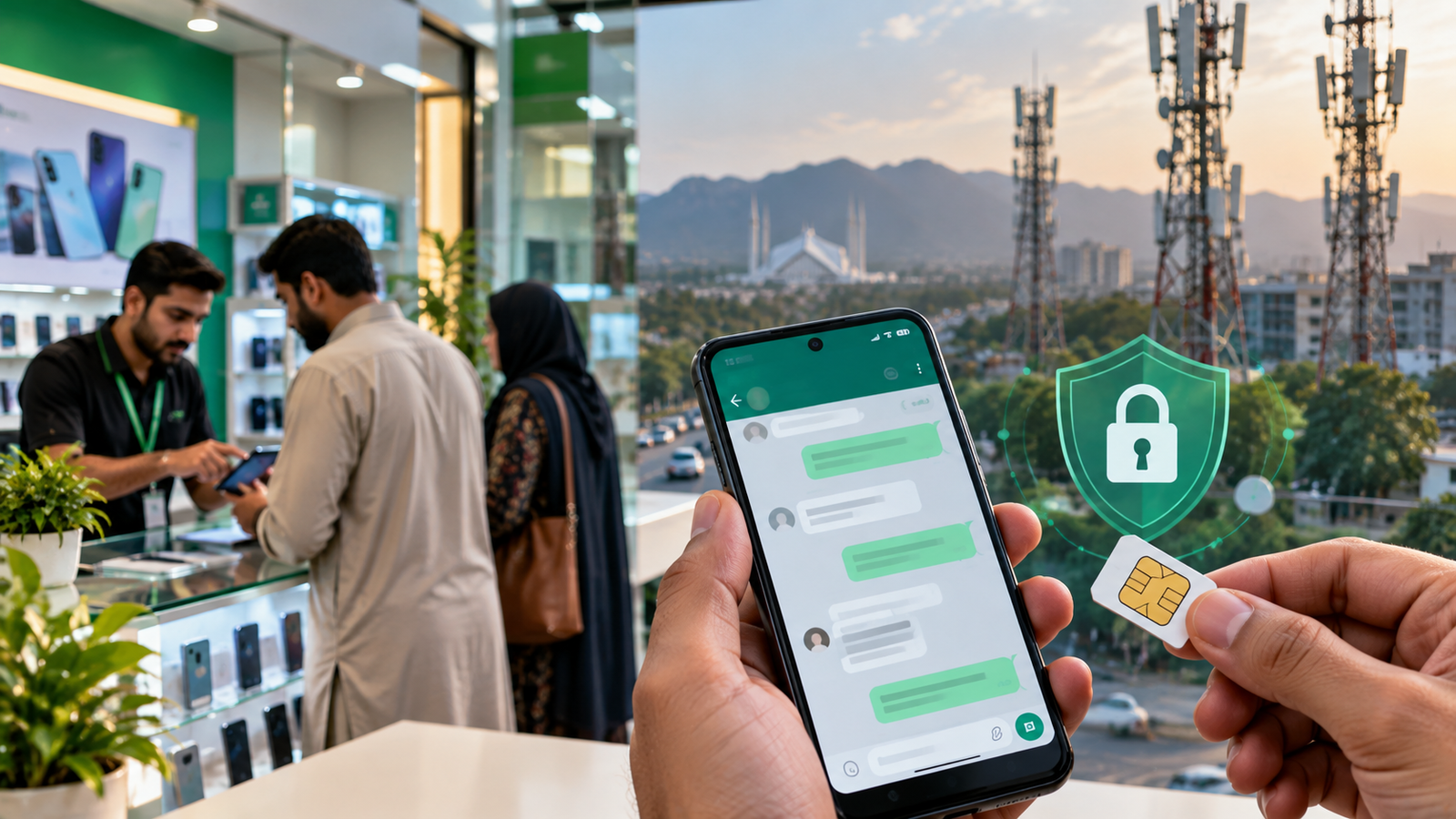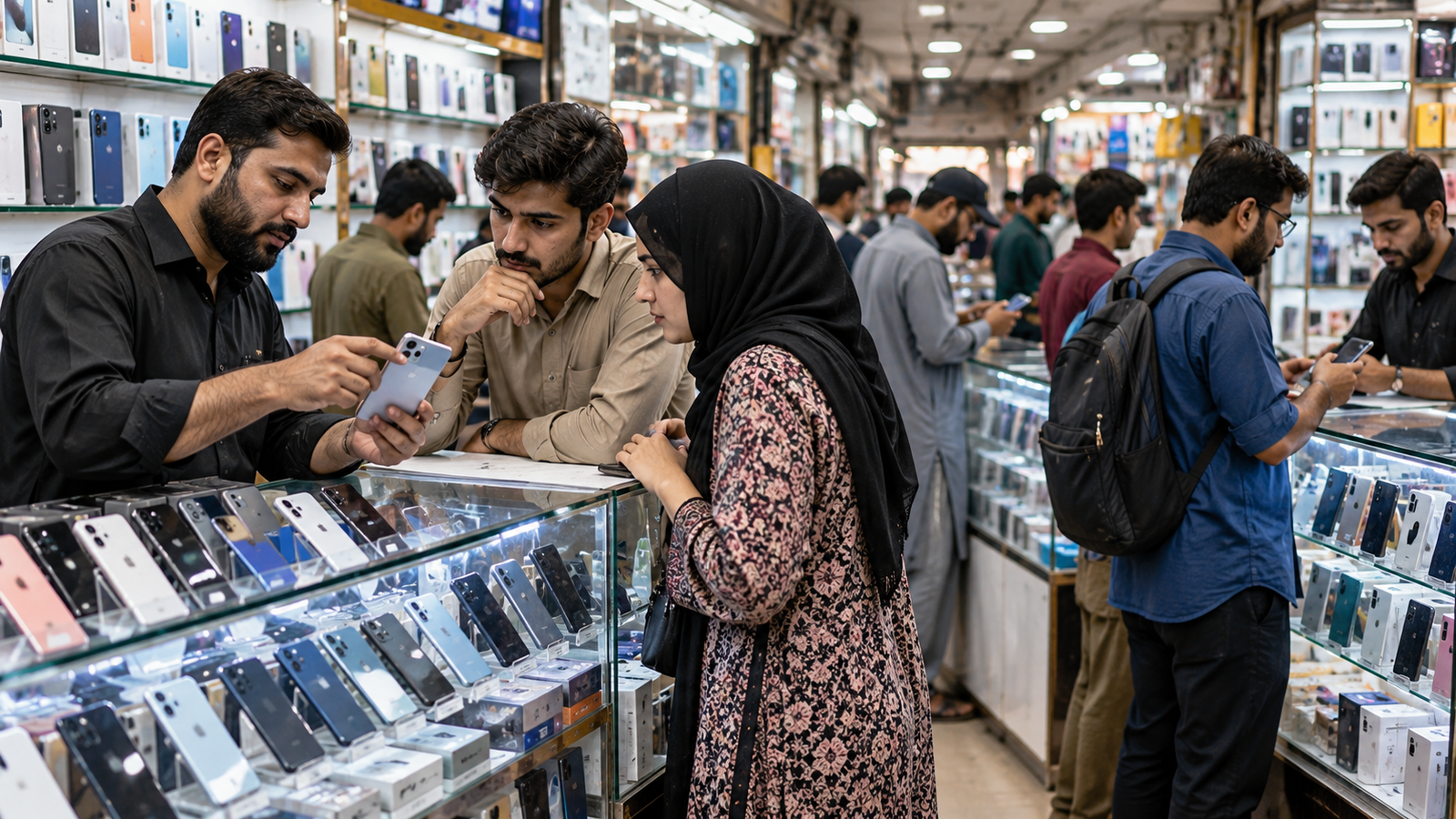
Karachi smartphone prices 2026 have become a major concern for budget-conscious consumers as even entry-level handsets are moving beyond what many households expected to spend. A market survey published by Dawn on October 26 found that the average asking price for a phone with 4GB of RAM and 64GB of storage had reached roughly Rs40,000, compared with approximately Rs22,000 a few months earlier.
The difference is around Rs18,000, or approximately 82 percent relative to the earlier benchmark. It is a comparison drawn from the newspaper’s Karachi market reporting, not a national inflation statistic or a government-certified price index. The newspaper also reported dealers describing increases of approximately Rs15,000 to Rs30,000 on various handsets. Those figures should not be assumed to apply equally to every model, retailer or city.
For consumers, the increase is more than an inconvenience. Smartphones support education, digital payments, employment, transport bookings and communication. This article explains what the October 26 reporting established, what sellers said about potential causes, how prices may vary and what buyers should check before spending money.
Karachi Smartphone Prices 2026: Key Facts
Source: Dawn market survey published October 26, 2026.
Location: Karachi, including Saddar’s electronic market and North Karachi’s Abdullah Mobile Market.
Reported former comparison: Around Rs22,000 for a basic 4GB RAM/64GB storage device a few months earlier.
Reported current market average: Around Rs40,000 for a comparable basic configuration.
Approximate difference: Rs18,000, or 81.8 percent based on those two rounded amounts.
Reported increases across models: Dealers and the newspaper cited many handsets becoming Rs15,000–Rs30,000 more expensive.
People especially affected: Price-sensitive consumers, including students and lower- and middle-income buyers.
Dealer explanation: Higher costs of chips and electronic components were identified as a major factor; a significant recent increase in government phone taxes was not established as the principal cause.
Consumer response: Greater interest in used, refurbished and lower-specification phones.
Important scope: A dated local market survey, not proof of the exact current price of every Pakistani smartphone.
How Much Have Basic Smartphone Prices Increased?
The headline comparison in the October 26 report is stark. A phone with 4GB of RAM and 64GB of storage—often considered a baseline for everyday messaging, browsing and common apps—was described as costing around Rs22,000 a few months ago and approximately Rs40,000 in the surveyed Karachi market. On those rounded benchmarks the percentage increase is (40,000 minus 22,000) divided by 22,000, or about 81.8 percent.
That calculation illustrates the scale of the reported change but should not be mistaken for a measured increase in the official consumer price index. The figures are market observations, and individual models can change price because of stock levels, age, warranty arrangements, sales promotions and specifications. Two handsets with identical RAM and storage figures can have different processors, cameras, batteries and software support.
Consumers should compare a specific model and variant rather than rely solely on the general average. A price of Rs40,000 for one configuration is not a claim that all phones with 4GB RAM and 64GB storage sell for exactly that amount nationwide.
What Did Karachi Mobile Dealers Tell Reporters?
The Dawn survey included visits to major city electronics markets and interviews with customers facing higher asking prices. Dealers said the cost of chips and other imported components was affecting the prices of new handsets. The report specifically distinguished this explanation from the common assumption that a large recent increase in government phone taxes was necessarily responsible for the entire rise.
A seller’s assessment is useful market evidence, but it is not the same as a published cost breakdown from every brand. Manufacturers, importers and retailers have different pricing structures. Without detailed input-cost data, it would be inaccurate to attribute an exact percentage of every price increase to a single factor such as semiconductor costs, currency exchange rates or taxation.
The report also reflects local market conditions at a specific time. Buyers in Lahore, Islamabad, Faisalabad or other Pakistani cities may encounter different prices and stock. A reliable news article should identify Karachi as the surveyed market rather than turn its observations into an unsupported national average.
Why Are Semiconductor and Memory Costs Important?
Smartphones contain chips for processing, memory, storage, connectivity and power management. When the cost or availability of these components changes, manufacturers and distributors may face pressure to adjust wholesale prices, product specifications or profit margins. Budget phones can be especially sensitive because an increase of only a few thousand rupees represents a considerable share of their retail price.
Dealers interviewed by Dawn said rising chip costs were influencing new handset prices. More broadly, semiconductor supply involves global factories, component contracts and international logistics, so costs are not determined solely within Pakistan. However, the available market survey did not independently audit manufacturing costs or identify the precise cost contribution of each component.
For readers, the defensible conclusion is that vendors cited component costs as a driver. It would be premature to claim that artificial intelligence demand, one foreign conflict or a particular company independently caused the entire increase without stronger model-specific evidence.
Are Government Taxes Responsible for the New Prices?
Taxes and regulatory charges are relevant to the total price of imported and locally assembled smartphones. However, the October 26 Dawn report specifically noted dealers’ statements that government tax changes had not been especially significant in the period being discussed. The same dealers pointed toward higher chip costs affecting the price of new phones.
That does not mean taxes are zero, unimportant or identical for all devices. It means the report does not substantiate blaming the entire recent jump on a newly imposed tax. A reliable explanation would need the applicable tariff and sales-tax schedules, the model’s import or assembly status, and the manufacturer’s updated cost structure.
Readers should distinguish overall tax burden from a change in taxes over time. A charge can raise a phone’s baseline price while still not explaining why it became much more expensive between two particular months.
The Impact on Students and Working Households
A usable smartphone is increasingly needed to receive school updates, access educational resources and complete basic digital tasks. Working people may need one to communicate with employers, arrange transport, use maps, confirm bank transfers or receive two-factor authentication messages. Rising prices can therefore affect participation in digital services, not merely the ability to buy entertainment technology.
Dawn quoted market customers describing how an expected purchase became unaffordable after prices rose again before they had saved enough. One shopper had considered a phone near Rs22,000–Rs23,000, then encountered a price around Rs30,000 and later found the desired purchase still more expensive. Others said that even a budget of Rs25,000–Rs30,000 was insufficient for the features they wanted.
These accounts show the pressure experienced by some customers but are individual interviews, not a representative nationwide household survey. They nonetheless illustrate why the loss of affordable entry-level options matters to the telecommunications ecosystem.
Why Some Buyers Are Considering Used Phones
As new devices become less affordable, second-hand phones can appear attractive because buyers may obtain higher specifications for the same money. Dawn described consumers turning toward used phones and ‘kit phones’, a market term commonly applied to phones sold without their original retail packaging and often associated with imported or refurbished stock.
The lower upfront cost may come with risks. A used phone could have a worn battery, damaged charging port, screen replacement, poor water resistance or a software-support period that is nearly over. Some devices may have regulatory registration issues or uncertain ownership history. The term ‘kit phone’ alone does not establish a device’s quality, legality or actual condition.
Buyers should verify the phone’s identity and status, seek a written receipt, inspect physical components and test basic functions before payment. A seemingly inexpensive handset may cost more over time if repairs or registration problems emerge.
What Should Buyers Check Before Purchasing?
The first step is to identify essential needs. Someone using messaging, digital banking and lightweight educational applications may prioritise reliable software, sufficient storage, a good battery and compatible cellular connectivity over multiple cameras or high-end graphics. Another buyer may require more memory or storage for work.
Compare exact model numbers and variants across several reputable sellers. Confirm whether the quoted price includes a valid warranty, taxes and any required local device registration. Ask whether the device is new, officially refurbished or used, and request clear documentation rather than relying on verbal claims alone.
Where possible, test calls, mobile data, Wi-Fi, microphones, speakers, charging, cameras, biometric functions and battery behaviour. Review manufacturer software-update support. Do not share sensitive banking or personal credentials to a salesperson simply to demonstrate that an application opens.
How to Verify PTA and IMEI Status
Pakistan’s device identification and registration framework is relevant when purchasing an imported or second-hand phone. An International Mobile Equipment Identity (IMEI) is used to identify a mobile handset on cellular networks. Buyers can check official Pakistan Telecommunication Authority guidance and its Device Identification, Registration and Blocking System (DIRBS) channels to understand the status of a device.
Avoid assuming that a seller’s claim of ‘PTA approved’ is sufficient. Compare the device’s displayed IMEI with its packaging and settings where relevant, and use an authorised verification channel. A dual-SIM handset can have more than one IMEI, so checking only one identifier may not provide the full picture.
Because official verification services, procedures and supported channels can change, buyers should follow PTA’s current published instructions rather than a screenshot or third-party message. This advice is a consumer-safety precaution and should not be interpreted as an allegation against any particular market or dealer.
Can Lower Storage and RAM Reduce the Cost?
Phones with lower specifications may sometimes be cheaper, but there are practical limits. Very limited storage can fill quickly once the operating system, updates, photographs and apps are installed. Insufficient physical RAM may affect multitasking, although performance also depends on the processor, software optimisation and the apps being used.
The reference 4GB/64GB configuration in the Dawn report is not a universal technical minimum or an official requirement from Pakistani regulators. It is an illustrative entry-level configuration used in reporting on consumer affordability. Some users can manage with less, while others may need more to use current apps comfortably.
Before choosing a lower-specification device purely to save money, consider update support, available internal space and whether commonly used services continue working smoothly. A cheap phone that must be replaced very quickly may offer poor overall value.
What About Local Assembly and Imported Handsets?
Pakistan’s phone retail market includes devices assembled domestically and imported from abroad. Their final prices can be influenced by component sourcing, exchange-rate movements, logistics, local competition, warranty support and policy-related charges. Locally assembled does not necessarily mean every chip or component is manufactured within Pakistan.
This distinction matters when global component costs increase. A locally assembled device may still depend on internationally sourced semiconductors or displays, while an imported phone has its own freight, distribution and duty considerations. Without brand-specific invoices or audited production data, the impact on each model cannot be quantified confidently.
The October 26 market report provides a snapshot of consumer-facing prices rather than a complete manufacturing-sector analysis. Separate official production and import statistics would be required for stronger claims about national supply and local industry performance.
Could Higher Prices Slow Digital Inclusion?
Smartphones are a gateway to mobile banking, public information, online learning, emergency communication and economic opportunities. If entry-level devices become harder to afford, some people may postpone replacement or rely on older hardware. That can affect access to digital services, especially where reliable computers or fixed broadband are unavailable.
However, one local price survey cannot establish the exact effect on national mobile subscriptions, internet penetration or long-term digital exclusion. Those outcomes require data from telecommunications operators, regulators and household surveys. The affordability concern is plausible and significant, but the magnitude should not be invented.
Policymakers and businesses may examine affordability alongside quality, digital literacy and network coverage. More affordable handsets can help expand access, but connectivity also depends on data prices, coverage, service reliability and consumers’ ability to use online tools safely.
What Should Retailers and Smartphone Brands Consider?
Retailers may face fewer purchases, longer decision periods and greater requests for cheaper alternatives when household budgets are strained. Brands could respond through lower-cost models, promotional offers, trade-in programmes, refurbished-device channels or financing arrangements, although each approach has risks and costs.
Installment purchasing can spread a payment over time, but consumers need to understand any financing charge, late-payment condition and total cost. A lower monthly amount is not necessarily a lower price. Used-device programmes can expand access when devices are properly inspected and sold with honest information about condition and support.
The Dawn survey does not confirm that any specific manufacturer has launched a new price-relief policy. Suggestions in this section are general business responses that may be considered, not reported announcements.
Will Smartphone Prices Fall Soon?
The available reporting does not establish a reliable date for prices to decline. Changes in global component costs, exchange rates, inventory, competitive discounts and policy can all affect future retail prices. A decline in one component’s cost may not immediately reach consumers if distributors hold older, more expensive stock.
Consumers should be wary of confident predictions that a certain phone will become cheaper next week unless a verified retailer or manufacturer has announced a dated promotion. Likewise, claims that every brand will continue increasing prices by a fixed amount have not been substantiated by the market survey.
For buyers with an urgent need, the practical choice is to compare current verified quotes and device condition. For those able to wait, monitoring official model prices and reputable sellers may help identify better value without assuming a guaranteed market reversal.
How Mukhbir Interprets the October 26 Report
The most reliable core finding is that Karachi’s surveyed market has become significantly less affordable for customers looking for new budget smartphones, with a representative 4GB/64GB price comparison of roughly Rs22,000 to Rs40,000. Interviews in Saddar and North Karachi support the account of budget pressure and growing interest in second-hand options.
The story also illustrates the need to separate reported observations from wider conclusions. It does not provide a complete current national price catalogue, independently verified brand-by-brand increases, a detailed chip-cost dataset or a definitive forecast. Readers can use the figures as context while confirming specific retail offers before buying.
A balanced telecom report should recognise the economic stress on consumers while allowing for multiple supply-chain explanations. It should neither blame a single institution without evidence nor advertise an unverified cheap alternative as a solution.
Conclusion
Karachi smartphone prices 2026 are posing a genuine affordability challenge for customers who depend on mobile technology for daily life. Dawn’s October 26 survey reports that a basic 4GB RAM/64GB storage handset has risen from around Rs22,000 to roughly Rs40,000 in the city market. Dealers cited higher component costs, while interviewees described delaying purchases or considering used phones.
The increase deserves attention because smartphones have become necessary tools for education, communication and financial services. Yet the reported prices are indicative local observations, not a universal national price floor. Buyers should compare precise models, confirm warranty and device-registration status, and assess the total cost of an alternative before committing.
Future official market data and manufacturer disclosures may help explain how much each supply-chain factor contributes. Until then, this article presents the verified consumer impact while acknowledging what the available evidence cannot establish.
Frequently Asked Questions
Why are smartphone prices rising in Karachi in 2026?
Dealers interviewed by Dawn cited higher chip and electronic component costs. The precise contribution of each factor has not been independently established for every phone.
How much does a basic 4GB/64GB phone cost?
Dawn’s October 26 Karachi survey puts the comparison price at around Rs40,000 versus approximately Rs22,000 a few months earlier. Individual model prices vary.
Have prices increased by 82 percent?
The change from Rs22,000 to Rs40,000 is about 81.8 percent mathematically, but it is a comparison of rounded market benchmarks, not an official national smartphone inflation rate.
Did government taxes cause the entire increase?
The surveyed dealers did not identify a major recent tax increase as the main driver; they pointed to component costs. Taxes can still affect the overall retail price.
Are phone prices the same in other Pakistani cities?
No nationwide equivalence was verified. Karachi survey prices may differ from offers in Lahore, Islamabad and other cities.
Is buying a used smartphone a good option?
It may reduce upfront cost, but buyers should inspect condition, battery, software support, IMEI status and seller documentation before purchasing.
What does PTA approval mean for a phone?
Buyers should verify a phone’s device-identification and registration status using current PTA-approved channels rather than relying only on a retailer’s verbal assurance.
When will smartphone prices go down in Pakistan?
No reliable date can be established from the October 26 report. Future prices depend on supply-chain costs, currency conditions, stock and market competition.
About The Author