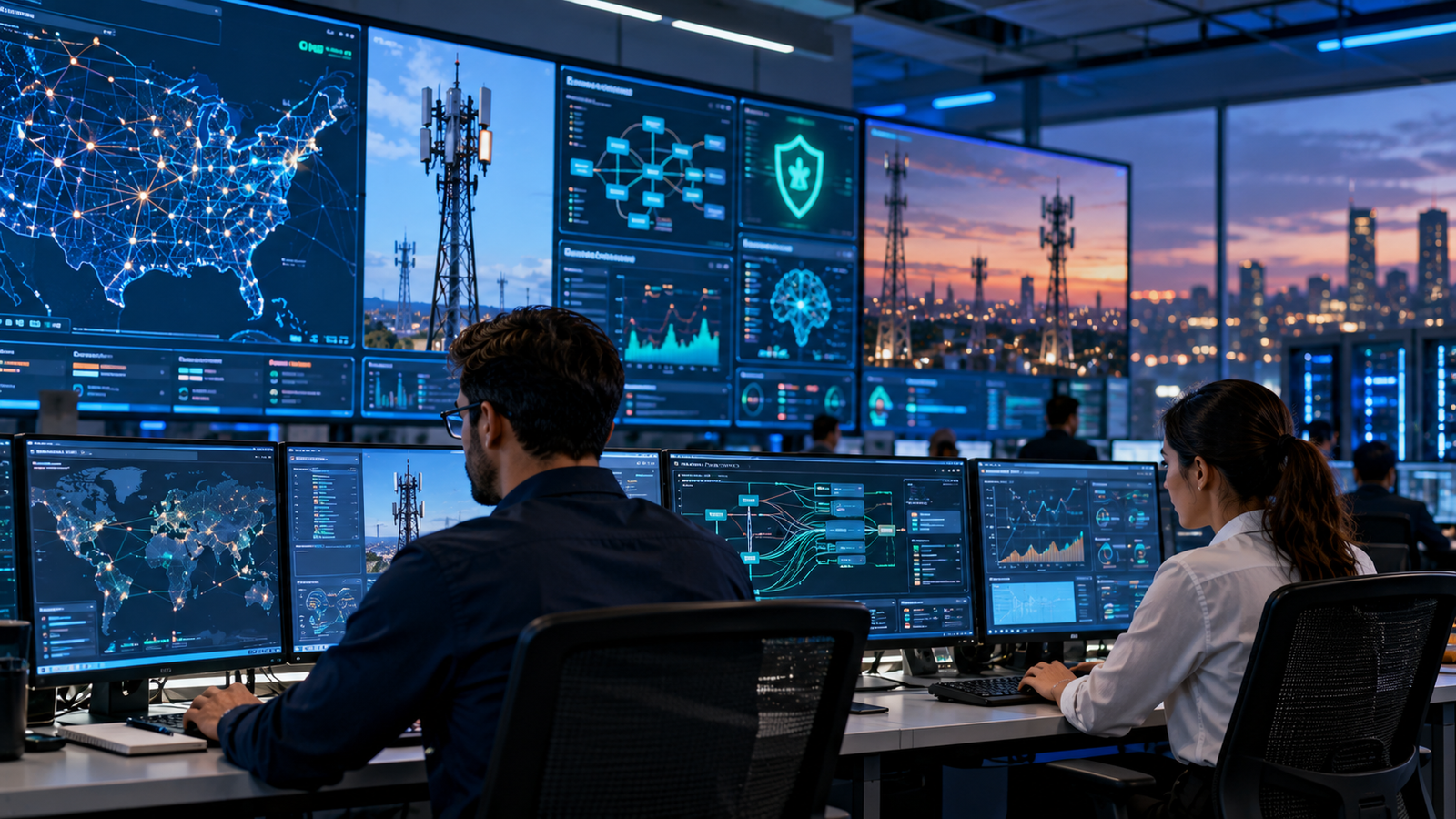
AT&T and T-Mobile are strengthening cybersecurity safeguards as artificial intelligence takes on more tasks in telecommunications networks, according to interviews with executives reported by Reuters on October 23, 2026. The companies are using AI to help analyse faults, adjust network equipment and respond more quickly to disruptions. Yet their executives cautioned that fully autonomous telecom networks remain years away, and human involvement is still important for complex problems.
The development is significant because telecom operators manage critical communications services as well as large volumes of customer information. Giving AI agents access to accounts, software tools and network controls can improve efficiency, but can also create new security risks if permissions, suppliers or automated actions are not adequately supervised. The news concerns evolving safeguards and operational use cases—not an announcement that the networks now run without people.
What Did AT&T and T-Mobile Tell Reuters?
Executives from the two US carriers said their companies are investing more in ways to monitor, contain and respond to threats arising from increased AI integration. T-Mobile chief technology officer John Saw told the Reuters Global Markets Forum that the company was increasing security-related investment and working with vendors to address vulnerabilities. AT&T chief technology officer Jeremy Legg discussed the risks associated with third-party software and AI agents that access sensitive systems.
Both described AI as useful for selected network-management tasks, but neither established a deadline for an entirely self-governing nationwide network. Their remarks explain a measured approach: automate repeatable decisions where appropriate, maintain safeguards around privileged access and retain people for exceptional incidents.
Why AI Creates New Cybersecurity Challenges for Telecoms
A telecommunications network contains operational equipment, customer records, network-management applications and connections to external suppliers. AI tools may need access to some of these systems to detect anomalies or recommend fixes. If an agent receives more authority than it needs, an error or compromise could affect a wider area than a faulty individual software task.
Threats can include unauthorised data access, manipulation of automated workflows and disruption through insecure third-party integrations. These are risks identified by industry executives, not evidence that a new breach has already happened at either company because of the systems discussed in October. Responsible reporting distinguishes possible vulnerabilities from confirmed security incidents.
How AT&T Uses AI to Manage Network Problems
Reuters reported that AT&T uses AI to examine network trouble tickets and, in some cases, help implement repairs. A trouble ticket records a fault, customer complaint or infrastructure issue that an operations team needs to resolve. Automation can group similar reports, highlight probable causes and speed routine response steps.
However, a software recommendation does not necessarily capture all conditions in the field. A failure involving physical infrastructure, a severe outage or inconsistent monitoring data may require technicians and supervisors to intervene. That is one reason AT&T’s interest in AI is paired with human review, identity controls and careful permissions.
T-Mobile’s AI-Managed Network Adjustments
T-Mobile has used automated systems to adjust antenna settings and compensate for certain cell-site problems, Reuters reported. Its September company announcement also discussed AutoPilot capabilities within a self-organising network and nationwide expansion of Dynamic CX, technology intended to adjust network conditions and improve customer experience.
T-Mobile’s October 20 update described live trials of AI-managed beamforming developed with Ericsson as part of its 5G Advanced strategy. These are real company-reported initiatives, but performance figures from internal testing should not be interpreted as guarantees for every subscriber or location. Network conditions vary with traffic, weather, terrain and infrastructure availability.
What Happened During Winter Storm Fern?
Reuters cited T-Mobile’s response to Winter Storm Fern in January 2026 as an example of automated network resilience. Company executives reported that coverage was restored to approximately 66% of affected customers within one hour and about 90% within eight hours. These figures describe the specific company-reported response to that event, not a universal service-restoration guarantee.
Storm recovery can involve backup power, alternative transport connections, radio adjustments and field repair work. AI-assisted antenna tuning is one part of a much broader response. Credible coverage should not conclude that AI alone restored every connection or that human engineers were unnecessary.
What Security Controls Is AT&T Using?
AT&T’s CTO described safeguards that include encryption, multi-factor authentication, human oversight and checks on AI agents seeking access to customer accounts. These are familiar cybersecurity principles adapted to an environment where automated software might request information or carry out actions on behalf of an employee or system.
Encryption helps protect information, authentication verifies access and human approval can prevent sensitive automated actions from proceeding without review. None of these controls is a complete guarantee against intrusion. Their effectiveness depends on implementation, maintenance, auditing and whether outside suppliers apply compatible standards.
Why AI Agents Need Strict Permissions
An AI agent can connect several tools and act on data, making it potentially more powerful than a model that only produces text. In a telecom environment, access might include troubleshooting systems, configuration settings and customer-support records. The safest design typically limits each agent to the minimum resources and operations needed for its task.
If an agent is compromised or misinterprets instructions, constrained permissions can reduce the damage it could cause. Human approvals, logs and mechanisms to reverse changes can provide additional protection. Operators must also consider whether external software or data might manipulate an agent into taking an unauthorised action.
Third-Party Vendors and Industry Standards
Telecom networks rely on a combination of in-house systems and technology supplied by vendors. Equipment makers, cloud providers, contractors and software partners may each affect the network’s security. Reuters reported that AT&T’s Jeremy Legg emphasised risks from third-party software and the need for industry-wide standards for AI-based systems.
Common standards can help operators define how AI agents prove their identities, receive permissions and record decisions. Yet an executive’s call for standards is not proof that a binding new worldwide telecom security standard has been adopted. Any future framework would require separate verification of its publication, scope and enforcement.
What Does a Fully Autonomous Network Mean?
A more autonomous network can monitor conditions, predict faults, adjust configuration and respond to routine problems with less manual intervention. The long-term vision is an infrastructure system that can optimise many functions in near real time. But autonomy exists along a spectrum, and specific automated functions should not be confused with complete independence from human judgement.
Both carriers continue to rely on people for complex failures and sensitive decisions. This matters to readers because headlines promising that AI has taken over 5G networks could create an inaccurate impression about technical readiness, regulatory responsibility and customer safety.
How AI Could Improve Network Reliability
AI-based network monitoring may identify patterns faster than manual inspection, helping teams direct attention to unusual traffic or failing equipment. Predictive analysis can flag signs of deterioration before customers encounter a full outage. Automated adjustments can also distribute available radio capacity to nearby sites when conditions change.
But reliability depends on quality data, sound engineering and adequate physical infrastructure. A well-trained model cannot restore electricity to a tower with no backup power, replace a damaged fibre cable or resolve every issue caused by a severe disaster. AI should therefore be understood as an operational tool rather than a substitute for network investment.
Customer Data Privacy Remains Central
Telecom companies handle personal and account information, which can be attractive to criminals. Increasing AI access raises questions about which records are used, how long information is retained and whether external services can see it. Security systems should be designed so that operational needs do not lead to indiscriminate exposure of customer data.
Reuters referred to T-Mobile’s history of major breaches in 2021 and 2023 as context for current attention to safeguards. Those prior incidents are not evidence that the October 2026 AI systems have been breached. A clear article separates historical security events from new measures intended to manage emerging risks.
How Will This Affect Mobile Subscribers?
Customers may eventually notice fewer interruptions, faster troubleshooting and more responsive service if automated processes perform as intended. Better traffic management might also improve connectivity in crowded areas or when nearby sites face problems. These are potential benefits associated with operational technology, not verified improvements for every AT&T or T-Mobile customer today.
Users should continue following standard account-security practices, including strong passwords and multi-factor authentication where available. They should also rely on official carrier notices for genuine service disruptions instead of assuming that every slow connection is an AI-related failure.
Does This Replace Earlier AT&T Earnings News?
No. AT&T’s October 21 earnings report concerned revenue, wireless customer additions, broadband connections and profit guidance. The October 23 Reuters story concerns cybersecurity controls, AI agents and network operations at two major carriers. They involve an overlapping company but different developments, sources and reader questions.
For Mukhbir’s editorial tracker, the stories should be categorised separately: one is a telecom business performance article, and the other is a technology-and-security report. Repeating the same background statistics in both articles is not necessary to explain their independent news value.
Competition, 5G Advanced and the Move Toward 6G
Telecom operators are gradually introducing smarter management across existing 5G infrastructure while researching capabilities that may become important in future network generations. T-Mobile’s October 20 publication linked AI-radio systems to 5G Advanced and a longer-term path toward 6G. This demonstrates active experimentation and selective deployment rather than a confirmed nationwide 6G launch.
Competition can encourage investment in better performance and resilience, but faster automation also expands the need for consistent cybersecurity practices. Any claim of a successful new generation of mobile service should identify the applicable standard, coverage, commercial availability and independent evidence.
Relevance for Pakistan and South Asia
The AT&T and T-Mobile developments primarily concern US networks and do not announce a Pakistani partnership, a new licence or a security upgrade at a local carrier. Nonetheless, the issues are internationally relevant because telecom operators everywhere face rising network complexity and pressure to protect customer information.
Pakistan and South Asian telecom companies may follow similar developments when assessing automated monitoring, vendor security and resilient network design. However, Mukhbir should not imply that a specific Pakistani provider has adopted an identical system without a separate verified announcement.
What Happens Next?
Key developments to watch include further operator disclosures about AI governance, documented network performance, incident response controls and any common technical standards for trusted AI agents. Public information from equipment vendors may show whether new safeguards are deployed or remain in pilot testing. Independent security assessments could also provide more evidence about the risks.
The October 23 story establishes that two large carriers are increasing attention to AI safety while using automation in selected operational tasks. It does not establish a completed autonomous network, a new data breach or a guaranteed timetable for replacing human operations teams.
Conclusion
AT&T and T-Mobile are expanding the use of artificial intelligence in telecom operations while investing in controls to protect sensitive information and infrastructure. Executives interviewed by Reuters on October 23 highlighted encryption, authentication, monitoring, vendor security and human oversight as important measures. Existing AI tools can help diagnose faults and adapt parts of a mobile network, but complex issues still require human involvement.
For the industry, the central question is not whether automation is useful but how to deploy it without introducing unacceptable risks. As operators explore 5G Advanced and longer-term autonomous capabilities, clear permissions, strong security practices and evidence-based performance claims will remain essential.
Frequently Asked Questions
Are AT&T and T-Mobile using AI in their networks?
Yes. Reuters reported that both use AI for selected operational tasks, including troubleshooting and automated radio-network adjustments.
Why are the companies increasing cybersecurity investment?
AI agents can access sensitive information and connected systems, creating additional risks if controls are inadequate.
Are AT&T and T-Mobile networks fully autonomous?
No. Executives said completely autonomous networks remain years away and human involvement is still essential.
What safeguards has AT&T described?
AT&T executives cited encryption, multi-factor authentication, human oversight and verification of AI agents requesting account access.
How does T-Mobile use AI during network disruptions?
It uses automation to help adjust cell-site settings and support network recovery in certain situations.
Does this news mean a new data breach occurred?
No. The October reporting discusses potential threats and safeguards; past breaches are historical context, not confirmation of a new incident.
Will AI automatically improve every customer’s signal?
No. Any improvement depends on coverage, local infrastructure, traffic, outages and successful implementation.
Does this announcement involve Pakistan telecom operators?
No specific Pakistan partnership or network deployment was established by the cited US reports.
About The Author