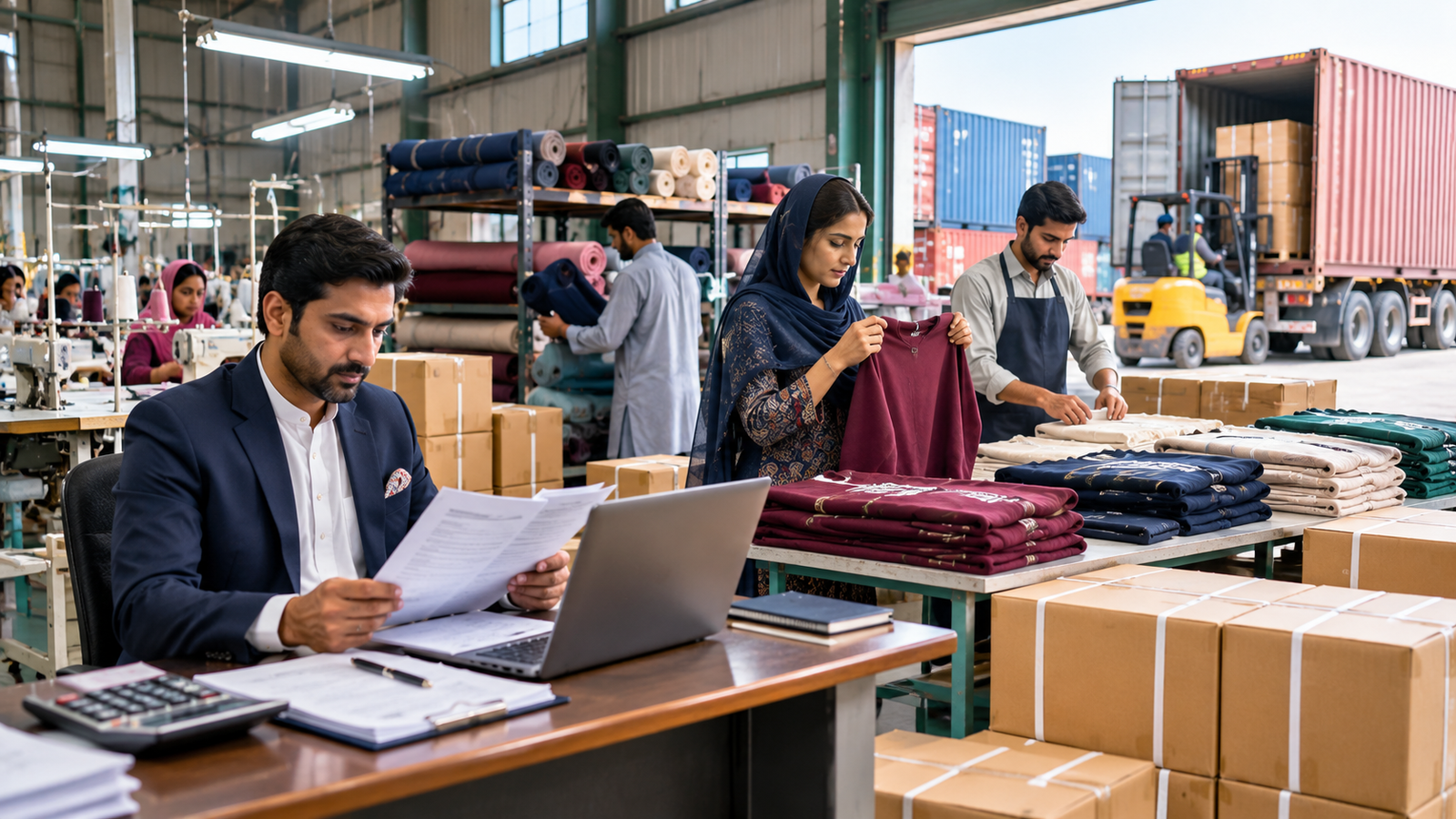
The Pakistan Rs300 Billion SME Export Finance Scheme 2026 has drawn fresh attention after the Pakistan Hosiery Manufacturers and Exporters Association (PHMA) welcomed the government’s decision to reserve Rs300 billion exclusively for eligible small and medium-sized enterprise (SME) exporters during fiscal year 2026–27. The dedicated allocation is being administered through the Pakistan Export-Import Bank (Pak EXIM) under the government’s Export Finance Scheme, with the stated objective of improving access to working capital and helping smaller businesses compete in international markets.
The announcement is significant for Pakistan’s business sector because small exporters often face difficulties obtaining affordable financing when they receive large international orders or need to purchase raw materials, pay workers and expand production. Limited access to working capital can prevent businesses from accepting new orders, maintaining delivery schedules or investing in the equipment and quality standards required by overseas buyers. A dedicated financing allocation could help address some of these challenges if eligible businesses can access the funds through participating banks in a timely and transparent manner.
Business Recorder reported on November 14 that PHMA Chairman Syed Zia Alamdar Hussain welcomed the allocation, describing affordable working capital as one of the major challenges faced by small and medium-sized exporters. He said the financing could help businesses expand production capacity, take on new export orders and improve their competitiveness. The association also called on participating banks to communicate eligibility requirements clearly and process applications without unnecessary delays.
The government had announced the Rs300 billion allocation earlier in November, saying the entire amount would be dedicated to eligible SME exporters through Pak EXIM. The move forms part of a wider effort to strengthen export-led growth, improve access to finance and broaden Pakistan’s export base. However, the allocation should not be confused with money already disbursed to businesses. Its real impact will depend on eligibility rules, bank processing, financing uptake and the ability of SMEs to convert funding into completed export orders.
Pakistan Rs300 Billion SME Export Finance Scheme 2026: What Has Been Announced?
The government has reserved Rs300 billion under the Export Finance Scheme for eligible small and medium-sized enterprise exporters for fiscal year 2026–27. The allocation is being administered through Pak EXIM, Pakistan’s export-import bank, and is intended to provide dedicated financing support to smaller businesses involved in exports.
According to Business Recorder’s November 8 report, Adviser to the Finance Minister Khurram Schehzad announced that the entire Rs300 billion allocation, equivalent to approximately $1.1 billion at the reported conversion, would be dedicated to eligible SME exporters. He said the amount had previously been shared with other categories of borrowers but was being ring-fenced for SMEs to improve their access to export financing.
The decision is intended to help smaller businesses obtain working capital at concessional financing terms, reduce the cost of fulfilling export orders and improve their ability to compete in international markets. Pak EXIM has also directed participating banks to ensure effective implementation and utilisation of the dedicated allocation, according to the announcement reported by Business Recorder.
The Pakistan Hosiery Manufacturers and Exporters Association welcomed the decision on November 14, highlighting the importance of affordable finance for manufacturers and exporters. Its chairman said smaller businesses need working capital to expand production, accept new orders and compete with suppliers in other countries.
The distinction between an announced allocation and actual lending is important. The Rs300 billion figure represents financing reserved under the scheme, not a confirmed amount already received by SMEs. The level of disbursement will depend on applications, eligibility checks, participating banks and the availability of qualifying export transactions.
Why Small Businesses Need Affordable Export Financing
Small and medium-sized enterprises are an important part of Pakistan’s industrial and commercial economy. They operate in sectors such as textiles, garments, leather, food processing, engineering, sports goods, surgical instruments and other export-oriented industries. Many smaller firms supply larger manufacturers, while others deal directly with international buyers.
One of the biggest challenges for these businesses is the time gap between receiving an export order and collecting payment. A manufacturer may need to purchase cotton, fabric, leather, packaging materials or other inputs before production can begin. It must also pay employees, cover electricity bills, arrange transport and meet quality requirements before the shipment is completed.
These costs arise before the exporter receives payment from an overseas customer. If a business does not have sufficient working capital, it may struggle to accept a large order even when international demand exists. It may also be forced to rely on expensive borrowing, delay production or decline opportunities.
Export finance can help bridge this gap by providing short-term funding linked to export transactions. Depending on the facility and applicable conditions, financing may support pre-shipment production costs or post-shipment requirements. This can help businesses manage cash flow while meeting contractual obligations.
The Rs300 billion SME allocation is designed to improve access to this type of financing. However, the extent of its benefit will depend on how easily smaller firms can understand the scheme, meet documentation requirements and receive decisions from participating banks.
How the Pak EXIM Export Finance Scheme Works
The Export Finance Scheme is intended to support exporters by providing financing for eligible export-related activities. Pak EXIM administers the dedicated allocation, while participating banks play a role in processing and providing financing to businesses that meet the scheme’s requirements.
The National Bank of Pakistan’s published information on SME Export Finance Schemes describes facilities for eligible direct and indirect exporters, particularly those involved in value-added goods and services. It explains that transaction-based financing can support exporters at the pre-shipment or post-shipment stage against qualifying export orders, contracts or letters of credit.
Direct exporters are businesses that sell goods or services to overseas buyers. Indirect exporters may supply inputs, materials or components to businesses that fulfil export orders. Supporting both types of businesses can strengthen the wider supply chain because smaller suppliers often contribute to the production of goods that are eventually shipped abroad.
The NBP information also describes a concessional markup arrangement linked to the State Bank of Pakistan’s policy rate, with the published terms stating a rate three percentage points below the policy rate for the relevant facility. It describes financing periods of up to 180 days, subject to the applicable conditions. Businesses should confirm current rates, documentation and eligibility with a participating bank before applying, as scheme terms and financing conditions can be updated.
The government has not, in the reports reviewed for this announcement, published a complete account of how much of the new Rs300 billion allocation has already been disbursed or how many businesses have received financing under the revised arrangement. Those figures will be important for assessing the scheme’s actual performance.
What Types of Businesses Could Benefit from the Rs300 Billion Allocation?
The scheme is aimed at eligible small and medium-sized exporters, with the intention of helping businesses that have export orders but face difficulties securing working capital. The strongest potential beneficiaries are firms that can demonstrate a genuine export-related financing requirement and meet the applicable SME and banking criteria.
Textile and garment manufacturers are one important group because they often need to purchase raw materials, maintain production lines and meet shipment deadlines. The Pakistan Hosiery Manufacturers and Exporters Association’s positive response highlights the relevance of the allocation for businesses involved in hosiery and related textile exports.
Other export-oriented manufacturers may also benefit if their products and transactions fall within the scheme’s eligible categories. These could include businesses involved in engineering goods, leather products, sports goods, surgical instruments, processed foods and other value-added products. The exact eligibility of each business depends on the rules and documentation applicable to the facility.
Indirect exporters may also be relevant to the wider financing system. A smaller supplier that provides components, materials or services to a direct exporter can be an important part of the export supply chain. If eligible, such businesses may use export-linked financing to manage production and delivery requirements.
However, the allocation does not mean that every small business automatically qualifies for funding. Applicants will need to meet the applicable SME definitions, provide the required financial and export documentation, and satisfy the conditions set by the scheme and participating banks.
PHMA Welcomes the Financing Decision and Calls for Faster Bank Processing
The Pakistan Hosiery Manufacturers and Exporters Association welcomed the Rs300 billion allocation in a statement reported by Business Recorder on November 14. PHMA Chairman Syed Zia Alamdar Hussain said affordable working capital had long been one of the biggest challenges facing small and medium-sized exporters.
He said the dedicated allocation could help businesses expand production capacity, accept new export orders and compete more effectively in international markets. The association also described SMEs as an important part of Pakistan’s industrial and export ecosystem because they contribute to employment, entrepreneurship and industrial diversification.
PHMA emphasised that the availability of a financing allocation alone would not be enough. It called on participating banks to process applications in a transparent, timely and hassle-free manner so that genuine SME exporters could benefit from the facility without unnecessary delays.
The association also said banks should clearly communicate eligibility requirements and help deserving businesses understand how to access the scheme. This is important because smaller firms may not have dedicated finance departments or specialised staff to navigate complex documentation and banking procedures.
The response highlights a central implementation challenge: financing programmes must be accessible in practice, not simply announced. If application procedures are unclear or processing takes too long, businesses may be unable to use the funds when they need them most.
How the SME Export Finance Scheme Could Support Pakistan’s Exports
Pakistan’s export performance depends on a combination of production capacity, product quality, pricing, logistics, international market access and the ability of businesses to fulfil orders reliably. Access to finance is an important part of this equation because manufacturers need capital before they receive export payments.
If SMEs can obtain affordable working capital, they may be better positioned to purchase raw materials, maintain production schedules and accept larger orders. Businesses could also use improved cash flow to invest in machinery, packaging, quality assurance and other requirements that help them meet international standards.
A stronger SME export base could support diversification by allowing more firms to participate in international trade. Instead of relying heavily on a limited number of large exporters or traditional product categories, Pakistan could gradually expand the number of businesses selling value-added products to overseas markets.
The impact will not be automatic. Financing can help a business produce more, but it cannot by itself guarantee overseas demand, competitive prices or access to foreign markets. Exporters also need reliable electricity, efficient ports, predictable taxation, testing facilities, timely refunds and effective trade documentation.
The government has identified export-led growth as a wider economic priority. The Rs300 billion allocation is one part of that effort, and its success will depend on whether financing is combined with improvements in the business environment.
Government Measures to Improve SME Financing and Export Access
The Rs300 billion export finance allocation is part of a broader series of government measures aimed at improving access to finance for smaller businesses. On November 5, Radio Pakistan reported that Prime Minister Shehbaz Sharif had directed authorities to remove the requirement for SMEs to export at least 80 per cent of their products to qualify for long-term financing.
The same report said the government had been informed that around 17,000 SMEs in Pakistan were associated with exports. It also reported that more than 10,000 applications had been received following the launch of a State Bank of Pakistan portal on November 1 to facilitate access to SME loans.
The meeting also discussed issues raised by SME representatives, including taxes, refunds, provincial levies, accreditation, logistics, payments and financing. The prime minister called for improvements in accreditation standards, expansion of laboratory facilities and simpler regulatory procedures to help exporters.
These measures address challenges that go beyond access to working capital. Exporters need internationally recognised testing and certification facilities, efficient transport systems and predictable rules if they are to compete with suppliers from other countries.
The government’s wider financing plans also include support through long-term financing facilities. Radio Pakistan reported that Rs350 billion had been earmarked for the Long-Term Financing Facility during the year. This is a separate financing allocation and should not be confused with the Rs300 billion reserved under the Export Finance Scheme for eligible SME exporters.
What Challenges Could Limit the Impact of the Rs300 Billion Scheme?
The first challenge is accessibility. Smaller firms may struggle to understand eligibility rules, prepare financial statements or provide the documents required by banks. Clear guidance and practical support will be necessary to ensure that the allocation reaches businesses that genuinely need export financing.
The second challenge is the speed of processing. Export orders often have fixed delivery schedules, and delays in obtaining finance can prevent manufacturers from purchasing raw materials or starting production on time. A scheme designed to support exporters must therefore provide decisions within commercially useful timeframes.
The third challenge is the cost of doing business. Affordable finance can reduce one financial pressure, but exporters also face electricity costs, transport expenses, taxation, customs procedures and international competition. If these costs remain high, access to credit alone may not be enough to make Pakistani products more competitive.
Another issue is the effective use of the allocation. A financing programme must reach businesses with viable export opportunities rather than simply record a large amount of reserved funding. Transparent reporting on approvals, disbursements, sectors covered and repayment performance would help assess whether the scheme is achieving its objectives.
Finally, exporters need access to markets. Even a well-financed manufacturer may struggle if it cannot meet international quality requirements, obtain certifications or secure reliable overseas buyers. The financing programme will be more effective when supported by trade facilitation, market development and industrial infrastructure.
What SMEs Should Check Before Applying for Export Finance
Businesses interested in the scheme should first confirm whether they meet the applicable SME and exporter criteria. They should contact a participating bank or relevant Pak EXIM channel to obtain the latest eligibility requirements, financing terms and application procedures.
Exporters should also prepare the documents that banks may require, such as business registration details, financial records, tax information, export orders, contracts, letters of credit or evidence of their role in an export supply chain. The precise documentation will depend on the type of financing and the bank’s requirements.
Businesses should distinguish between transaction-based working capital and long-term financing for machinery or expansion. These facilities serve different purposes and may have different tenures, pricing structures and documentation requirements. An exporter seeking funds to complete a specific shipment should confirm which facility is appropriate for that need.
Applicants should also ask about the current markup rate, financing period, collateral requirements, processing time and any fees. Published bank information can provide an initial guide, but the latest terms should be confirmed directly before making a financial commitment.
Most importantly, businesses should not assume that the Rs300 billion allocation guarantees approval. Funding remains subject to eligibility, documentation, bank assessment and the scheme’s applicable conditions.
Conclusion: Rs300 Billion Export Finance Could Give Pakistan’s SMEs a Wider Opportunity
The Pakistan Rs300 Billion SME Export Finance Scheme 2026 represents an important financing initiative aimed at improving access to working capital for eligible small and medium-sized exporters. The government has reserved the allocation under the Pak EXIM-administered Export Finance Scheme for FY2026–27, while PHMA has welcomed the decision and urged banks to make the facility accessible through transparent and timely processing.
For smaller exporters, affordable financing can help bridge the gap between receiving an international order and collecting payment. It can support raw-material purchases, production costs and shipment preparation, allowing businesses to compete for opportunities that might otherwise be beyond their financial capacity.
However, the allocation should be judged by actual results rather than its announced size alone. The number of businesses financed, the amount disbursed, the speed of application processing and the value of export orders supported will be important measures of success.
Pakistan’s SME exporters also need improvements in energy costs, logistics, taxation, testing facilities and access to international markets. Financing can strengthen their capacity, but sustainable export growth requires a wider business environment that supports productivity and competitiveness.
If the scheme is implemented effectively and reaches genuine exporters, it could help more Pakistani businesses participate in international trade, expand production and contribute to the country’s export earnings.
What is Pakistan’s Rs300 billion SME Export Finance Scheme 2026?
It is a dedicated financing allocation under the Export Finance Scheme for eligible small and medium-sized enterprise exporters in Pakistan during fiscal year 2026–27. Pak EXIM administers the facility.
Who announced the Rs300 billion SME export finance allocation?
The allocation was announced by Finance Minister’s Adviser Khurram Schehzad in November 2026, according to Business Recorder’s report.
Which businesses can benefit from the Rs300 billion export finance scheme?
Eligible small and medium-sized exporters may apply, subject to the scheme’s SME criteria, qualifying export activity, documentation and participating bank assessment.
How can SME exporters use the financing?
Export finance can help eligible businesses meet working-capital requirements, purchase raw materials, manage production costs and fulfil qualifying export orders.
Which bank administers Pakistan’s SME export finance scheme?
The dedicated allocation is administered through the Pakistan Export-Import Bank, commonly known as Pak EXIM, with participating banks involved in financing.
Has the entire Rs300 billion already been given to businesses?
No. The Rs300 billion is a reserved financing allocation. It should not be confused with funds already disbursed to SME exporters.
Why did the Pakistan Hosiery Manufacturers and Exporters Association welcome the scheme?
PHMA welcomed the allocation because affordable working capital can help smaller exporters expand production, accept new international orders and improve competitiveness.
What should businesses check before applying for SME export finance?
Businesses should confirm current eligibility criteria, export documentation, markup rates, financing periods, collateral requirements and application procedures with Pak EXIM or a participating bank.
About The Author