Mars has long been known as a world shaped by enormous volcanic eruptions in its distant past. Its surface preserves vast lava plains and some of the largest volcanoes in the Solar System. But whether the Red Planet still has enough internal heat to support volcanic activity has remained an important scientific question.
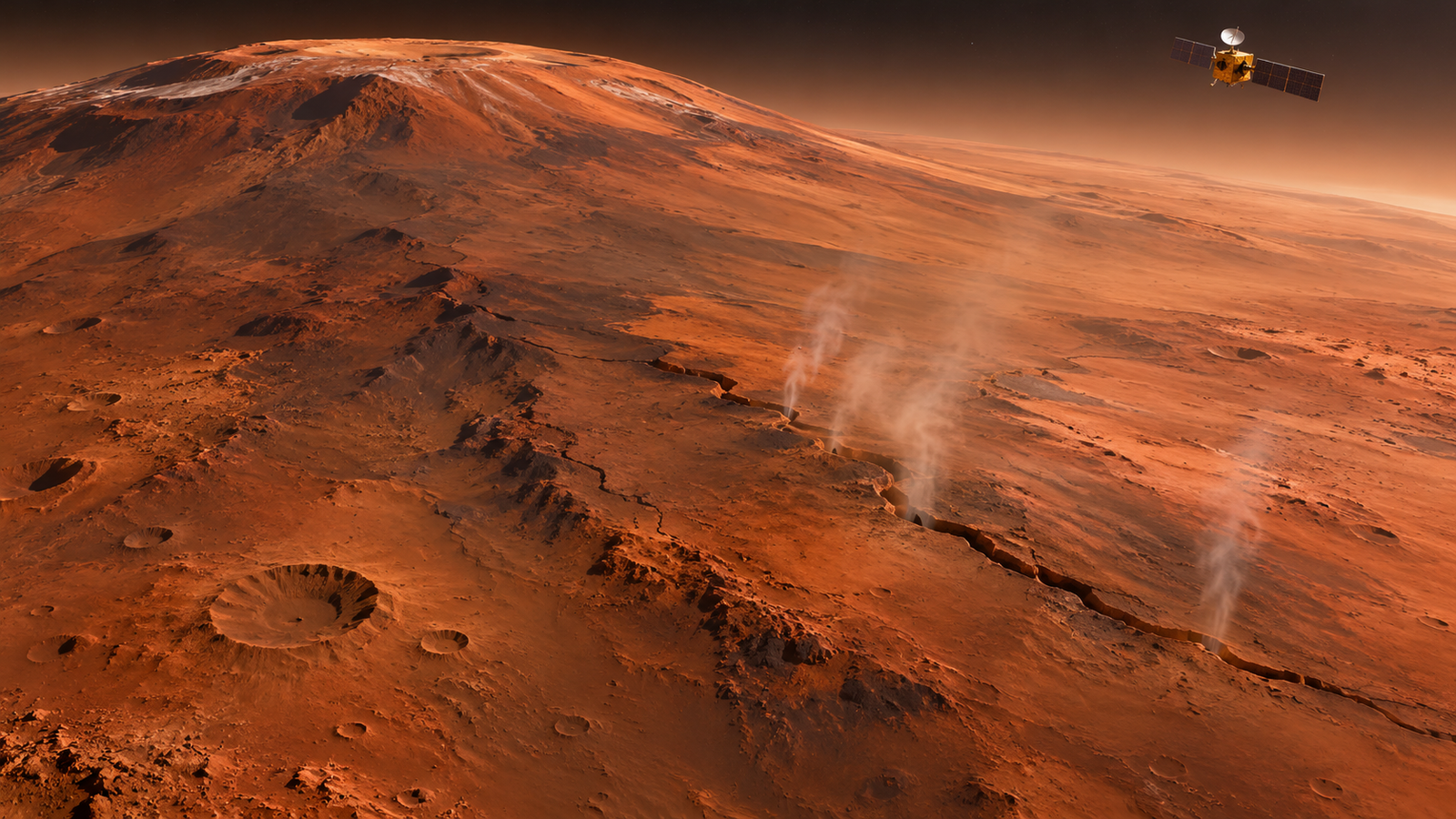
A new study published in the journal Science Advances on November 4, 2026, has added fresh evidence to that debate. Researchers analysing observations from the European-Russian ExoMars Trace Gas Orbiter (TGO) detected hydrogen chloride gas in the lower atmosphere above fissures near Alba Mons, a vast shield volcano in the northern hemisphere of Mars.
The gas appeared in a particular region and during a seasonal period when scientists did not expect to find it. The research team says the most likely explanation is that hydrogen chloride is seeping from the planet’s interior through fractures connected to underground magmatic material.
The finding does not mean that a Martian volcano has been seen erupting. No new lava flow or active eruption has been observed. Instead, the discovery offers a possible sign that geological processes linked to magma may still be occurring below the surface.
The research is important for another reason: underground heat can interact with water and rock, potentially creating environments more suitable for microbial life than the cold, radiation-exposed Martian surface. Scientists say such locations could become valuable targets in the continuing search for life beyond Earth.
Key Facts: What Scientists Have Discovered
The study was published in Science Advances on November 4, 2026.
Researchers analysed data from the ExoMars Trace Gas Orbiter, a spacecraft that studies the Martian atmosphere.
The instrument detected hydrogen chloride (HCl) in the lower atmosphere near the Alba Mons volcanic region.
The unusual detections were localised around fissures and appeared during the cold-season period in observations from two Martian years.
The research team believes volcanic seepage from underground magmatic material is the most plausible explanation.
The findings suggest Mars may have retained enough internal heat to support volcanic processes until relatively recently, and possibly still does.
Scientists have not confirmed a current eruption, flowing lava or the existence of life on Mars.
The distinction between a possible volcanic signal and a confirmed eruption is central to understanding the study. The evidence is atmospheric and geological: gas was detected above a particular region, and orbital images show narrow surface fractures that could provide pathways from below.
Why Hydrogen Chloride Matters
Hydrogen chloride is a chemical compound made of hydrogen and chlorine. When it enters water, it forms hydrochloric acid. On Earth, hydrogen chloride can be released by volcanic systems and magmatic vents, making it useful to researchers studying the movement of gases from a planet’s interior.
The presence of this gas on Mars is not entirely new. The ExoMars Trace Gas Orbiter detected hydrogen chloride in the Martian atmosphere in earlier observations, with the first reported discovery dating back to 2021. Those earlier observations raised questions about where the gas came from and which chemical and atmospheric processes could explain its presence.
The new research focuses on a different pattern. Scientists identified detections during the colder aphelion season, concentrated around the Alba Mons region. This localised pattern was difficult to explain using the atmospheric processes that account for much of the planet’s seasonal hydrogen chloride variation.
The researchers examined the atmospheric conditions and the geological setting to assess possible sources. Their analysis points towards a non-atmospheric source, potentially below the surface. In this interpretation, chlorine-bearing compounds dissolved in magma could release hydrogen chloride as magma rises and pressure decreases.
This does not make hydrogen chloride a definitive proof of active magma. It is a clue that becomes more persuasive when considered alongside the location of the detections and the nearby fractures. The study presents volcanic seepage as the explanation that best fits the available observations, while leaving room for further investigation.
Alba Mons: The Volcanic Region Under Investigation
Alba Mons is a broad shield volcano located in the northern hemisphere of Mars, within the Tharsis region. Unlike a steep-sided cone, a shield volcano has wide, gently sloping sides built through repeated volcanic activity over geological time.
Mars contains several enormous volcanic structures. Olympus Mons is the tallest known volcano in the Solar System, while Alba Mons is notable for its great surface area and broad profile. These features show that Mars was once volcanically active on a scale far beyond most volcanic systems on Earth.
The new study focuses on fissures on and around the northern flanks of Alba Mons. Researchers used images from the Trace Gas Orbiter’s Colour and Stereo Surface Imaging System, known as CaSSIS, to examine the landscape. The images showed narrow, relatively fresh-looking fractures, in some cases extending for hundreds of metres in the regional imagery.
The team considered whether these fractures could be connected to deeper structures. On Earth, volcanic gases can escape through cracks and vents even when there is no large eruption at the surface. A similar process may be possible on Mars, where gas could move through fractures from underground magmatic material.
The proposed link remains an interpretation rather than a directly observed underground pathway. Orbital instruments can map surface features and detect atmospheric chemicals, but they cannot simply look through the Martian crust and photograph a magma chamber. Future measurements will be needed to test the explanation.
How the ExoMars Trace Gas Orbiter Detected the Signal
The ExoMars Trace Gas Orbiter is designed to study the composition and behaviour of gases in the Martian atmosphere. Its Atmospheric Chemistry Suite includes instruments that analyse sunlight as it passes through the atmosphere during orbital observations.
This technique allows scientists to identify chemical fingerprints. Different gases absorb light at particular wavelengths, and instruments can use those patterns to estimate which substances are present and how their concentrations change with altitude.
In the new study, researchers examined hydrogen chloride observations and found a set of detections concentrated near Alba Mons during the cold-season period. The gas was present at low atmospheric levels, and the pattern differed from the more widespread seasonal detections associated with atmospheric and dust-related processes.
The team then compared the atmospheric findings with geological images of the same general region. The combination of localised gas detections and nearby fissures strengthened the case for a source below the surface.
This is an example of how planetary science increasingly relies on several kinds of evidence working together. A chemical measurement can identify a gas, while imaging can show the landscape through which that gas might escape. Neither observation alone necessarily answers the full question, but together they can help researchers develop and test a scientific explanation.
Could Mars Still Have Underground Magma?
The study raises the possibility that Mars is not completely geologically inactive. The planet is often described as dormant because its most dramatic volcanic features were formed long ago and no present-day eruption has been directly observed.
However, dormant does not necessarily mean that every underground process has stopped. A planet can retain heat within its interior for a very long time. Depending on the temperature, composition and structure of the crust, that heat may allow magma-related processes or gas movement to continue in limited areas.
The researchers suggest that the hydrogen chloride may be associated with a dormant magma chamber or a system of magmatic material beneath the Alba Mons region. As gases rise through fractures, they could become trapped by ice or frozen material near the surface during colder conditions.
When temperatures rise during the relevant Martian season, the ice may sublimate, allowing gas to escape into the atmosphere. This seasonal mechanism could help explain why the signal appears at a particular time rather than continuously.
The proposal is scientifically significant, but it should not be presented as confirmation that a large molten reservoir has been directly detected. The spacecraft has measured atmospheric gas and mapped surface features. The underground source is an interpretation based on those observations.
What the Discovery Could Mean for the Search for Life
The possibility of underground volcanic activity is relevant to astrobiology, the study of life in the universe. On Earth, some microorganisms survive in environments far from sunlight, including deep underground and around hydrothermal systems where water interacts with heated rock.
If magma or hot rock exists beneath parts of Mars, it could potentially warm underground water or melt ice. In suitable conditions, the interaction between heat, water and minerals may create chemical energy sources that microorganisms could use.
Such environments would also offer more protection than the exposed Martian surface. Mars has a thin atmosphere and lacks the global magnetic field that protects Earth from much of the solar wind. The surface is exposed to radiation, extreme temperature changes and other conditions that make it difficult for life as we know it to survive.
A subsurface environment could be comparatively shielded. That does not mean the Alba Mons region contains living organisms. The new study has not detected cells, biological molecules or any direct evidence of life.
Instead, it identifies a geological setting that may deserve further attention. If future missions can establish that heat, liquid water and suitable chemical conditions coexist below the surface, researchers may have a stronger reason to investigate the area for possible microbial habitats.
Why the Findings Need Further Confirmation
Scientific discoveries are strengthened when different instruments, methods and missions independently test the same explanation. The Alba Mons interpretation is promising, but several questions remain open.
First, researchers need to understand the source of the hydrogen chloride more precisely. The observed pattern is consistent with volcanic seepage, but further atmospheric measurements could help distinguish between possible geological and chemical processes.
Second, the fissures need to be studied in greater detail. High-resolution imaging, repeated observations and geological mapping could help determine their age, structure and relationship to the locations where gas was detected.
Third, scientists would benefit from measurements of temperature, mineral composition and other gases. A broader chemical signature could help establish whether the gas is connected to magmatic activity or another process.
Finally, a lander or rover operating near the region could provide measurements from the surface. Such a mission would be technically challenging because of the terrain, distance and need to identify a safe landing site, but surface measurements could add information that orbiting instruments cannot provide.
Until further evidence is available, the most accurate description is that researchers have found a possible signature of ongoing or relatively recent igneous processes on Mars, not proof of an active eruption or life.
What This Means for Future Mars Missions
The discovery could influence how scientists prioritise future observations of Mars. Missions often have to choose between many scientifically interesting locations, and evidence of possible subsurface heat can make a region more attractive for further study.
Orbiters can continue monitoring atmospheric gases and looking for seasonal changes. Repeated observations could show whether the hydrogen chloride signal returns, changes in strength or appears in additional locations. Improved maps of fractures could also help scientists identify where gas may be escaping.
Landers and rovers could investigate the mineral composition of the surface, search for signs of past water activity and measure environmental conditions. A future mission designed to study subsurface environments could provide even more direct evidence, although drilling beneath the surface presents engineering and operational challenges.
The findings also demonstrate the long-term value of orbital missions. The Trace Gas Orbiter can revisit large areas and collect atmospheric information over time, allowing scientists to detect patterns that a short surface mission might miss.
As Mars exploration continues, the most promising targets may not always be the largest volcanoes or most dramatic landscapes. Small fractures, unusual chemical signals and protected underground environments could hold important clues about the planet’s internal history and habitability.
Conclusion: Mars May Be Dormant, but Its Interior Could Still Be Active
The detection of hydrogen chloride near Alba Mons has given planetary scientists a new reason to examine whether Mars still hosts volcanic processes beneath its surface. Published in Science Advances on November 4, 2026, the study combines atmospheric observations from the ExoMars Trace Gas Orbiter with orbital images of fissures in the region.
The research team argues that volcanic seepage from underground magmatic material is the most likely explanation for the unusual gas detections. If that interpretation is correct, Mars may have retained enough internal heat to support geological activity long after its most visible volcanic era.
The discovery is also relevant to the search for life because underground heat could interact with water and minerals, potentially creating protected environments where microbial life might be possible. However, no life has been detected, and no active eruption has been confirmed.
For now, the findings are an important scientific clue rather than a final answer. Continued observations and future missions will be needed to establish how the gas is produced, whether magma remains active and whether the underground environment could support habitable conditions.
Mars may look quiet from orbit, but the latest research suggests that its interior could still have secrets waiting to be uncovered.
Frequently Asked Questions
What did scientists discover on Mars in November 2026?
Researchers detected hydrogen chloride gas near fissures around the Alba Mons volcanic region, a possible sign of volcanic seepage.
Where is Alba Mons located?
Alba Mons is a broad shield volcano in the northern hemisphere of Mars, within the Tharsis region.
What is hydrogen chloride?
Hydrogen chloride is a compound of hydrogen and chlorine that can be released by volcanic systems and other chemical processes.
Which spacecraft detected the gas?
The ExoMars Trace Gas Orbiter detected the hydrogen chloride using its atmospheric instruments.
Does the discovery prove that Mars is currently erupting?
No. It suggests possible volcanic processes beneath the surface, but no active eruption or new lava flow has been observed.
Could volcanic activity make Mars suitable for life?
Underground heat could interact with water and minerals to create potentially habitable environments, but no life has been found.
Was the research published in a scientific journal?
Yes. The study was published in the peer-reviewed journal Science Advances on November 4, 2026.
What will scientists investigate next?
Researchers will seek repeat gas detections, better maps of fissures and additional evidence about underground heat, water and chemistry.
About The Author