NASA Swift Satellite Re-entry 2026 became a major space science story as NASA’s Neil Gehrels Swift Observatory was expected to re-enter Earth’s atmosphere on November 4, after nearly 22 years studying some of the most powerful explosions in the universe. The roughly 3,200-pound (1,450-kilogram) spacecraft had ended science operations in October following a rapid decline in orbital altitude. NASA’s November 2 update cited a US Space Force estimate of approximately 3:30 a.m. Eastern Standard Time on November 4, with an uncertainty window of 11 hours. That forecast was not a confirmed re-entry timestamp. NASA expected most of the satellite to burn up, although some components could survive, with a stated likelihood of harm to any person on Earth of approximately one in 2,100. Swift was launched in 2004 for a two-year prime mission but remained scientifically productive for more than two decades, tracking gamma-ray bursts, supernovae, black holes and other changing celestial objects. A last-ditch rescue effort to lift it into a higher orbit did not succeed. As of the official updates reviewed for this November 4 article, a final, verified re-entry location and confirmation of completion had not been established. The distinction between predicted and confirmed events is essential to responsible coverage.
NASA Swift Satellite Re-entry 2026: Key Facts
Official name: Neil Gehrels Swift Observatory.
Agency: NASA, with international scientific partnerships.
Launch year: 2004.
Original prime mission: Two years.
Scientific lifetime: Nearly 22 years.
Expected re-entry date in NASA’s November 2 bulletin: Wednesday, November 4, 2026.
US Space Force central estimate as of November 2: Around 3:30 a.m. EST, plus or minus an 11-hour uncertainty.
Spacecraft mass: Approximately 3,200 pounds (about 1,450 kilograms).
Final science observation: October 20, 2026, according to NASA.
Approximate altitude when operations ended: 171 miles (275 kilometers).
Primary research target: Gamma-ray bursts and other transient cosmic events.
Main instrument types: Gamma-ray, X-ray and ultraviolet/optical telescopes.
Rescue effort: Katalyst Space LINK servicing/boost mission; boost not completed.
Likely outcome: Most spacecraft material burns up in atmospheric re-entry.
Possible surviving debris: NASA said some components may survive.
NASA’s quoted risk of harm to anyone on Earth: Approximately 1 in 2,100.
Possible latitude band of surviving debris: Between 20.6° north and 20.6° south, based on orbital inclination.
Verified precise impact point or full re-entry completion: Not established in the official updates reviewed for this report.
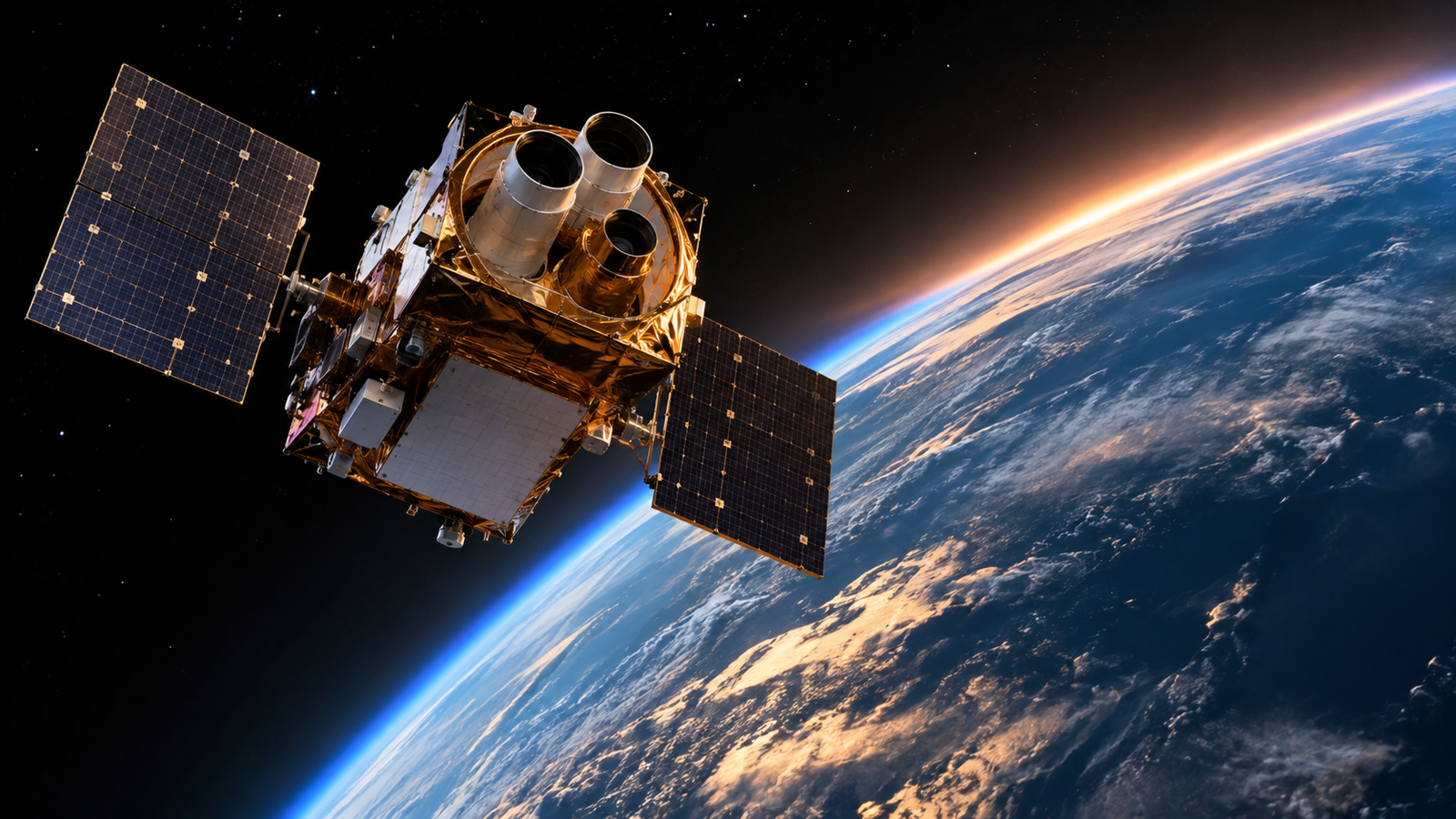
Featured image: AI illustration, not live imagery.
What Is NASA’s Neil Gehrels Swift Observatory?
The spacecraft at the center of NASA Swift Satellite Re-entry 2026 is a space-based astrophysics observatory built to detect and study brief, energetic changes in the universe. Its most famous targets are gamma-ray bursts, powerful flashes associated with extreme cosmic events. Unlike an ordinary imaging satellite, Swift was designed to respond quickly when a burst appeared and to examine the same event at different wavelengths. Its array of three instruments allowed astronomers to connect an initial high-energy signal with X-ray and ultraviolet or optical observations. NASA operated the mission with scientific partners and researchers across the world. Swift’s value came not only from individual discoveries but also from its rapid alerts to ground and space telescopes, which enabled coordinated follow-up observations of events that might otherwise fade before scientists could examine them.
Why Is the NASA Swift Satellite Returning to Earth?
Swift was operating in low Earth orbit, where the atmosphere is extremely thin but not entirely absent. Over time, this residual gas produces drag, slowly reducing a satellite’s orbital energy. NASA said heightened solar activity increased atmospheric drag on Swift and accelerated its descent. The spacecraft had no propulsion system capable of independently raising its orbit. Its orbit therefore became progressively lower, eventually making stable science observations impractical. A lower altitude does not automatically establish the minute or location of re-entry because atmospheric density and the satellite’s orientation can change. NASA and tracking organizations continued to update the forecast as more observations became available.
When Is NASA Swift Expected to Re-enter Earth’s Atmosphere?
The NASA Swift Satellite Re-entry 2026 forecast, published by NASA on November 2, cited a U.S. Space Force central estimate near 3:30 a.m. EST on November 4, with an uncertainty of 11 hours. The central estimate corresponds to 8:30 a.m. UTC and 1:30 p.m. Pakistan Standard Time, but it is not a guaranteed event time. Forecasts from different tracking models can differ, especially when a satellite is descending rapidly. A published prediction describes a time range calculated from available orbital measurements, not a confirmed observation that the spacecraft has already burned up. Mukhbir will treat an official post-event confirmation as a separate development requiring a dated update.
Has NASA Confirmed That Swift Already Crashed?
The NASA releases reviewed for this article describe an expected November 4 atmospheric re-entry, the spacecraft’s completed science operations and monitoring by the Space Force. They do not provide a verified exact impact location or a post-re-entry completion notice. It would therefore be inaccurate to say that the satellite has definitely hit a particular country, city or ocean area merely because a predicted time has passed. Satellite tracking estimates may change before the event, and a confirmation can come after analysis of the last observed orbit. Readers should consult NASA’s official Swift mission updates rather than interpreting social-media images of meteors as evidence of this particular spacecraft.
Where Could Swift Debris Fall?
For the NASA Swift Satellite Re-entry 2026 event, NASA explained that the satellite’s low orbital inclination limits any surviving debris to a belt between approximately 20.6 degrees north and 20.6 degrees south latitude. The precise longitude and location of descent depend on when the spacecraft finally enters denser layers of the atmosphere. Because much of Earth’s surface is ocean, a forecast of a broad latitude band does not imply that a populated area will be struck. It also does not establish that every place inside the belt is equally likely to receive debris. An authenticated location would require tracking evidence and a post-event assessment, neither of which was available in the NASA updates used here.
Is Pakistan in the Predicted Re-entry Zone?
Most of Pakistan lies north of the latitude band NASA identified for potential surviving fragments. Its southernmost territory, near the Arabian Sea, lies around the northern edge of that belt, so geography must be described carefully rather than asserting an unqualified national risk. The latitude band covers a broad range of places and oceans; it is not a forecast that debris will strike any Pakistani location. NASA assessed the global chance of harm to anyone as low. Mukhbir has found no official announcement identifying Pakistan as a debris landing site. Claims that Swift will fall on a specific Pakistani city require verified evidence, not a screenshot of a speculative tracking map.
How Dangerous Is the Falling Space Telescope?
NASA expected most of Swift’s approximately 3,200 pounds of material to burn up during atmospheric re-entry, while acknowledging that some parts could survive. Its published probability of harm to any person on Earth was about one in 2,100. That statistic is an overall risk estimate; it is not the chance that a particular individual will be hit. Although debris events require monitoring, a wide ocean-covered planet and the breakup of spacecraft in the atmosphere generally reduce public exposure. The estimate should not be rewritten as a claim that injury has occurred, nor should the public be falsely reassured that every component is certain to vaporize.
What Does a One-in-2,100 Risk Mean?
NASA’s one-in-2,100 number describes an estimated chance of harm to someone on Earth from surviving re-entry fragments. It is a technical risk assessment, not a prediction of casualty numbers or a probability for each country. Such estimates incorporate assumptions about the spacecraft, fragment survival and exposed population across a potential path. Different forecasting methods can refine the estimate, especially as the object’s orbit becomes better known. Clear journalism should reproduce the agency’s description and avoid comparing it with unrelated everyday risks without equivalent methods. The main practical message is that the agency regarded human harm as unlikely, while continuing to monitor the event.
Why Might Some Satellite Parts Survive Re-entry?
During re-entry, a satellite encounters increasingly dense air at very high speed, generating intense heating and forces that can break it apart. Lightweight structures and many components may burn up, but some relatively dense or heat-resistant pieces can remain intact for longer. Exactly which pieces survive depends on materials, size, structure and the trajectory through the atmosphere. NASA did not publish a verified debris inventory showing where particular Swift components had landed in the official updates reviewed here. Descriptions of surviving fragments should therefore remain conditional. Photographs of unrelated space debris cannot establish their origin without analysis by the relevant authorities.
Why Did NASA End Swift Operations in October 2026?
NASA reported that Swift reached an orbital altitude of about 171 miles, or 275 kilometers, on October 20. At that height, drag made it difficult for the satellite to maintain stable pointing for its instruments. The spacecraft entered safe mode, and the operations team at Pennsylvania State University sent commands effectively ending the mission to prepare for the unavoidable descent. Swift’s final scientific observation occurred on October 20. Ending operations was a deliberate response to the spacecraft’s deteriorating orbit, not evidence that all of its scientific data had been lost. Researchers can continue using its long-term archive after the spacecraft’s physical mission ends.
How Did Solar Activity Accelerate Swift’s Decline?
Solar activity can heat and expand Earth’s upper atmosphere. When more atmospheric particles are present at a satellite’s altitude, the drag force can increase, gradually robbing it of orbital energy. NASA specifically cited recent solar activity as an important reason Swift began descending faster. This relationship is familiar to satellite operators, but predicting the resulting orbit decay remains challenging because solar conditions and spacecraft orientation vary. A low satellite with no means of orbit raising has limited options once drag becomes too strong. The Swift case illustrates a practical link between space weather and the usable lifetime of scientific spacecraft.
Why Was the Swift Boost Rescue Mission Attempted?
Scientists hoped to extend the productive life of an observatory that was still capable of valuable work. NASA supported a commercial servicing effort intended to reach Swift, capture it and move it to a higher orbit where atmospheric drag would be weaker. The effort was ambitious because it involved interacting with a satellite that had not originally been designed for this kind of servicing. If successful, the maneuver might have preserved further years of observations. It was also relevant to wider efforts to develop orbital servicing technologies for satellites that need inspection, refueling, repair or repositioning. The rescue plan was distinct from Swift’s core astronomy mission.
Why Did the Katalyst LINK Rescue Fail?
NASA’s August updates said the commercial LINK spacecraft encountered an attitude-control problem, preventing the planned capture and boost of Swift. Reuters later described LINK as spinning uncontrollably, and managers abandoned the orbit-raising attempt. The failure does not mean Swift’s telescopes had stopped collecting science throughout the whole year; NASA subsequently restarted observations for a period before the shrinking orbit forced shutdown. It would be misleading to claim that NASA successfully docked with Swift or raised it to a safe orbit. The failed effort remains significant as an example of the technical difficulty of servicing an aging spacecraft in a narrow time window.
What Did Swift Discover During Its 22 Years in Space?
Swift spent decades examining gamma-ray bursts and many other transient or variable astronomical sources. Its rapid-reaction design helped astronomers observe afterglows that fade quickly and coordinate observations from other telescopes. NASA reported that its science extended to supernova explosions, active galaxies powered by supermassive black holes, X-ray flares from stars, comets and asteroids. Media reports have cited more than 2,000 gamma-ray bursts observed during its lifetime. The mission produced a large archive that remains useful to scientists studying high-energy processes and changing cosmic objects. Its longevity far exceeded the two-year prime mission envisioned at launch.
What Are Gamma-ray Bursts and Why Do They Matter?
Gamma-ray bursts are brief flashes of extremely energetic radiation associated with some of the universe’s most violent phenomena. Depending on their origin, they can be linked to the collapse of massive stars or the merger of compact stellar remnants. Understanding these events helps researchers investigate black holes, neutron stars, extreme magnetic fields and conditions far beyond what laboratories can reproduce. Swift’s instruments were configured to detect a burst and quickly turn toward its location, making it possible to study the fading glow at other wavelengths. This rapid response provided information that a single high-energy detector alone might not capture.
How Did Swift’s Three Telescopes Work Together?
Swift carried instruments sensitive to different parts of the electromagnetic spectrum, including gamma rays, X-rays and ultraviolet or visible light. One instrument could identify an initial high-energy event and help point the spacecraft toward it. Follow-up instruments then collected additional observations as the event evolved. Studying the same object across multiple wavelengths gives astronomers a more complete picture of its physical behavior. The mission’s ability to change targets quickly was particularly important because many explosive events fade within minutes or hours. Swift also alerted outside observatories, making it a coordinating platform rather than an isolated telescope.
Did Swift Study Black Holes and Supernovae Too?
Yes. Although gamma-ray bursts were the original focus, NASA described Swift’s contributions to studies of active galaxies powered by supermassive black holes, stellar disruptions, supernovae and other high-energy sources. It also observed objects much closer to home, including comets and asteroids in the solar system. The observatory’s broad scientific reach developed from its instruments’ ability to revisit changing targets and observe them at different wavelengths. A mission originally planned for two years consequently delivered much more extensive data than was expected at launch. Those scientific records remain valuable even if the satellite itself cannot be recovered.
Why Was Swift’s Long Lifetime Scientifically Important?
Swift operated for more than ten times its planned two-year prime mission, allowing researchers to observe rare phenomena across many years. Long-term monitoring can reveal patterns that would not be apparent in a short observation campaign. A lengthy mission also improves the chances of detecting uncommon events and making rapid alerts available to the astronomy community. Swift’s data support published research and continued archival study. Its physical re-entry marks the end of one spacecraft’s operations, not the destruction of all discoveries it enabled. The mission offers a striking example of how successful scientific hardware can outlive original engineering expectations.
Could the Re-entry Be Seen as a Fireball?
A large object breaking apart in the atmosphere may produce a bright streak visible from the ground under the right conditions. Whether Swift’s descent would be visible to an observer depends on the exact re-entry track, the time of day, cloud cover, lighting and local geography. NASA’s broad prediction does not allow Mukhbir to promise a visible fireball from Pakistan or any other particular country. A video of a bright object in the sky should not automatically be labeled Swift without matching verified timing and location information. Public-interest space coverage can explain the physics without treating speculative social posts as authentic recordings.
Can People Track the Satellite in Real Time?
Satellite trackers may display modeled orbital positions and predicted decay windows derived from public observations. These can be useful for understanding the event, but their estimates can change rapidly and may disagree with one another. A map displaying an orbital line is not proof of the final debris footprint. NASA directed readers to its Swift mission blog for updated information and said it would monitor the event with the U.S. Space Force. For publication, a newsroom should cite the date and source of each estimate, distinguish model output from confirmation and avoid inventing exact coordinates that official agencies have not supplied.
What Should Someone Do if They Find Suspected Space Debris?
If an unusual piece of suspected spacecraft material is found, it should not be handled casually, moved or treated as a souvenir. The safe response is to keep people at a distance and contact relevant local authorities, who can determine whether specialist assessment is needed. Appearance alone cannot identify a fragment as part of Swift, and unrelated industrial debris can be mistaken for spacecraft hardware. Mukhbir does not claim any Swift debris has been found in Pakistan or elsewhere without an authenticated report. General safety advice should not be confused with an announcement that a specific danger is present at a particular location.
What Does the Failed Rescue Mean for Satellite Servicing?
The attempted LINK operation highlighted the promise and challenge of commercial spacecraft servicing. Robotic vehicles may one day extend satellite lifetimes by adjusting orbits, inspecting hardware or providing other services, potentially reducing replacement costs and some forms of orbital debris. But successful rendezvous and capture require precise navigation, attitude control and compatibility with the target spacecraft. The Swift attempt did not accomplish its planned orbit boost, and it cannot be presented as evidence of a completed rescue. The lessons may nevertheless inform the design of future servicing vehicles and mission strategies, subject to subsequent technical review.
Could Future Missions Replace Swift’s Scientific Role?
Swift combined rapid alerts and observations across several wavelengths in a way that was especially useful for transient astronomy. Other observatories continue studying gamma-ray bursts and related phenomena, but a replacement with precisely the same capabilities, response speed and operating schedule cannot be assumed. The scientific community may adapt by coordinating different space and ground instruments or developing new missions. NASA’s archive of Swift observations remains available for ongoing analysis. Any announcement of a formally approved successor mission would require a separate official source and should not be inferred merely from the end of Swift’s mission.
Is This Re-entry Connected to a Wider Space Debris Problem?
As the number of spacecraft in orbit grows, satellite end-of-life planning and debris management attract increasing attention. Atmospheric re-entry can remove objects from orbit, but uncontrolled descents create uncertainty about when and where any surviving fragments will arrive. Swift is an aging science spacecraft that was launched long before some current servicing concepts matured. Its case demonstrates why orbital design, propulsion, monitoring and disposal decisions matter. It does not establish that every satellite will cause comparable risk or that every object falling through the atmosphere is dangerous. The specifics of mass, composition and orbit are essential to assessing an individual event.
What Is the Global Importance of Swift’s Final Descent?
The story brings together two major science themes: the legacy of an influential astronomy mission and the operational limits of satellites in low Earth orbit. Globally, Swift’s re-entry concerns astronomers who relied on its rapid alerts, engineers studying spacecraft lifetime and developers of orbital servicing systems. The failed boost attempt adds a commercial-space technology dimension. Public attention is also driven by curiosity about what survives a fiery descent. Responsible reporting should make the uncertainty and low estimated risk clear, while giving substantial attention to the discoveries that made the observatory important in the first place.
Does the Swift Re-entry Have Any Business or Technology Impact?
Swift’s end provides a real-world example of the economic and engineering trade-offs of keeping spacecraft operational beyond their original design lifetime. Launching replacements can be expensive, while developing reliable servicing technology may create future commercial opportunities. The LINK effort was closely followed as a potential demonstration of orbital capture and repositioning capabilities. However, this event alone does not prove that a particular servicing company will succeed or fail commercially in the long term. Its direct near-term business effects cannot be quantified from NASA’s re-entry bulletin. The strongest supported technological angle concerns spacecraft longevity, attitude control and the difficulty of boosting a satellite with a shrinking orbit.
What Happens Next and How Will NASA Confirm Re-entry?
NASA and the U.S. Space Force said they would continue tracking Swift and updating predicted re-entry windows. A reliable final report may establish the last observation of the spacecraft, a refined time estimate and any confirmed debris information. If such a notice appears, Mukhbir should update the headline and article with an exact publication time and clear attribution. Until then, the central factual distinction remains that Swift had already ended science operations while atmospheric re-entry was expected, not confirmed in the sources reviewed. The mission’s extensive astronomy archive will remain part of its scientific legacy regardless of where its physical components ultimately come down.
Conclusion
NASA’s Swift Observatory approached the end of a remarkable mission after nearly 22 years in space, far beyond the two years originally planned. By November 4, 2026, its instruments had been shut down, its orbit had decayed and NASA had issued a prediction for atmospheric re-entry with substantial timing uncertainty. Most of the spacecraft was expected to burn up, although some debris could survive, with a low but nonzero estimated chance of harm to anyone. A rescue attempt failed before it could raise Swift’s orbit. The telescope’s scientific record—especially its rapid observations of gamma-ray bursts and other changing cosmic events—will remain valuable after the hardware is gone. A confirmed re-entry time, debris location or impact report must be established from subsequent official evidence rather than guessed from forecasts.
Frequently Asked Questions
What is NASA Swift satellite re-entry 2026?
It is the expected return of NASA’s Neil Gehrels Swift Observatory to Earth’s atmosphere after almost 22 years in orbit.
What date was Swift expected to re-enter?
NASA’s November 2 forecast expected re-entry on November 4, 2026, with a substantial uncertainty window.
Has NASA confirmed the exact crash location?
The official material reviewed for this report did not establish a confirmed exact location or final completed re-entry.
Is the falling satellite dangerous?
NASA said most material should burn up and estimated the chance of harm to any person on Earth at around one in 2,100.
Can Swift debris fall in Pakistan?
NASA’s projected latitude belt extended between 20.6 degrees north and south. No specific Pakistani impact site was confirmed.
Why did the Swift rescue attempt fail?
The Katalyst LINK servicing vehicle developed attitude-control problems and could not carry out the planned orbit boost.
What did Swift discover?
The mission observed gamma-ray bursts, supernovae, black-hole-related activity, stellar flares and objects in the solar system.
How long was Swift supposed to operate?
Its original prime science mission was two years, but the observatory remained scientifically productive for more than two decades.
About The Author