The ESA Hera asteroid mission has achieved an important milestone in planetary defence by distinguishing its two target asteroids, Didymos and Dimorphos, in images captured by its own onboard camera for the first time. The European Space Agency announced the achievement on October 27, 2026, after the spacecraft used its monochromatic Asteroid Framing Camera to observe the pair on October 18 from about 1,280 kilometres away. The smaller Dimorphos is barely one pixel across in the initial image, but scientists can now identify it separately from the larger Didymos. This step prepares Hera for a detailed investigation of the asteroid that NASA’s DART probe deliberately struck in 2022.
ESA Hera Asteroid Mission: Key Facts
Agency: European Space Agency (ESA).
Mission: Hera, planetary defence investigation.
News announced: October 27, 2026.
Observation date reported by ESA: October 18, 2026.
Spacecraft distance from the asteroid pair during imaging: about 1,280 km.
Earth-to-system distance reported by ESA: approximately 197 million km.
Larger asteroid: Didymos, about 780 metres across.
Smaller asteroid: Dimorphos, about 151 metres across.
Average separation of the pair: approximately 1.15 km.
Dimorphos orbital speed around Didymos: about 18 cm per second.
NASA DART impact date: September 26, 2022.
Reported change to Dimorphos orbital period following DART: approximately 33 minutes.
Next planned detailed image milestone: November 25, 2026.
Future investigation: close-range observations and two CubeSats, Milani and Juventas.
What Has ESA’s Hera Spacecraft Discovered?
The latest achievement is an observation rather than the discovery of two previously unknown asteroids. Scientists already knew that Didymos is orbited by Dimorphos and had studied their orbit with telescopes. What is new is the spacecraft’s own ability to resolve both targets as two separate points of light. Earlier in October, Hera had spotted its destination from farther away, but the system still looked like a single distant dot. By October 18, its Asteroid Framing Camera was close enough to distinguish the moonlet. That is an important sign that the probe is approaching its intended destination and that its navigation and imaging systems can support the next phase of the mission.
Why the First Separate Image Matters
At a distance of 1,280 kilometres, the smaller asteroid occupies only about one pixel in Hera’s first separated view. The initial picture is not a close-up geological map and cannot yet reveal small boulders, a definitive impact crater or details of the surface. Instead, it establishes that the spacecraft can now observe both parts of a binary asteroid system independently. That capability helps the mission team refine future imaging, navigation and scientific investigations. Images from much closer range should provide higher resolution and allow scientists to compare post-impact structures with expectations developed before the mission arrived.
How Hera Reached the Didymos System
Hera launched on October 7, 2024, and spent roughly two years travelling through space. Its route included major trajectory adjustments and a Mars flyby in March 2025, when it also observed the Martian moon Deimos. Earlier in October 2026, the team carried out braking operations so the spacecraft could reduce its relative speed near the target asteroids. ESA says a pair of thruster firings about a week apart slowed the probe to around 20 metres per second relative to the system. That controlled approach matters because the weak gravity of small asteroids makes navigation very different from orbiting Earth or Mars. The goal is careful observation rather than a high-speed collision.
What Are Didymos and Dimorphos?
Didymos and Dimorphos are a binary asteroid system: a larger body and a smaller companion orbiting it. Didymos measures roughly 780 metres in diameter, while Dimorphos is approximately 151 metres across. According to ESA, the two bodies have an average separation of about 1.15 kilometres, with Dimorphos moving around its parent at roughly 18 centimetres per second. Those distances are very small by astronomical standards, yet the asteroid pair is millions of kilometres from Earth. Small size and weak gravity make the system an especially useful laboratory for understanding how rocky objects respond to impacts and other forces.
Why NASA Struck Dimorphos in 2022
NASA’s Double Asteroid Redirection Test, or DART, was a controlled experiment intended to test whether a spacecraft could change the motion of an asteroid by striking it. On September 26, 2022, the DART probe impacted Dimorphos at approximately 6.1 kilometres per second. The collision produced a large debris plume and measurably changed the smaller asteroid’s orbit around Didymos. ESA reports that the orbital period shortened by about 33 minutes. The demonstration was significant because it showed a kinetic impactor could influence an asteroid’s motion. It did not mean that an asteroid was about to hit Earth or that scientists had solved every possible impact scenario.
What Questions Are Still Unanswered After DART?
Ground-based observations confirmed that Dimorphos changed its orbital period, but they did not settle what happened to the body itself. Did DART leave a recognizable crater, cause a major reshaping, rearrange boulders or dislodge substantial material? What is Dimorphos made of inside, and how does that structure affect the transfer of momentum during a collision? Scientists also want more precise measurements of mass, shape and density. These factors are central to turning a successful test into reliable calculations for future missions. Hera’s primary role is to investigate the aftermath in detail, not to repeat the DART impact.
Why the 33-Minute Orbit Change Is Important
The DART impact changed Dimorphos’s orbital period around its parent by approximately 33 minutes, much more than the initial minimum goal of the experiment. Measuring the change tells scientists that momentum was transferred, but the magnitude depends on factors including asteroid composition and debris ejected after the strike. Material flying away can contribute additional momentum, somewhat like recoil. Without knowing the target’s properties in detail, a successful result at one asteroid cannot be generalized automatically to every other body. Hera’s measurements should improve models that estimate how a kinetic impactor might redirect different objects under different circumstances.
How Hera Will Study the Impact Site
As the spacecraft draws nearer, mission scientists plan to use cameras and other instruments to examine the shape and physical properties of both asteroids. Close-range views should help distinguish whether the impact produced an obvious crater or instead altered Dimorphos on a broader scale. The mission will also gather measurements needed to determine the moonlet’s mass and surface characteristics. Because debris, irregular surfaces and weak gravity complicate operations, these investigations must be performed cautiously. ESA’s October announcement identified November 25 as the date for revealing the first detailed pictures of Dimorphos. The future images are scheduled, not already delivered.
The Role of Milani and Juventas CubeSats
Hera carries two small spacecraft named Milani and Juventas, designed to carry out specialized investigations closer to the asteroid pair. Milani is intended to collect information about surface materials, while Juventas will explore internal structure with radar-related measurements and other instrumentation. ESA’s mission plans also envisage later close approaches and potentially landing operations for the CubeSats. These are future mission stages, not achievements confirmed by the October 27 image announcement. Their measurements should complement Hera’s observations by providing additional perspectives on the asteroid system, which is difficult to study comprehensively from Earth.
What the Asteroid Framing Camera Actually Recorded
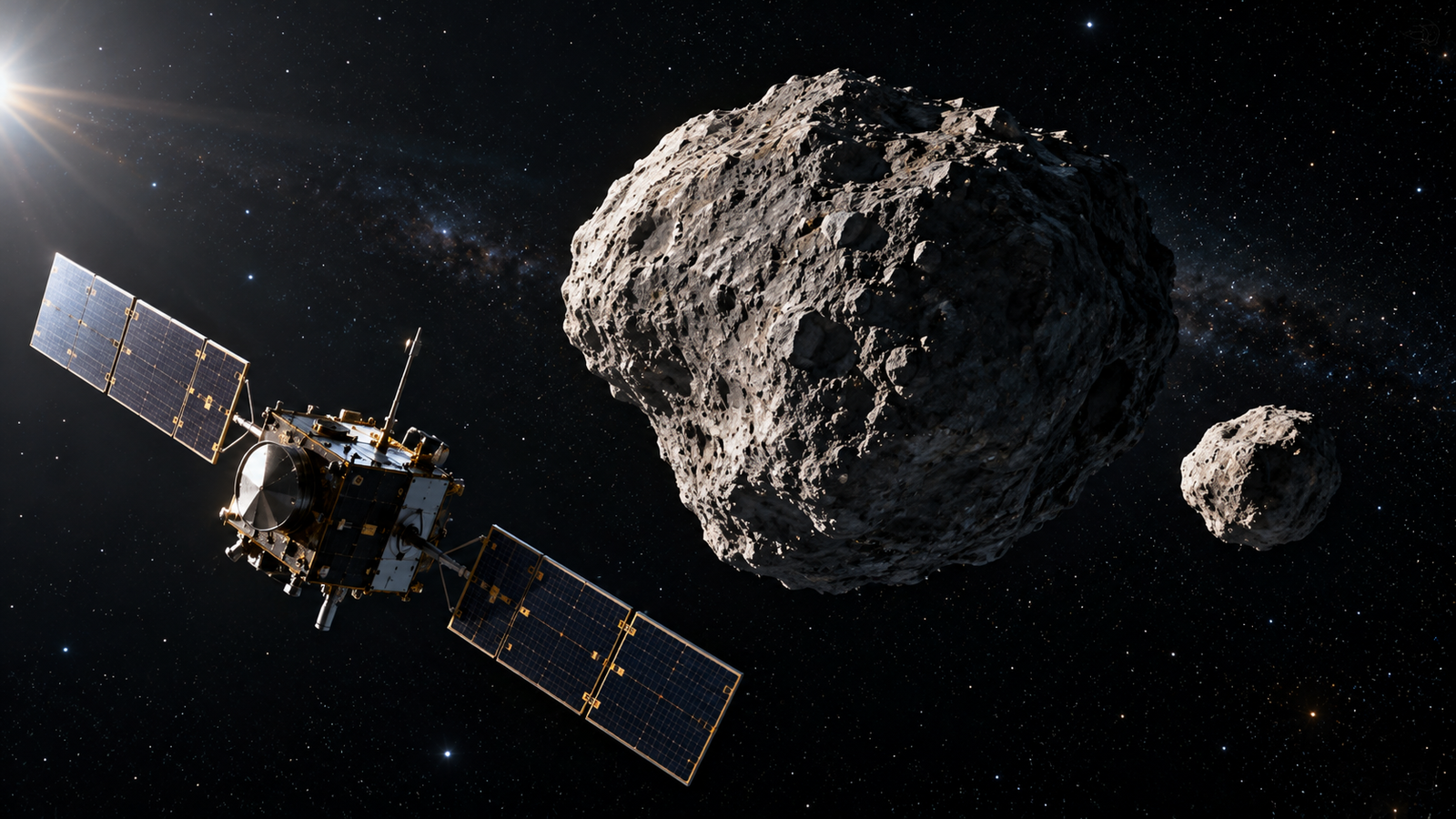
Hera’s Asteroid Framing Camera, often abbreviated AFC, recorded the binary system in monochrome. That means the newly published scientific view is not a colourful, detailed depiction of asteroid surfaces. At the observation distance, Dimorphos was just around a pixel wide and seen separately from the brighter Didymos target. This matters for visual reporting: artistic impressions showing large, illuminated rocks are useful for explaining the mission but should not be labelled as genuine photographs from the new observation. Mukhbir’s featured image is therefore disclosed as conceptual. Readers looking for authentic mission imagery should use ESA’s original release and accompanying image credits.
Can the Hera Mission Help Protect Earth?
Hera contributes to planetary defence by helping researchers understand how an asteroid responds when a spacecraft strikes it. If an asteroid were discovered on a possible collision course with Earth far enough in advance, changing its trajectory slightly might make the difference between an impact and a safe passage. The required deflection would depend on the size, orbit, composition and warning time for that specific object. A single technique cannot be assumed to work in every scenario. Hera’s detailed study of a real impact is valuable because better physical measurements can reduce uncertainty in future planning. It is a research and preparedness mission, not a response to an imminent threat.
Why Early Warning Remains Essential
An impactor changes an object’s motion; it does not magically remove an asteroid from space. A small change in velocity can produce a much larger difference in position if applied years before a predicted close encounter. That makes surveys, orbit calculations and continuous observation essential parts of planetary defence. A late discovery leaves far fewer options and may require strategies different from a single DART-like probe. Hera contributes one piece of this larger system by studying the results of a known collision. Detecting and tracking potentially hazardous near-Earth objects is still necessary for any effective risk-reduction strategy.
The Technology Challenges of Exploring Small Asteroids
Navigation near Didymos is challenging because gravity is extremely weak and uneven compared with familiar planetary environments. The spacecraft must account for the motion of both bodies, sunlight, communications delays and the need to avoid unnecessary risk. ESA describes increasing onboard autonomy as Hera approaches its targets. Unlike the earlier Rosetta comet mission, which relied heavily on ground calculations, Hera is designed to perform more navigation decisions with spacecraft systems. Onboard autonomy can improve operations where communication with Earth takes many minutes, but controllers still monitor mission plans and evaluate scientific priorities.
Why ESA and NASA Are Working on Complementary Missions
DART and Hera form two parts of the same scientific investigation. NASA conducted the initial kinetic-impact demonstration in 2022; ESA is following up with measurements that cannot be obtained adequately from a distant vantage point alone. DART established a change in the orbit. Hera aims to explain the physical processes behind that change. International cooperation helps spread engineering expertise, observational capability and the cost of conducting complex deep-space investigations. The results may also inform future spacecraft guidance, robotics and small-body science, although the principal objective remains understanding asteroid deflection.
What Does the Discovery Mean for Astronomy?
For astronomers, the first separated view confirms that Hera has moved from distant target detection toward direct observation of a binary asteroid system. The next images should allow much more detailed characterization of the moonlet and surrounding environment. Scientists can compare the observed shapes and physical features with models developed from telescopes and the 2022 impact. The mission also provides a rare opportunity to study a small object that has experienced a known artificial impact. However, the image itself does not establish the internal structure or a complete surface map; those scientific questions require additional measurements.
Why This Story Matters to Global and South Asian Readers
Planetary defence is a global scientific concern because an asteroid impact would not respect national borders. Hera’s results can improve shared knowledge used by space agencies, observatories and researchers worldwide. In South Asia, universities, students and astronomy communities can follow the ESA mission to learn about robotics, physics, celestial mechanics and spacecraft navigation. There is no evidence in the cited ESA announcement of a new Pakistan-specific contract or a direct impact risk to the country. The local relevance is therefore educational and scientific rather than a domestic policy or investment event. Readers should avoid sensational headlines implying danger to Pakistan.
What Happens Next in November and December 2026?
ESA expects Hera to move into increasingly detailed observation phases as it approaches the pair. The agency plans to present the first detailed images of Dimorphos on November 25. Mission operations guidance describes an initial characterization phase in November and December at approximate distances of 25–30 kilometres, with further close examination at about 10 kilometres later in December. A subsequent phase would involve the two CubeSats. Planned distances and timelines can evolve as navigation and safety assessments continue. As of October 28, the official news is the first separate observation, not the completion of all later survey stages.
What Scientists Will Look for in the New Images
Researchers will examine the moonlet’s outline, surface texture, possible impact changes and the distribution of visible material. They will combine camera images with other sensor data rather than drawing final conclusions from photographs alone. Measurements of mass and internal characteristics will be important in calculating how the DART collision transferred momentum. Hera may also help establish the conditions under which simulations predicted too little or too much deflection. These questions matter scientifically even if the exact appearance of the impact site differs from expectations. The process is intended to replace assumptions with evidence from the actual asteroid.
Conclusion
The ESA Hera asteroid mission has reached a verified milestone by imaging Didymos and Dimorphos separately for the first time with its own spacecraft camera. The October 18 observation, announced on October 27, comes after successful braking operations and marks progress toward detailed analysis of NASA’s historic DART impact. The new image is an early navigation and scientific achievement, not a finished investigation of the asteroid’s structure. Later close-up observations and the Milani and Juventas CubeSats should help researchers understand how kinetic impacts alter asteroid motion and how that knowledge could support future planetary defence.
Frequently Asked Questions
What is the ESA Hera asteroid mission?
Hera is a European Space Agency planetary-defence mission investigating the Didymos and Dimorphos asteroid system after NASA’s 2022 DART impact.
What did Hera discover in October 2026?
Its onboard camera resolved Didymos and Dimorphos as two separate targets for the first time. Scientists already knew the binary system existed.
When was Hera’s new asteroid image captured?
ESA reports the observation on October 18, 2026, and announced the result on October 27.
How far was Hera from the asteroids during the observation?
The spacecraft photographed the pair from approximately 1,280 kilometres away.
How big are Didymos and Dimorphos?
Didymos is around 780 metres across and Dimorphos approximately 151 metres across, according to ESA.
What did NASA’s DART spacecraft do?
DART deliberately hit Dimorphos in September 2022 and changed its orbital period around Didymos by roughly 33 minutes.
When will ESA show more detailed images of Dimorphos?
ESA has scheduled the first detailed images for November 25, 2026, subject to mission operations.
Is the Didymos asteroid system currently threatening Earth?
The official Hera announcement does not describe an imminent impact threat. The mission investigates a planetary-defence method rather than responding to an incoming asteroid.
About The Author