Introduction
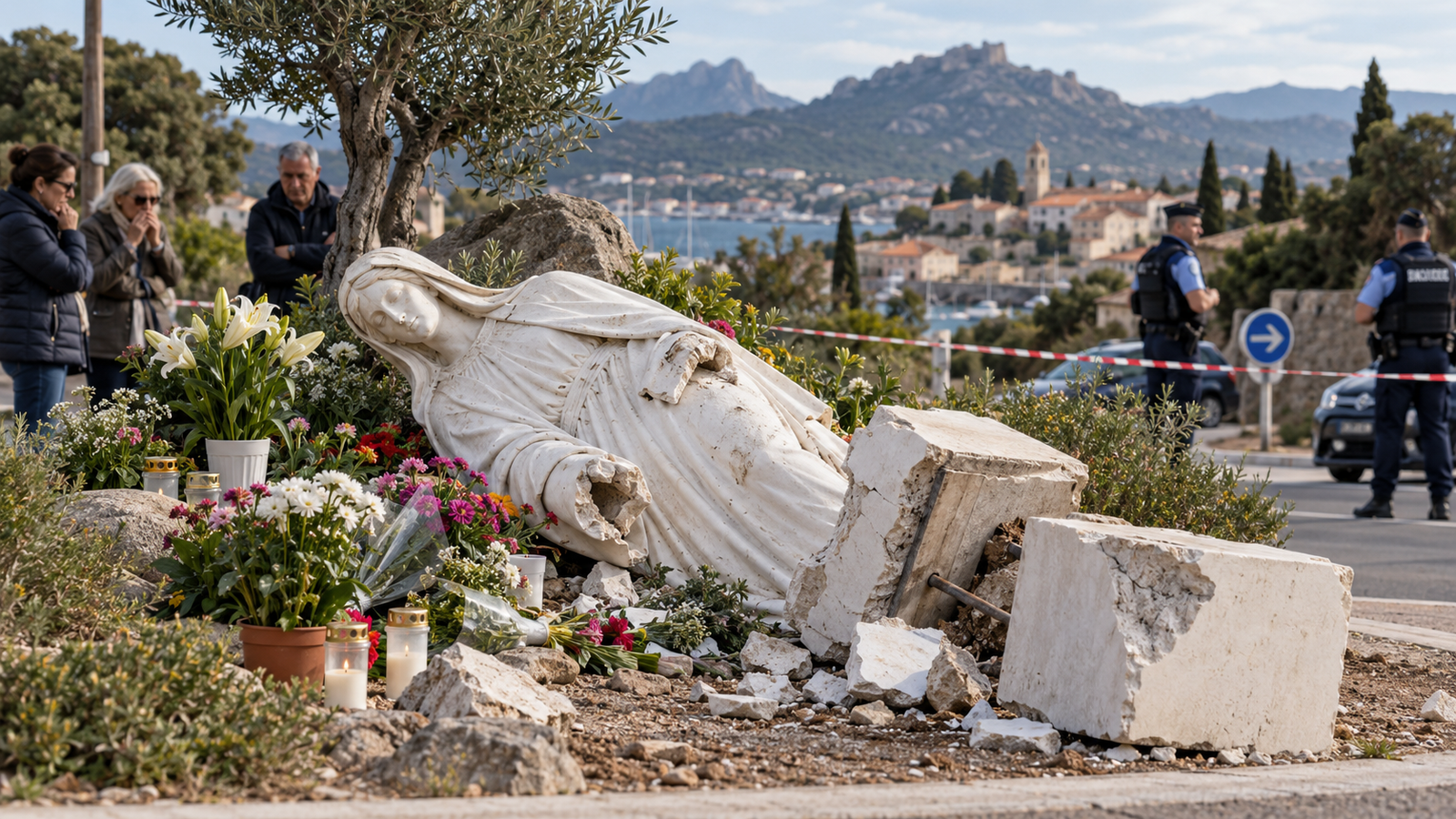
A Virgin Mary statue vandalized in France has become the focus of a major controversy on the Mediterranean island of Corsica, where the destruction of a religious landmark led to public anger, police action and a forthcoming court case. The incident occurred in the early hours of October 1, 2026, at the Stabiacciu roundabout in Porto-Vecchio, a town in southern Corsica. Video recorded at the site spread rapidly on social media and intensified the reaction among residents who considered the statue an important symbol of their community.
French authorities investigated the damage and detained two men who had been working seasonal jobs on the island. The suspects were subsequently placed under judicial supervision, with their court appearance scheduled for November 16, 2026, in Ajaccio. The case has prompted debate not only about the treatment of religious symbols but also about the dangers of threats and vigilante retaliation. The events are being reported as an October 2026 incident, not as a new development on the publication date of this explainer.
What Happened to the Virgin Mary Statue in Corsica?
According to reporting by Le Monde, TF1 and Corsican news organizations, the incident unfolded shortly before 3 a.m. on Thursday, October 1. A white statue representing the Virgin Mary stood at the Stabiacciu roundabout near the entrance to Porto-Vecchio. Two young men were filmed at the monument. Investigators said one of them hung from the statue and made sexually explicit gestures while the other recorded the scene. The statue was pulled from its base and suffered serious damage.
The footage circulated online later that morning, triggering intense criticism. What might have begun as a local police matter quickly became a widely discussed event in Corsica and mainland France. Images and videos of the damaged statue drew attention to the symbolic importance of the figure and to the manner in which the monument had been treated. The available reporting describes a statue on a public roundabout; it was not a tomb, mausoleum or burial shrine.
Where Is Porto-Vecchio, and Why Was the Statue Important?
Porto-Vecchio is a town in Corse-du-Sud, the southern part of the French island of Corsica. The Stabiacciu roundabout is a recognizable public location where the statue of the Virgin Mary served as a visible religious landmark. For members of the local Catholic community, an image of Mary is more than a decorative sculpture. It represents a central figure in Christian devotion and may be associated with prayer, remembrance and communal identity.
Religious imagery also has an important historical and cultural role in Corsican life. As a result, damage to a statue placed in a familiar public setting can be felt as an attack on local heritage as well as an act of vandalism. Some residents and public figures used the language of desecration or profanation when reacting to the incident. Those terms reflect their assessments of the conduct, while the precise legal allegations are described separately by prosecutors.
How the Video Spread and Sparked Public Outrage
The video was a decisive factor in turning the destruction of the statue into a regional controversy. The footage reportedly showed conduct that residents considered insulting and disrespectful toward a sacred figure. Its distribution on social media enabled viewers well beyond the immediate area to see the incident and express anger. Local news outlets covered the growing public reaction as police worked to identify those involved.
There is an important distinction between reporting what a video appears to show and establishing legal responsibility. Investigators cited the footage among the evidence supporting their case, but criminal allegations are ultimately assessed through the judicial process. A video going viral does not replace investigation or trial. This distinction is particularly important when online attention leads to publication of personal information, threats or demands for immediate punishment.
Who Were the Two Suspects?
The Ajaccio prosecutor’s office said two men aged 21 and 24 were detained in connection with the damaged statue. Local reporting identified them as seasonal workers in the hospitality and restaurant sector who had come to Porto-Vecchio for employment. They were detained on October 1 after the incident and subsequently appeared before prosecutors.
Some early French reports differed slightly in the ages they listed, but prosecutor-based reporting and Le Monde described the two as 21 and 24. The men are suspects in a criminal case, not individuals who have been convicted of these charges. Mukhbir is therefore not treating the allegations as established guilt, and the names of the suspects are not necessary to explain the public-interest aspects of the story.
What Charges Are the Suspects Facing?
The prosecutor’s office reported that the two men were summoned to appear before the Ajaccio criminal court on November 16, 2026. The allegations include serious damage committed jointly to the Virgin Mary statue, with the parish and municipal authorities identified as affected parties. Prosecutors also cited a sexual-exhibition allegation relating to the recorded conduct at the site.
Both men were placed under judicial supervision pending trial. According to local reporting, the conditions included leaving Corsica and regularly reporting to a police station in their place of residence. Judicial supervision is not a criminal conviction. As of the October 20 editorial date, the scheduled November hearing had not yet taken place, and any account of the eventual result would be premature.
Why Did the Suspects Have to Leave Corsica?
The reaction in Porto-Vecchio and elsewhere on the island went beyond ordinary criticism. News reports described crowds gathering near a gendarmerie station and instances of threatening rhetoric directed at the suspects. Le Monde reported that a coffin bearing their names was placed outside the station, an alarming sign of the tension surrounding the case. Authorities faced the difficult task of allowing the legal process to continue while preventing further confrontation.
The suspects were ordered to leave Corsica as part of their judicial-supervision conditions. Reporting also described difficulties with their departure after their presence at an airport provoked hostility and security concerns. French authorities ultimately facilitated their departure from the island. These developments illustrate how a legitimate public demand for accountability can become intertwined with dangerous attempts to intimidate people before a court has heard the case.
How Did Local Residents and Religious Communities Respond?
Residents expressed sorrow, anger and disbelief after images of the damaged statue became public. Some visited the location and participated in a religious gathering. TF1 reported continuing anger in Corsica several days after the vandalism, while Le Monde described the local response and the wider public pressure directed at the suspects. The mayor of Porto-Vecchio, Jean-Christophe Angelini, publicly condemned the conduct.
The reaction reflected the importance that many people attach to the Virgin Mary as a religious and cultural symbol. Yet it was not uniform in every respect. Some public figures who condemned the damage also warned against calls for violence and mob justice. That difference is important: disapproval of destruction or offensive conduct does not require endorsement of threats, harassment or extrajudicial punishment.
Religious Sensitivity and the Meaning of the Virgin Mary
The Virgin Mary, the mother of Jesus, holds a distinguished place in Christianity. In Catholic traditions, depictions of Mary can provide a focus for prayer and expressions of faith. To some observers, a damaged statue may represent a painful affront to a religious community’s beliefs, particularly when the act is accompanied by deliberately insulting gestures.
Mary is also an honored figure in Islam, where she is known as Maryam. However, traditions concerning religious statues and devotional images differ between communities. Explaining these distinctions can help international audiences understand the emotional reaction without implying that all faiths share identical practices. The core verified event remains the damage to a Virgin Mary statue in Corsica and the subsequent legal response.
Was This an Attack on a Mosque, Shrine or Grave?
No. Accounts of the October 1 incident locate it at a public roundabout in Porto-Vecchio and describe a white statue of the Virgin Mary. The monument was not described as a grave, a tomb or a Muslim shrine. Using the word ‘mazar’ for this story would therefore be inaccurate, even though readers may use it informally to refer to a place they consider sacred.
Precise terminology is necessary for reliable international reporting. In English, the most accurate short description is ‘Virgin Mary statue vandalized in Corsica, France.’ The phrase communicates what was damaged without misidentifying the location or the community associated with it.
What Do French Authorities Say About the Investigation?
According to coverage quoting the Ajaccio public prosecutor, video evidence and witness information were important elements of the initial investigation. The authorities identified and detained two individuals soon after the footage became public. Formal proceedings followed on October 2, with the court date scheduled for November 16.
The prosecutor’s statements provide a more reliable basis for reporting the legal position than speculation on social media. They also clarify the distinction between alleged criminal damage, alleged sexual exhibition and the broader public perception of sacrilege. The case demonstrates why reporters should use exact legal language rather than assuming that a religiously offensive act automatically corresponds to a particular criminal charge.
The Debate Over Public Anger and the Rule of Law
The intensity of public reaction created a second significant story alongside the vandalism itself. Citizens have the right to condemn acts they consider deeply disrespectful, and religious communities may seek restoration of a damaged monument and accountability through lawful means. But threatening suspects or attempting to punish them outside a courtroom creates separate risks.
Le Monde documented the angry gathering and the difficulties encountered when authorities attempted to move the suspects away from the island. It also quoted criticism of calls for lynching and mob retaliation. The principle is straightforward: investigation, a fair hearing and lawful sentencing should determine criminal responsibility. Public outrage can explain why an incident becomes prominent, but it cannot substitute for due process.
Why the Story Has International and Social-Media Interest
The incident sits at the intersection of religion, heritage, social media and the justice system. A recognizable religious figure, a recorded act of vandalism and a strong public response created conditions in which the news spread quickly beyond Corsica. That does not mean every viral claim attached to the footage is reliable. Posts may omit the date, exaggerate the damage or misidentify the location.
For readers in Pakistan, South Asia and other regions, the story is relevant as an example of how religious imagery and cultural heritage can shape public reaction in Europe. This relevance should be explained rather than manufactured. The main story remains local to France, and there is no verified reason to describe the incident as involving Pakistan or a Pakistani community.
What Happens Next in the Court Case?
The next confirmed legal milestone reported by French media was the scheduled November 16, 2026 hearing at the Ajaccio criminal court. The court may consider the allegations and evidence, hear the parties and determine what outcome is appropriate under French law. Any expected sentence, verdict or motive beyond what investigators have said would be speculation.
Readers should also distinguish the legal timetable from the public reaction. A scheduled trial is a future event; it is not proof of a conviction. The most responsible way to update the story will be to check official court information and credible reporting once the hearing has taken place.
Conclusion
The vandalism of a Virgin Mary statue at the Stabiacciu roundabout in Porto-Vecchio on October 1, 2026, prompted a major response in Corsica. Prosecutors detained two suspects, placed them under judicial supervision and scheduled their trial for November 16. The incident was widely condemned by residents and local leaders, while reports of threats against the suspects raised concerns about public safety and the rule of law.
The story is a reminder that incidents involving religious symbols require accuracy, sensitivity and careful attribution. The damage to the statue, the video, the response of authorities and the court schedule are matters that can be reported with evidence. Claims about guilt, motive and eventual punishment must remain distinct until resolved through appropriate legal procedures.
Frequently Asked Questions
What happened to the Virgin Mary statue in France?
A white statue of the Virgin Mary was pulled from its base and severely damaged at the Stabiacciu roundabout in Porto-Vecchio, Corsica.
When did the statue vandalism take place?
The incident occurred in the early hours of October 1, 2026.
Where is Porto-Vecchio?
It is a town in the Corse-du-Sud region of Corsica, a Mediterranean island that forms part of France.
How many suspects were detained?
French authorities detained two men in connection with the incident.
What are the suspects accused of?
They face allegations concerning serious damage to the statue and sexual exhibition connected to the reported conduct.
When is the court hearing?
The reported trial date is November 16, 2026, in Ajaccio.
Why did people protest?
Many residents considered the damage and recorded behavior a serious insult to a respected religious symbol.
Was this a destroyed grave or a shrine?
No. French reports identified a public statue of the Virgin Mary, rather than a tomb or burial shrine.
About The Author