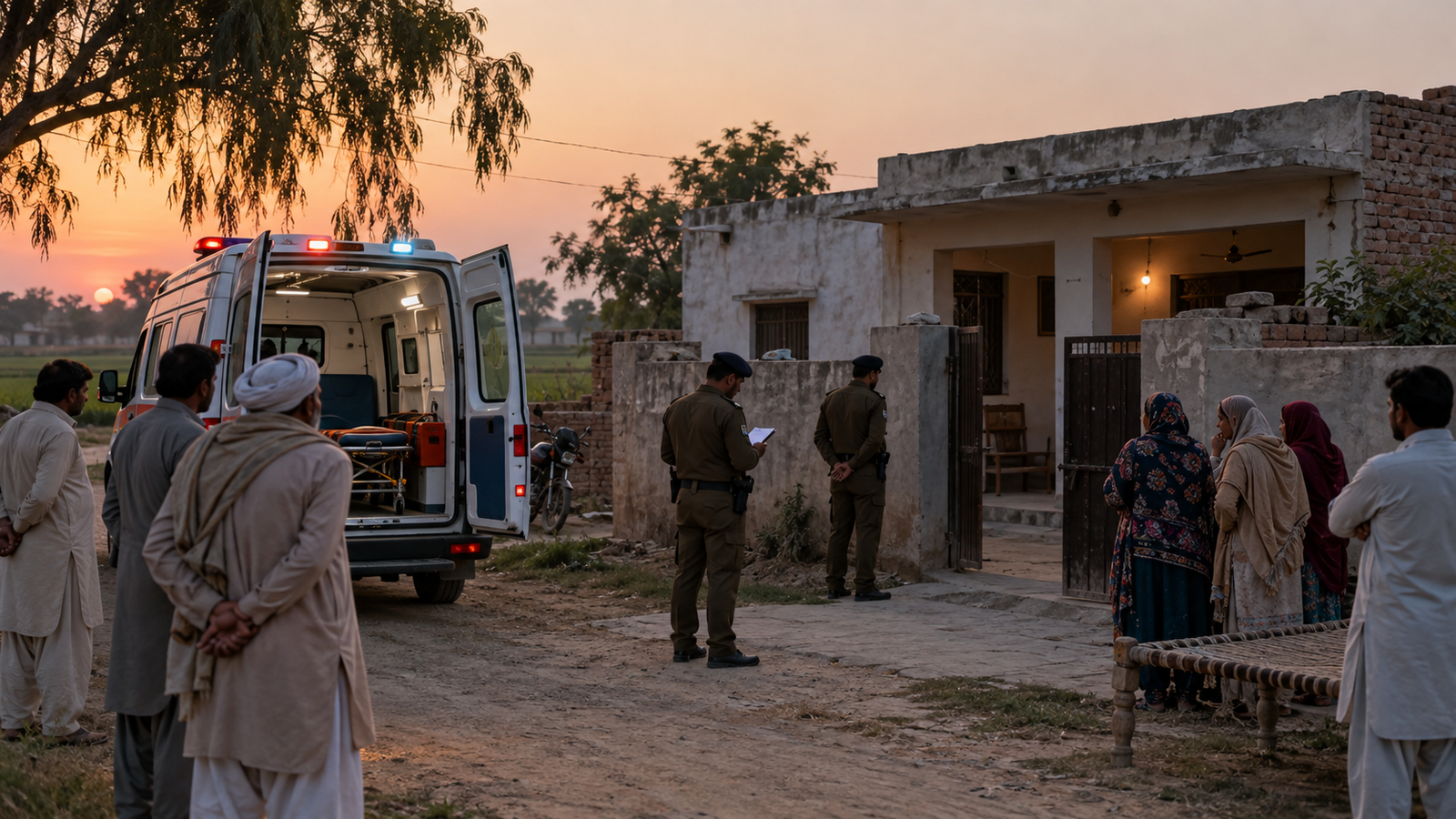
Kasur family deaths have prompted an investigation in Punjab after five members of one household died following a reported meal of homemade kheer in a rural area near Kanganpur. The deceased included Qasim Ali, his wife Hasna Bibi, and their three sons, Asif, Nazim and Amanat. Reports published between October 28 and 30, 2026, describe the family’s illnesses, hospital transfers and subsequent deaths over several days. Police have collected samples connected to the food and arranged postmortem examinations, while the precise cause of the deaths remains unconfirmed in the reports reviewed for this October 31 article. A claim that a lizard entered the dish has circulated in local accounts, but no final forensic finding establishes that explanation. Authorities have said the case is being examined from multiple angles.
Kasur Family Deaths: Quick Facts
Location: Village Mahmood Khaneke, near Kanganpur, Chunian tehsil, Kasur district, Punjab, Pakistan.
Deaths confirmed in reporting: Five people belonging to one household.
Family head: Qasim Ali, reported age 55 in Dawn’s detailed coverage.
Mother: Hasna Bibi, reported age 52.
Sons: Asif Ali, 28; Nazim Ali, 25; Amanat Ali, 15.
Reported food: Homemade rice pudding known as kheer.
Approximate onset: October 22, 2026, in detailed retrospective reporting.
First reported death: Nazim Ali.
Final reported death: Hasna Bibi, by the reports published October 29–30.
Treatment: Local hospital referral followed by hospital care in Lahore.
Police investigation: Ongoing in the reviewed sources.
Forensic tests: Samples of the suspected food and biological material sent for analysis.
Postmortem: Reports indicate examinations on four family members; Nazim was initially buried before further inquiry.
Confirmed cause: Not established by a final forensic report in sources available for this article.
Suggested explanation involving a lizard: Unverified local account, not a forensic conclusion.
Editorial status: Public-safety report, not a finding of murder or deliberate poisoning.
Where Did the Kasur Incident Take Place?
The incident occurred in a village identified in reporting as Mahmood Khaneke or Khankey near Kanganpur, within Chunian tehsil of Kasur district. Dawn described the area as a rural settlement near the Sutlej River. Its location matters because news coverage points to the practical difficulty of accessing advanced healthcare from smaller villages. The affected household was engaged in farming, and the father and sons were reported to work in the fields. The village has since become the focus of media attention and a police investigation. Readers should understand that descriptions of the family’s home and living circumstances come from journalists and local sources; any visual reconstruction used with this report is an illustration, not evidence.
Who Were the Five Family Members?
Dawn identified the affected family members as Qasim, 55, Hasna Bibi, 52, Asif, 28, Nazim, 25 and Amanat, 15. Aaj News confirmed that the deceased were the couple and their three sons, while other reports supplied varying ages for the father. This article uses the ages from the more detailed Dawn account and marks them as reported rather than presenting the inconsistent numbers as a certified official register. The names and relationships are relevant to understanding the scale of the tragedy, but the family should not be subjected to speculation about private disagreements or an imagined motive. The case involves real bereavement, and responsible coverage must respect that.
What Happened Before the Family Became Ill?
Detailed accounts describe the family eating homemade kheer, a dessert made with rice and milk, before several members began to feel unwell. Some reporting places this event on October 22, 2026, while early articles described it less precisely as occurring several days before hospital treatment. The father and sons were reportedly working in agriculture at the time of the illness. Family statements reported by police mention the dish as a common meal. The important established sequence is that the household experienced a serious shared medical emergency after the reported meal. Whether the dish itself caused the illness, contained a harmful substance or was connected in another way requires forensic findings.
The Reported Timeline From Illness to Hospital Care
Reports indicate that the household experienced symptoms over several days and was eventually taken for medical attention when the condition of the patients deteriorated. The exact dates and transfer sequence differ in some early articles: retrospective accounts describe a local hospital visit around October 25, while Dawn’s October 29 report describes a referral through Chunian Tehsil Headquarters Hospital and onward to Lahore General Hospital. Mukhbir does not attempt to eliminate those differences by inventing a precise hour-by-hour account. What is consistently reported is that all five patients became seriously ill, were referred for further treatment and subsequently died. Investigators may be able to establish the definitive sequence from hospital records.
What Happened at Lahore General Hospital?
The family members received hospital care after being moved from the local area to Lahore as their conditions worsened. Nazim Ali was the first reported death. Asif Ali, Amanat Ali and Qasim Ali subsequently died, while Hasna Bibi was initially reported in critical condition. Aaj News and other updates confirmed her death as the fifth fatality. This progression explains why early news reports said four people had died while later articles correctly stated five. It does not necessarily mean any report was misleading: the reported death toll changed as new information became available. The medical reasons for each patient’s deterioration have not been established in a publicly verified final forensic report.
Why Some Reports Initially Listed Four Deaths
On the morning of October 29, Dawn reported that the death toll had risen to four, noting that the mother remained in critical condition. Later October 29 reporting from Aaj News confirmed that Hasna Bibi had also died, raising the total to five. Dunya News carried a further report on October 30 covering the final death. This is an important lesson when reading developing news stories: reports published only hours apart may contain different totals because events are still unfolding. The most recent verified death toll in the reviewed reporting is five. Editors should preserve the publication times of source articles rather than compare undated screenshots and treat a former total as current.
What Are Police Investigating?
Police are investigating the circumstances surrounding the illnesses and deaths, including possible links to the food reportedly consumed by the family. Dawn said samples of the sweet dish had been sent to the Punjab Forensic Science Authority laboratory. Other reporting states that postmortem examinations were arranged and biological samples submitted for analysis. These procedures are intended to help determine whether a toxic or other harmful substance was present and whether it could explain the illnesses. An open investigation does not prove that a crime occurred. Nor should a police inquiry be interpreted as evidence that a particular relative, neighbor or other individual was responsible.
Why the Forensic Report Is Central to This Story
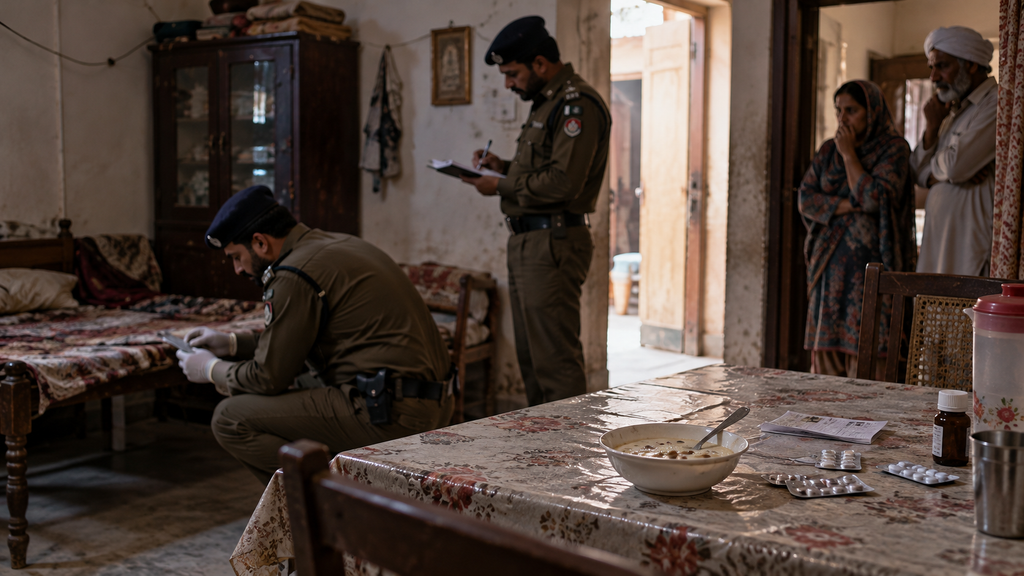
A forensic assessment may examine the composition of a food sample and relevant biological evidence. Such testing can help investigators evaluate possible toxic exposure, but results must be interpreted alongside clinical records, the chain of custody and the circumstances of the case. A preliminary suspicion is not equivalent to a laboratory finding. As of the reports reviewed for this October 31 edition, no final publicly confirmed result identifies the specific substance or definitive medical explanation responsible for all five deaths. If officials later release findings, the article should be updated with the exact issuing authority, date and conclusion. Until then, ’cause under investigation’ is the accurate description.
Why Four Postmortem Examinations Were Reported
Detailed subsequent coverage reports that examinations were conducted on four of the deceased. Nazim Ali, the first person to die, was initially buried before the wider circumstances prompted a police investigation, according to local reporting. The handling of subsequent deaths therefore differed. A postmortem is a medical examination intended to establish relevant findings after death, but merely confirming that an examination took place does not reveal its outcome. Mukhbir will not claim that the examinations proved poisoning, identified an individual or ruled out all other causes without seeing reliable results. Any later forensic interpretation must be attributed to the relevant officials.
What Is Known About the Kheer?
Kheer is a common dessert in Pakistan, often prepared with milk, rice and sugar. Reports say the family had consumed homemade kheer before they became ill, and investigators collected a sample connected with that account. The dessert became a focus of public discussion because it was reportedly eaten by all affected household members. However, the simultaneous illness of several people after a meal does not by itself establish the exact route or cause of exposure. Food preparation, storage, possible contamination and other medical factors may need examination. Publishing a definite accusation about the ingredients, cooking process or person who prepared the meal would go beyond the evidence currently available.
Did a Lizard Fall Into the Kheer?
Some police-linked and family accounts quoted in news coverage say that a lizard may have fallen into the dish and was removed before the food was eaten. Dawn described the allegation in a report citing local police sources, while Aaj News and ARY News explicitly noted that the cause had not been confirmed. This is an unverified explanation, not a final scientific finding. Readers should not assume that the presence of a lizard, if established, automatically explains five deaths or proves that the dish was poisoned. The investigation must determine whether the report is accurate, whether the food contained any harmful material and whether the evidence supports a medically plausible causal connection.
Can a Lizard Automatically Make Food Deadly?
There is no sound basis in the reviewed reporting to conclude that a lizard’s alleged presence explains this incident. Contamination risks can involve microorganisms or other substances, and the severity of illness depends on what actually entered the food, the amount consumed and the health of those affected. A specific poisoning diagnosis cannot be made from a social-media description of an animal falling into a pot. The responsible approach is to avoid dramatic claims about how ‘poisonous’ a lizard must have been, and to wait for testing. Anyone who suspects contaminated food should stop eating it and seek appropriate medical help if symptoms develop.
What About Reports of Delayed Medical Treatment?
Dawn reported local statements suggesting the family initially sought help from a faith healer rather than receiving prompt hospital-based treatment. Later accounts also describe the family’s condition worsening over several days before they were taken to healthcare facilities. These are reported circumstances, not a basis for blaming the deceased, a spiritual practitioner or a particular medical professional for the outcome. Even where treatment is delayed, establishing whether an earlier intervention would have changed the result requires clinical evidence. The broader public-health message is that severe or persistent symptoms involving several people after a shared meal warrant urgent professional medical assessment.
Why Timely Medical Care Matters in Suspected Poisoning
When multiple people experience serious symptoms after eating the same food, emergency medical assessment can help identify dehydration, organ-related complications or possible exposure to a harmful substance. Qualified clinicians can provide monitoring, tests and treatment appropriate to the actual symptoms. Neither spiritual practices nor online speculation can reliably diagnose the cause of a medical emergency. At the same time, journalists should not claim with certainty that timely intervention would have saved every member of this family; the necessary clinical and toxicological information has not been published. This article offers general safety information, not treatment instructions for an individual patient.
How Authorities Have Responded
Dawn reported that Punjab Law Minister Rana Muhammad Iqbal sought a detailed report from the Kasur deputy commissioner. Police statements in regional coverage describe an investigation and the collection or submission of samples for laboratory analysis. These steps show official attention to the incident but do not amount to a completed criminal inquiry or final public medical conclusion. Decisions about any future legal proceedings should follow evidence and applicable procedures. Mukhbir will identify any subsequent official determination by date and source, rather than imply that the existence of an inquiry already establishes deliberate wrongdoing.
Why Investigators Must Consider More Than One Possibility
In a case involving several related deaths, investigators may need to reconstruct shared exposures, timings, medical histories, food handling and relevant laboratory findings. Multiple possibilities can be assessed without treating them as equally likely or making a public accusation. Police have been quoted as examining different aspects of the incident. The fact that people are asking questions about the dessert does not prove foul play, and it is inappropriate to invent a suspect or motive. The available evidence supports a serious unexplained-deaths inquiry with a reported potential food link. A definitive classification will require stronger official medical and investigative findings.
What the Local Community Has Experienced
The confirmed loss of five people from one household has affected the nearby community. News outlets reported funerals and widespread mourning in the area around Kanganpur. Local residents have raised questions about what happened and why the family became so ill. Their concern is understandable, but grief and suspicion must not be converted into unsupported accusations. Respecting survivors and neighbors means avoiding identifiable photographs of grieving people without appropriate permission and avoiding images that pretend to show the family home or actual forensic evidence. Public-interest reporting can remain compelling while giving the affected community dignity and space.
Why This Story Matters for Rural Healthcare
The family reportedly had to travel through more than one level of healthcare to receive specialist treatment in Lahore. The case highlights questions worth asking about access to emergency care, referral systems and public awareness in rural communities. However, one tragedy cannot establish that a particular hospital or medical worker failed in their duty. A detailed review would need actual patient records and verified information about the referrals. The story may encourage discussion of how people recognize dangerous symptoms and reach emergency services quickly. Those are legitimate public-safety questions, distinct from assigning blame for this family’s deaths.
How Readers Can Verify Updates
Readers should look for dated statements from Kasur Police, the Punjab Forensic Science Authority, hospitals involved in the case or reputable news organizations citing named officials. An updated report should distinguish a preliminary laboratory observation from a final medical cause of death. Social-media clips, forwarded voice notes and sensational captions can omit dates or repeat unverified theories. The original Dawn, Aaj News and Dunya News articles can establish what was known at specific points in the timeline. If results are released, Mukhbir should publish a separate clearly dated update and, where necessary, revise the earlier explanation to prevent conflicting information remaining online.
Kasur Family Deaths and the Role of Responsible Journalism
A credible news article should answer who was affected, where the event occurred, what was reported and which questions remain unresolved. It should not accuse a cook, relative, spiritual practitioner or doctor without substantiated evidence. The same caution applies to declaring that an animal caused the deaths before scientific testing. Editors should use words such as ‘reportedly,’ ‘according to police’ and ‘under investigation’ where the facts require attribution. These qualifications are not attempts to hide the story; they make the difference between established events and pending findings visible to readers. That distinction is especially important for reporting involving deceased people and grieving families.
What Happens Next in the Investigation?
The key next step is obtaining official forensic and postmortem findings that clarify what caused the deaths. Investigators may also review the sequence of symptoms, hospital records and accounts from individuals who observed the family’s condition. Whether further legal proceedings follow cannot be determined from the currently published information. The public should not expect rumors to settle the question before the relevant evidence is assessed. A new Mukhbir report should be issued if police release a verified cause or official procedural decision. In the meantime, the deaths are confirmed, while the explanation remains open in the material reviewed as of October 31, 2026.
Conclusion
The Kasur family deaths in a village near Kanganpur have left five members of one household dead and prompted a police investigation. Qasim Ali, his wife Hasna Bibi and their sons Asif, Nazim and Amanat became seriously ill after a reportedly shared meal of homemade kheer. The final death toll is confirmed in late-October reporting, and authorities have sought forensic evidence to establish what happened. Claims about a lizard falling into the dish remain unproven, as does any suggestion that a particular person deliberately caused the deaths. Until official results are available, the most accurate public-interest account is a tragic, still-investigated incident with an unresolved cause.
Frequently Asked Questions
What happened in the Kasur family deaths case?
Five people from one household near Kanganpur in Kasur district died after becoming seriously ill following a reported shared meal of homemade kheer. Police are investigating the cause.
Who were the five family members?
They were Qasim Ali, his wife Hasna Bibi and their three sons Asif Ali, Nazim Ali and Amanat Ali, according to local and national news coverage.
Where did the incident take place?
The family lived in the Mahmood Khaneke or Khankey area near Kanganpur, Chunian tehsil, Kasur district, Punjab.
Was the kheer proven to be poisonous?
No final publicly verified forensic conclusion was available in the sources reviewed for this October 31 article.
Did a lizard cause the deaths?
The lizard account appeared in local reporting, but its role and any causal link to the deaths are not confirmed by a final laboratory report.
Were postmortem examinations conducted?
Reports indicate that four family members underwent postmortem examinations, while Nazim Ali had already been buried before the wider inquiry.
Has police identified a suspect or established murder?
The reviewed sources do not establish a named suspect or a final finding of deliberate poisoning or murder.
What should readers watch for next?
A dated police statement and verified forensic or postmortem findings explaining the cause and any official next steps.
About The Author