
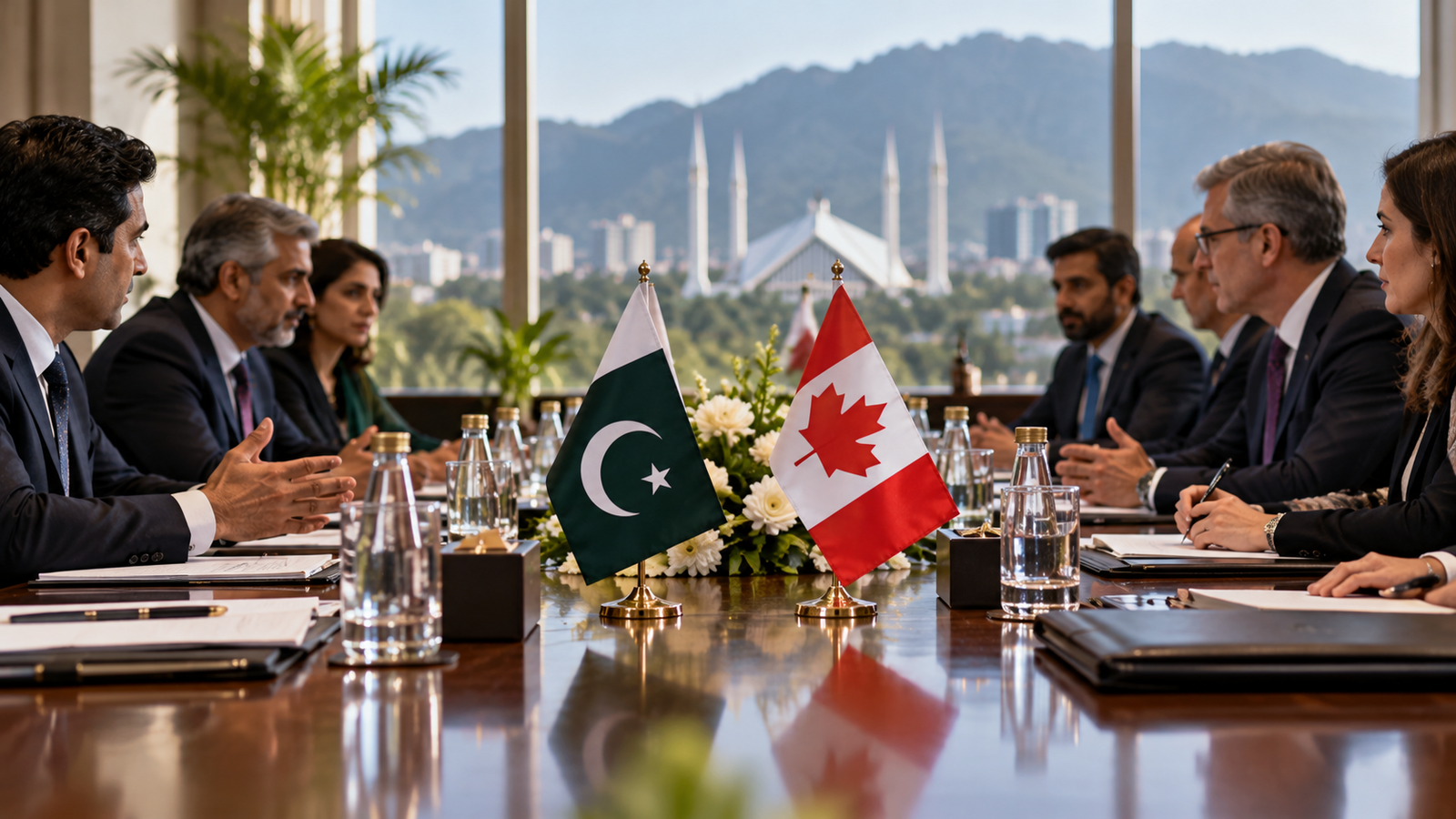
Pakistan and Canada have concluded a third round of negotiations on a proposed bilateral investment treaty, marking further progress in efforts to establish a more predictable framework for investment between the two countries. The talks ended in Islamabad on October 24, 2026, according to Pakistan’s official Press Information Department, with Dawn and The Express Tribune reporting the development on October 25.
The negotiating teams signed the minutes of their discussions at a closing ceremony attended by Federal Minister for the Board of Investment Qaiser Ahmed Sheikh and Canadian High Commissioner Tariq Ali Khan. The signed minutes document the proceedings of the round; they are not a signed bilateral investment treaty. The governments have not announced a final treaty text or an effective date.
Officials on both sides described the negotiations as constructive and said the proposed agreement could support investor confidence, economic cooperation and business opportunities. These are stated objectives, not evidence that additional investment has already arrived as a result of the talks.
Key Developments at a Glance
Development: Third round of bilateral investment treaty negotiations concluded.
Place: Islamabad, Pakistan.
Official announcement: October 24, 2026.
Participants at closing: Board of Investment Minister Qaiser Ahmed Sheikh and Canadian High Commissioner Tariq Ali Khan.
Document signed: Minutes recording the negotiation round, not a final treaty.
Topics discussed: Direct and indirect investment, portfolio investment, performance requirements, expropriation, third-party funding and investor-state dispute settlement, according to Dawn.
Priority sectors highlighted by Pakistan: Renewable energy, mining, agriculture and information technology.
Next milestone: Further talks, agreement on treaty provisions, formal signing and any necessary domestic approvals before entry into force.
What Is a Bilateral Investment Treaty?
A bilateral investment treaty, often called a BIT, is an agreement between two countries intended to establish rules governing certain investments by investors from each country in the other’s territory. These agreements can define covered investors and investments, standards of treatment, provisions for expropriation and mechanisms for resolving disputes.
Treaties vary significantly. Some provide access to international arbitration, while others contain limitations, exclusions or conditions. Certain provisions may address transparency and the relationship between investor protections and a government’s ability to regulate in the public interest.
Because the Pakistan–Canada text remains under negotiation, it would be inaccurate to claim that any particular investor protection, compensation formula or arbitration route is already guaranteed by this proposed instrument. Readers should distinguish the general concept of a BIT from the precise commitments that may appear in the final signed agreement.
Who Represented Pakistan and Canada?
The closing ceremony brought together Pakistan’s Federal Minister for the Board of Investment Qaiser Ahmed Sheikh and Canadian High Commissioner Tariq Ali Khan. Both praised the work carried out by the negotiating teams and supported continued engagement.
Dawn reported that the Canadian negotiating delegation was led by Daphnee Campeau, a senior trade policy officer in Global Affairs Canada’s Investment and Government Procurement Division. The Pakistani negotiating delegation was led by Additional Secretary Khashih ur Rehman from the Ministry of Law and Justice.
The officials’ respective diplomatic and technical roles should not be conflated. Senior leaders attending a closing ceremony may provide policy direction, while specialist teams work through the legal language and terms of an agreement. No final signed treaty was announced at this event.
What Was Discussed During the Third Round?
Dawn said the teams addressed direct and indirect investments, portfolio investments, performance requirements, expropriation, third-party funding and investor-state dispute settlement. These subjects are important because they determine the scope of investor protections, the rights and responsibilities of investors and governments, and procedures for handling disagreements.
For example, expropriation provisions can address the circumstances in which the state takes or significantly interferes with a covered investment and what compensation requirements may apply. Performance requirements may concern conditions that governments can attach to particular investments. Third-party funding can raise issues of disclosure and responsibility when outside entities finance legal claims.
Discussing these topics does not mean that both sides have agreed to every proposed clause. The final terms, including potential exceptions and safeguards, will only be clear when an authoritative draft or completed treaty text is made public.
Why Does Pakistan Want an Investment Protection Agreement?
Pakistan’s Board of Investment says a predictable and transparent investment framework can strengthen business confidence and encourage cross-border investment. Foreign investors often assess not only market potential but also regulatory clarity, contract enforcement, dispute procedures and how rules may change over the lifetime of a project.
A treaty may help define selected legal commitments, but it cannot by itself resolve every barrier to investment. Investors also consider infrastructure, energy reliability, taxation, currency availability, skilled labour, political risk and operating costs. The ministry’s statements should therefore be understood as a policy ambition to improve the investment environment, not proof that the treaty would automatically bring a specified amount of foreign capital.
The case for such an agreement also requires careful balance between investor predictability and the government’s legitimate authority to regulate health, environmental protection, labour standards and other public interests.
What Is Canada’s Interest in the Treaty?
At the closing ceremony, Canada’s High Commissioner emphasised the value of a balanced agreement designed to facilitate investment, strengthen confidence and deepen mutually beneficial economic links. Canada’s policy interest may include clearer protections and processes for its companies operating in Pakistan, alongside opportunities for Pakistani investors with interests in Canada.
The September 15 official Pakistan government statement described the proposed investment protection agreement, also called a Foreign Investment Promotion and Protection Agreement, as a foundational step for attracting investment and supporting joint ventures. It mentioned legal protection and dispute-resolution arrangements as matters of interest.
Those remarks explain the direction of talks; they do not establish that Canadian companies have committed new funds or that particular projects have obtained final commercial approval.
Renewable Energy: A Potential Cooperation Area
Renewable energy was one of the sectors highlighted by Pakistan’s Board of Investment. Pakistan has substantial needs for reliable and affordable electricity, while Canadian businesses may offer expertise or investment in selected energy technologies, engineering services and project development.
In September, Pakistan’s Press Information Department said officials had discussed progress on a proposed hybrid renewable-energy project in Jhimpir and Canadian companies offering solar and green-energy solutions. That announcement concerned possibilities and ongoing work, rather than a newly finalised contract within the October treaty negotiations.
Investment in energy depends on bankable power arrangements, transmission capacity, policy consistency, financing costs and regulatory approvals. An investment treaty could influence the legal environment for some investors, but it does not replace those practical requirements.
Mining and Critical Minerals
Mining is another sector Pakistan identified for potential Canadian investment. The two countries have discussed mineral exploration, services, equipment and supply chains. Canada has a well-established international mining industry, and Pakistani officials have sought to encourage foreign participation in domestic mineral development.
A separate October 16 official statement described discussions relating to the Barrick mining project, including its security review and financing considerations. These were part of broader bilateral economic conversations rather than evidence that the October 24 treaty round approved or changed the status of that project.
New mining investments would still depend on project-specific licences, geological findings, commercial agreements, environmental safeguards, local stakeholder engagement and financing. No additional mining investment amount was confirmed in the treaty announcement.
Agriculture and Food-Processing Opportunities
Pakistan and Canada also identified agriculture and agri-industry as possible areas of deeper cooperation. Earlier discussions covered dairy development, livestock genetics, canola, edible oils, food processing and value-added exports. These sectors matter because they link primary production with processing capacity, storage, technology and access to markets.
The September 15 Press Information Department statement noted Pakistan’s imports of Canadian canola seed and discussed the potential to expand domestic processing and business partnerships. Such initiatives could create economic opportunities if commercial arrangements progress, but they are not automatic benefits of a future BIT.
Any claim about new factories, employment, export orders or agricultural investment should be supported by separate company and official disclosures. The current development is progress in legal negotiations at the government level.
Information Technology and Digital Services
Information technology was the fourth priority sector listed by Pakistan’s Board of Investment. Potential investment areas could include software development, IT-enabled services, digital infrastructure, cybersecurity services and other technology activities, subject to actual market conditions and commercial decisions.
Pakistan and Canada discussed IT services and AI skills during meetings involving Finance Minister Muhammad Aurangzeb and Canadian officials earlier in October. These contacts show that technology cooperation is part of the wider bilateral agenda. However, no specific new startup funding round, data centre agreement or Canadian technology investment was announced as a completed outcome of the third negotiation round.
The practical value of an eventual agreement for technology companies would depend on the definition of covered investments, applicable domestic rules and the business conditions in each country.
How Could a Treaty Affect Foreign Direct Investment?
Foreign direct investment generally involves a lasting interest or significant degree of influence in an enterprise located in another economy. A bilateral treaty may be relevant by establishing rules about how covered investors are treated, but an investment decision usually depends on commercial returns as well as legal protections.
Investors may pay particular attention to the clarity of covered investments, standards of treatment, dispute resolution and any exceptions allowing governments to regulate. Companies are also likely to assess tax rules, local financing, profit repatriation, infrastructure and sector-specific permissions.
There is no verified basis to forecast a particular percentage increase in FDI or an exact dollar amount from this announcement. The treaty remains a proposal, and investment flows depend on multiple domestic and international factors.
Why Investor-State Dispute Settlement Matters
Investor-state dispute settlement, or ISDS, refers to legal processes through which an investor may seek a remedy against a state in certain circumstances defined by an investment agreement. Such arrangements are debated internationally because they can offer a formal mechanism for resolving claims, while also raising questions about cost, transparency, consistency and governments’ regulatory flexibility.
The fact that ISDS was discussed does not reveal the final model Pakistan and Canada will choose. Negotiators may consider how claims are initiated, what limits apply, how proceedings are funded and whether exceptions protect legitimate public policy measures.
Reporting on the negotiations should therefore avoid portraying ISDS as automatically beneficial or harmful. The significance will depend on the wording, safeguards and obligations of any agreement the two countries ultimately adopt.
What Is the Difference Between a BIT and a Trade Agreement?
An investment treaty mainly concerns treatment and protection of qualifying investments. A free-trade agreement typically covers a broader set of market-access arrangements, which may include tariffs, customs procedures, trade in services and other commercial rules.
Although trade and investment often support each other, signing an investment treaty would not automatically remove tariffs on goods moving between Pakistan and Canada. Nor would the October 24 conclusion of negotiations create a new visa category or guarantee immigration benefits for citizens of either country.
The governments have discussed wider trade cooperation in separate meetings. Those possibilities are relevant background, but they must not be reported as provisions of a treaty whose final text has not yet been completed.
Earlier Negotiations and the 2026 Timeline
The current round follows earlier engagement over several years. An official Press Information Department statement from June 17, 2026 reported that a Pakistani delegation travelled to Ottawa for talks on the draft Foreign Investment Protection and Promotion Agreement or Bilateral Investment Treaty. That statement said the previous round had taken place in Islamabad in October 2025.
On September 15, 2026, Pakistani and Canadian officials discussed accelerating the process and resolving outstanding issues. Dawn reported the start of the third round on October 20, while the official October 24 press release confirmed its conclusion. These dates describe stages in an ongoing negotiation, not three separate final treaties.
The chronology also explains why the October development is new: it records the completion of a substantive round and the signing of minutes after earlier preparatory and technical contacts.
Were Any New Investments Announced?
The official October 24 statement did not name a newly approved investment amount, a completed Canadian acquisition, a newly funded project or a quantified number of jobs resulting from the treaty talks. The ministers and diplomats identified potential sectors and expressed expectations about investment confidence and commercial links.
It would be misleading to convert those expectations into headlines claiming Canada has invested billions of dollars because of the agreement. A signed record of negotiating minutes is an administrative diplomatic milestone, not a financial transfer.
Investment announcements should be confirmed separately through companies, financial regulators or relevant ministries, with attention to whether a figure represents a proposal, commitment, disbursement or completed investment.
What Could This Mean for Pakistani Businesses?
For Pakistani companies seeking Canadian partners or investment, a clearer future legal framework might make some cross-border projects easier to evaluate. Businesses in energy, agriculture, mining and technology may take interest in the direction of talks and the possibility of rules addressing investment treatment and dispute procedures.
Nevertheless, companies should continue to assess actual commercial demand, financing, licensing and local regulations. A prospective treaty does not eliminate due diligence or ensure that every business activity qualifies as a protected investment.
Smaller businesses and startups may benefit indirectly from broader investment confidence, but no specific startup-support programme or grant was announced at the conclusion of this round.
What Happens Next?
The two countries will need to continue discussions, reconcile outstanding legal issues and agree on a final text before any agreement can be formally signed. Depending on its terms and domestic legal requirements, further approvals or ratification procedures may be needed before entry into force.
As of October 25, 2026, neither an effective date nor a final treaty text had been announced in the official release. Future updates should identify whether a completed agreement has been initialled, signed, approved or brought into force. Those are separate legal stages.
Mukhbir will also distinguish the eventual treaty from actual investment transactions, which should be documented independently when they occur.
Conclusion
Pakistan and Canada completed the third round of negotiations on a proposed bilateral investment treaty in Islamabad on October 24, 2026. Officials welcomed progress, discussed provisions relevant to investor protections and dispute resolution, and identified renewable energy, mining, agriculture and information technology as priority sectors for potential cooperation.
The development reflects continued diplomatic and economic engagement, but the negotiating teams signed only the minutes of the round. The final treaty remains under discussion, and there are no verified new investment or job totals attributable to this event. The next substantive milestone will be agreement on the treaty text and confirmation of its formal legal status.
Frequently Asked Questions
What happened in the Pakistan Canada investment treaty talks?
The two countries concluded a third round of negotiations in Islamabad on October 24, 2026.
Has Pakistan signed a final investment treaty with Canada?
No. Officials signed the minutes of the negotiation round, not a final treaty.
What is the purpose of a bilateral investment treaty?
Such agreements can set rules for the treatment and protection of covered cross-border investments, depending on the agreed text.
Which sectors did Pakistan highlight?
Renewable energy, mining, agriculture and information technology.
Who attended the closing ceremony?
Federal Minister for the Board of Investment Qaiser Ahmed Sheikh and Canadian High Commissioner Tariq Ali Khan attended.
Will the treaty immediately increase Canadian investment?
No investment increase is guaranteed, and no specific new amount was confirmed in the announcement.
What issues were discussed?
Dawn reported talks on direct and portfolio investment, performance requirements, expropriation, third-party funding and investor-state dispute settlement.
When will the treaty take effect?
There is no confirmed entry-into-force date. Further negotiation and any required approvals would need to be completed.
About The Author