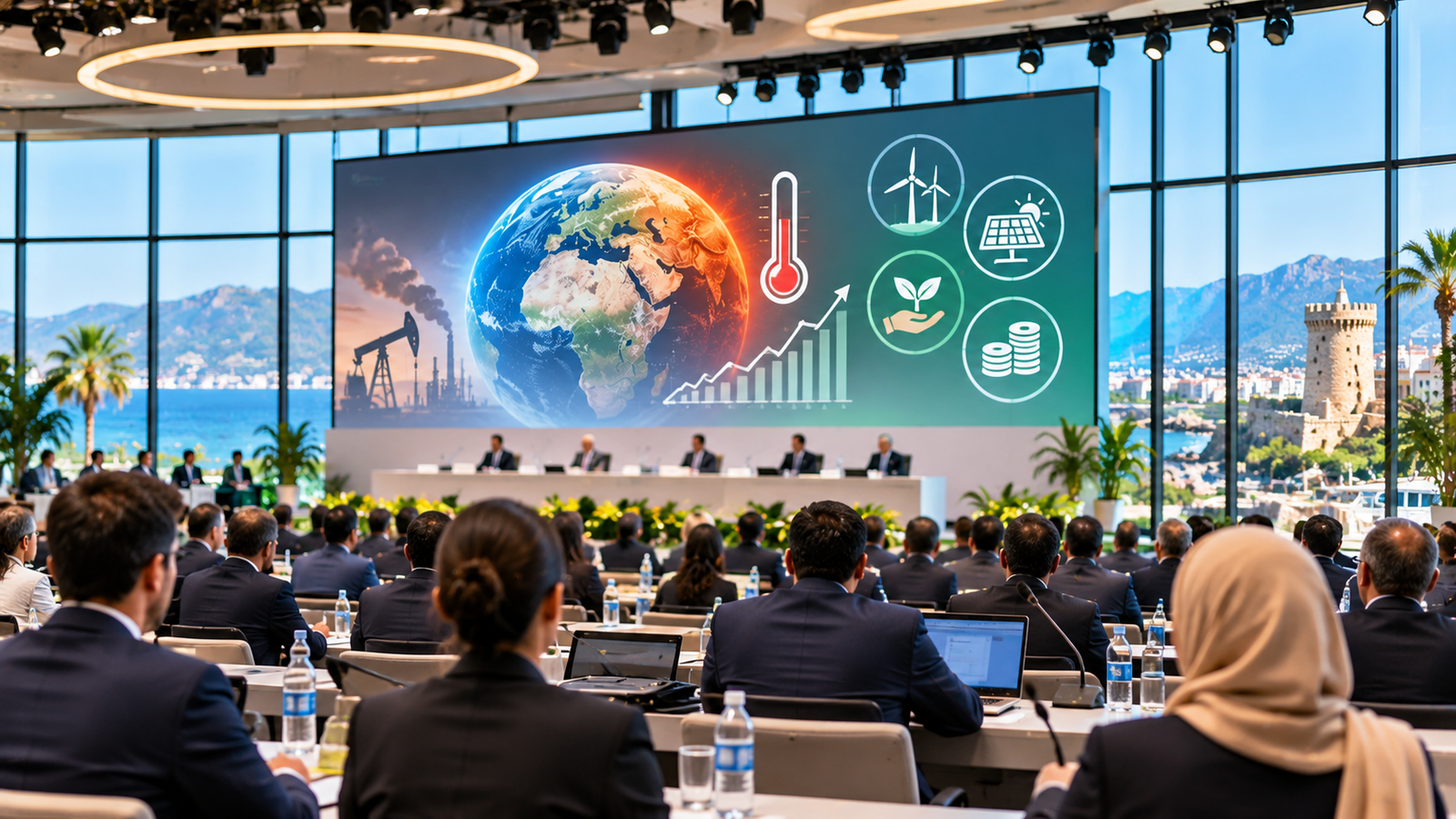
A revised climate agreement draft at the 31st United Nations Climate Change Conference (COP31) in Antalya, Türkiye, has removed explicit references to phasing out fossil fuels and dropped a proposed $120 billion adaptation finance target for developing countries. The changes have triggered criticism from climate campaigners and raised questions about the level of ambition countries are prepared to accept as the negotiations approach their scheduled conclusion on November 20, 2026.
The revised text was published on November 19 after negotiations involving nearly 200 countries. It replaced an earlier draft that had included language calling for accelerated action to phase out fossil fuels, alongside proposals concerning climate finance, electrification and international cooperation. The latest version is shorter and reflects efforts by the conference leadership to find wording that can secure agreement among countries with different economic interests and climate priorities.
The removal of fossil fuel language is particularly significant because coal, oil and gas remain the largest sources of global greenhouse gas emissions. Developing countries have also raised concerns about the financial support available to help them adapt to rising temperatures, extreme weather, floods, droughts and other climate-related risks. The removal of the proposed $120 billion adaptation finance target has therefore become another major point of disagreement.
However, the revised text is still a draft and should not be treated as the final COP31 agreement. Negotiations were continuing ahead of the conference deadline, and countries could still seek further changes before any final decision is adopted. The development nevertheless highlights the difficult balance between climate ambition, energy security, economic development and the financial responsibilities of developed countries.
What Happened at COP31 in Antalya?
COP31 is the 31st session of the United Nations Climate Change Conference, taking place in Antalya, Türkiye, from November 9 to November 20, 2026. The conference brings together governments, climate experts, international organisations, civil society groups and other stakeholders to discuss how countries should respond to climate change.
The negotiations focus on several major issues, including reducing greenhouse gas emissions, adapting to climate impacts, financing climate action, supporting developing countries and implementing commitments under the Paris Agreement.
The latest controversy emerged after a revised draft of the conference’s proposed cover decision was published on November 19. The cover decision is an important political text intended to summarise key messages and areas of agreement from the conference. It is not the same as every technical decision being negotiated at COP31, but it can influence the overall direction and public assessment of the summit.
The earlier version contained language on accelerating the phaseout of fossil fuels and included a proposed adaptation finance target. The revised text removed explicit references to fossil fuels and dropped the proposed $120 billion target.
The changes came as negotiators attempted to narrow disagreements and produce a document acceptable to nearly 200 participating countries. Because COP decisions generally require consensus, even a small number of countries can influence the final wording on politically sensitive issues.
The revised draft therefore reflects the negotiating positions and compromises being considered at the summit, rather than a completed international climate agreement.
Why the Fossil Fuel Phaseout Language Was Removed
Fossil fuels, including coal, oil and natural gas, are major sources of carbon dioxide emissions when burned for energy. These emissions contribute to global warming and are central to international discussions about how quickly countries should transition towards cleaner energy systems.
The earlier COP31 draft included language calling for countries to accelerate the phaseout of fossil fuels. The revised version removed explicit references to fossil fuels, making it less direct on one of the most important issues in climate negotiations.
The disagreement reflects different economic and energy priorities among participating countries. Many economies still depend heavily on fossil fuels for electricity generation, transportation, industrial production and government revenue. Countries with large oil and gas sectors may be concerned about the economic consequences of commitments that require rapid changes to their energy systems.
Other countries and climate campaigners argue that stronger language is necessary to keep global emissions reduction efforts aligned with the goals of the Paris Agreement. They believe that governments need clearer commitments and timelines for reducing dependence on coal, oil and gas.
The challenge for negotiators is to agree on language that recognises the need for climate action while addressing concerns about energy access, economic development and national circumstances.
Removing explicit fossil fuel language from a draft does not mean that fossil fuel use has become environmentally harmless or that countries have abandoned all previous commitments. It means that the revised text does not include the specific phaseout wording that appeared in the earlier proposal.
The Connection With the Paris Agreement
The Paris Agreement is the central international framework for addressing climate change. Adopted in 2015, it aims to strengthen the global response to climate change by keeping the rise in average global temperature well below 2°C above pre-industrial levels and pursuing efforts to limit the increase to 1.5°C.
Countries participating in the agreement submit national climate plans, known as Nationally Determined Contributions (NDCs), which outline their intended actions to reduce emissions and address climate impacts.
The COP31 negotiations are taking place within this wider framework. Governments are discussing how existing commitments can be implemented, how ambition can be strengthened and how financial and technical support can be made available to countries with fewer resources.
The revised COP31 draft acknowledges the possibility that global warming could exceed the 1.5°C threshold. It also refers to the global transition towards low-greenhouse-gas emissions and climate-resilient development.
This acknowledgement is important because it recognises the gap between international temperature goals and current global emissions pathways. However, recognising the risk of exceeding a temperature threshold is not the same as adopting a new legally binding emissions target.
The final significance of the COP31 outcome will depend on the language agreed by countries and the extent to which it supports implementation of the Paris Agreement.
Why the $120 Billion Climate Finance Target Matters
Climate finance is another major issue in the COP31 negotiations. Developing countries need financial resources to prepare for climate impacts, protect communities, improve infrastructure and strengthen their ability to respond to extreme weather.
Adaptation finance is particularly important because it supports measures that help countries cope with the effects of climate change. These measures can include flood protection, water management, early-warning systems, climate-resilient agriculture, improved drainage and stronger public infrastructure.
The earlier COP31 draft included a proposed target of $120 billion in annual adaptation finance by 2035. The revised version removed that specific figure, creating concern among developing countries and climate campaigners about the level of financial support that will be available.
It is important to distinguish adaptation finance from the broader category of climate finance. Climate finance can include funding for both mitigation and adaptation. Mitigation focuses on reducing greenhouse gas emissions, while adaptation aims to reduce vulnerability to climate impacts that are already occurring or expected in the future.
The removal of a specific adaptation finance figure does not mean that all climate finance discussions have ended. The revised negotiations still involve wider questions about funding arrangements, implementation and international cooperation.
However, without a clear target, developing countries may have less certainty about the scale of support they can expect. This is especially important for countries that face significant climate risks but have limited domestic resources to finance large-scale adaptation projects.
Why Developing Countries Are Concerned
Developing countries often face a difficult combination of climate vulnerability, financial constraints and development needs. Many have limited resources to invest in climate-resilient infrastructure while also providing essential services, creating jobs and supporting economic growth.
Climate-related disasters can increase these pressures. Floods can damage roads, homes, schools and agricultural land. Droughts can affect food production and water availability, while heatwaves can create risks for public health, labour productivity and electricity systems.
For countries with limited fiscal capacity, recovery after a major disaster can require borrowing, emergency spending and international assistance. This can create additional pressure on public finances and delay long-term development projects.
Climate finance is therefore an important part of international climate negotiations. Developing countries argue that financial support should be predictable, accessible and sufficient to help them prepare for climate impacts.
The removal of the proposed $120 billion annual adaptation target has raised concerns because it reduces the clarity of the financial commitment being considered in the revised draft.
However, the draft’s removal of that particular figure should not be interpreted as the cancellation of every existing climate finance commitment. The final agreement and other international financing arrangements need to be examined separately.
Electrification Target Remains in the Revised Draft
Although the revised COP31 text removed explicit fossil fuel phaseout language, it retained a global electrification proposal. The draft calls for increasing the share of electricity in global final energy consumption to 35 percent by 2035.
Electrification refers to replacing activities that rely directly on fossil fuels with electricity-based alternatives where practical. Examples include electric vehicles, electric heating systems and industrial processes that can operate using electricity instead of direct fossil fuel combustion.
The potential climate benefit depends on how the electricity is generated. Electrification can reduce emissions when electricity increasingly comes from renewable and other low-emission sources. If electricity production remains heavily dependent on coal and gas, the overall emissions benefits may be more limited.
The 35 percent proposal is therefore connected to wider discussions about renewable energy, electricity infrastructure and energy efficiency.
The revised draft also refers to the importance of increasing renewable energy capacity and improving energy efficiency. These issues are closely connected because cleaner electricity systems can help countries reduce emissions while meeting growing demand for energy.
However, the proposed global electrification target should not be confused with a binding national obligation for every country. The text remained part of the negotiations and could still change before the final conference outcome.
The Role of Renewable Energy in the Climate Transition
Renewable energy is an important part of efforts to reduce greenhouse gas emissions. Solar, wind and hydropower can generate electricity without the direct carbon emissions associated with burning fossil fuels during operation.
Expanding renewable energy can also help countries diversify their energy sources and reduce exposure to international fossil fuel price volatility. However, the transition requires investment in generation capacity, electricity transmission, energy storage and grid management.
The revised COP31 draft’s continued reference to electrification and renewable energy reflects the importance of these technologies in the global climate discussion.
Countries seeking to increase renewable electricity generation must also address practical challenges. Solar and wind output can vary according to weather and time of day, requiring flexible power systems and suitable storage or balancing arrangements.
Industrial economies may also need significant investment to electrify processes that currently rely on direct fossil fuel use. These changes can require new equipment, technical skills and long-term infrastructure planning.
For developing countries, financing is particularly important. Governments may support renewable energy projects through public investment, private-sector participation, international development finance and climate-related funding mechanisms.
The COP31 debate demonstrates that agreement on energy transition targets is closely connected to questions about who will pay for the required infrastructure and how quickly countries can make the transition.
What the Draft Could Mean for Pakistan
Pakistan has a direct interest in international climate negotiations because the country faces significant exposure to climate-related risks. Flooding, extreme heat, water stress and agricultural disruption can affect communities, infrastructure and economic activity.
The country’s experience with major floods has demonstrated the financial and social consequences of climate-related disasters. Damage to homes, roads, crops and public infrastructure can create long-term recovery requirements and place additional pressure on government budgets.
For Pakistan, adaptation finance can support projects such as flood-resilient infrastructure, improved drainage, water conservation, climate-resilient agriculture and stronger early-warning systems.
The removal of the proposed $120 billion annual adaptation finance target could therefore be relevant to Pakistan’s long-term climate planning. A clearer international financing framework could help vulnerable countries estimate the support available for major adaptation requirements.
Pakistan also has an interest in the global energy transition. Expanding renewable energy and improving energy efficiency can help diversify electricity supplies, reduce exposure to imported fuel prices and support a more sustainable energy system.
However, the transition needs to consider affordability, grid capacity, financing and the country’s wider development requirements. Rapid changes without adequate investment and planning could create additional challenges for electricity supply and industrial competitiveness.
The COP31 draft does not announce a new Pakistan-specific funding allocation. Any claim that Pakistan has secured a particular amount through the revised text would therefore be unsupported.
Climate Finance and the Responsibility of Developed Countries
The question of who should finance climate action has been a central issue in international negotiations for many years. Developed countries have historically contributed a large share of cumulative greenhouse gas emissions and generally possess greater financial and technological resources.
Developing countries argue that international climate finance should reflect differences in historical responsibility, economic capacity and vulnerability. They also emphasise that climate action should not prevent them from meeting essential development needs.
The principle of common but differentiated responsibilities and respective capabilities is part of the wider framework of international climate cooperation. It recognises that countries have shared responsibilities but different levels of capacity and historical contribution.
The COP31 draft continues to refer to this principle and the importance of implementing the Paris Agreement in light of different national circumstances.
The removal of a specific adaptation finance target has therefore become more than a technical disagreement about numbers. It reflects wider questions about the fairness, predictability and accountability of international climate support.
The final agreement will need to address these concerns if countries are to maintain confidence in the multilateral climate process.
Climate Campaigners Criticise the Revised Draft
The revised text has faced criticism from climate campaigners who argue that removing explicit fossil fuel language weakens the political message of the conference.
Mohamed Adow, director of Power Shift Africa, criticised the changes, warning that the revised text represented a setback for climate ambition. Other campaigners also raised concerns about the removal of financial targets and stronger language on accountability.
The criticism reflects concerns that international climate negotiations could lose momentum if governments repeatedly weaken commitments when disagreements emerge.
The conference leadership, however, has defended the negotiating approach. Türkiye and Australia have argued that the focus should be on delivering commitments that countries can accept and implement, rather than repeating language that does not have sufficient support.
This disagreement illustrates a recurring challenge in international climate diplomacy. A highly ambitious draft may face opposition and fail to secure consensus, while a more limited text may attract wider support but provide weaker commitments.
The effectiveness of the final outcome will therefore depend not only on the language included but also on whether governments follow through with practical action after the conference.
Why the Final COP31 Agreement Still Matters
The revised draft published on November 19 was not the final agreement. Negotiators were expected to continue discussions ahead of the scheduled conclusion of the summit on November 20.
This distinction is essential when reporting on international climate decisions. Draft documents can change as countries negotiate wording, remove disputed provisions or introduce compromise language.
The final outcome may retain some parts of the revised text, restore earlier proposals or introduce different language to address disagreements. Until the final document is formally agreed, it is not possible to describe the revised draft as the conference’s adopted position.
The final agreement will be important because it can influence future climate planning, international cooperation and expectations about financial support.
For developing countries, the outcome on adaptation finance will be particularly important. For energy-producing economies and countries dependent on fossil fuels, the language on the energy transition will remain politically and economically significant.
The final text will also be assessed against the wider objectives of the Paris Agreement and the need to reduce emissions while supporting communities facing climate impacts.
What Happens Next?
The immediate next step is the completion of COP31 negotiations and the adoption of a final outcome by participating countries. The conference leadership will need to resolve outstanding disagreements and present language that can secure consensus.
Countries will continue to examine the draft’s provisions on fossil fuels, electrification, climate finance, adaptation and other issues. The outcome will depend on whether negotiators can agree on compromises that address the concerns of different country groups.
After the summit, attention will shift towards implementation. Governments will need to translate international commitments into national climate policies, investment plans and practical projects.
For Pakistan, future developments will be particularly relevant in areas such as adaptation funding, renewable energy, water management and climate-resilient infrastructure.
International observers will also assess whether COP31 produces a meaningful outcome or whether unresolved disagreements limit the conference’s impact.
The final adopted text, rather than the November 19 draft alone, will provide the basis for assessing what countries have formally agreed.
Conclusion
The revised COP31 climate draft has created major debate by removing explicit fossil fuel phaseout language and dropping a proposed $120 billion annual adaptation finance target for developing countries. The changes highlight continuing disagreements over energy transition, climate finance and the responsibilities of countries with different levels of economic capacity.
The draft retains a proposed global electrification target of 35 percent by 2035 and acknowledges the possibility that global warming could exceed the 1.5°C threshold. These provisions show that climate action remains part of the negotiations, even as some of the earlier language has been removed.
For Pakistan and other climate-vulnerable developing countries, the adaptation finance debate is especially important. Access to predictable funding can help support flood protection, water management, resilient agriculture and other measures needed to prepare for climate impacts.
However, the revised text was still a draft as of the reporting available on November 20. It should not be treated as the final COP31 agreement or as proof that countries have formally abandoned all previous climate commitments.
The conference’s ultimate significance will depend on the final consensus text and the actions governments take after the negotiations. The challenge remains to turn international climate promises into practical measures that reduce emissions, protect vulnerable communities and support a fair transition towards a more sustainable global economy.
What changed in the revised COP31 climate draft?
The revised COP31 draft released on November 19 removed explicit references to phasing out fossil fuels and dropped a proposed $120 billion annual adaptation finance target for developing countries.
Where is COP31 being held in 2026?
COP31 is taking place in Antalya, Türkiye, from November 9 to November 20, 2026.
Why is the removal of fossil fuel language important?
Coal, oil and natural gas are major sources of greenhouse gas emissions. Removing explicit phaseout language from the draft has raised concerns about the strength of international commitments on the energy transition.
What was the proposed $120 billion climate finance target?
The earlier draft included a proposed target of $120 billion in annual adaptation finance by 2035 to help developing countries address climate impacts. This specific target was removed from the revised text.
What electrification target remains in the COP31 draft?
The revised draft retains a proposal to increase electricity’s share of global final energy consumption to 35 percent by 2035.
How could the COP31 climate finance debate affect Pakistan?
Pakistan needs resources for climate adaptation measures such as flood protection, water management and climate-resilient agriculture. Changes to international adaptation finance arrangements could affect the availability and predictability of future support, but no new Pakistan-specific allocation was announced in this draft.
Has COP31 officially adopted the revised climate draft?
The November 19 document was a revised draft, not the final adopted agreement. Negotiations were continuing ahead of the conference’s scheduled conclusion on November 20.
What is the difference between climate mitigation and adaptation?
Climate mitigation focuses on reducing greenhouse gas emissions, while adaptation involves preparing for and reducing the harm caused by climate impacts such as floods, heatwaves and droughts.
About The Author