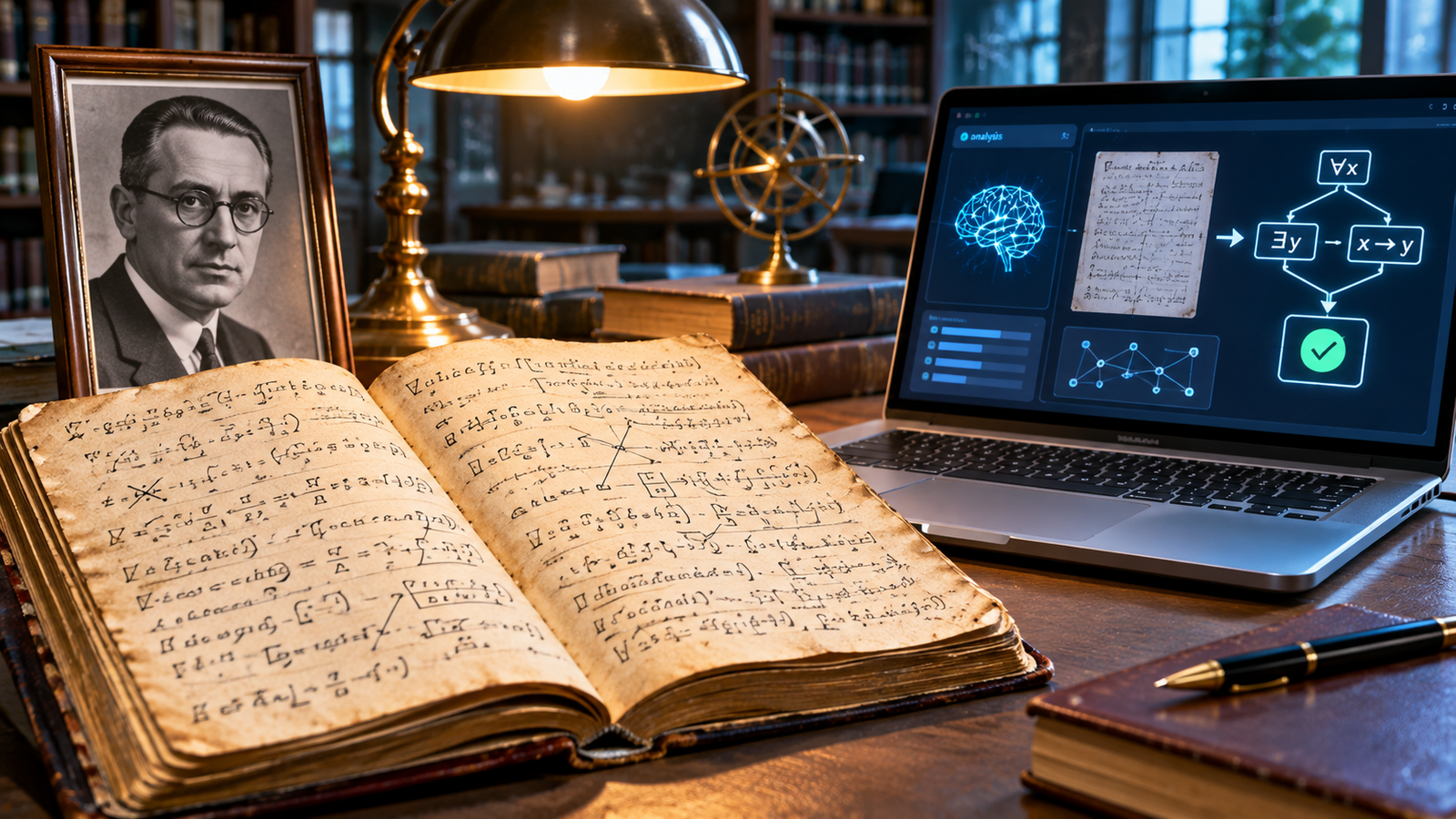
The AI analysis of Kurt Gödel’s notebooks 2026 has attracted international attention after artificial intelligence helped researchers examine more than 1,000 pages of unpublished mathematical work by one of the most influential logicians of the 20th century. A research project led by Finnish logician Jan von Plato used the AI model Claude to analyse transcriptions of notebooks written by Kurt Gödel in the early 1940s, identifying hundreds of mathematical results, proof sketches and ideas that had received little or no attention.
The notebooks contain 1,009 pages of mathematical and logical material, much of it originally written in Gabelsberger, an old German shorthand system. Researchers had been studying the documents for years, but progress was slow because the writing was difficult to interpret and required specialist knowledge. According to a report published by The Guardian on November 13, 2026, the AI-assisted analysis produced a detailed explanation of the material within days, allowing the research team to examine connections across the notebooks more efficiently.
The findings are particularly interesting because they show how AI can support historical scientific research. However, the results were not accepted simply because an AI model identified them. Researchers used Coq, a formal proof assistant, to check the mathematical claims. Of 663 extracted theorem statements, approximately 400 were verified as stated, around 200 needed corrections or additional assumptions, and about 50 were found to be false.
The AI analysis of Kurt Gödel’s notebooks 2026 therefore highlights both the potential and limitations of artificial intelligence in mathematics. It demonstrates how AI can help researchers navigate large and difficult collections of historical material, while also showing why human expertise and independent verification remain essential.
AI Analysis of Kurt Gödel’s Notebooks 2026: What Did Researchers Discover?
The research project focused on 16 notebooks written by Kurt Gödel during the early 1940s. Together, these notebooks contain 1,009 pages of mathematical notes, logical arguments and unfinished ideas. Many pages use Gabelsberger shorthand, a German writing system that is now rarely understood.
Jan von Plato, a Finnish logician at the University of Helsinki, has led the project since 2017. His team had been working through the material at a pace of approximately one page per week. The challenge was not simply reading the words. Researchers also needed to understand the mathematical context, reconstruct arguments and identify relationships between ideas recorded across different notebooks.
The project received a new opportunity when von Plato decided to use Claude to help analyse the material. He provided the AI model with his transcriptions of Gödel’s notebooks, six books he had written about Gödel and additional scientific literature. The model then produced a comprehensive analysis of the material within a few days.
According to von Plato’s account reported by The Guardian, the resulting explanation ran to approximately 650 pages. It helped identify hundreds of mathematical results and more than a dozen themes in logic and the foundations of mathematics that had not been explored in detail.
The findings do not mean that every identified result was a completed mathematical proof. Some were established arguments, while others were sketches, incomplete ideas or statements requiring further work. That distinction is important when describing what the AI-assisted project actually achieved.
Who Was Kurt Gödel and Why Are His Notebooks Important?
Kurt Gödel was an Austrian-born mathematician and logician widely regarded as one of the most influential thinkers in the history of modern mathematics. He is best known for his two incompleteness theorems, published in 1931, which fundamentally changed how mathematicians understand formal systems and mathematical proof.
In simplified terms, Gödel demonstrated that sufficiently powerful formal mathematical systems contain statements that cannot be proved or disproved within those systems using their own rules, provided the systems meet certain conditions. His work challenged earlier hopes that mathematics could be reduced to a complete and fully self-contained set of formal proofs.
Gödel’s ideas influenced later developments in mathematical logic, theoretical computer science and the foundations of computation. His work also inspired researchers such as Alan Turing, whose contributions helped establish the theoretical foundations of modern computing.
Although Gödel published only a limited number of papers after his major results of the 1930s, he left behind a substantial body of unpublished material. His manuscripts have remained important to historians of mathematics because they may reveal how some of his ideas developed and how he approached difficult mathematical problems.
The 16 notebooks examined by von Plato offer an opportunity to understand more of that intellectual work. Their importance lies not only in the results they may contain but also in the possibility of reconstructing the development of mathematical ideas that were never formally published.
How Did AI Help Researchers Examine More Than 1,000 Pages?
The key contribution of AI in this project was its ability to analyse a large body of transcribed material together and identify connections across different sections. Human researchers generally work through complex historical documents page by page, building an understanding gradually. This can make it difficult to remember every detail and recognise relationships between ideas separated by hundreds of pages.
Von Plato supplied Claude with the transcriptions rather than relying on the model to independently read the original shorthand handwriting. This distinction is important: the human research process included learning and interpreting Gabelsberger shorthand before the AI was used to help analyse the mathematical content.
Claude was then able to examine the material as a connected collection. It produced a detailed digest and helped identify mathematical statements, proof sketches and possible relationships between results. The researcher still had to review the output and assess whether the interpretations were accurate.
The process illustrates a useful application of AI in academic research. A model can help organise large volumes of information, identify patterns and suggest connections that may be difficult to notice during conventional reading. However, its suggestions must be checked against the original sources and the relevant subject knowledge.
In this case, the AI did not replace the mathematician. It helped accelerate a research process that still depended on specialist interpretation, mathematical judgement and formal verification.
What Happened When Researchers Checked the 663 Mathematical Results?
One of the most important parts of the project was the verification process. After Claude identified 663 theorem statements, including results Gödel had proved, outlined or considered, von Plato and his colleagues used Coq to assess their mathematical validity.
Coq is a formal proof assistant. It allows mathematical arguments to be expressed in a precise formal language and checks whether the logical steps follow according to the specified rules. This provides a much stronger test than simply asking an AI model whether a mathematical argument appears correct.
The results were mixed. Approximately 400 theorem statements were verified as written. Around 200 needed repairs, which could involve making a statement more precise or adding an assumption. Approximately 50 were found to be false.
These results demonstrate why AI-generated mathematical analysis requires careful checking. A model may identify a promising argument but misunderstand a definition, overlook a necessary condition or produce an incorrect interpretation. Formal verification can help distinguish valid mathematical reasoning from claims that need correction.
The false results were not necessarily surprising to the researchers. Gödel himself sometimes added comments to his notes indicating that a particular argument was incorrect or unsatisfactory. Historical notebooks can contain unfinished work, abandoned ideas and mistakes alongside important discoveries.
The verification process is therefore central to the story. The achievement was not simply that AI produced a long list of mathematical statements; it was that researchers used an independent formal system to examine which statements could be supported.
Did Gödel Nearly Prove a Result Before Paul Cohen?
One of the most historically interesting findings concerns the independence of the axiom of choice, an important question in set theory. The axiom of choice is a mathematical principle used in many areas of mathematics, but its relationship with other foundational assumptions has been the subject of extensive research.
In 1966, American mathematician Paul Cohen received the Fields Medal for major work demonstrating the independence of the continuum hypothesis and the axiom of choice from the standard axioms of set theory.
Gödel had earlier claimed that he had already proved the relevant independence result during the 1940s. However, when colleagues later asked him to reconstruct the proof, he could not produce a complete argument from his notes.
During the new analysis, von Plato asked Claude to examine whether the notebooks contained a proof of the independence of the axiom of choice. According to his account, the AI identified an argument that came close to a complete proof. One definition in the argument was incorrect, although Gödel had used the correct definition in earlier notes.
Von Plato said the reconstructed argument passed through Coq after the definition was corrected. He described the structure of the proof as mathematically significant because it connected several results in set theory through a consistent approach.
Nevertheless, this finding should not be reported as definitive proof that Gödel completed and published the result before Cohen. A modern reconstruction based on historical notes does not automatically establish exactly what Gödel had formally achieved or whether the argument was complete in its original form.
Logician Joel David Hamkins, quoted by The Guardian, said the finding would be historically interesting if the reconstruction stood up, but he emphasised that historians still need to determine how much of the argument belongs to Gödel and how much comes from the modern reconstruction.
Why the Discovery Matters for Artificial Intelligence and Mathematics
The project offers an example of AI being used for more than generating text, answering questions or writing computer code. It shows how an AI model can help researchers examine complicated historical material and identify relationships across a large collection of documents.
Mathematics is particularly demanding because a result must be supported by a precise argument. A statement that sounds plausible is not necessarily true, and a proof that works in one situation may fail if a required assumption is missing.
The combination of AI analysis and formal proof checking could help researchers work with difficult mathematical archives, technical documents and large collections of scientific literature. AI can suggest interpretations and identify possible results, while formal systems and human experts assess whether those interpretations are valid.
The approach may also be useful in other areas of research where important information is spread across large collections of historical documents. Scientists and historians often work with handwritten manuscripts, old scientific terminology and incomplete records. AI tools could help organise and compare this material, although the accuracy of the results will depend on the quality of the source transcriptions and the verification process.
The Gödel project does not show that AI has replaced mathematicians or independently created hundreds of proven new theorems. Instead, it demonstrates how AI can support expert research when used alongside careful checking and subject knowledge.
What Are the Limitations of AI in Mathematical Research?
Despite the impressive speed of the analysis, the project also highlights important limitations. The model worked from human-prepared transcriptions and supporting material, meaning the accuracy of its analysis depended partly on the quality of those inputs.
It also produced results that required extensive checking. Approximately 200 statements needed repairs and around 50 were false, showing that an AI-generated explanation cannot be treated as an authoritative mathematical source without further examination.
Formal verification has its own limits. Coq can check whether a proof follows from the definitions and assumptions entered into the system. It cannot independently establish that a modern reconstruction perfectly represents what a historical mathematician intended in an old notebook.
There is also a question of historical attribution. If an AI model reconstructs an argument from incomplete notes, researchers must distinguish the original mathematician’s written work from the modern interpretation and corrections introduced during reconstruction.
These questions are especially important when discussing Gödel’s possible anticipation of later mathematical results. The notebooks may show that he was working towards an important result, but historical credit requires careful analysis of what was actually written, proved and communicated.
The project therefore offers a balanced lesson: AI can make difficult research faster and more manageable, but speed does not remove the need for accuracy, transparency and independent review.
What Researchers Plan to Explore Next
The analysis of Gödel’s mathematical notebooks has opened several new research directions. Von Plato said the material contains more than a dozen themes in logic and the foundations of mathematics that deserve further investigation.
These themes could help researchers understand how Gödel approached problems, how his ideas developed and whether some of his unpublished work anticipated mathematical developments that became widely known decades later.
The project may also expand beyond the notebooks already examined. Gödel left extensive unpublished material, including manuscripts relating to physics and cosmology. Von Plato has indicated that these areas could become subjects of future investigation after the current logic projects are completed.
The wider importance of this work is that many historical scientific documents remain difficult to interpret. New AI-assisted methods may help researchers explore them more efficiently, particularly when combined with specialist knowledge and tools capable of checking technical claims.
Further work will be needed to establish the historical and mathematical significance of individual findings. The current results should be viewed as an important research development rather than a final account of everything contained in Gödel’s unpublished manuscripts.
Conclusion: AI Opens a New Path into the History of Mathematics
The AI analysis of Kurt Gödel’s notebooks 2026 demonstrates how artificial intelligence can help researchers investigate complex historical scientific material. By analysing human-prepared transcriptions of 1,009 pages of mathematical notes, Claude helped identify 663 theorem statements, proof sketches and ideas that could then be examined using formal verification tools.
The results were not uniformly correct. Approximately 400 statements passed verification as written, around 200 required corrections or additional assumptions, and about 50 were false. This makes the project an important example of why AI-assisted research must include independent checking rather than relying on generated answers alone.
The investigation into Gödel’s near-proof of the independence of the axiom of choice is particularly interesting, although its historical significance still requires careful expert assessment. The findings also point towards further opportunities to examine Gödel’s unpublished work in logic, physics and cosmology.
For the scientific community, the project highlights a promising partnership between human expertise, artificial intelligence and formal mathematical verification. AI can help researchers discover connections that are difficult to identify through traditional reading, but reliable scientific conclusions still depend on evidence, reasoning and independent validation.
What did AI discover in Kurt Gödel’s notebooks in 2026?
AI helped researcher Jan von Plato identify 663 theorem statements, proof sketches and mathematical ideas in Kurt Gödel’s 1940s notebooks. The findings were subsequently examined using the Coq proof assistant.
Who used AI to analyse Kurt Gödel’s notebooks?
Finnish logician Jan von Plato, who leads a research project at the University of Helsinki, used the AI model Claude to analyse transcriptions of Gödel’s notebooks.
How many pages were included in Gödel’s notebooks?
The 16 notebooks examined in the project contain a total of 1,009 pages of mathematical and logical notes.
Were all 663 mathematical results verified as correct?
No. Approximately 400 were verified as stated, around 200 needed repairs or additional assumptions, and about 50 were found to be false.
What is Coq in mathematical research?
Coq is a formal proof assistant that helps researchers express mathematical arguments precisely and check whether their logical steps follow from the stated assumptions.
What is the axiom of choice and why is Gödel’s work important?
The axiom of choice is an important principle in set theory. The notebook analysis identified a near-complete argument related to its independence, a result associated with Paul Cohen’s major work in 1966.
Did AI read Gödel’s original shorthand handwriting?
The researcher supplied Claude with human-prepared transcriptions of the notebooks, rather than relying on the model to independently decipher the original Gabelsberger shorthand.
What does this discovery mean for the future of AI in science?
It shows that AI can help researchers analyse large and complex collections of scientific material, but human expertise and independent verification remain necessary to establish reliable conclusions.
About The Author