The historic black hole image released in 2019 has received another important scientific confirmation. An independent research team has reanalysed observations of the supermassive black hole at the centre of the M87 galaxy and recovered the same distinctive ring-like structure, strengthening confidence in the original Event Horizon Telescope (EHT) results.
The new study, published in the journal Nature on November 11, 2026, used an independent image-reconstruction approach to examine data collected by the Event Horizon Telescope in 2017, 2018 and 2021. Researchers reported that their analysis consistently recovered a compact, ring-shaped source around the black hole’s shadow.
The finding matters because the first black hole image, unveiled in April 2019, was a major achievement in astronomy. However, reconstructing an image of an object billions of light-years away from radio telescope measurements is technically challenging. Some researchers had questioned whether the bright ring in the original image could have been influenced by the mathematical methods used to process the observations.
The latest research addresses that debate by applying a different technique that relies on calibration-independent measurements. The team reported a ring diameter of approximately 42.2 microarcseconds and estimated the black hole’s mass at around 6.5 billion times the mass of the Sun.
The study does not represent a newly captured photograph of a black hole. Instead, it provides an independent scientific analysis of existing telescope data and supports the interpretation of the original image.
What Did the New Black Hole Study Discover?
The new study examined the supermassive black hole known as M87*, located at the centre of the Messier 87 galaxy.
Researchers applied an independent imaging method to publicly available Event Horizon Telescope observations. Their analysis produced a ring-like structure consistent with the black hole image released by the EHT collaboration in 2019.
According to the research published in Nature, the reconstructed ring had an angular diameter of 42.2 ± 1.5 microarcseconds. Using the study’s adopted scaling assumptions, the researchers estimated the black hole’s mass at approximately 6.5 billion solar masses.
The team also found that the ring-like appearance remained consistent across observations from different years and different reconstruction settings.
This is important because the image reconstruction process is not straightforward. Radio telescopes do not capture a conventional photograph in the way a digital camera does. Instead, they collect signals that must be combined and processed using sophisticated mathematical techniques.
The independent analysis offers additional evidence that the ring is a genuine feature supported by the observational data rather than simply an artefact created by one particular imaging method.
Why Was the First Black Hole Image Controversial?
In April 2019, the Event Horizon Telescope collaboration released the first-ever image of a black hole’s shadow. The image showed a bright, uneven ring surrounding a dark central region.
The image represented the supermassive black hole M87*, located approximately 55 million light-years from Earth.
The announcement attracted worldwide attention because it provided the first direct visual evidence of the region surrounding a black hole at event-horizon scales.
However, producing the image required researchers to combine observations from radio telescopes located in different parts of the world. The resulting dataset was incomplete and required advanced computational methods to reconstruct the source.
Some researchers questioned whether the ring-like structure was sufficiently supported by the available measurements. They argued that different assumptions, calibration choices and reconstruction techniques could produce different appearances.
An alternative analysis published in 2022 by another research group produced a different representation of the source, including a bright, less clearly ring-shaped feature.
These disagreements did not mean that black holes were being disproved. Instead, they highlighted a technical question: how reliably could scientists reconstruct the structure around M87* from incomplete radio telescope measurements?
The new Nature study directly addresses this issue by using a different method and reporting that the ring-like structure is consistently recovered.
How Did Scientists Reanalyse the Black Hole Image?
The research team used an imaging approach called Generative Deep learning Image Reconstruction with Closure Terms, or GenDIReCT.
The method was developed to reconstruct astronomical images using measurements known as closure invariants. These measurements contain information about the structure of a radio source while being less sensitive to certain instrument calibration errors.
Traditional radio interferometry imaging can be affected by incomplete telescope coverage, atmospheric disturbances, calibration uncertainties and the assumptions used during image reconstruction.
The researchers aimed to reduce dependence on manually selected image shapes and other prescribed assumptions.
GenDIReCT uses a machine-learning-based generative imaging system. It combines a latent diffusion model with a neural network designed to produce an image that is consistent with the measured telescope data.
The team applied the method to publicly available M87* observations from three observing periods: 2017, 2018 and 2021.
They tested different image fields of view and generated multiple reconstructions for the datasets. The results repeatedly showed a compact ring-like structure on an angular scale of approximately 40 microarcseconds.
The researchers also compared their findings with earlier Event Horizon Telescope reconstructions.
The consistency across different observation periods and reconstruction settings strengthened the case that the ring-like structure was supported by the underlying measurements.
What Is the Event Horizon Telescope?
The Event Horizon Telescope is an international network of radio observatories that work together to study black holes at extremely high angular resolution.
Instead of relying on one enormous physical telescope, the project connects observatories across different continents through a technique known as very-long-baseline interferometry (VLBI).
The technique combines signals recorded by multiple radio telescopes observing the same astronomical object. The distance between the participating observatories creates an effective telescope with a resolution comparable to that of an instrument spanning a large fraction of Earth’s diameter.
This capability is essential for studying objects that appear extremely small in the sky.
The 2019 image of M87* demonstrated how observations from a global network could be combined to reveal structures close to a black hole’s event horizon.
The EHT has also observed the supermassive black hole at the centre of our own Milky Way, known as Sagittarius A*.
The project continues to improve its observing capabilities and data analysis methods, helping astronomers investigate the environments surrounding some of the universe’s most extreme objects.
How Large Is the M87* Black Hole?
M87* is an extremely massive black hole located at the centre of the giant elliptical galaxy Messier 87.
The independent 2026 study estimated its mass at approximately 6.5 billion solar masses, with an uncertainty of about 0.5 billion solar masses under the assumptions used in the analysis.
A solar mass is the mass of our Sun. This means that M87* contains the equivalent of billions of Suns compressed into an extraordinarily compact region.
The study measured the ring’s angular diameter at approximately 42.2 microarcseconds. A microarcsecond is one-millionth of an arcsecond, an extremely small unit used by astronomers to measure apparent angles in the sky.
The measurement helps scientists compare the observed structure with theoretical models of black holes and the matter surrounding them.
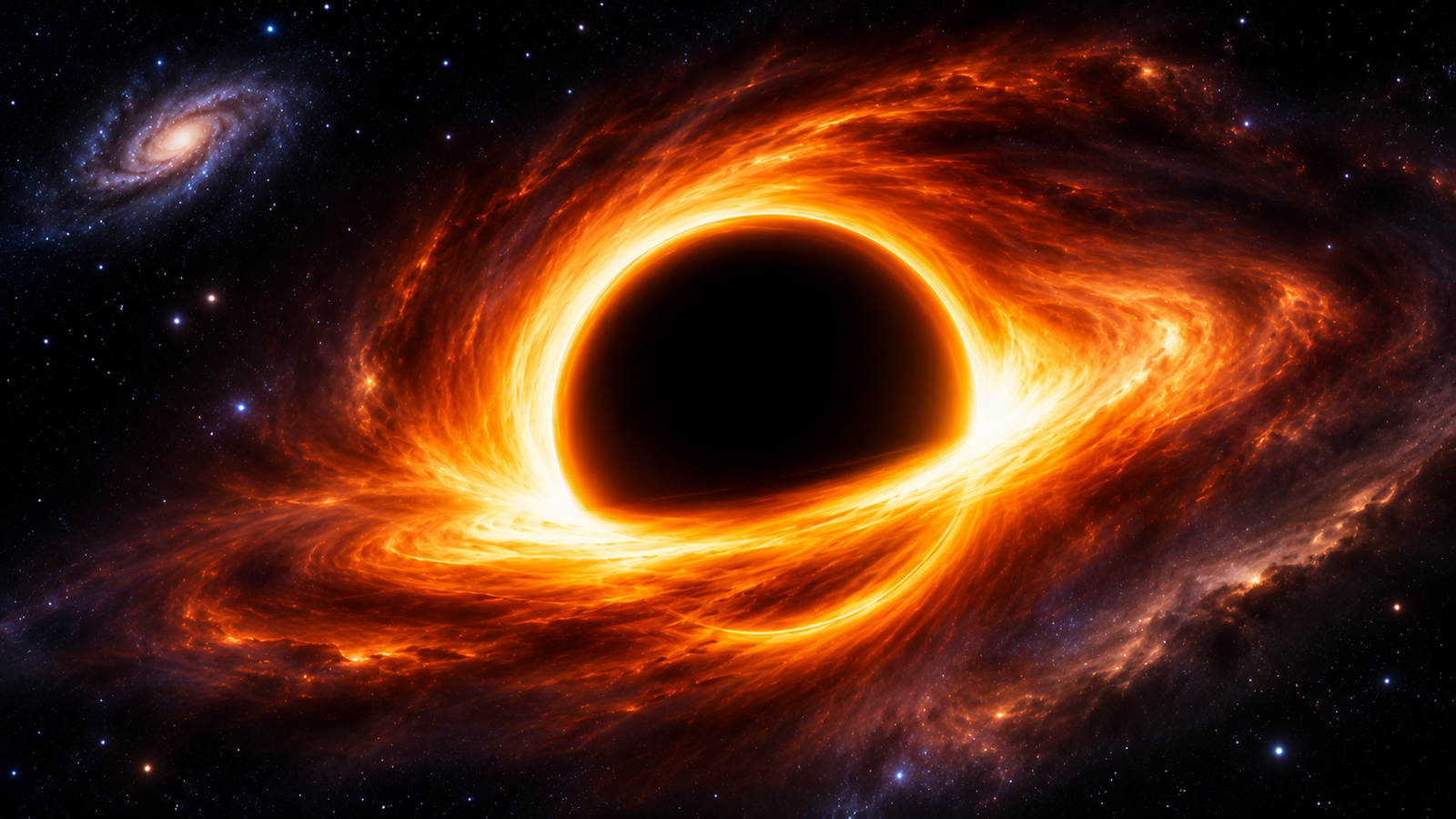
It is important to distinguish the bright ring from the black hole itself. The glowing material comes from extremely hot matter around the black hole, while the central dark region is associated with the black hole’s shadow.
What Does the Bright Ring Around a Black Hole Represent?
The bright ring visible in the M87* image is associated with radiation emitted by hot material surrounding the black hole.
This material forms an accretion flow, in which gas and plasma move under the influence of the black hole’s intense gravity.
As the material approaches the black hole, it can become extremely hot and emit radiation. The black hole’s gravity also bends the paths of light, creating a distorted appearance around the central dark region.
The dark area is commonly described as the black hole’s shadow. It is not a photograph of the event horizon itself, but an observable feature produced by the way gravity affects light around the black hole.
The uneven brightness of the ring reflects the complex environment around M87*. The appearance depends on the motion of the emitting material, gravitational effects and the viewing angle.
Scientists study these features to understand how matter behaves under extreme gravitational conditions.
Why Is the 2026 Confirmation Important for Einstein’s Theory of Relativity?
Black holes are among the most important predictions of Albert Einstein’s general theory of relativity.
The theory describes gravity as the curvature of spacetime caused by mass and energy. In the extreme environment around a black hole, this curvature becomes so strong that light cannot escape once it crosses the event horizon.
The appearance of the M87* shadow is broadly consistent with expectations based on general relativity and models of matter surrounding a supermassive black hole.
The new study strengthens confidence in the measured ring-like structure by showing that an independent reconstruction method can recover it from the observational data.
However, the research should not be described as a final proof of every aspect of Einstein’s theory. It is a significant observational cross-check of the black hole image and its measured properties.
Further observations and improved imaging techniques will be needed to investigate additional details, including the black hole’s spin and the structure of the matter close to its event horizon.
Could Scientists Produce Even Clearer Black Hole Images in the Future?
Astronomers are continuing to improve the techniques used to observe black holes.
Future observations may benefit from additional radio telescopes, improved sensitivity, better data coverage and more advanced image reconstruction methods.
One important goal is to obtain clearer information about the structure of the bright emission around black holes and potentially resolve finer features associated with the photon ring.
The photon ring is related to light that has travelled along paths strongly bent by the black hole’s gravity. Detecting and studying it in greater detail could provide additional information about the geometry of spacetime near the event horizon.
Researchers also hope that future observations will help investigate black hole spin and the relationship between black holes and powerful jets of material launched from their surroundings.
The 2026 study is an example of how better analysis methods can extract additional scientific information from observations that have already been collected.
What Does This Discovery Mean for Astronomy?
The independent confirmation of the M87* image demonstrates the importance of testing major scientific results through different methods.
Astronomy often involves observing objects that cannot be studied directly or visited by spacecraft. Scientists must rely on signals collected from enormous distances and use mathematical models to interpret them.
Independent verification helps researchers identify weaknesses in analysis methods and determine whether a result remains consistent when different techniques are applied.
The M87* research also demonstrates how machine learning can contribute to scientific imaging. In this case, the GenDIReCT method was used to reconstruct radio telescope data and examine the structure around a black hole.
The study does not mean that artificial intelligence independently discovered a new black hole. Rather, researchers developed and tested a computational method to analyse real astronomical measurements.
This distinction is important when explaining the scientific result to readers.
Conclusion: New Research Strengthens Confidence in the Historic Black Hole Image
The latest independent analysis of M87* provides further support for the historic black hole image released by the Event Horizon Telescope in 2019.
Published in Nature on November 11, 2026, the research used a different image-reconstruction method to analyse observations collected in 2017, 2018 and 2021.
The team consistently recovered a ring-like structure with a measured diameter of approximately 42.2 microarcseconds and estimated the black hole’s mass at around 6.5 billion solar masses.
The result is important because it addresses earlier questions about whether the original ring-shaped image could have been influenced by reconstruction assumptions.
Although the study does not provide a new photograph or settle every question about M87*, it offers an independent scientific confirmation of a major astronomical observation.
As telescope networks and computational methods continue to improve, scientists may be able to investigate black holes in even greater detail and gain new insights into gravity, matter and the structure of the universe.
What did the new 2026 black hole study confirm?
The study independently confirmed the ring-like structure around the M87* black hole by analysing existing Event Horizon Telescope data with a different imaging method.
Which black hole was examined in the new research?
Researchers examined M87*, the supermassive black hole located at the centre of the Messier 87 galaxy.
When was the new black hole study published?
The independent research was published in the journal Nature on November 11, 2026.
How massive is the M87* black hole?
The 2026 study estimated the mass of M87* at approximately 6.5 billion times the mass of the Sun.
What is the Event Horizon Telescope?
The Event Horizon Telescope is a global network of radio observatories that work together using very-long-baseline interferometry to study black holes.
What is the bright ring around a black hole?
The bright ring is produced by hot matter surrounding the black hole, while gravity bends light around the central dark region known as the black hole’s shadow.
Did scientists capture a new black hole photograph in 2026?
No. The researchers reanalysed existing Event Horizon Telescope observations using an independent image-reconstruction method.
Why is the M87* black hole study important for science?
It provides independent support for the historic black hole image and demonstrates how improved computational methods can help scientists analyse complex astronomical observations.
About The Author