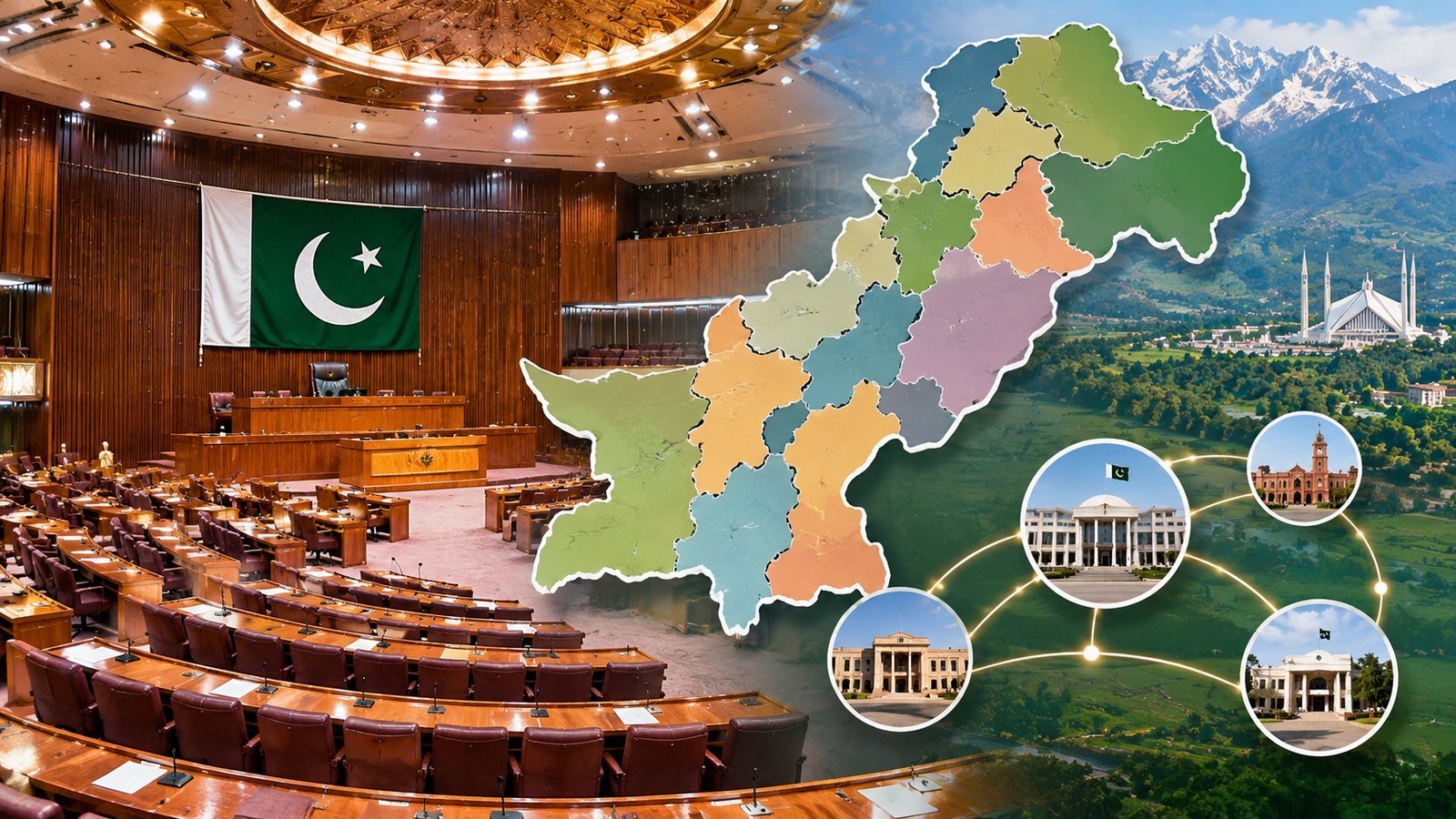
Pakistan’s debate over creating additional provinces has gained fresh attention after Defence Minister Khawaja Asif publicly backed the idea of establishing as many as 12 administrative units in the country. Speaking to Geo News in Sialkot on November 8, the minister said any new provinces should be formed on administrative grounds rather than on the basis of language, ethnicity or political interests. His remarks were reported by multiple Pakistani news organisations on November 8 and 9, 2026.
Asif argued that Pakistan’s growing population required a more effective governance structure and that decision-making powers should not remain concentrated in provincial capitals. He also called for greater devolution of authority and resources to local institutions, saying local governments remained dependent on provincial administrations.
The statement has renewed discussion about administrative restructuring, public-service delivery and the distribution of resources. However, it is important to distinguish a minister’s public support for an idea from an approved government policy. No final decision on creating 12 provinces, their boundaries or a constitutional timetable has been announced in the reports reviewed for this article.
What Khawaja Asif said about 12 provinces
In his interview with Geo News, Defence Minister Khawaja Asif said that if there was a proposal for 12 provinces, the idea could be considered, provided the new units were not created on linguistic, ethnic or political grounds. He presented administrative efficiency and improved public-service delivery as the central reasons for considering smaller units.
The minister said Pakistan’s population had grown and argued that governance could become more effective if administrative authority was brought closer to the people. He questioned the concentration of decision-making in provincial capitals, including Lahore, Karachi, Quetta and Peshawar, and called for powers to be transferred to smaller administrative units.
Asif’s remarks amount to support for discussing administrative restructuring. They do not, by themselves, establish that the federal cabinet has approved a plan, that a constitutional amendment has been drafted or that a referendum has been scheduled. Those matters would require separate official steps and confirmation.
Why the debate over new provinces has returned
The debate over creating new provinces in Pakistan has surfaced periodically, often linked to demands for better administration, more equitable development and greater access to government services. Supporters of smaller provinces argue that large provincial administrations can struggle to address the needs of distant districts and fast-growing urban areas.
The argument is that smaller administrative units could bring government offices, planning decisions and public spending closer to residents. Advocates also say that a more localised system may improve oversight and make it easier for citizens to hold officials accountable for schools, hospitals, roads, water supply and municipal services.
However, the issue is complex. New provincial boundaries can affect political representation, public finances, civil-service structures, assets, water arrangements and the distribution of natural resources. Any proposal would therefore need detailed consultation, legal analysis and agreement among relevant political and constitutional stakeholders.
Administrative grounds versus ethnic or linguistic divisions
A central part of Asif’s statement was his insistence that new provinces should be based on administrative requirements rather than language, ethnicity or political interests. This distinction is important in a country where provincial identity, language and regional history are significant parts of public life.
An administrative case for restructuring would normally examine population size, distance from provincial headquarters, service-delivery gaps, infrastructure, economic links and the capacity of local institutions. It would also need to consider whether new units could deliver measurable improvements in governance rather than simply create additional layers of administration.
At the same time, any constitutional discussion would need to recognise the rights and concerns of communities living in the affected areas. A durable arrangement would require transparent criteria, public consultation and safeguards against discrimination. The minister’s comments set out his stated preference, but they do not resolve how those criteria would be defined or applied.
Devolution of powers and resources to local governments
Asif’s remarks also focused on the relationship between provincial governments and local institutions. He argued that resources transferred by the federal government remained largely under provincial control, while local governments continued to depend on provincial administrations for funds and authority.
This part of the debate goes beyond the number of provinces. Local governments are responsible for services that directly affect daily life, including municipal roads, sanitation, local planning and some community-level infrastructure. Their ability to deliver these services depends on predictable funding, clear legal responsibilities and administrative capacity.
Creating more provinces would not automatically guarantee stronger local government. If authority remains concentrated at the new provincial headquarters, residents may see little change. Any restructuring proposal would therefore need to explain how powers, budgets and accountability would be distributed among provincial, district and municipal institutions.
Constitutional process: why a political statement is not a decision
Changing the number or boundaries of provinces is a constitutional matter. Pakistan’s Constitution sets out a special procedure for altering provincial limits. Under Article 239(4), a constitutional amendment affecting the limits of a province cannot be presented to the President for assent unless it has been passed by the provincial assembly of that province by at least a two-thirds majority of its total membership.
This means a proposal to create new provinces would require more than a minister’s statement or an announcement by one political party. The exact constitutional route would depend on the details of the proposed changes and would involve parliamentary and provincial constitutional processes. Political agreement and legislative approval would be essential.
As of the reports published on November 9, 2026, no final boundaries, approved constitutional amendment or confirmed implementation schedule had been announced. Readers should therefore treat discussion of a possible 12-province structure as a proposal under debate, not as a change that is already taking place.
What is known – and what remains unconfirmed
The confirmed development is that Khawaja Asif publicly expressed support for the possibility of up to 12 provinces, provided they were formed on administrative rather than ethnic, linguistic or political grounds. His remarks were reported by Dawn, The News and The Express Tribune, which attributed the comments to his interview with Geo News.
Other media reports have discussed a possible arrangement that could divide Punjab into four units, Khyber Pakhtunkhwa and Balochistan into three each, and Sindh into two. Some reports have also referred to a possible referendum or a future 28th Constitutional Amendment. These details have been presented as reported proposals or discussions, not as an approved government plan.
No official final map, provincial boundaries, referendum date, constitutional bill or implementation timetable was identified in the reporting used for this article. Mukhbir should update the story only if an official document, parliamentary record or further on-record statement confirms those details.
Potential impact on public services and development
If a future restructuring plan is formally developed, its public value would depend on whether it improves services and reduces the distance between citizens and decision-makers. Smaller units could, in principle, make it easier to plan local infrastructure, monitor public spending and respond to regional needs. But those benefits are not automatic and would depend on institutional design and funding.
The transition could also involve significant costs. New provincial administrations may require buildings, staff, departments, assemblies, legal frameworks and budget arrangements. The distribution of existing public assets, debts, employees and development projects would need careful planning. Without transparent financial estimates, it would be difficult to assess whether the benefits would outweigh the costs.
Any serious proposal would need to explain how it would affect the National Finance Commission process, provincial revenue, local-government funding, water and energy arrangements, and the delivery of public services during the transition. These questions should be addressed before boundaries are finalised or political commitments are made.
Political reactions and the need for broader consultation
The discussion has also been accompanied by renewed demands from political parties for administrative units and greater devolution. Dawn reported that MQM-P reiterated its call for new administrative units in Sindh, linking the demand to the transfer of powers and resources to the grassroots level. The party discussed the issue at a meeting chaired by its convener, Khalid Maqbool Siddiqui, according to a party press release cited in the report.
Such positions show that the debate involves multiple political actors and different regional concerns. However, demands made by a party or comments from an individual minister should not be confused with a consensus among all provinces or a formal government decision.
A national discussion would need to include provincial governments, political parties, local representatives, civil society, legal experts and communities in areas that could be affected. Transparent consultation would be important to understand local preferences and to prevent administrative reforms from becoming a source of new disputes.
Conclusion
Defence Minister Khawaja Asif’s support for considering up to 12 provinces has brought Pakistan’s administrative-restructuring debate back into the spotlight. His stated position is that any new units should be created for administrative efficiency and better public-service delivery, not on ethnic, linguistic or political grounds. He has also called for more authority and resources to reach local institutions.
The remarks are a confirmed political development, but they do not mean Pakistan is about to become a 12-province country. No final government decision, constitutional amendment, referendum date or official boundary plan has been confirmed in the reports reviewed for this article. Any change would require a constitutional process and substantial political agreement.
The central question is not simply how many provinces Pakistan should have. It is whether any proposed reform can improve governance, strengthen local institutions, distribute resources fairly and deliver better services to citizens. Those outcomes—not the number of administrative units alone—should guide any future debate.
Frequently Asked Questions
What did Khawaja Asif say about creating new provinces?
Defence Minister Khawaja Asif said Pakistan could consider up to 12 provinces if they were created on administrative grounds rather than linguistic, ethnic or political considerations.
When did Khawaja Asif make the statement?
He made the remarks in an interview with Geo News in Sialkot on November 8, 2026. Pakistani newspapers reported the statement on November 8 and 9.
Has Pakistan officially decided to create 12 provinces?
No. The reports reviewed for this article describe the minister’s support and public debate. They do not establish an approved government decision to create 12 provinces.
Why does Khawaja Asif support smaller administrative units?
He argued that Pakistan’s growing population requires more effective governance and that smaller units could bring public services and decision-making closer to people.
Did the minister say new provinces should be based on ethnicity or language?
No. He said new provinces should not be created on linguistic, ethnic or political grounds, but should be based on administrative requirements.
What role did local governments play in his remarks?
Asif argued that local governments remained dependent on provincial administrations for funds and authority, and called for greater devolution of powers and resources.
Would creating new provinces require a constitutional amendment?
Changing provincial boundaries involves a constitutional process. Article 239(4) requires approval by the affected provincial assembly with at least a two-thirds majority of its total membership before the amendment is presented for presidential assent.
Has an official map of the proposed 12 provinces been released?
No official final map or confirmed provincial boundaries were identified in the reports used for this article. Some media reports have discussed possible arrangements, but they remain unapproved proposals.
About The Author