CERN’s LHCb experiment has reported the first evidence from a single experiment of an extraordinarily rare particle process: the decay of a neutral B0 meson into two muons. The result, announced on 3 November 2026, follows a search lasting more than four decades and marks an important step in the study of fundamental particles.
The rare B0 particle decay is predicted to happen only about once in every 10 billion B0 mesons. The LHCb team measured the signal with a statistical significance of 3.0 standard deviations using data collected in 2024 and 2025. When the new data were combined with earlier Run 1 and Run 2 results, the significance increased to 3.2 standard deviations.
The result is evidence, not yet a confirmed discovery under the usual five-sigma standard used in particle physics. It is also consistent with the predictions of the Standard Model, the leading theory describing known fundamental particles and their interactions. The finding gives physicists a more precise way to test that theory and search for possible effects of unknown particles.
What Is the Rare B0 Particle Decay?
A B0 meson is a short-lived subatomic particle made from a beauty quark and a down antiquark. In the process studied by LHCb, the meson transforms into two muons: a negatively charged muon and a positively charged muon. Muons resemble electrons but are much heavier.
The transformation is exceptionally uncommon. The Standard Model predicts that the B0 meson will decay into this pair of muons only around once in 10 billion cases. Most B0 mesons decay through other processes, creating a large background that researchers must distinguish from the rare signal.
Because the predicted rate is so small, even a modest contribution from an undiscovered particle or interaction could potentially affect how often the decay occurs. This makes the process a valuable precision test of particle physics. It does not mean that the new result has revealed a new particle; the measured value is currently compatible with the Standard Model.
How CERN’s LHCb Experiment Found the Signal
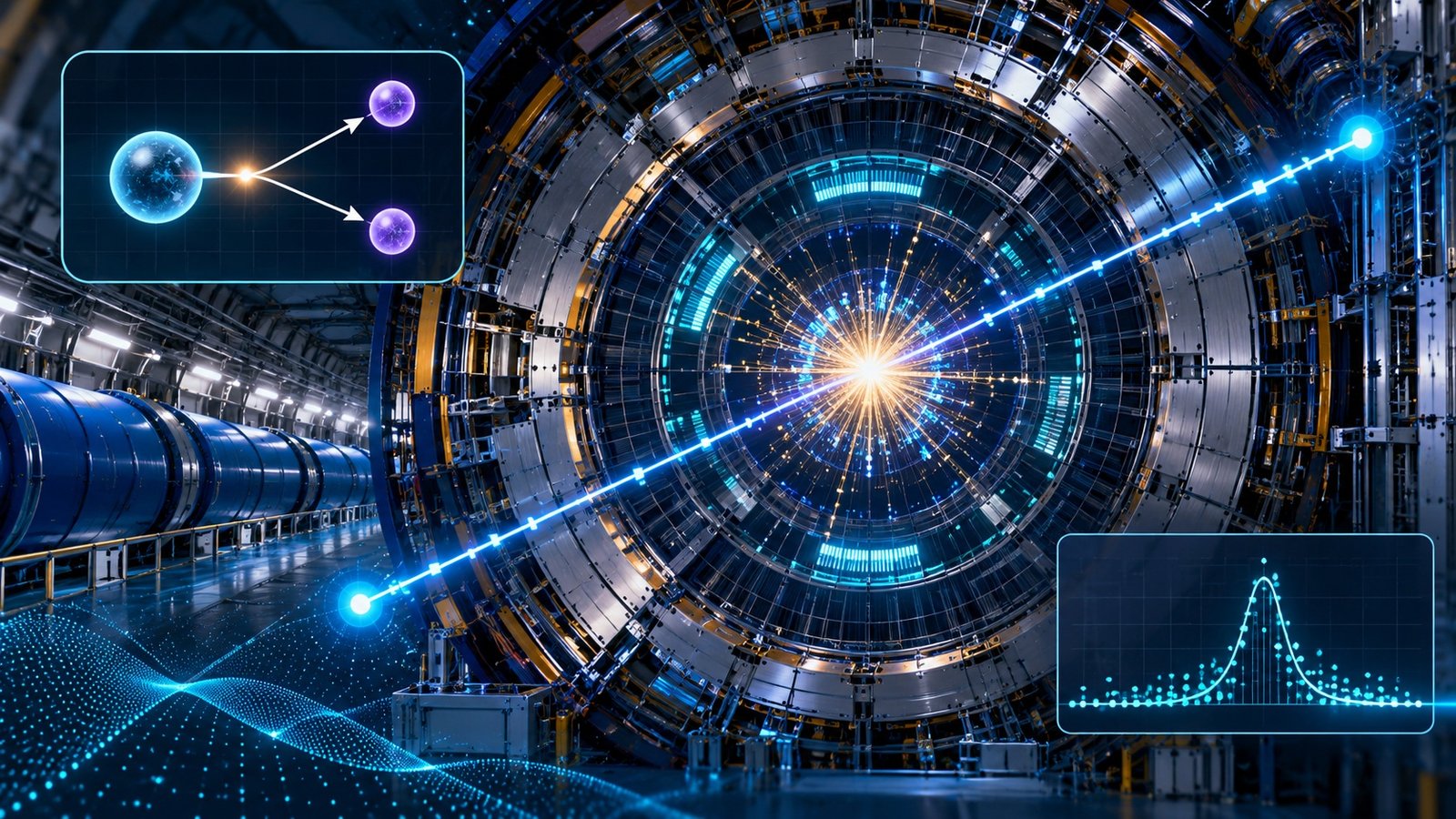
The Large Hadron Collider (LHC) near Geneva accelerates and collides protons at very high energies. These collisions produce many short-lived particles, including mesons containing beauty quarks. The LHCb detector is designed to study the particles produced in these collisions and reconstruct how they decay.
The upgraded LHCb detector began collecting data for Run 3 in 2024. According to CERN, the upgrade allows the experiment to record collisions at up to five times the rate achieved between 2010 and 2018. It also improves the detector’s ability to distinguish different particle types.
Researchers analysed data recorded in 2024 and 2025 and used machine-learning techniques to separate the possible B0-to-two-muon signal from a much larger number of other particle events. The new data produced evidence at 3.0 standard deviations. Combining the result with data from earlier LHC runs raised the significance to 3.2 standard deviations.
That improvement is important because rare decays cannot be studied by looking at a handful of collisions. Scientists need enormous data samples, sensitive detectors and careful statistical analysis to identify a faint signal among many ordinary processes.
Why a 3.2-Sigma Result Is Evidence, Not a Discovery
In particle physics, researchers use statistical significance to estimate how unlikely it would be for background processes alone to produce a signal as strong as the one observed. A result at three standard deviations is generally described as evidence. The widely used threshold for claiming a discovery is five standard deviations.
The LHCb result reaches 3.2 standard deviations after combining data sets. It therefore represents the first evidence from one experiment for this particular B0 decay, but it does not yet meet the five-sigma discovery threshold. Additional data and independent analysis will be needed to establish the result more firmly.
This distinction matters for accurate science reporting. Headlines describing the result as a confirmed discovery or proof of new physics would go beyond what the collaboration has announced. The finding is a milestone because it brings a very rare process into clearer view and gives future measurements a stronger starting point.
What the Finding Could Reveal About New Physics
The Standard Model explains many observed properties of elementary particles, but it does not answer every major question in physics. For example, it does not fully explain dark matter or why the observable universe contains much more matter than antimatter.
Some theories that extend the Standard Model propose additional particles or interactions. If such particles exist, they could influence the probability of rare meson decays, even if the particles themselves are too heavy to be produced directly in the LHC collisions being analysed.
That is why researchers pay close attention to rare processes such as B0 decays into muons. A clear deviation from the Standard Model prediction could point towards physics beyond the established theory. In the current result, however, CERN says the measurements are consistent with the Standard Model and place stronger constraints on possible extensions.
The result therefore does not establish the existence of dark matter particles, extra Higgs bosons or any other hypothetical particle. It improves the precision of a test that could help scientists assess such ideas as more data become available.
The Related Bs0 Decay and Improved Measurements
The same LHCb analysis also produced the most precise measurements to date of a related process, in which a Bs0 meson decays into two muons. This decay is also rare, but it occurs more frequently than the B0 process.
Measuring both processes helps physicists compare how different beauty mesons behave. Their relative decay rates can test theoretical predictions in complementary ways. The collaboration also reported an improved measurement of the effective lifetime associated with the Bs0 decay.
These measurements are useful because new physics could affect different decay channels in different ways. Scientists can compare the results with precise theoretical calculations and look for patterns that would be difficult to explain within the Standard Model.
A Search That Began More Than 40 Years Ago
The search for the B0-to-two-muon decay has lasted for more than four decades. Earlier experiments had reported hints, but the evidence did not remain strong enough in later analyses to establish the process in a single experiment.
CERN says the new result is the first single-experiment evidence for the decay. The analysis uses the improved capabilities of LHCb and a combination of recent and historical data. It demonstrates how upgrades to detectors and analysis methods can help scientists revisit questions that remained unresolved for many years.
The work is also an international effort. The LHCb collaboration includes researchers from universities and laboratories across multiple countries. The analysis was co-led by physicists working within this wider collaboration, with teams contributing detector expertise, data processing and statistical interpretation.
What Happens Next at the Large Hadron Collider?
The next major step is to collect more data and determine whether the signal becomes strong enough to meet the five-sigma discovery threshold. More measurements will also help reduce uncertainties and test whether the decay rate continues to agree with the Standard Model.
CERN has pointed to future upgrades as an opportunity to increase the amount of data available to LHCb. The planned High-Luminosity LHC programme, expected to start around 2030, and a further LHCb upgrade later in the next decade could significantly increase the experiment’s sensitivity.
Future results may confirm the rare decay with greater confidence or reveal a measurable difference from theoretical predictions. Either outcome would be scientifically valuable: confirmation would strengthen the Standard Model’s precision tests, while a robust discrepancy could motivate new explanations.
Why This Discovery Matters Beyond Particle Physics
The research is not expected to produce an immediate consumer technology or medical application. Its importance is more fundamental: it tests the rules that govern matter at extremely small scales and helps scientists understand whether the current theory of particles is complete.
Large international experiments also drive advances in detector engineering, data analysis, computing and machine learning. These tools are developed to solve demanding research problems and can contribute to wider scientific and technical capabilities, although specific practical benefits should not be assumed from this result alone.
For students and science readers in Pakistan and South Asia, the finding offers an accessible example of how international research teams use mathematics, computing and advanced instruments to investigate the structure of the universe. Universities and science institutions in the region can follow such results as part of broader interest in physics education and research collaboration.
Why the Muon Pair Is a Useful Signal
Muons are particularly useful in collider experiments because they can travel through detector material and leave identifiable tracks. LHCb can measure the tracks and momenta of the two muons, then calculate whether they are consistent with coming from the decay of a B0 meson. This does not make the measurement simple: many other collision processes can also produce muons, so the team must use detector information and statistical methods to separate signal from background.
The analysis therefore depends on several layers of work. The detector records collision products, reconstruction software estimates the particles’ paths and properties, and statistical models test whether the observed pattern is more consistent with a rare decay signal than with background alone. Machine learning helps classify events, but the final scientific claim still depends on validated analysis methods and the collaboration’s statistical assessment.
How to Read the Result Without Overstating It
The phrase “first evidence” has a specific meaning in particle physics. It tells readers that an experiment has measured a signal with enough statistical strength to be taken seriously, but not enough to meet the conventional discovery threshold. It is not the same as saying that scientists have found a completely new particle or overturned an established theory.
In this case, the result is especially notable because the decay is so rare and the search has lasted for decades. Yet the collaboration reports that the measured result agrees with the Standard Model. The most accurate interpretation is that LHCb has brought an elusive process into view and created a stronger basis for testing theoretical predictions.
Global Research and Pakistan’s Science Community
The result is a global science story because CERN’s experiments involve international research teams and address fundamental questions about the nature of matter. There is no specific Pakistan-only development announced as part of this measurement, so its relevance to Pakistan is primarily educational and scientific rather than a direct policy or commercial impact.
Researchers and students in Pakistan can follow the published LHCb analysis, learn how particle detectors and statistical significance work, and use the result as a case study in experimental physics. The collaboration also illustrates the scale of international cooperation required to build instruments, analyse large data sets and test predictions at the frontier of science.
Conclusion
CERN’s LHCb collaboration has reached a major milestone in the long search for the rare B0 meson decay into two muons. The signal, observed with 3.2-sigma significance after combining data sets, is the first evidence from a single experiment for a process predicted to occur only about once in every 10 billion B0 mesons.
The result is not yet a five-sigma discovery and does not demonstrate new physics. Instead, it provides a sharper test of the Standard Model and a foundation for future measurements. As the Large Hadron Collider gathers more data, scientists will continue to examine whether this rare process behaves exactly as predicted or offers clues to physics still unknown.
Frequently Asked Questions
What is the rare B0 particle decay?
It is a process in which a neutral B0 meson decays into two muons, one positively charged and one negatively charged.
How rare is the B0 meson decay?
The Standard Model predicts that it occurs around once in every 10 billion B0 mesons.
Which experiment reported the evidence?
The evidence was reported by the LHCb collaboration at CERN’s Large Hadron Collider near Geneva.
When was the result announced?
CERN announced the result on 3 November 2026.
Does the result confirm a new particle?
No. The measurement is consistent with the Standard Model and does not confirm the existence of a new particle.
What does 3.2 sigma mean?
It is the statistical significance of the combined result. It is evidence, but below the five-sigma threshold commonly used for a discovery claim.
Why are muons important in this experiment?
The decay produces a pair of muons, which researchers can identify and use to reconstruct the rare process.
How did the LHCb upgrade help?
The upgraded detector can record collisions at a higher rate and distinguish particle types more effectively, helping researchers isolate rare signals.
About The Author